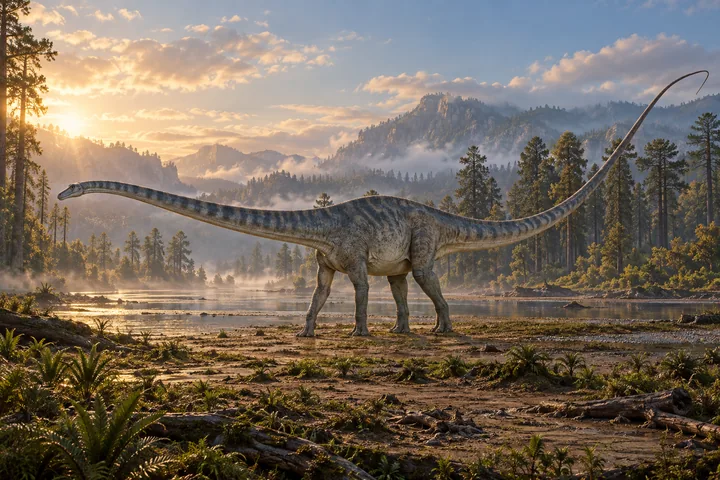
Length
InferredAbout 21 m (museum reference)
A rounded museum reference, not a measured population range; the page does not specify the specimen, method or growth stage. [D1]
EXHIBIT 51
Apatosaurus
A narrow skull restored after decades with the wrong head.
TWO WAYS TO PICTURE THE PAST
Compare the evidence with the familiar movie image. The illustrations are not to a shared scale.

The artist identifies this reconstruction as Apatosaurus ajax. This view illustrates one form within the genus, rather than every species or individual. Fossil-informed anatomy: Large four-legged sauropod with a long neck, tapering tail and narrow Apatosaurus-like head; avoid the deeper Camarasaurus skull used on an old mount. Colour and soft tissue are artistic interpretation. Source anatomical caption specifies A. ajax while its prose discusses the genus. [1] [2]
Apatosaurus TD.png — TotalDino. CC0 1.0. Remote source artwork displayed without additional cropping; Wikimedia supplies any display-size derivative.
Scientific picture served by Wikimedia · internet connection required.
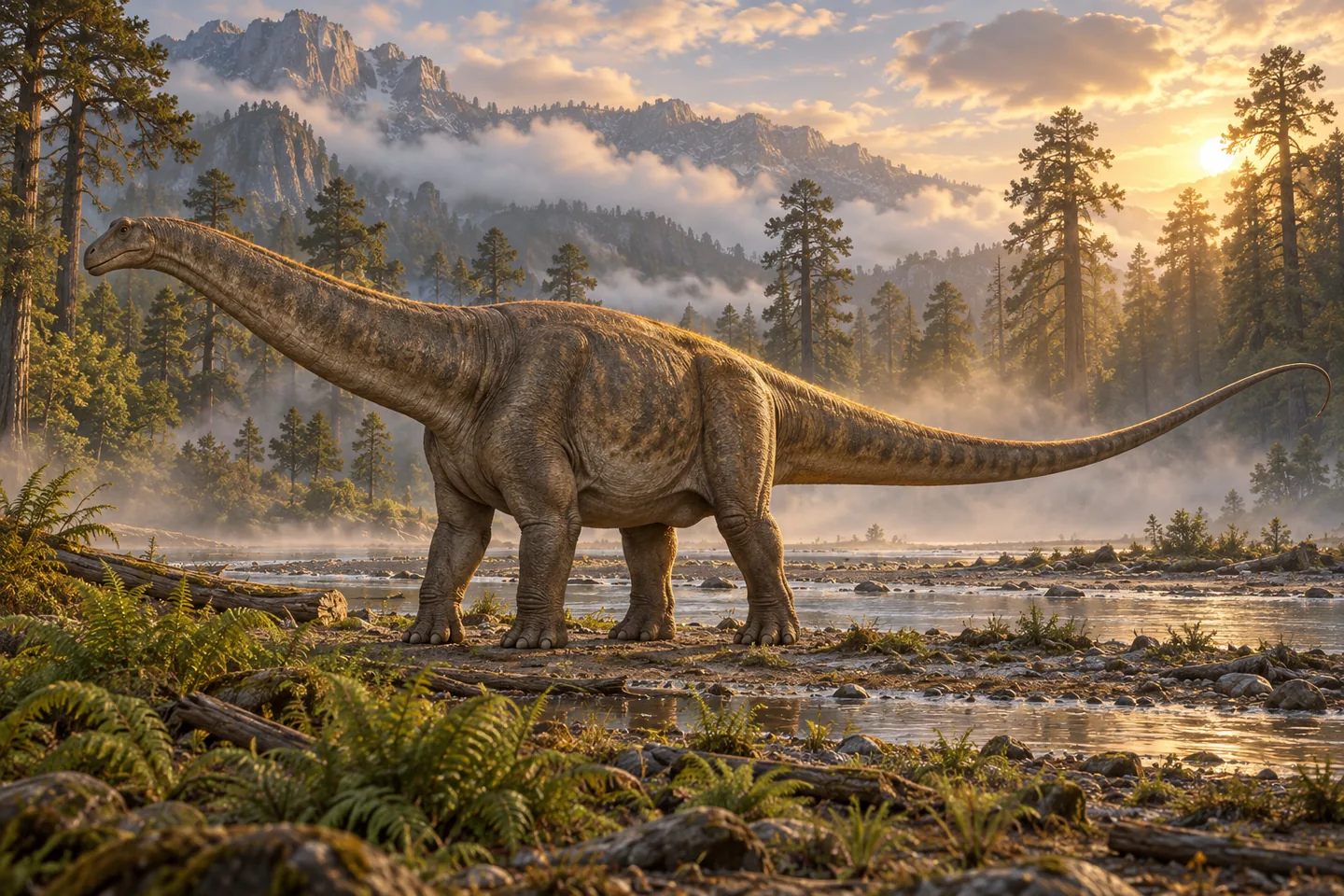
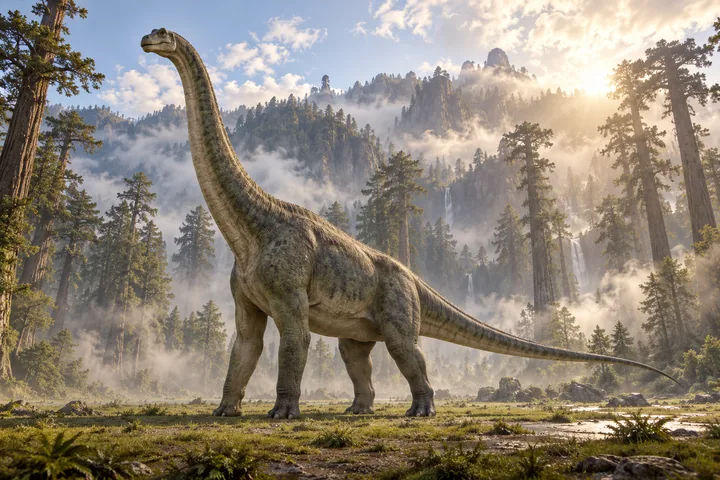
Cinematic large Apatosaurus with long neck and narrowing tail, narrow low skull and four supporting limbs; speculative colours and terrestrial stance. Dramatic lighting, surface detail and scenery are artistic choices. This is an original cinema-inspired picture, rather than a frame from a film or a documented fossil locality.
Original artwork · artistic interpretation.
Scientific view: credited paleoart interpreting fossil evidence, served online by Wikimedia. Movie-style view: Original artistic interpretation. Colors, soft tissues and settings involve reconstruction.
MEET THE ANIMAL
Apatosaurus was a long-necked plant eater from western North America during the Late Jurassic, roughly 150 million years ago. It belonged to the sauropods, the dinosaur group famous for enormous bodies and long necks. The skull was a surprisingly difficult part of its reconstruction: for many years, nobody had found an Apatosaurus head still attached to its neck. [S1]
Carnegie Museum’s Apatosaurus louisae skeleton initially stood without a head. In 1932, a blunt-snouted skull with broad teeth was added, following the scientific opinion of the time. That head actually belonged to Camarasaurus, another sauropod. The mistake mattered because skull shape and teeth affect our understanding of how an animal gathered and processed plants. [S1]
A narrower, more Diplodocus-like skull had been recovered with the skeleton. Researchers reconsidered that evidence, and a later discovery of an attached Apatosaurus skull and neck confirmed the interpretation. The correct head was installed in 1979. This specimen’s history explains the slender skull in modern reconstructions while showing why bones found together must be identified carefully, rather than simply fitted onto the nearest large skeleton. [S1]
PREHISTORIC ANIMAL DOSSIER
The animal, the evidence, and the questions still open.
Apatosaurus was a robust Morrison Formation sauropod with a long neck and tapering tail. The Carnegie A. louisae mount once bore a Camarasaurus skull before a cast of the correct narrow skull was installed in 1979.
Profile scope: Genus: Apatosaurus; skull history and volumetric masses concern A. louisae, specimen CM 3018.
Source supported identifies a description documented by the cited source. Inferred marks a reconstruction or functional estimate. Debated marks competing interpretations. Not established means the sources reviewed for this dossier do not support a firm conclusion; it does not mean a behavior never occurred.
A size reference is an estimate, not a population range. Nesting evidence does not by itself establish courtship, mate choice, or lifelong pairing.
About 21 m (museum reference)
A rounded museum reference, not a measured population range; the page does not specify the specimen, method or growth stage. [D1]
CM 3018: approximately 21.8–38.2 tonnes (models)
Three volumetric reconstructions give about 21,800, 27,400 and 38,200 kg for an A. louisae specimen. These model outcomes are not a verified adult genus range. [D3]
Plant eater
The museum identifies herbivory. Particular plant species and feeding heights are not established by the reviewed profiles. [D1]
Morrison forests, rivers and floodplains reconstructed
The museum reconstructs a semi-arid environment with wet and dry seasons. Fossil sites include Wyoming, Colorado and Montana. [D1]
Four-legged terrestrial reconstruction
The comparative skeletal model places four limbs beneath the body. This modelling pose does not establish a particular gait or speed. [D3]
Long neck, tapering tail and narrow skull
The A. louisae skull history shows why reconstructed heads require specimen-level checking. The correct skull cast replaced a Camarasaurus head on the Carnegie mount. [D2] [D1]
Not established here
The reviewed sources do not establish nest structure, incubation or parental care for Apatosaurus.
Not established here
The reviewed sources do not establish a courtship sequence or mating system for Apatosaurus.
Herd living proposed in museum reconstruction
The museum invokes herds as added protection. Its profile does not supply taxon-specific trackway or bonebed analysis establishing usual group size. [D1]
Sources and inspection notes for the claims in this profile.
THE STORY IN THE FOSSILS
Apatosaurus fossils occur in the Morrison Formation, including Wyoming, Colorado and Montana. The museum reconstructs its setting as semi-arid landscapes with forests, rivers and floodplains. It shared this world with Diplodocus, Stegosaurus and Allosaurus, carrying a long neck and a long, narrowing tail. [1]
Tail vertebrae discovered in Utah in 1909 led to the Carnegie Quarry and an important Apatosaurus louisae skeleton. Its nearby narrow skull was initially disputed. A Camarasaurus skull added in 1932 remained until 1979, when the museum replaced it with a cast of the correct skull. [2]
We have not established a comparable adult total-length estimate for this taxon in this draft. Specimen measurements in the text describe those individuals. The cited dates are approximately 152–145 million years ago. Unknown does not mean zero.
Sources and evidence notes for this exhibit.
KEEP EXPLORING
Brontosaurus
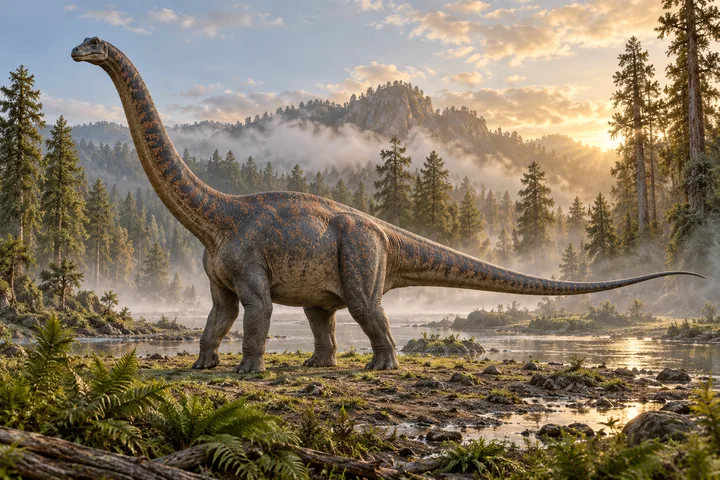
The thunder lizard revived by detailed anatomical comparison.
Brachiosaurus altithorax
Air-filled ribs, towering shoulders, and a fossil record with big gaps.