Length
Source supportedHistoric Peabody mount: about 20 m
Peabody describes its earlier B. excelsus mount as 65 feet long. This is a historical exhibit measurement, not a current living-body estimate or adult genus range. [D2]
EXHIBIT 52
Brontosaurus
The thunder lizard revived by detailed anatomical comparison.
TWO WAYS TO PICTURE THE PAST
Compare the evidence with the familiar movie image. The illustrations are not to a shared scale.

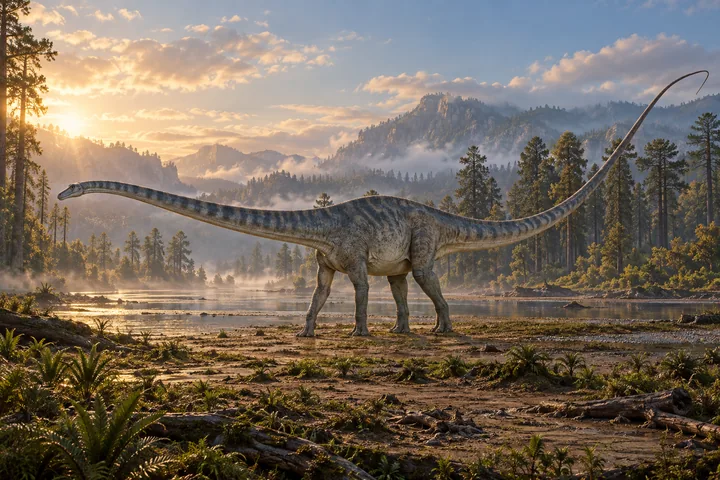
The artist identifies this reconstruction as Brontosaurus excelsus. This view illustrates one form within the genus, rather than every species or individual. Fossil-informed anatomy: Long-necked, long-tailed sauropod; less robust and thinner, less low-set neck than Apatosaurus, while retaining a substantial quadrupedal body. Soft tissue, colour and exact posture remain reconstructed. Skull appearance and general proportions draw on reconstruction of this diplodocid; no source-page accuracy warning was found. [1]
Brontosaurus by Tom Parker.png — Tom Parker. CC BY-SA 4.0. Remote source artwork displayed without additional cropping; Wikimedia supplies any display-size derivative.
Scientific picture served by Wikimedia · internet connection required.
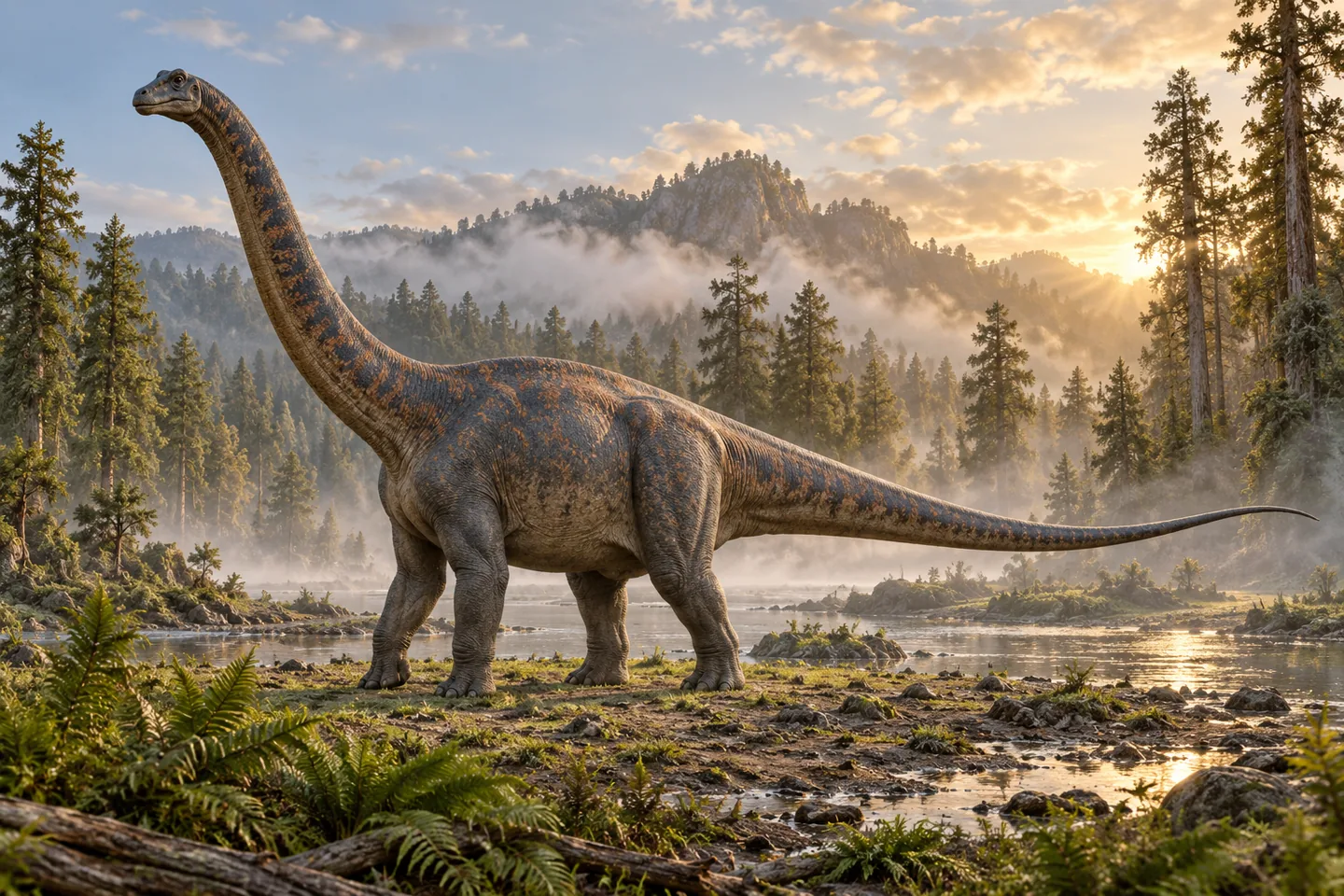
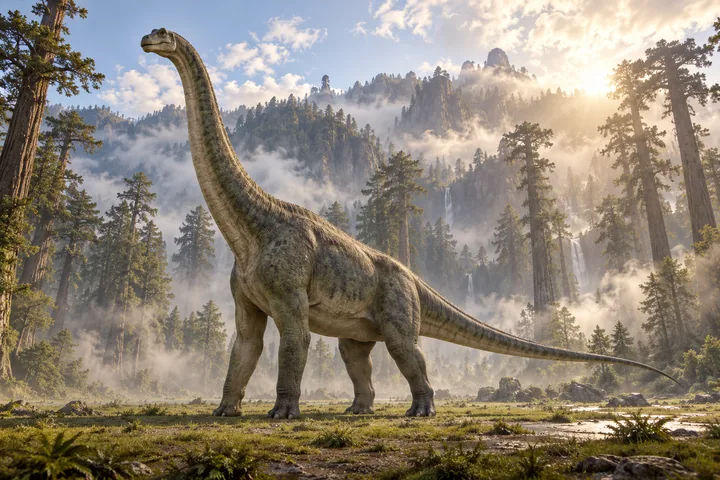
Cinematic Brontosaurus with a substantial four-legged body, tapering tail and long neck that is thinner and less low-set than Apatosaurus; speculative colours. Dramatic lighting, surface detail and scenery are artistic choices. This is an original cinema-inspired picture, rather than a frame from a film or a documented fossil locality.
Original artwork · artistic interpretation.
Scientific view: credited paleoart interpreting fossil evidence, served online by Wikimedia. Movie-style view: Original artistic interpretation. Colors, soft tissues and settings involve reconstruction.
MEET THE ANIMAL
Brontosaurus was a long-necked, long-tailed plant eater that stood on four legs. The famous Brontosaurus excelsus skeleton at Yale represents an animal from the Jurassic world of western North America. Its name means thunder lizard. A large body and extended neck make it recognizable, but those features alone do not distinguish it from every other sauropod, its broader dinosaur group. [S1]
For much of the twentieth century, Brontosaurus was treated as another name for Apatosaurus. A detailed 2015 comparison of individual skeletons supported separating the genera again. A genus is a named group of closely related species; deciding its boundaries requires comparisons of bones, not just familiar names. The study compared many anatomical features consistently instead of relying on one dramatic difference. [S2]
Even a museum skeleton changes as evidence improves. Yale’s remounted Brontosaurus has 27 additional vertebrae and holds its tail above the ground. These revisions make the display a reconstruction informed by current anatomy, rather than an untouched outline of a living animal. An older mounted length therefore should not be mistaken for the final dimensions of this reconstruction or a size range for every Brontosaurus. [S3]
PREHISTORIC ANIMAL DOSSIER
The animal, the evidence, and the questions still open.
Brontosaurus has a less robust, less low-set neck than Apatosaurus in the reviewed comparison. A 2015 analysis revived the genus using consistent anatomical differences, although genus boundaries remain open to further evidence.
Profile scope: Genus: Brontosaurus; historic mounted length concerns the Peabody B. excelsus specimen.
Source supported identifies a description documented by the cited source. Inferred marks a reconstruction or functional estimate. Debated marks competing interpretations. Not established means the sources reviewed for this dossier do not support a firm conclusion; it does not mean a behavior never occurred.
A size reference is an estimate, not a population range. Nesting evidence does not by itself establish courtship, mate choice, or lifelong pairing.
Historic Peabody mount: about 20 m
Peabody describes its earlier B. excelsus mount as 65 feet long. This is a historical exhibit measurement, not a current living-body estimate or adult genus range. [D2]
Not established here
The reviewed sources do not establish a verified body-mass estimate for Brontosaurus.
Plant eater; browsing style unresolved
The museum discusses high foliage and broad low browsing as alternatives. These anatomical reconstructions do not identify an exclusive food source. [D1]
Late Jurassic Morrison Formation, Wyoming
The B. excelsus name-bearing skeleton came from Wyoming's Morrison Formation. This fossil locality does not establish habitat preference throughout the genus. [D1]
Four-legged terrestrial reconstruction
Limb and vertebral anatomy supports carrying its weight on land. Precise gait and speed are not established here. [D1]
Long neck and tail; detailed vertebral differences
Reviewed distinctions from Apatosaurus include neck, back and shoulder bones. The thinner, higher-set neck is a comparative genus description. [D1]
Not established here
The reviewed sources do not establish nest structure, incubation or parental care for Brontosaurus.
Long-neck display proposed
The museum lists mate attraction among possible neck functions, alongside feeding and combat. This does not demonstrate a particular mating system. [D1]
Not established here
The reviewed sources do not establish usual group size or lasting social organization for Brontosaurus.
Sources and inspection notes for the claims in this profile.
THE STORY IN THE FOSSILS
The fossils that named Brontosaurus came from Wyoming’s Morrison Formation. They were later folded into Apatosaurus because the skeletons looked so similar. A 2015 comparison of many specimens and anatomical traits recovered consistent differences, including details in neck, back and shoulder bones. [1]
Brontosaurus had the long neck and tail characteristic of sauropods. Compared with Apatosaurus, the museum describes it as less massive and robust, with a thinner, less low-set neck. Its leaves-and-foliage diet is inferred; proposed combat or display functions for the neck remain hypotheses. [1]
We have not established a comparable adult total-length estimate for this taxon in this draft. Specimen measurements in the text describe those individuals. The cited dates are approximately 156–145 million years ago. Unknown does not mean zero.
Sources and evidence notes for this exhibit.
KEEP EXPLORING
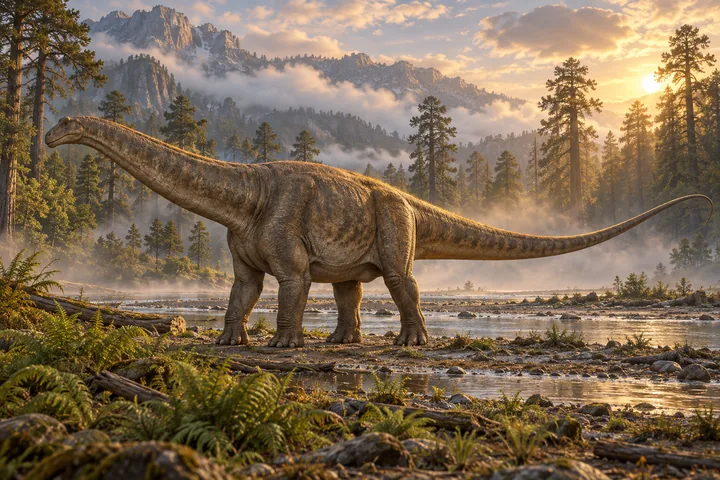
Apatosaurus
A narrow skull restored after decades with the wrong head.
Brachiosaurus altithorax
Air-filled ribs, towering shoulders, and a fossil record with big gaps.