EXPLORE PREHISTORY 220 prehistoric animal profiles · Scientific & movie-style image galleries

EXHIBIT 150

Omeisaurus

Omeisaurus junghsiensis

Omeisaurus is a Chinese sauropod genus represented by several named species whose fossils and size references must be kept separate. [1] [2]

Evidence profile
PERIODMiddle Jurassic[2]
DIETHerbivoreEvidence and uncertainty in the dossier
TOTAL LENGTHSee the dossierEstimate scope matters
FOSSILS FOUNDChina[2]
CompareRead the dossierView the sources

MEET THE ANIMAL

Meet Omeisaurus

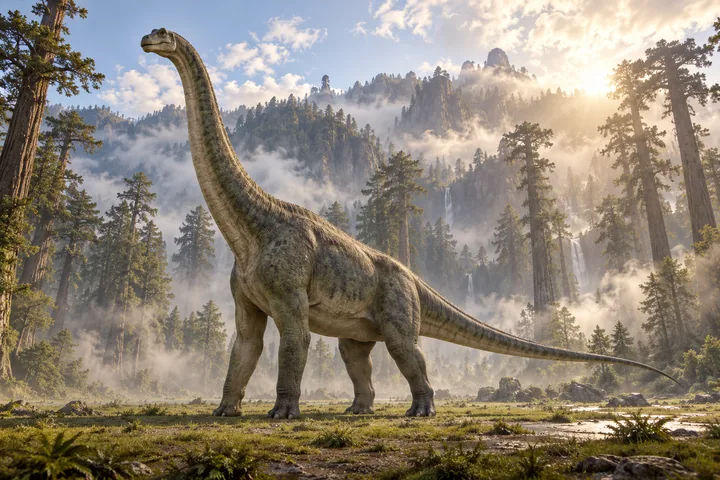
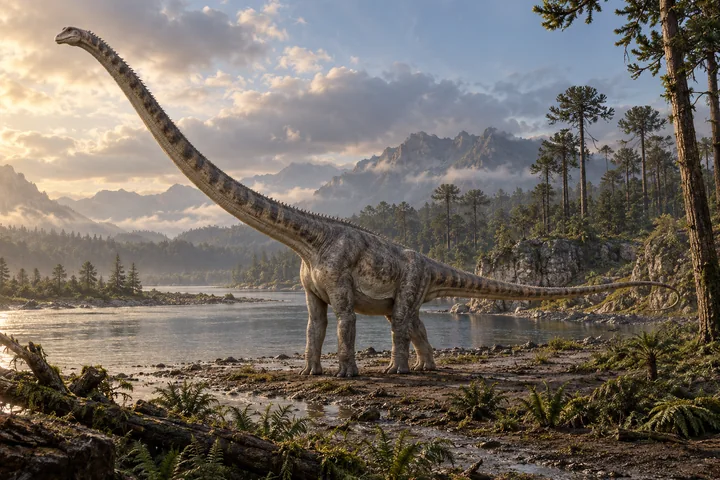
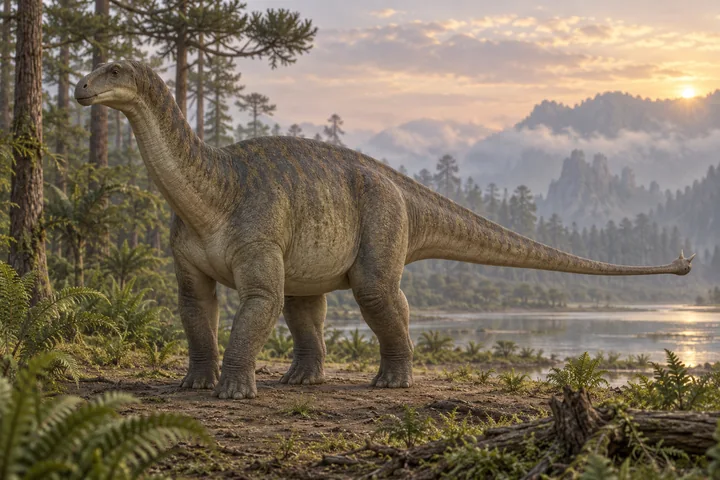
Omeisaurus was a plant-eating sauropod from Middle Jurassic China. Sauropods are the dinosaur group known for long necks and large bodies. Omeisaurus junghsiensis is the type species: the species originally used to define the genus. A broad museum size reference cannot automatically describe every species or identify the largest individual that ever lived. [D1]

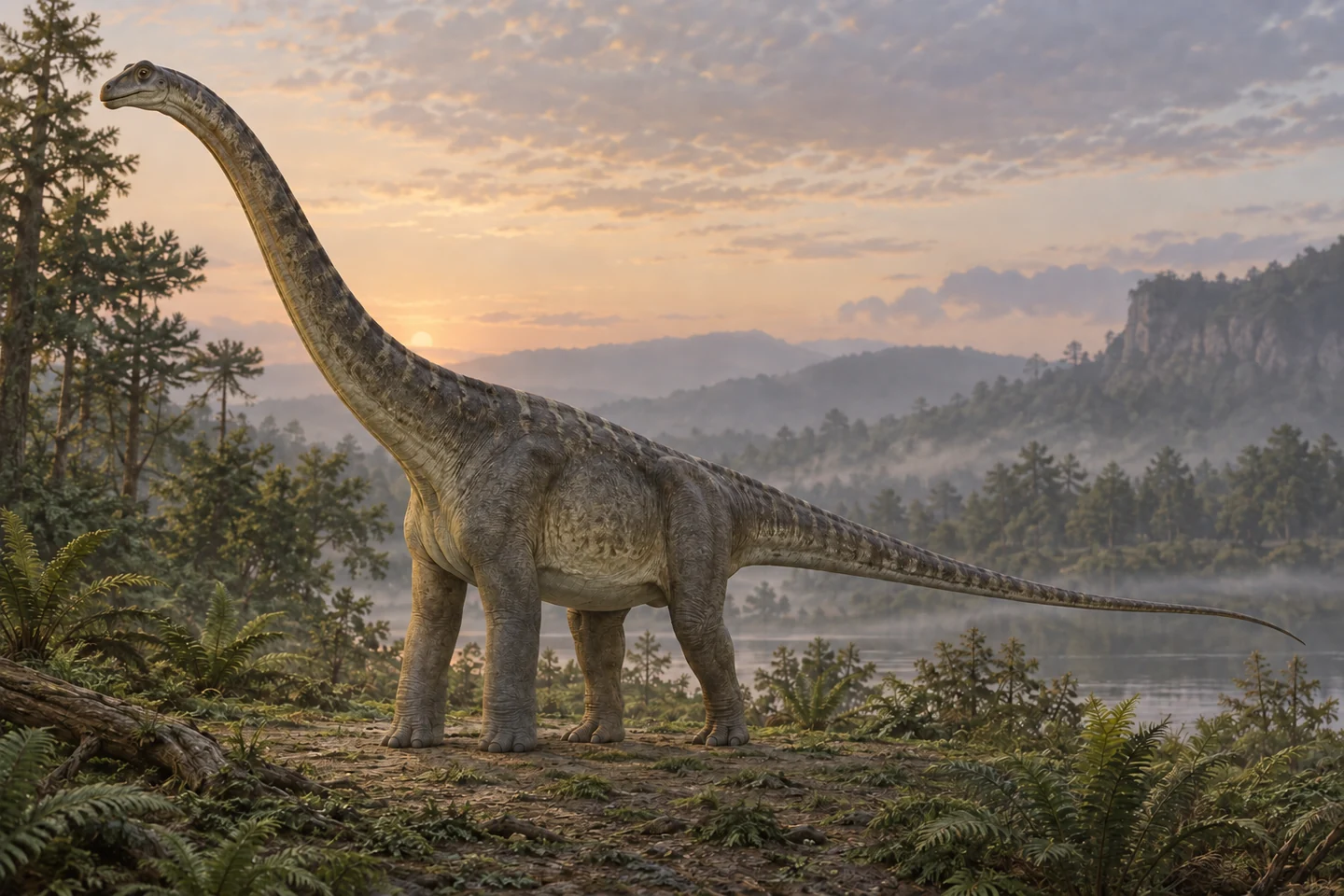
One newer species, Omeisaurus puxiani, was found at Yunyang in southwestern China. Its partial skeleton was reconstructed as an animal about sixteen metres long and described as adult in the author's institutional account. Missing bones still have to be restored. That reconstruction belongs to this individual and species, rather than becoming a length range for the entire genus. [D4]

Researchers continue to test how the named East Asian sauropods are related. Some family-tree analyses do not group all the species called Omeisaurus in the same simple way. Comparing individual species and their actual bones is therefore more useful than imagining one uniform animal. Scientific names organize the evidence, but their boundaries can change when new anatomical comparisons become available. [D6]

PREHISTORIC ANIMAL DOSSIER

A life in profile.

The animal, the evidence, and the questions still open.

An unusually long neck accompanies four-legged sauropod anatomy. Relationships among named East Asian sauropods remain under review, so referral and species identity matter. [D6]

Profile scope: Genus profile anchored by type species Omeisaurus junghsiensis, with explicitly identified evidence from O. tianfuensis, O. jiaoi and O. puxiani. These individuals are not pooled into a size range. [D1] [D2] [D3]

Time
Middle Jurassic
Fossil locations in this exhibit
China
How to read the evidence

Source supported identifies a description documented by the cited source. Inferred marks a reconstruction or functional estimate. Debated marks competing interpretations. Not established means the sources reviewed for this dossier do not support a firm conclusion; it does not mean a behavior never occurred.

A size reference is an estimate, not a population range. Nesting evidence does not by itself establish courtship, mate choice, or lifelong pairing.

Body length

Inferred

About 16 m; O. puxiani reconstruction

The author’s institutional account labels the reconstructed individual adult but supplies no histological maturity criterion or complete length method. The partial skeleton’s estimate is not a genus-wide maximum or a range across species. [D4]
Body mass

Inferred

About 8.4 tonnes; O. tianfuensis model

Paul’s volume-scaled reconstruction uses ZDM T5701. Its density, restored soft tissues and unverified maturity limit precision; this is not O. puxiani’s mass or a combined species range. [D5]

Diet

Inferred

Plants

The museum identifies herbivory. Its genus-level feeding category does not establish identical menus, feeding heights or intake rates for every named species. [D1]

Habitat & fossil setting

Source supported

Middle Jurassic southwestern China

O. jiaoi comes from Xiashaximiao deposits at Zigong, Sichuan; O. puxiani comes from the Shaximiao Formation at Yunyang, Chongqing. These named localities should not be treated as one fossil assemblage. [D2] [D3]

Movement

Inferred

Four-legged sauropod reconstruction

O. jiaoi’s nearly complete skeleton and O. puxiani’s referred limbs support quadrupedal reconstruction. Neither accessible description establishes a genus-specific trackway, exact speed or one habitual neck posture. [D2] [D3]

Distinctive anatomy

Source supported

Species-specific vertebral distinctions

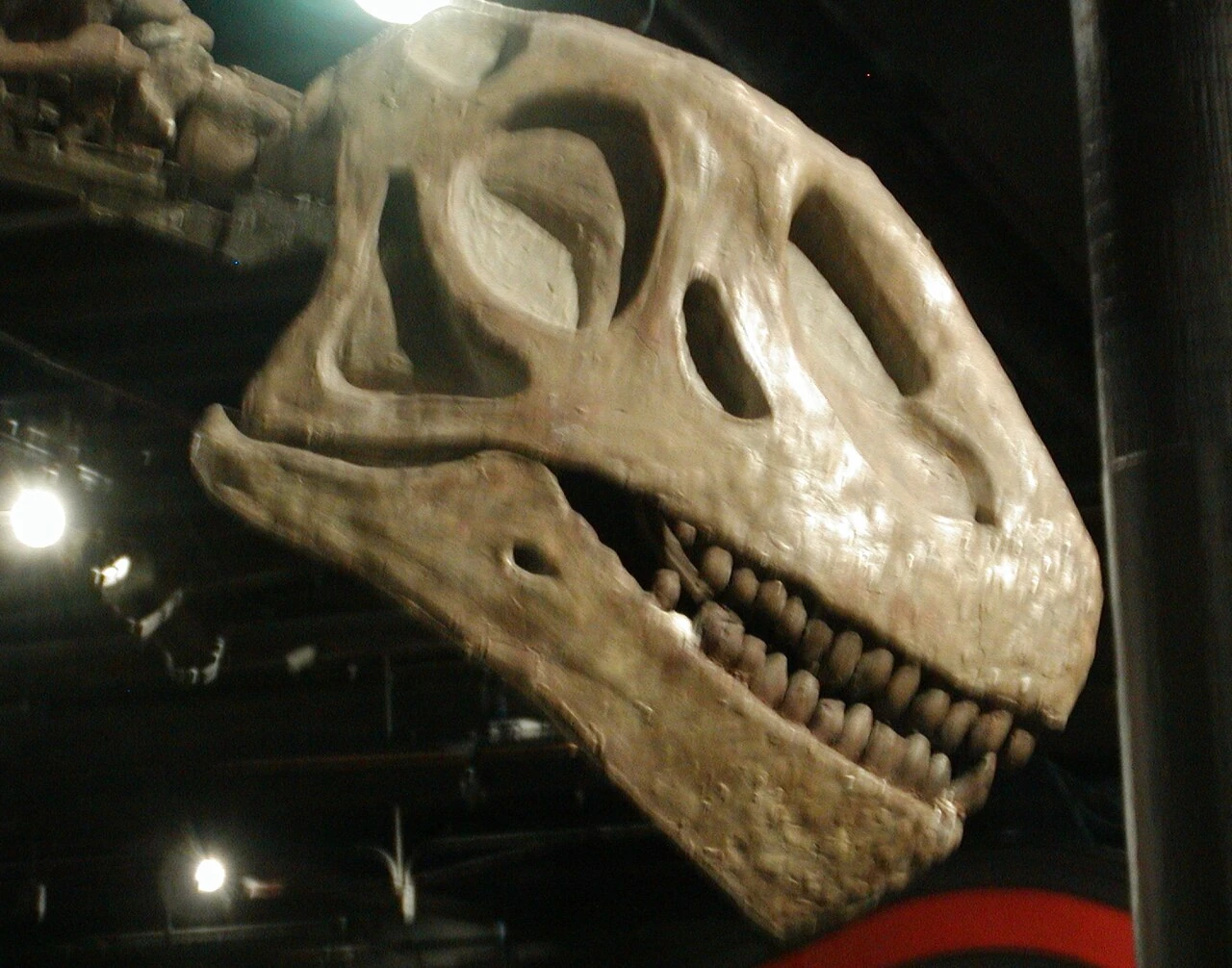
O. jiaoi has unbranched dorsal neural spines. O. puxiani has convex-fronted presacral joints and complex cervical fossae. A club-like neural-spine description is not evidence of an external tail club. [D2] [D3]

Reproduction & life together

Reproduction & nesting

Not established

Not established here

Focused searches did not establish securely identified genus-specific eggs, nests, embryos, clutch size, incubation behavior or parental care. General sauropod reproductive evidence is not assigned to a named Omeisaurus species.

Courtship & mating

Not established

Not established here

Reviewed descriptions and focused searches did not establish sex-specific anatomy, colors, displays, vocalizations, mate choice or mating rituals.

Social behavior

Not established

Not established here

The Yunyang locality contains multiple dinosaur taxa. Its rich assemblage does not identify a persistent Omeisaurus herd or family structure, and separate species localities cannot be combined into one social group. [D4]

Dossier research & sources

Sources and inspection notes for the claims in this profile.

  1. OmeisaurusNatural History Museum, London · Accessed 2026-10-02Current museum page inspected: type species junghsiensis, China, Middle Jurassic and plant feeding; unspecified 20 m reference not used as a species maximum. · Inspected: page
  2. A new species of Omeisaurus from the Middle Jurassic of Zigong, SichuanVertebrata PalAsiatica; Jiang, Ye & Peng (2011), official journal · Accessed 2026-10-02Original publisher abstract inspected: O. jiaoi ZDM 5050, nearly complete skeleton, Xiashaximiao locality and species-diagnostic vertebral/limb features. · Inspected: abstract
  3. A new species of Omeisaurus (Dinosauria: Sauropoda) from the Middle Jurassic of Yunyang, Chongqing, ChinaHistorical Biology; Tan and colleagues (2020 online; 2021 issue) · Accessed 2026-10-02Original publisher abstract/indexed text inspected: articulated O. puxiani partial skeleton, Shaximiao locality, presacral joints and complex cervical fossae. · Inspected: abstract
  4. 重庆云阳恐龙动物群发现恐龙新种——普贤峨眉龙 (New dinosaur species from the Chongqing Yunyang fauna—Omeisaurus puxiani)Nanjing Institute of Geology and Palaeontology, Chinese Academy of Sciences; Tan Chao (2020-04-27 account, institutional repost) · Accessed 2026-10-02Author’s institutional article inspected: adult-labeled approximately 16 m O. puxiani reconstruction, partial vertebrae/limbs, Yunyang locality and multi-taxon fauna. · Inspected: page
  5. Appendix: dinosaur massesPrinceton University Press; Paul (2016) · Accessed 2026-10-02Original appendix and model methods inspected: O. tianfuensis ZDM T5701 8,400 kg; neck and femur inputs are not total body length. · Inspected: excerpt
  6. Re-assessment of the Late Jurassic eusauropod Mamenchisaurus sinocanadorum and the evolution of exceptionally long necks in mamenchisauridsJournal of Systematic Palaeontology; Moore and colleagues (2023), UCL accepted paper · Accessed 2026-10-02Original accepted PDF inspected: competing mamenchisaurid definitions, Omeisaurus paraphyly in some analyses, species-level comparisons and remaining documentation gaps. · Inspected: excerpt

THE STORY IN THE FOSSILS

Meet Omeisaurus.

The 16 m length and 8.4 tonne mass belong to different named species and different reconstructions. Combining them would create an individual that neither source describes. [4] [5]

Omeisaurus relationships vary among phylogenetic analyses. This profile retains explicit species names and avoids assigning every historically named East Asian sauropod to one uniform animal. [6]

A note on scale and time

The dossier identifies the scope of each reference estimate. A mount, an individual fossil and a species-wide adult range are different measurements. Comparison metrics remain unavailable where adult scope has not been established. Unknown does not mean zero.

Sources & editorial notes

Sources support the stated claims and scopes. Refer to the evidence notes for uncertainty.

  1. OmeisaurusNatural History Museum, London · Accessed 2026-10-02Current museum page inspected: type species junghsiensis, China, Middle Jurassic and plant feeding; unspecified 20 m reference not used as a species maximum. · Inspected: page
  2. A new species of Omeisaurus from the Middle Jurassic of Zigong, SichuanVertebrata PalAsiatica; Jiang, Ye & Peng (2011), official journal · Accessed 2026-10-02Original publisher abstract inspected: O. jiaoi ZDM 5050, nearly complete skeleton, Xiashaximiao locality and species-diagnostic vertebral/limb features. · Inspected: abstract
  3. A new species of Omeisaurus (Dinosauria: Sauropoda) from the Middle Jurassic of Yunyang, Chongqing, ChinaHistorical Biology; Tan and colleagues (2020 online; 2021 issue) · Accessed 2026-10-02Original publisher abstract/indexed text inspected: articulated O. puxiani partial skeleton, Shaximiao locality, presacral joints and complex cervical fossae. · Inspected: abstract
  4. 重庆云阳恐龙动物群发现恐龙新种——普贤峨眉龙 (New dinosaur species from the Chongqing Yunyang fauna—Omeisaurus puxiani)Nanjing Institute of Geology and Palaeontology, Chinese Academy of Sciences; Tan Chao (2020-04-27 account, institutional repost) · Accessed 2026-10-02Author’s institutional article inspected: adult-labeled approximately 16 m O. puxiani reconstruction, partial vertebrae/limbs, Yunyang locality and multi-taxon fauna. · Inspected: page
  5. Appendix: dinosaur massesPrinceton University Press; Paul (2016) · Accessed 2026-10-02Original appendix and model methods inspected: O. tianfuensis ZDM T5701 8,400 kg; neck and femur inputs are not total body length. · Inspected: excerpt
  6. Re-assessment of the Late Jurassic eusauropod Mamenchisaurus sinocanadorum and the evolution of exceptionally long necks in mamenchisauridsJournal of Systematic Palaeontology; Moore and colleagues (2023), UCL accepted paper · Accessed 2026-10-02Original accepted PDF inspected: competing mamenchisaurid definitions, Omeisaurus paraphyly in some analyses, species-level comparisons and remaining documentation gaps. · Inspected: excerpt

FOLLOW YOUR CURIOSITY

Who will you meet next?

KEEP EXPLORING

More from the collection

Long-necked Brachiosaurus standing on four legs in a misty conifer valley, with high shoulders and its head above the trees.
Movie-style interpretation
Late Jurassic

Brachiosaurus

Brachiosaurus altithorax

Brachiosaurus altithorax was a giant sauropod from Late Jurassic North America. Its name-bearing skeleton is incomplete, and many familiar reconstructions borrow details from the separate African dinosaur Giraffatitan.