
Body length
InferredAbout 10 m; museum reference
The directory supplies no named individual, life stage or method. This reference is not a measured adult maximum. [D1]
EXHIBIT 84
Shunosaurus lii
Shunosaurus was a Chinese plant-eater with a comparatively short neck, stout teeth and a small bony tail club.
TWO WAYS TO PICTURE THE PAST
Compare the evidence with the familiar movie image. The illustrations are not to a shared scale.
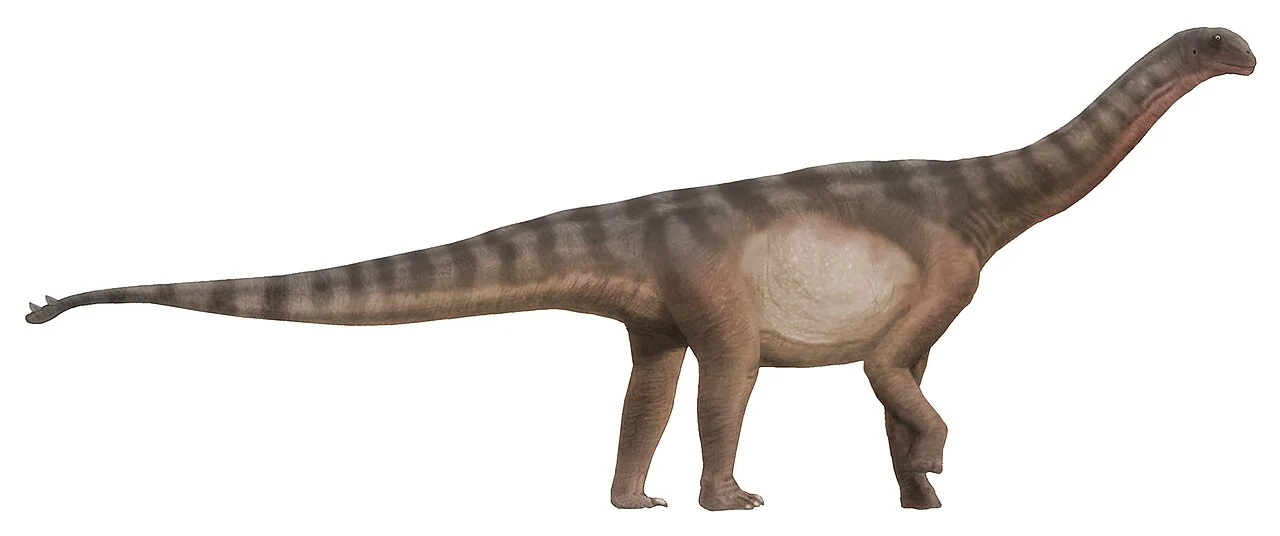
Artist reconstruction of Shunosaurus. Colours, skin and soft-tissue contours are interpretive; this is not a size measurement or behavioral observation. [3]
Shunosaurus life restoration.jpg · Smokeybjb; edits by Paleocolour. CC BY-SA 3.0. Resized proportionally and converted to WebP; no anatomical edits. Same source license applies.
Scientific reconstruction is an interpretation; source credit does not certify every anatomical detail.
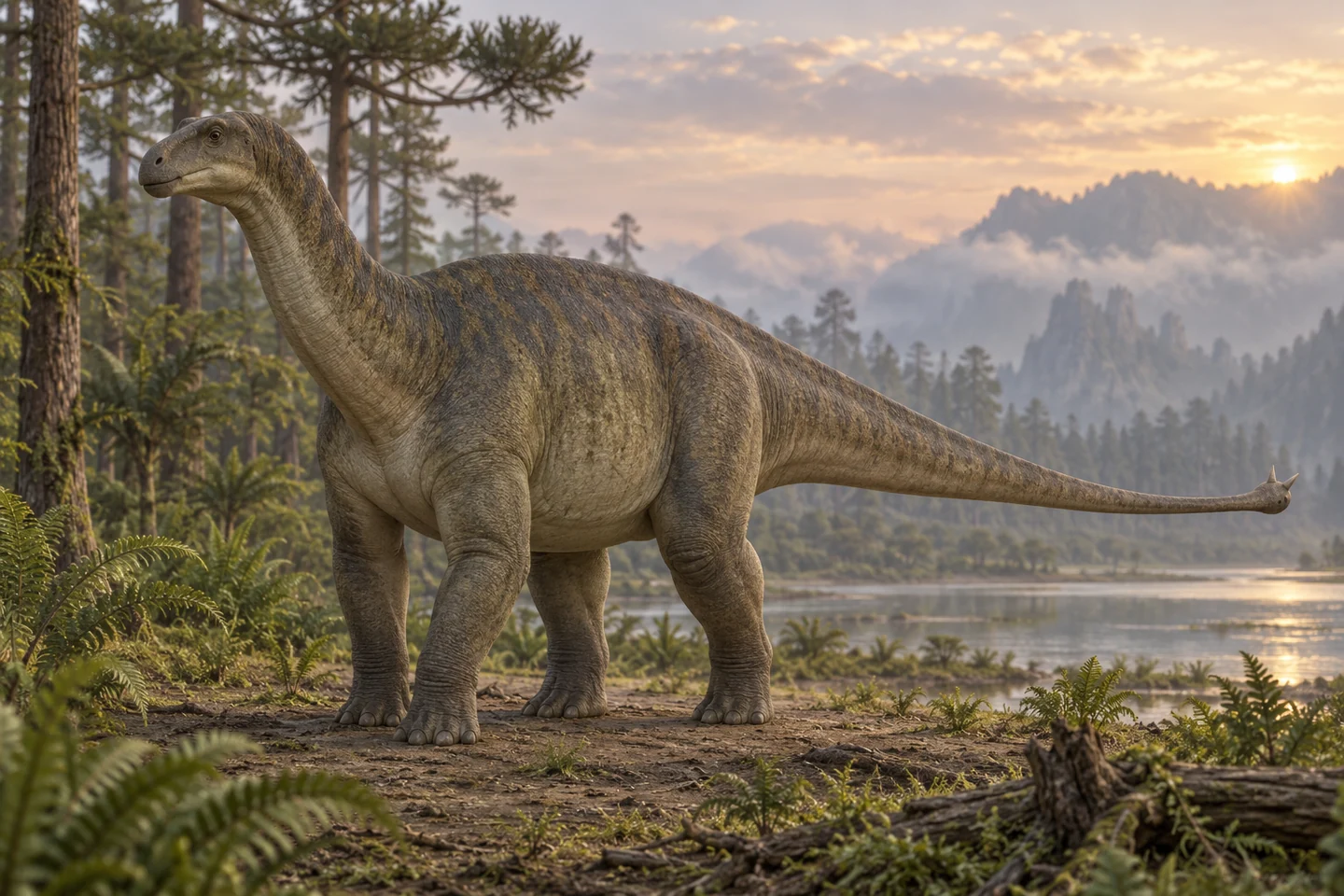
Original cinematic interpretation of Shunosaurus lii. Coloration, soft tissues and scenery are artistic choices; reconstructed proportions do not establish a measured individual. Lighting, coloration and scenery are artistic choices. This image does not document a fossil locality or behavior.
Original artwork · artistic interpretation.
Scientific view: source-informed reconstruction, credited paleoart or specimen-based imagery. Movie-style view: Original artistic interpretation. Reconstructions involve uncertainty.
MEET THE ANIMAL
Shunosaurus was a sauropod from Jurassic China. The familiar museum reference of about ten metres gives a rough introduction to its scale, rather than a confirmed adult maximum. Its place in the dinosaur family tree and its fossil record matter as much as that headline number: a long-necked body plan can contain distinctive feeding and tail features. [D1]
Its comparatively short neck and small bony tail club give it a recognizable outline. Worn teeth and the way its tooth rows passed each other suggest feeding on coarse plants close to the ground. The club's existence does not establish one particular defensive move, and the teeth do not identify a precise list of plants. [D3]
A small specimen from Yunyang adds evidence about growing animals. Its limb proportions and bone tissue help researchers distinguish age-related changes from differences between kinds of dinosaurs. Comparing the small skeleton with larger material connects body shape with development. The tissue provides a record of bone growth, rather than an exact account of its activities or an observed age at reproduction. [D4]
PREHISTORIC ANIMAL DOSSIER
The animal, the evidence, and the questions still open.
Skull wear and jaw geometry offer unusually detailed clues to feeding.
Profile scope: Genus profile centered on Shunosaurus lii; size references do not establish an adult population range.
Source supported identifies a description documented by the cited source. Inferred marks a reconstruction or functional estimate. Debated marks competing interpretations. Not established means the sources reviewed for this dossier do not support a firm conclusion; it does not mean a behavior never occurred.
A size reference is an estimate, not a population range. Nesting evidence does not by itself establish courtship, mate choice, or lifelong pairing.
About 10 m; museum reference
The directory supplies no named individual, life stage or method. This reference is not a measured adult maximum. [D1]
3.6 tonnes; historical model reference
Table 1 reports a displacement estimate without a specimen or maturity assessment; it is not linked to the museum length. [D6]
Plants; low browsing inferred
Stout, worn teeth and shearing tooth rows suggest coarse vegetation near ground level. Particular plant species remain unresolved. [D3]
Chinese Shaximiao deposits; chronology debated
Dashanpu is traditionally Middle Jurassic. Wang’s zircon study argues for an Oxfordian, Late Jurassic age; the catalog retains the traditional category with this caveat. [D2] [D5]
Four-legged terrestrial walker
The sauropod review reconstructs columnar limbs supporting walking on four legs; this is broader-group evidence, not a measured species speed. [D7]
Comparatively short neck; terminal bony club
The skull study documents a small club and distinctive tooth rows. Their presence does not establish courtship or a particular defensive maneuver. [D3]
Egg-laying inferred; nesting unresolved
Sauropod egg evidence supports the broader inference; reviewed sources do not identify Shunosaurus clutches, nesting sites or parental care. [D7]
Not established here
Focused literature searches and reviewed anatomical studies do not establish mate choice, sex differences or tail-club display.
Not established here
Multiple fossils are known, but the reviewed sources do not establish persistent herds or social organization.
Sources and inspection notes for the claims in this profile.
THE STORY IN THE FOSSILS
Upper and lower tooth rows sheared past one another. Together with tooth wear and skull proportions, this supports a reconstruction of Shunosaurus feeding on coarse vegetation close to the ground. [3]
A small Yunyang specimen reveals growth-related differences in limb proportions and bone tissue. Such juvenile anatomy helps researchers separate developmental change from differences between taxa. [4]
The dossier identifies the scope of each reference estimate. A mount, an individual fossil and a species-wide adult range are different measurements. Comparison metrics remain unavailable where adult scope has not been established. Unknown does not mean zero.
Sources support the stated claims and scopes. Refer to the evidence notes for uncertainty.
KEEP EXPLORING
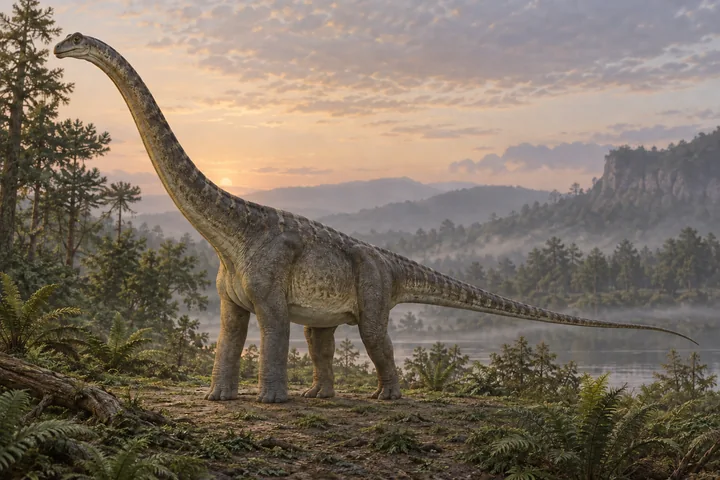
Omeisaurus junghsiensis
Omeisaurus is a Chinese sauropod genus represented by several named species whose fossils and size references must be kept separate.
Mamenchisaurus
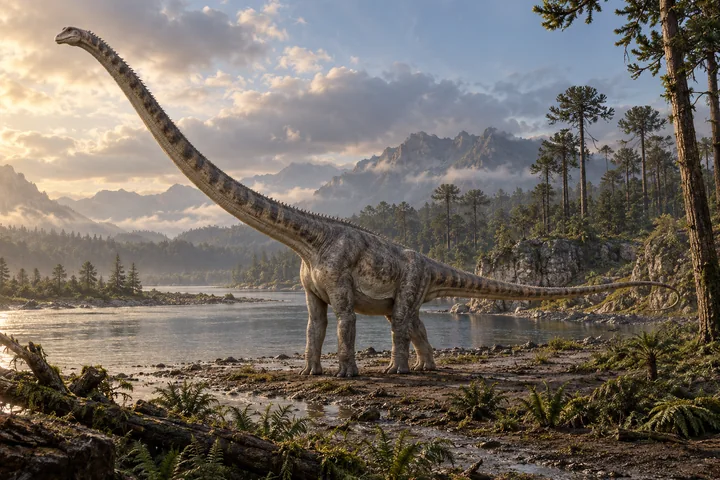
Mamenchisaurus includes long-necked Chinese sauropods. Differing species and recent research require revision of the traditional genus.
Huayangosaurus taibaii
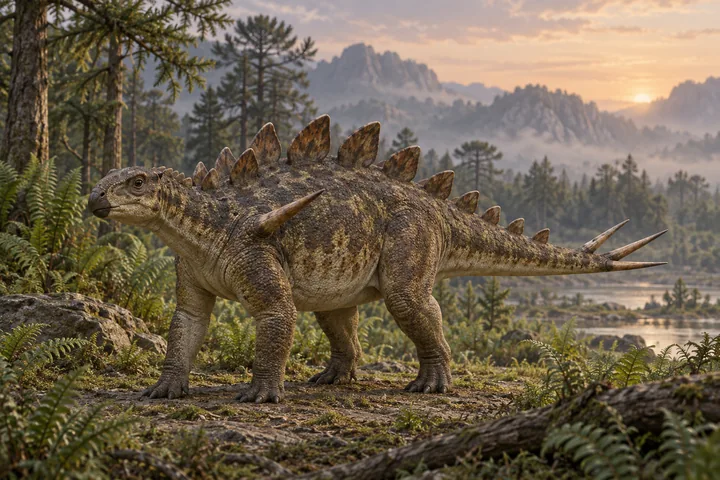
Huayangosaurus was a small Chinese stegosaur with a relatively broad skull and teeth at the front of its upper jaw.