
Length
Source supportedAbout4 m genus reference
The monograph gives a genus approximation, not a measured adult range for O. icenicus. [D1]
EXHIBIT 231
Ophthalmosaurus icenicus
Marine reptile
A large-eyed ichthyosaur whose British fossils must be separated from debated North American relatives. [1]
TWO WAYS TO PICTURE THE PAST
Compare the evidence with the familiar movie image. The illustrations are not to a shared scale.
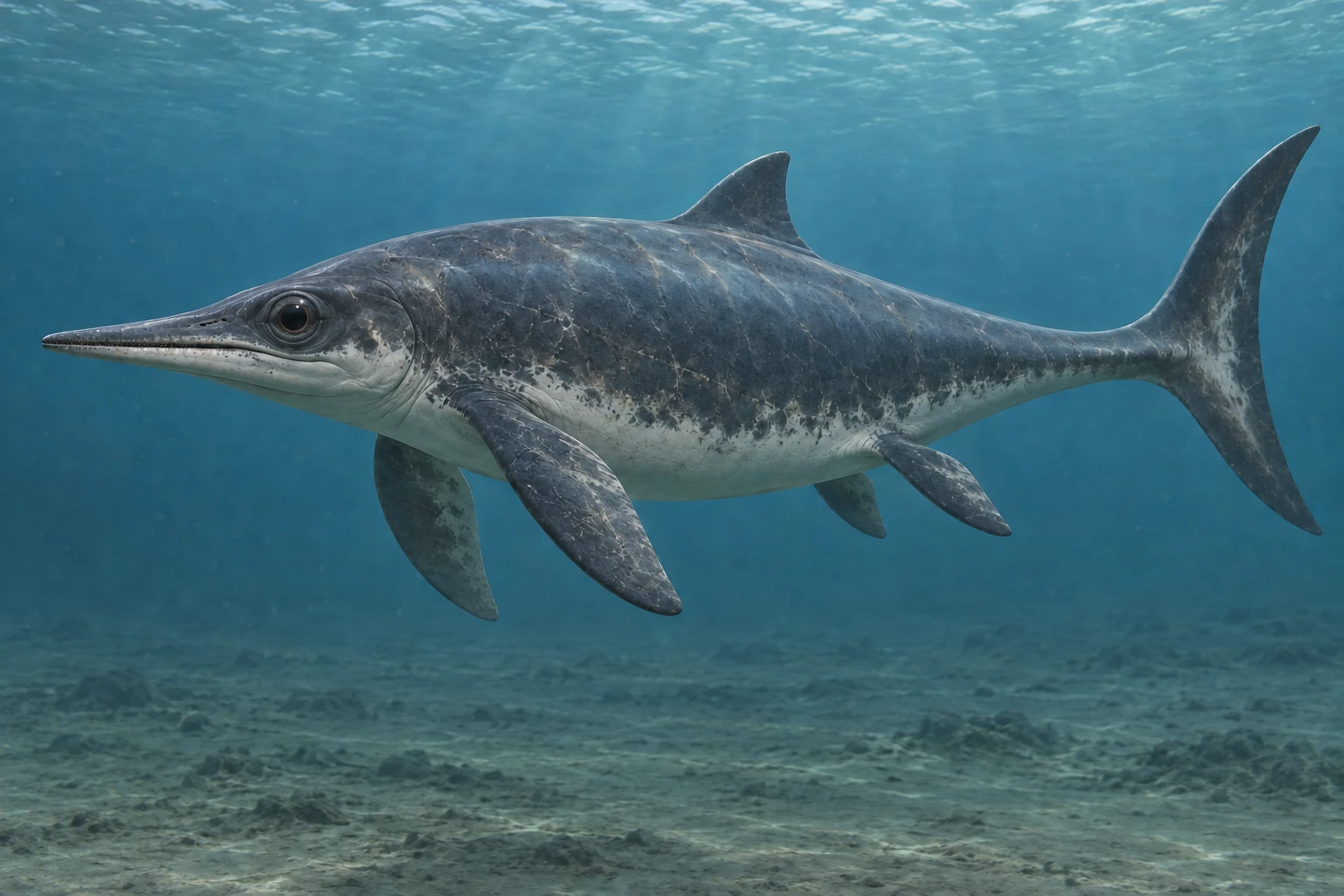
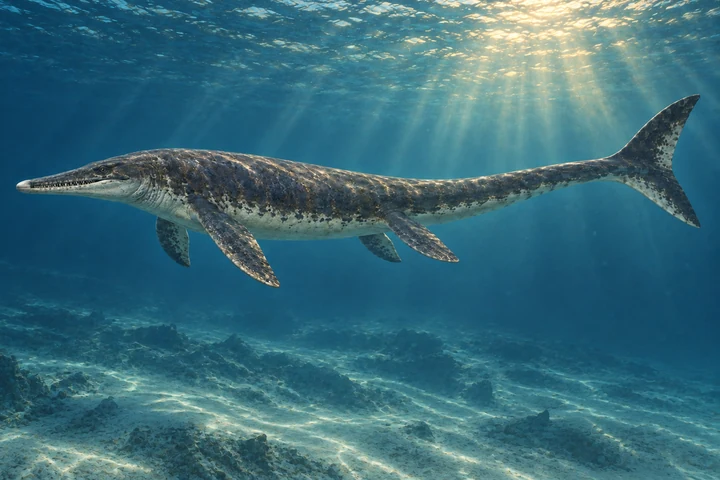
An illustrative reconstruction. Compare its anatomy with the evidence and limitations in the dossier. [1]
Source-informed reconstruction. Appearance evidence [1]. Original illustration; missing anatomy, coloration and scenery include interpretation.
Fossils constrain this life reconstruction. Missing anatomy, coloration and the environmental scene include interpretation; the dossier explains the evidence limits.
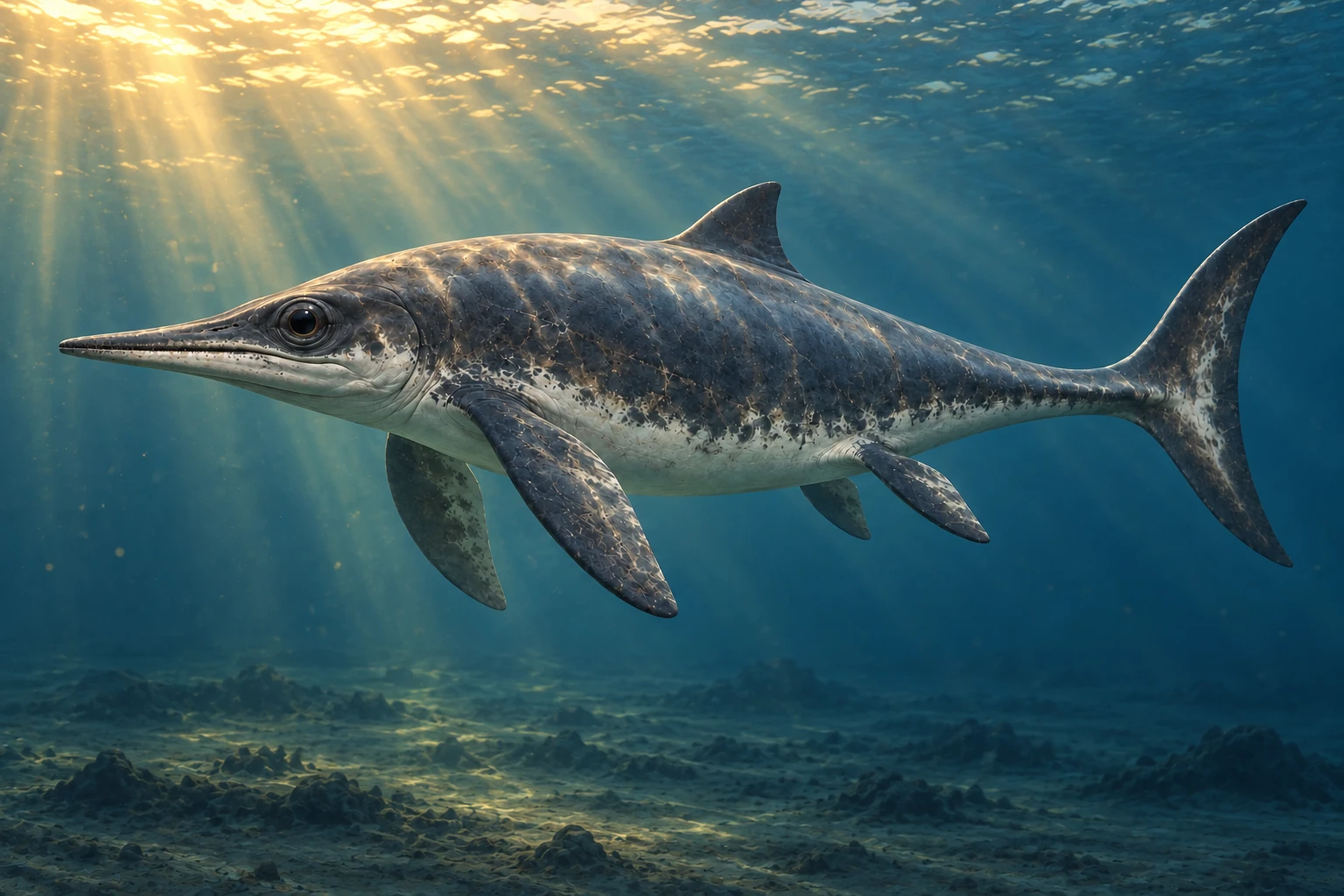
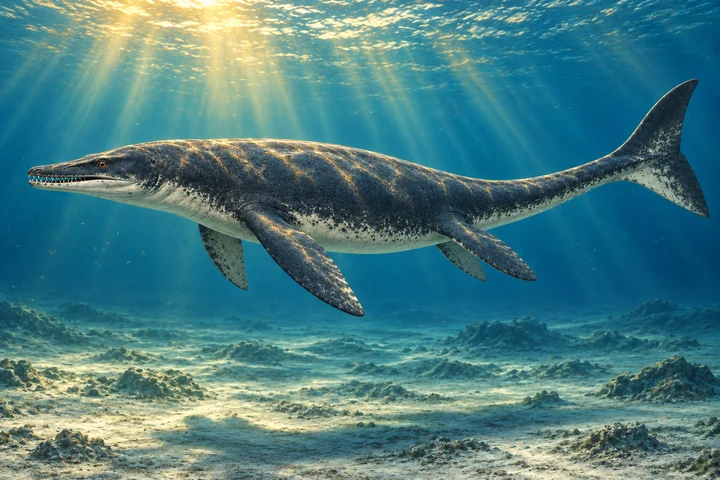
An illustrative reconstruction. Compare its anatomy with the evidence and limitations in the dossier. Lighting, coloration and scenery are artistic choices. This image does not document a fossil locality or behavior.
Original artwork · artistic interpretation.
Scientific view: source-informed reconstruction, credited paleoart or specimen-based imagery. Movie-style view: Original artistic interpretation. Reconstructions involve uncertainty.
MEET THE ANIMAL
Ophthalmosaurus was an ichthyosaur, and the British species O. icenicus is the reference for this exhibit. Its skull has large eye sockets and small teeth, while its limbs form paddles. The bones support a marine animal, but they do not supply its exact swimming speed or deepest dive. [D1]
Many fossils came from the Callovian marine rocks exposed in Cambridgeshire brick pits. Alfred Leeds collected important examples, and the Natural History Museum purchased major collections in 1890 and 1914. Keeping those fossils together with their records allows later researchers to test older descriptions instead of starting from scratch. [D2]
Names need the same care as measurements. North American Baptanodon has sometimes been placed in Ophthalmosaurus. A later study retained a separate genus after comparing braincase and limb features, while recognizing that individual variation could affect the differences. British and North American material therefore should not be silently mixed. [D3]
Live birth is strongly supported across ichthyosaurs by pregnant fossils from several genera. Applying that pattern here is a broader-group inference. It does not reveal an Ophthalmosaurus litter size, mating ritual or family arrangement; those attractive details need evidence from the relevant animals before becoming facts. [D4]
PREHISTORIC ANIMAL DOSSIER
The animal, the evidence, and the questions still open.
Museum collections retain many skull and limb remains. Revisiting differences between fossils changes how researchers decide where one genus ends and another begins. [D3]
Profile scope: Genus exhibit represented by British O. icenicus from the Oxford Clay; North American Baptanodon natans is kept separate under a published competing treatment. [D1]
Source supported identifies a description documented by the cited source. Inferred marks a reconstruction or functional estimate. Debated marks competing interpretations. Not established means the sources reviewed for this dossier do not support a firm conclusion; it does not mean a behavior never occurred.
A size reference is an estimate, not a population range. Nesting evidence does not by itself establish courtship, mate choice, or lifelong pairing.
About4 m genus reference
The monograph gives a genus approximation, not a measured adult range for O. icenicus. [D1]
Not established here
The collection page documents fossil holdings rather than a comparable adult body-mass estimate. [D2]
Animal feeding inferred
Small ridged teeth support animal feeding; the monograph does not establish a fixed prey menu for every O. icenicus individual. [D1]
Oxford Clay marine setting
Callovian marine fossils from Cambridgeshire brick pits include O. icenicus in the Alfred Leeds collections. [D2]
Aquatic swimming inferred
British O. icenicus has broad forelimbs and smaller hindlimbs; speed and dive-depth claims are not established by these bones. [D1]
Large orbits and paddle limbs
The skull has large eye sockets. Exact living eye dimensions and diving depth are not adopted here. [D1]
Live birth inferred for the broader group
Ichthyosaur pregnancies occur in other genera. The reviewed study does not list Ophthalmosaurus among directly documented gravid genera. [D4]
Not established here
No courtship display or breeding season is established. [D1]
Not established here
The historical collection contains many fossils, but collection size does not demonstrate a living school or parental group. [D2]
Sources and inspection notes for the claims in this profile.
THE STORY IN THE FOSSILS
Alfred Leeds collected marine fossils from Cambridgeshire brick pits. Large collections purchased in 1890 and 1914 include Ophthalmosaurus material. These historical holdings preserve evidence that can be studied again with different questions. [2]
A2022 study retained Baptanodon as distinct from Ophthalmosaurus, comparing skull and limb differences while acknowledging variation. This is why a North American fossil cannot automatically become evidence for the anatomy of British O. icenicus. [3]
The dossier identifies the scope of each reference estimate. A mount, an individual fossil and a species-wide adult range are different measurements. Comparison metrics remain unavailable where adult scope has not been established. Unknown does not mean zero.
Sources support the stated claims and scopes. Refer to the evidence notes for uncertainty.
KEEP EXPLORING
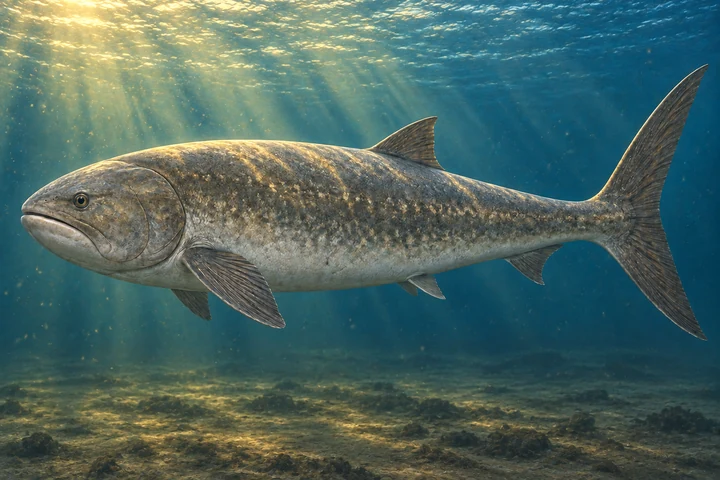
Leedsichthys problematicus
Prehistoric fish
A giant ray-finned fish whose filtering apparatus and incomplete skeleton make size reconstruction a careful puzzle.
Tylosaurus proriger
Marine reptile
A marine lizard with an elongated adult snout tip, whose fossil identities are still being revised.
Platecarpus tympaniticus
Marine reptile
A streamlined mosasaur known from an exceptional fossil preserving skin traces and digested fish.