
Body length
Not establishedNot established here
No complete body is preserved; informal comparative estimates are not adopted here. [D2]
EXHIBIT 280
Machairoceratops cronusi
Dinosaur
A Utah horned dinosaur distinguished by two long frill spikes that curve forward; much of its face and body remains unknown. [2]
TWO WAYS TO PICTURE THE PAST
Compare the evidence with the familiar movie image. The illustrations are not to a shared scale.
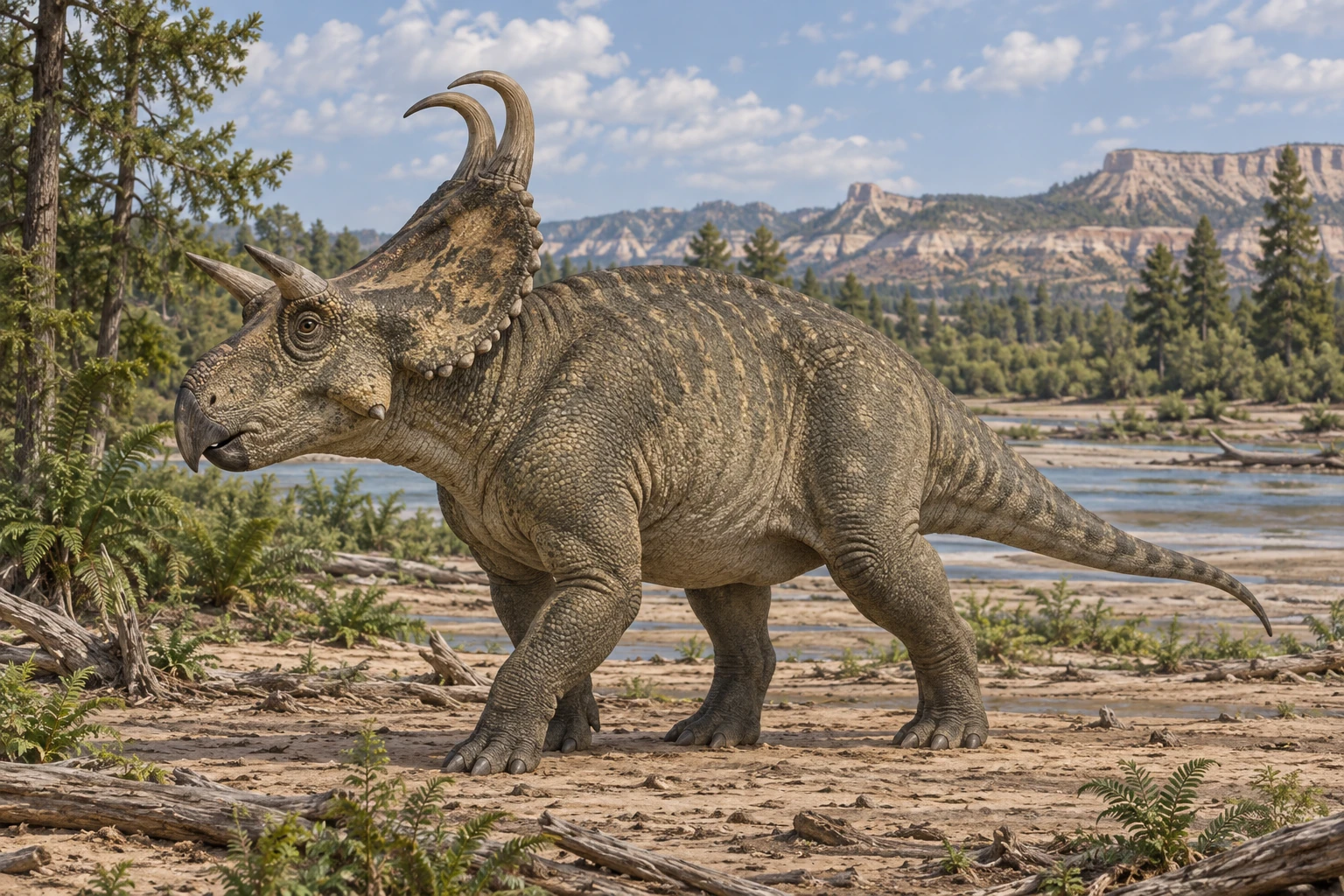
An illustrative reconstruction. Compare its anatomy with the evidence and limitations in the dossier. [1]
Source-informed reconstruction. Appearance evidence [1]. Original illustration; missing anatomy, coloration and scenery include interpretation.
Fossils constrain this life reconstruction. Missing anatomy, coloration and the environmental scene include interpretation; the dossier explains the evidence limits.
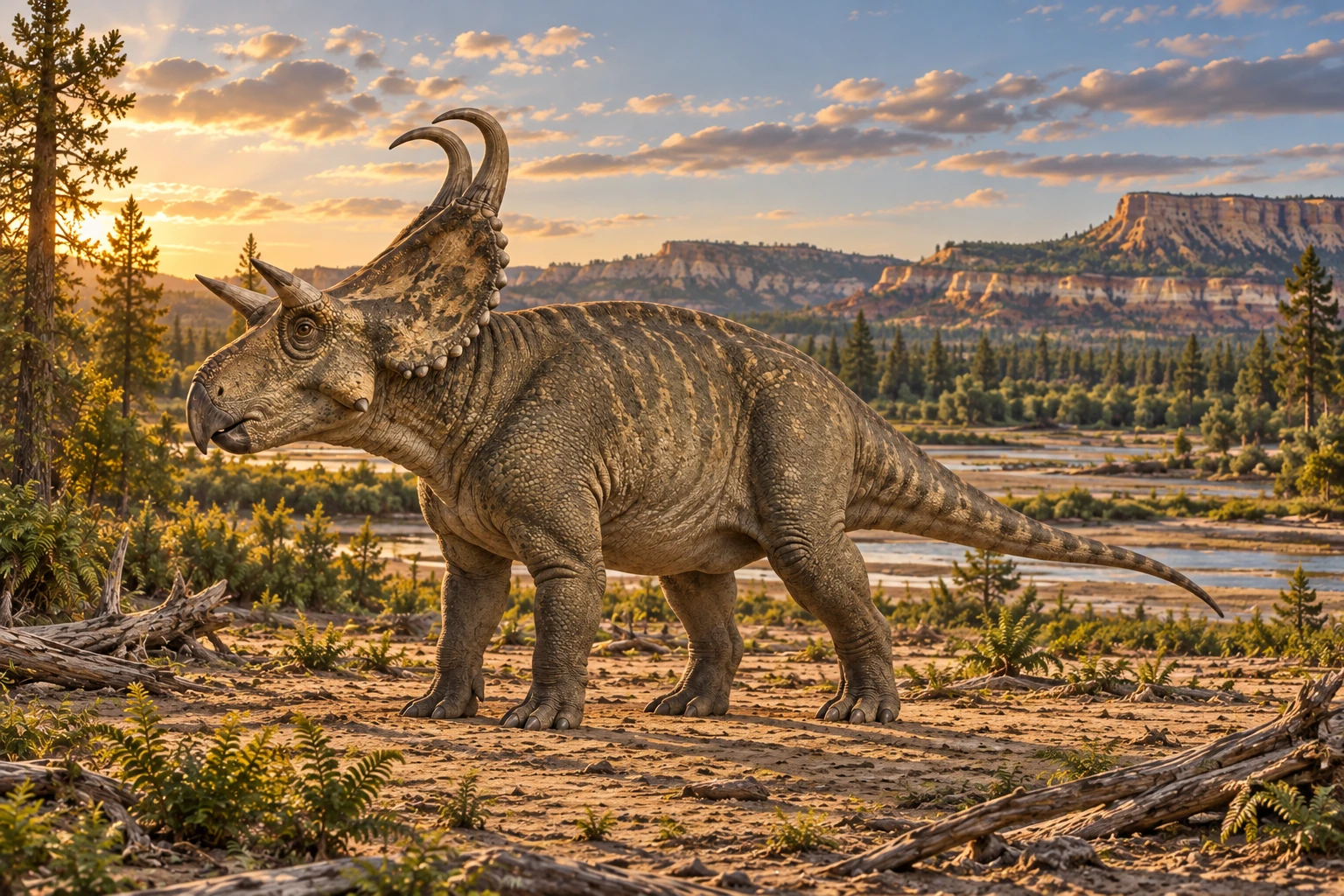
An illustrative reconstruction. Compare its anatomy with the evidence and limitations in the dossier. Lighting, coloration and scenery are artistic choices. This image does not document a fossil locality or behavior.
Original artwork · artistic interpretation.
Scientific view: source-informed reconstruction, credited paleoart or specimen-based imagery. Movie-style view: Original artistic interpretation. Reconstructions involve uncertainty.
MEET THE ANIMAL
Machairoceratops was a horned dinosaur from southern Utah. Two long spikes rising from the back of its frill curved forward, making the fossil distinct from other horned dinosaurs. Researchers compared those preserved features carefully before naming a new genus. A groove along the frill spikes is especially unusual, but its function is still uncertain. [D2]
The fossil is a partial skull, not a complete skeleton. Even its brow horns have broken bases, preventing scientists from confidently restoring their original direction. A picture of the complete animal must borrow missing facial and body details from relatives. That reconstruction can be useful, provided readers understand which features are supported directly and which need interpretation. [D1]
The discovery required several field seasons and help from excavators and volunteers. The animal belonged to the western North American landmass called Laramidia, separated from eastern North America by an inland sea. Comparing its skull with dinosaurs from different places and rock layers helps researchers investigate past diversity. It does not prove that the animal swam in that sea or explain its courtship and social life. [D3]
PREHISTORIC ANIMAL DOSSIER
The animal, the evidence, and the questions still open.
Three field seasons recovered its characteristic skull elements; comparisons distinguish it from other southern Laramidian ceratopsians. [D3]
Profile scope: This exhibit concerns Machairoceratops cronusi, known from the partial skull UMNHVP 20550. [D1]
Source supported identifies a description documented by the cited source. Inferred marks a reconstruction or functional estimate. Debated marks competing interpretations. Not established means the sources reviewed for this dossier do not support a firm conclusion; it does not mean a behavior never occurred.
A size reference is an estimate, not a population range. Nesting evidence does not by itself establish courtship, mate choice, or lifelong pairing.
Not established here
No complete body is preserved; informal comparative estimates are not adopted here. [D2]
Not established here
Skull fragments do not supply an adopted quantitative whole-body mass model. [D2]
Herbivory inferred from centrosaurine relatives.
Its own feeding apparatus is incomplete; preferred plants remain unresolved. [D2]
Terrestrial southern Laramidia, now Utah.
Wahweap occurrence establishes regional setting, not a specific everyday microhabitat. [D3]
Quadrupedal movement inferred from ceratopsid relatives.
The preserved skull supplies no direct limb or trackway evidence. [D2]
Paired forward-curving spikes on the frill.
Brow-horn bases are broken, so their original orientation is uncertain. [D1]
Not established here
The reviewed partial skull does not establish assigned eggs or nests. [D1]
Not established here
Frill ornament and its grooves do not demonstrate a mating ritual. [D2]
Not established here
One associated skull does not establish herd size or family structure. [D3]
Sources and inspection notes for the claims in this profile.
THE STORY IN THE FOSSILS
The diagnostic frill spikes retain an unusual groove whose function remains uncertain. Recognizable ornament does not automatically explain how an animal used it. [2]
Broken brow-horn bases limit their restored orientation. A complete face and body therefore require comparisons rather than pretending every illustrated part was preserved. [1]
The dossier identifies the scope of each reference estimate. A mount, an individual fossil and a species-wide adult range are different measurements. Comparison metrics remain unavailable where adult scope has not been established. Unknown does not mean zero.
Sources support the stated claims and scopes. Refer to the evidence notes for uncertainty.
KEEP EXPLORING
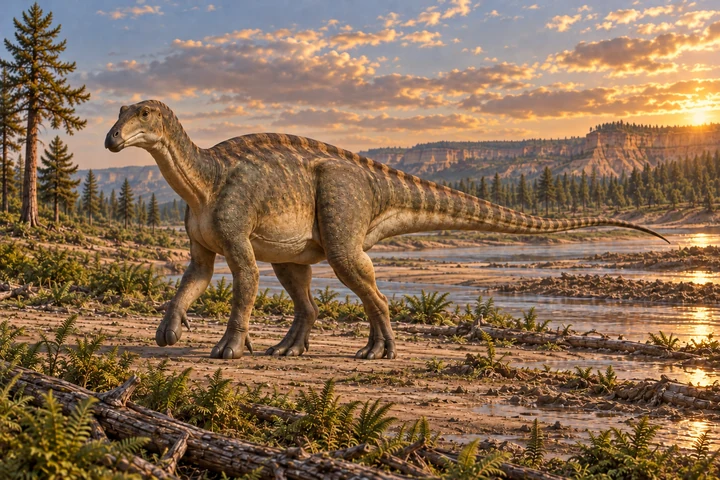
Eolambia caroljonesa
Dinosaur
A plant-eating Utah dinosaur related to duck-billed dinosaurs, known from complementary adult and juvenile fossils.
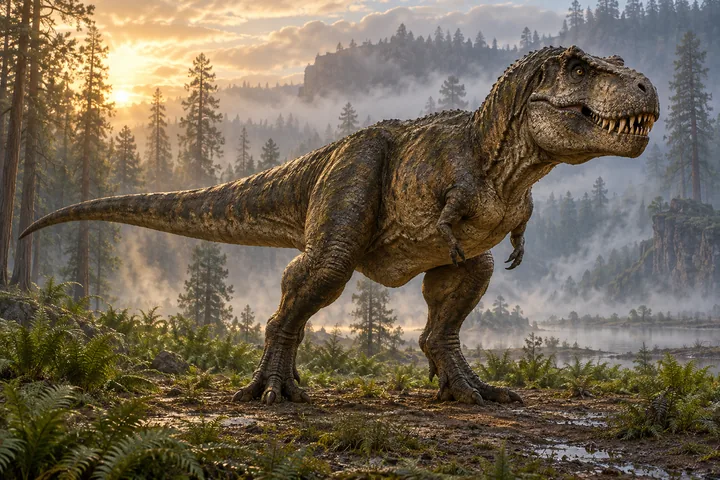
Tyrannosaurus rex
Tyrannosaurus rex was a large meat-eating dinosaur from the final part of the Cretaceous in western North America. Fossil teeth, bite marks and skeletons reveal a powerful animal whose behaviour still invites questions.
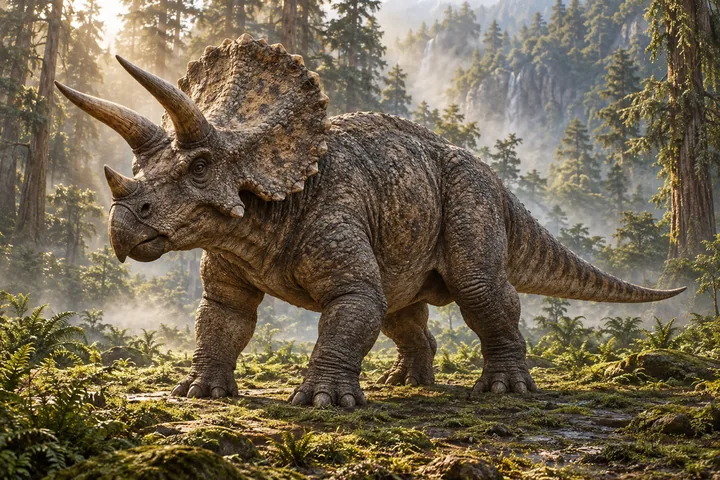
Triceratops horridus
Triceratops horridus was a horned dinosaur of the Late Cretaceous. Skin impressions attributed to this species reveal scales, while skulls and their positions in rock layers help researchers distinguish it from the later Triceratops prorsus.