
Size reference
Source supported78 mm preserved hindwing; 100–120 mm estimated complete wing
M. kerneri holotype reference. Neither measurement is body length or wingspan. [D1]
EXHIBIT 264
Makarkinia
Prehistoric insect
Makarkinia was a large Cretaceous lacewing known from distinctive fossil wings, including ringed hindwing eyespots. [1]
TWO WAYS TO PICTURE THE PAST
Compare the evidence with the familiar movie image. The illustrations are not to a shared scale.
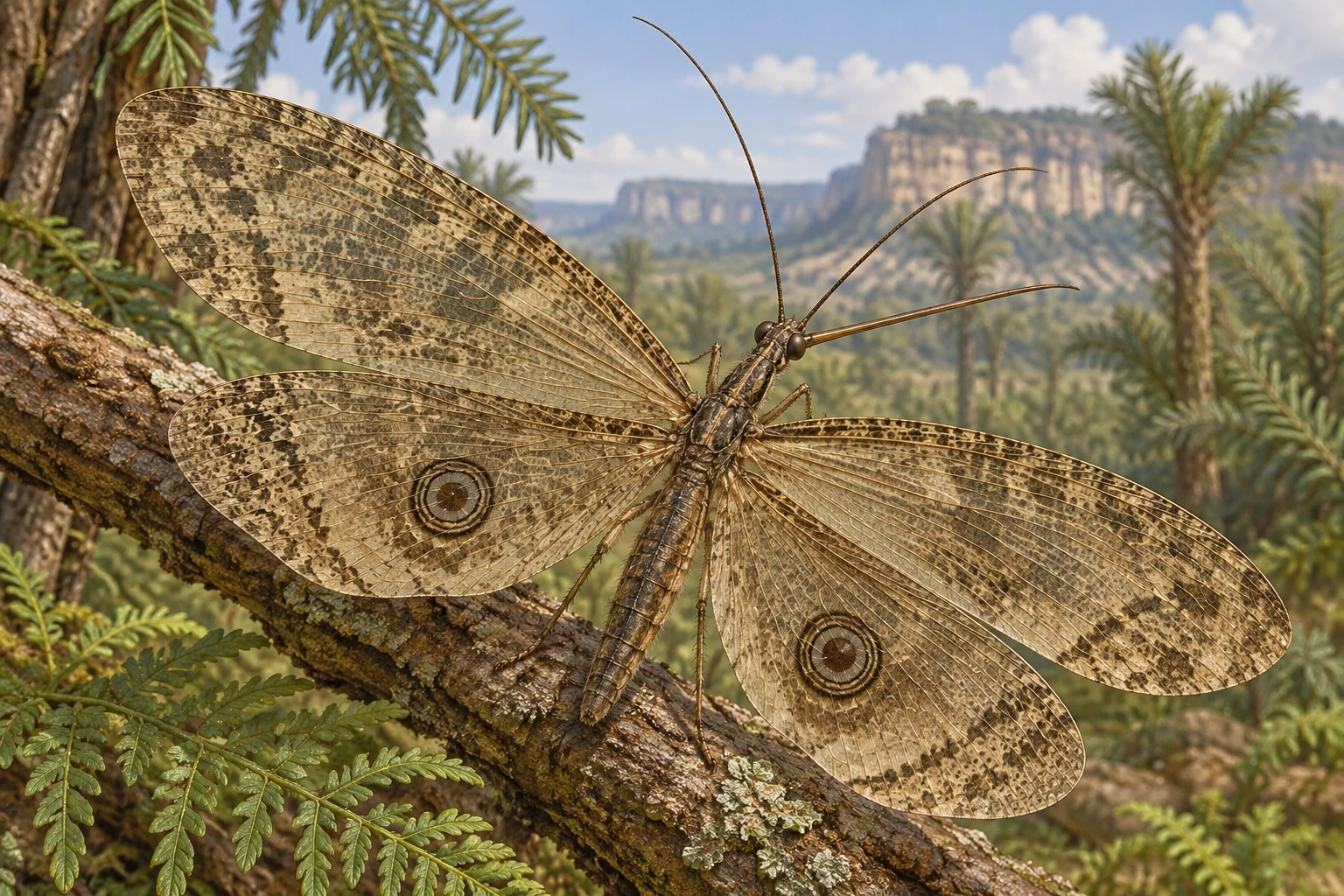
An illustrative reconstruction. Compare its anatomy with the evidence and limitations in the dossier. [1]
Source-informed reconstruction. Appearance evidence [1]. Original illustration; missing anatomy, coloration and scenery include interpretation.
Fossils constrain this life reconstruction. Missing anatomy, coloration and the environmental scene include interpretation; the dossier explains the evidence limits.
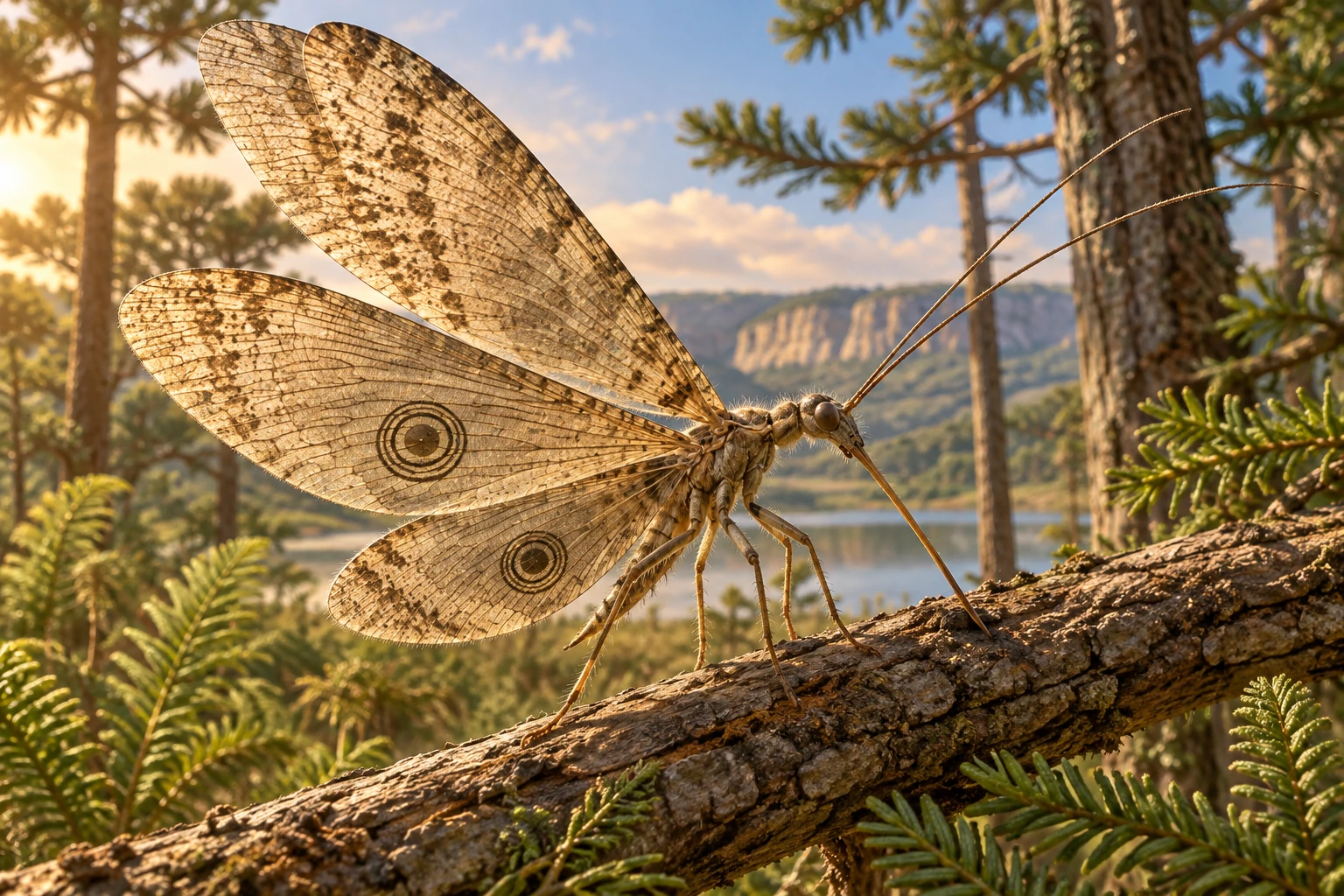
An illustrative reconstruction. Compare its anatomy with the evidence and limitations in the dossier. Lighting, coloration and scenery are artistic choices. This image does not document a fossil locality or behavior.
Original artwork · artistic interpretation.
Scientific view: source-informed reconstruction, credited paleoart or specimen-based imagery. Movie-style view: Original artistic interpretation. Reconstructions involve uncertainty.
MEET THE ANIMAL
Makarkinia was an extinct lacewing, rather than a butterfly or dinosaur. A 2016 study described a hindwing of M. kerneri with dense veins and a dark eyespot surrounded by three closely spaced rings. The preserved wing measures 78 millimeters, while the researchers estimated a complete length of 100 to 120 millimeters. Those numbers describe one wing; they must not be presented as the insect’s body length or total wingspan. [D1]
A Brazilian fossil catalog lists three species within the genus: M. adamsi, M. irmae and M. kerneri. All come from the Aptian Crato Formation. The older name Panfilovia adamsi refers to the species later placed in Makarkinia. That change does not make every species of Panfilovia the same animal. Careful attention to names prevents a renamed fossil from being counted as a second exhibit. [D2]
A later research abstract reconsidered relationships among these remarkable lacewings. It described Makarkinia as probably belonging in the subfamily Kalligrammatinae. The qualifying word shows that part of its placement remains uncertain. Its general relationship to other large lacewings is useful, but cannot supply missing body parts as directly preserved evidence. Reconstructing a complete living insect requires comparative choices that should remain separate from the measured fossil wing. [D3]
PREHISTORIC ANIMAL DOSSIER
The animal, the evidence, and the questions still open.
Its preserved wing is measurable; total body length, exact wingspan and life history remain uncertain. [D2]
Profile scope: Genus — Makarkinia; gallery pattern anchored to the M. kerneri hindwing holotype SMNS70287. Complete body anatomy is restored comparatively. [D1]
Source supported identifies a description documented by the cited source. Inferred marks a reconstruction or functional estimate. Debated marks competing interpretations. Not established means the sources reviewed for this dossier do not support a firm conclusion; it does not mean a behavior never occurred.
A size reference is an estimate, not a population range. Nesting evidence does not by itself establish courtship, mate choice, or lifelong pairing.
78 mm preserved hindwing; 100–120 mm estimated complete wing
M. kerneri holotype reference. Neither measurement is body length or wingspan. [D1]
Not established here
The reviewed wing description gives no body-mass estimate. [D1]
Plant-fluid feeding inferred
This is a kalligrammatid comparison; M. kerneri preserves no mouthparts or identified meal. [D1]
Terrestrial Crato landscape inferred
The Aptian lake-burial horizon does not establish an exact living perch. [D2]
Flight inferred
The described adult wing supports flight; detailed leg movement and speeds are unknown. [D1]
Dense wing veins and ringed eyespot
M. kerneri has three closely spaced dark rings around its hindwing eyespot; the body is unpreserved. [D1]
Not established here
The reviewed adult-wing material does not identify eggs, larvae or nests. [D2]
Not established here
The catalog’s taxonomic records do not demonstrate courtship displays. [D2]
Not established here
Distinct fossil species do not establish swarms, cooperation or colonies. [D2]
Sources and inspection notes for the claims in this profile.
THE STORY IN THE FOSSILS
The 2025 abstract places Makarkinia probably within Kalligrammatinae, retaining uncertainty in its subfamily assignment. [3]
The dossier identifies the scope of each reference estimate. A mount, an individual fossil and a species-wide adult range are different measurements. Comparison metrics remain unavailable where adult scope has not been established. Unknown does not mean zero.
Sources support the stated claims and scopes. Refer to the evidence notes for uncertainty.
KEEP EXPLORING
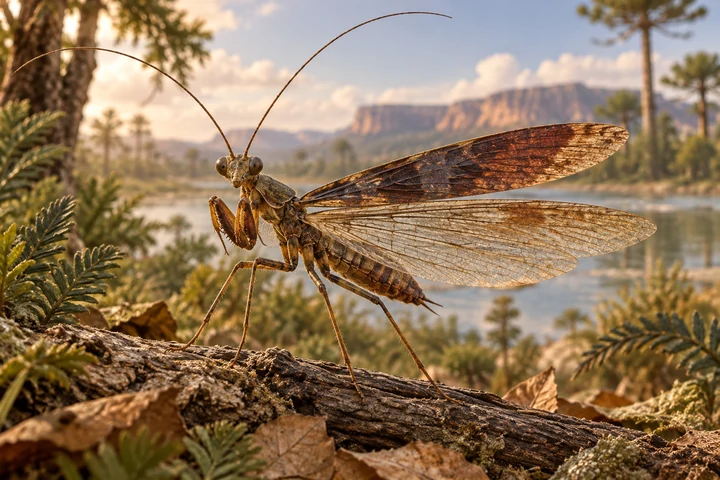
Santanmantis
Prehistoric insect
Santanmantis was a small Cretaceous mantis with a short thorax and wings extending well beyond its abdomen.
Oregramma
Prehistoric insect
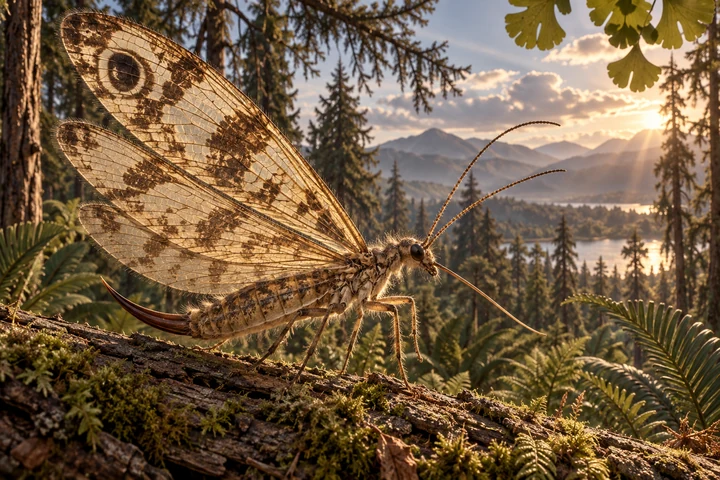
Oregramma was an eyespotted lacewing with sucking mouthparts; one female preserves an unusually long curved ovipositor.
Kalligramma
Prehistoric insect
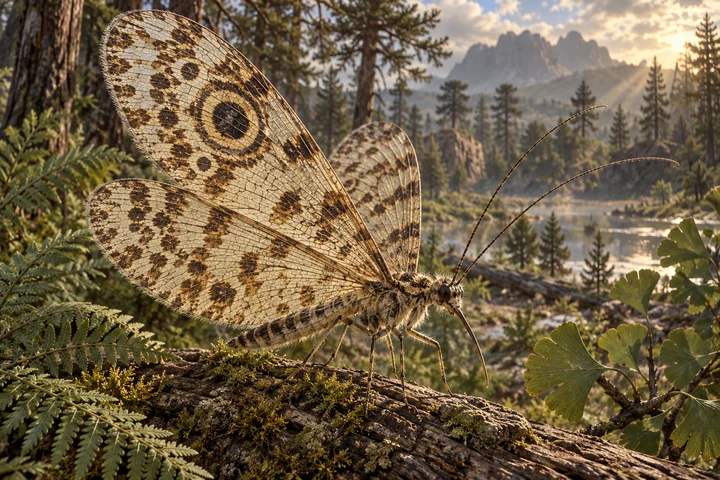
Kalligramma was a large lacewing whose patterned wings recall butterflies, despite its different ancestry.