
Size reference
Source supported75 mm forewing in the focal female
O. illecebrosa type measurement; the approximately 65 mm hind wing is a separate structure, not body length. [D1]
EXHIBIT 205
Oregramma
Prehistoric insect
Oregramma was an eyespotted lacewing with sucking mouthparts; one female preserves an unusually long curved ovipositor. [1]
TWO WAYS TO PICTURE THE PAST
Compare the evidence with the familiar movie image. The illustrations are not to a shared scale.
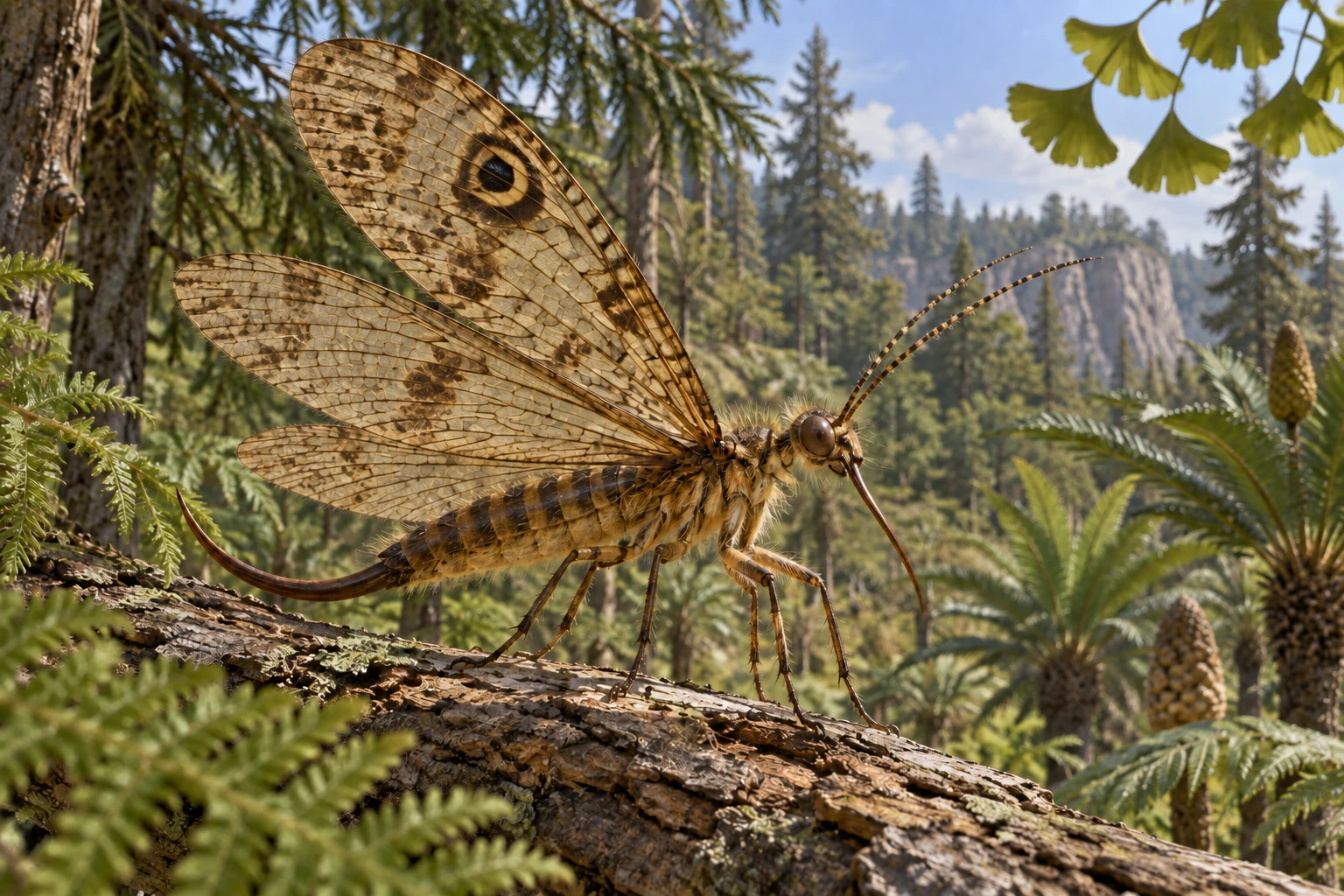
An illustrative reconstruction. Compare its anatomy with the evidence and limitations in the dossier. [1]
Source-informed reconstruction. Appearance evidence [1]. Original illustration; missing anatomy, coloration and scenery include interpretation.
Fossils constrain this life reconstruction. Missing anatomy, coloration and the environmental scene include interpretation; the dossier explains the evidence limits.
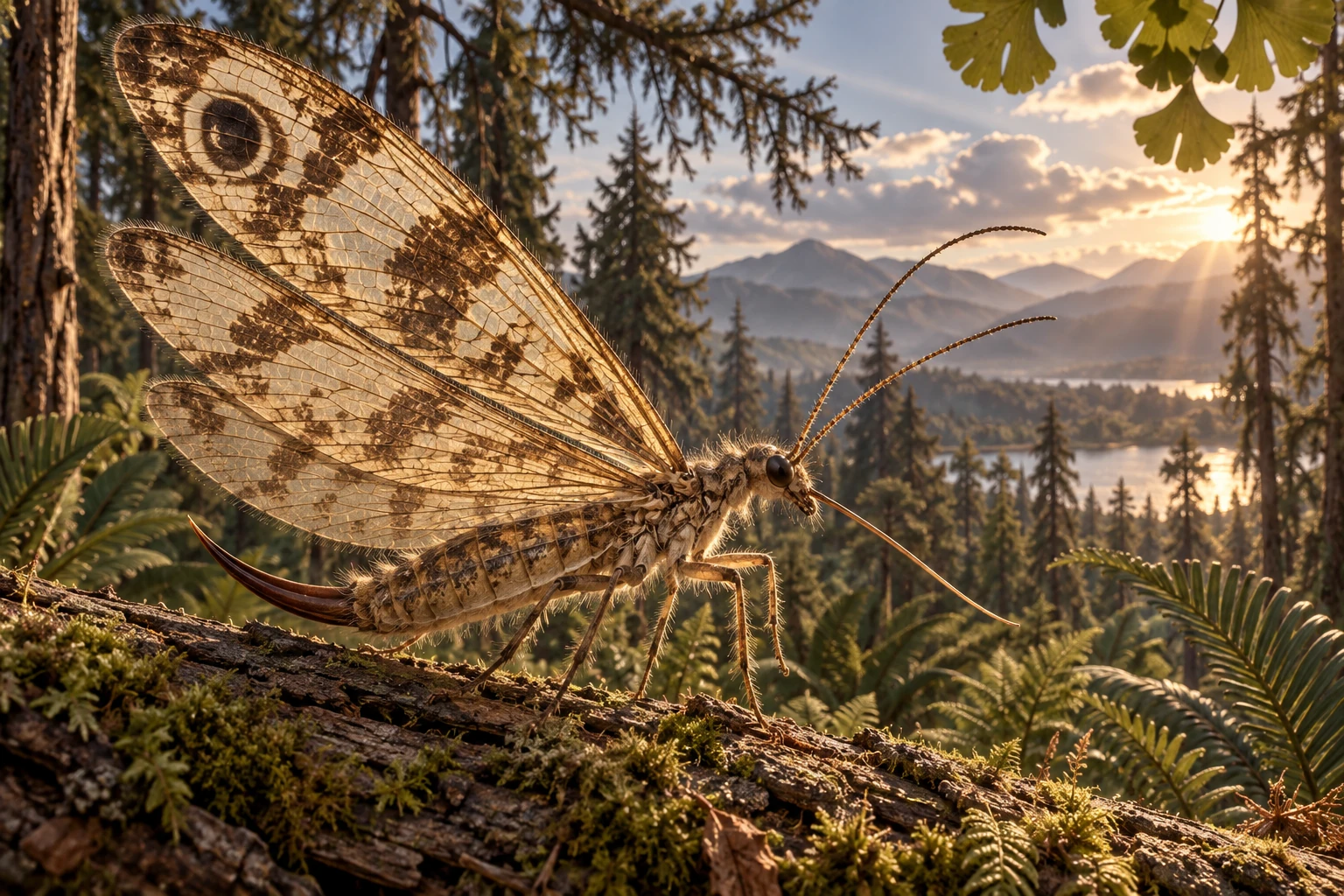
An illustrative reconstruction. Compare its anatomy with the evidence and limitations in the dossier. Lighting, coloration and scenery are artistic choices. This image does not document a fossil locality or behavior.
Original artwork · artistic interpretation.
Scientific view: source-informed reconstruction, credited paleoart or specimen-based imagery. Movie-style view: Original artistic interpretation. Reconstructions involve uncertainty.
MEET THE ANIMAL
Oregramma was a prehistoric lacewing from Early Cretaceous China. A female of the species Oregramma illecebrosa preserves a forewing 75 millimeters long and a conspicuous eye-shaped wing pattern. It also has a curved ovipositor, an egg-laying structure, about 25 millimeters long. These are measurements of parts of one fossil, not a full body size for every Oregramma. Some head details are missing. [D1]
Studying related lacewings helps researchers ask how these insects used their mouthparts and patterned wings. Long feeding structures fit drinking plant fluids, but a possible use is different from a preserved meal. Family-wide discoveries must also be handled carefully: an antenna or behavior found in another kind of lacewing does not automatically describe Oregramma. [D3]
The ovipositor gives an especially useful clue. Researchers compared it with marks in a much older Jurassic ginkgo relative and suggested that a related insect inserted eggs into plant tissue. Those marks are not identified Oregramma eggs. The comparison offers a way to test an idea while leaving the exact laying site and the young insect’s life unknown. [D4]
PREHISTORIC ANIMAL DOSSIER
The animal, the evidence, and the questions still open.
The focal female preserves wings and a curved egg-laying structure, while much of its head remains incomplete. [D1]
Profile scope: Genus — Oregramma; reconstruction anchored to O. illecebrosa from China’s Yixian Formation. [D1]
Source supported identifies a description documented by the cited source. Inferred marks a reconstruction or functional estimate. Debated marks competing interpretations. Not established means the sources reviewed for this dossier do not support a firm conclusion; it does not mean a behavior never occurred.
A size reference is an estimate, not a population range. Nesting evidence does not by itself establish courtship, mate choice, or lifelong pairing.
75 mm forewing in the focal female
O. illecebrosa type measurement; the approximately 65 mm hind wing is a separate structure, not body length. [D1]
Not established here
No fossil-individual mass is established by the reviewed studies. [D3]
Plant-fluid feeding inferred
Proboscis comparisons suggest gymnosperm pollination drops; particular host plants are not demonstrated for every species. [D2]
Yixian terrestrial vegetation near fossil lakes
Regional fossils and feeding comparisons support a vegetated setting; lake burial does not establish an aquatic adult. [D2]
Wing-powered flight inferred
Preserved forewings and hind wings support flight; speed remains unknown. [D1]
Forewing eyespot and curved ovipositor
The female has setose wings and sucking mouthparts; incomplete antennae need comparative restoration. [D1]
An ovipositor, not a preserved egg series
Its shape suggests inserting eggs into plant tissues. Older ginkgophyte scars use Oregramma only as a comparison, not an identified producer. [D4]
Not established here
A mating display is not established for Oregramma. [D3]
Not established here
No coordinated colony or group is demonstrated. [D3]
Sources and inspection notes for the claims in this profile.
THE STORY IN THE FOSSILS
A younger insect can help interpret an older plant scar without proving that the same genus made it. Here, anatomy supports a hypothesis rather than a direct identification. [4]
The dossier identifies the scope of each reference estimate. A mount, an individual fossil and a species-wide adult range are different measurements. Comparison metrics remain unavailable where adult scope has not been established. Unknown does not mean zero.
Sources support the stated claims and scopes. Refer to the evidence notes for uncertainty.
KEEP EXPLORING
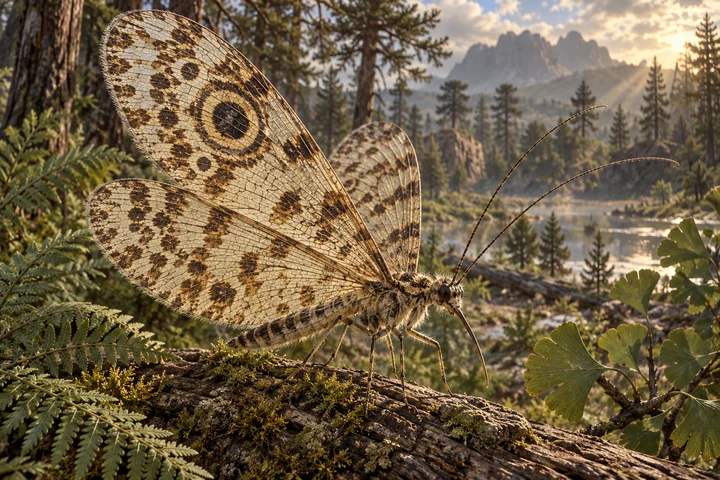
Kalligramma
Prehistoric insect
Kalligramma was a large lacewing whose patterned wings recall butterflies, despite its different ancestry.
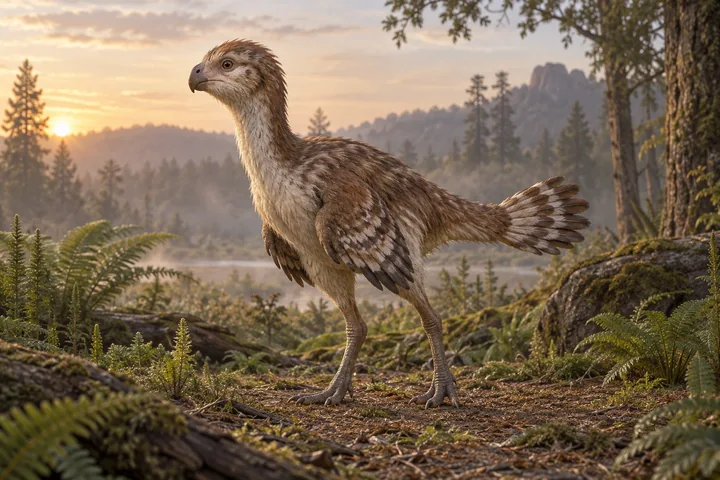
Caudipteryx zoui
Caudipteryx preserves a feather fan on a short tail.
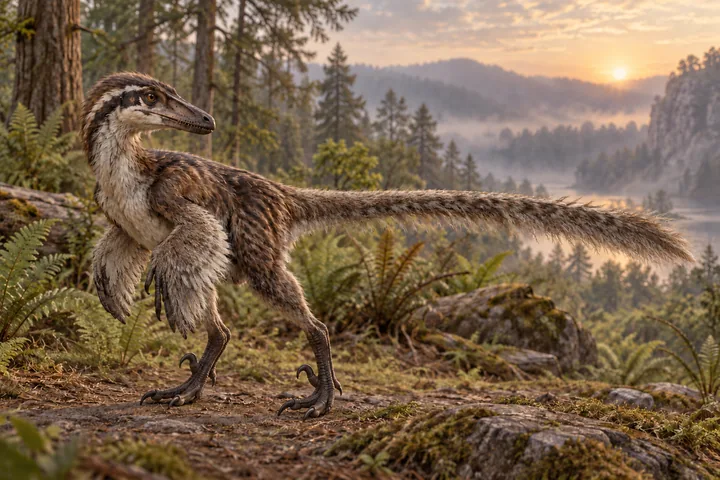
Sinornithosaurus millenii
Sinornithosaurus preserves branching feather structures in stone.