
Body length
InferredAbout 2 m (museum reference)
Rounded profile value without a named measured individual or maturity assessment; it is not an established adult maximum. [D1]
EXHIBIT 119
Sinornithosaurus millenii
Sinornithosaurus preserves branching feather structures in stone. [3]
TWO WAYS TO PICTURE THE PAST
Compare the evidence with the familiar movie image. The illustrations are not to a shared scale.
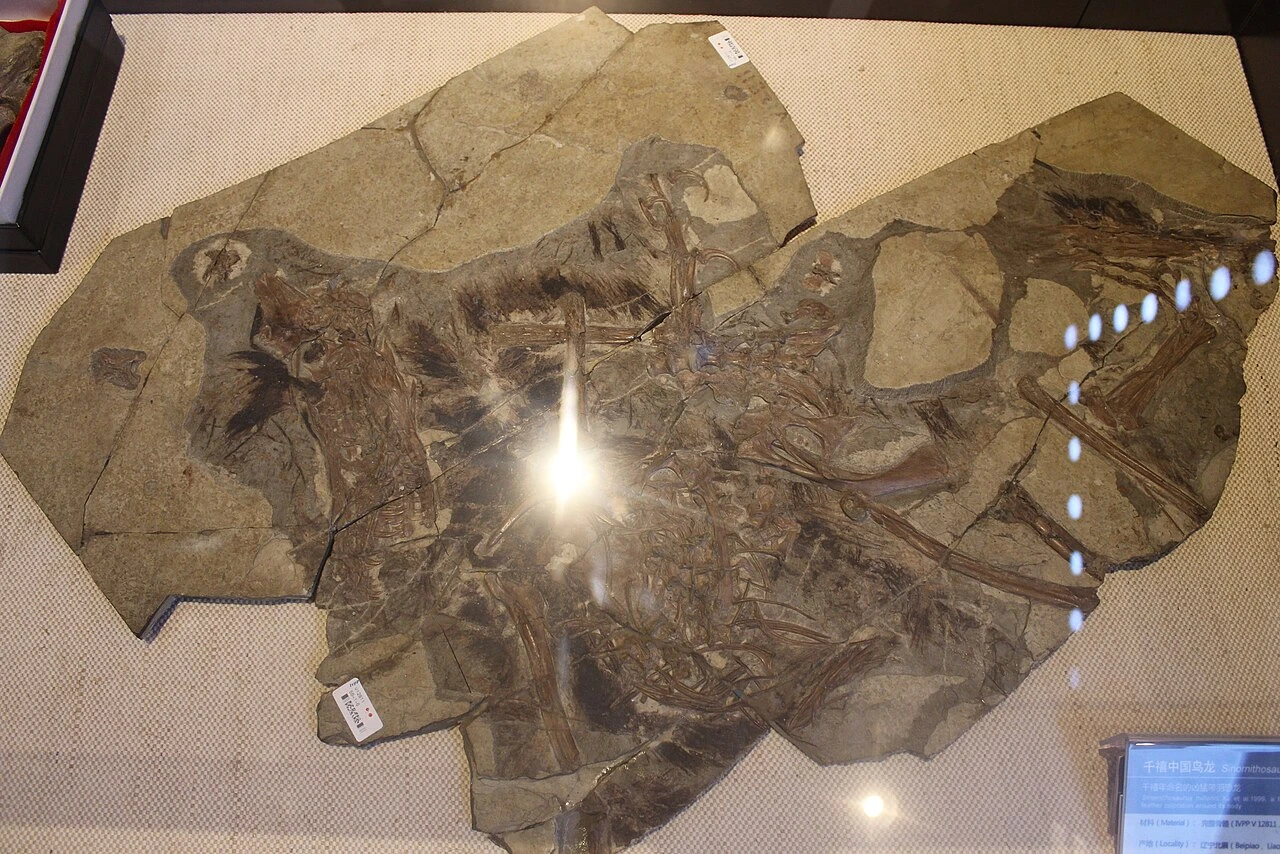
Holotype of Sinornithosaurus millenii, IVPP V12811, displayed at the Paleozoological Museum of China and photographed by Jonathan Chen. The fossil is flattened and photographed through reflective glass; dark preserved structures should not be read as a complete three-dimensional plumage or living color reconstruction. [3]
Sinornithosaurus-Paleozoological Museum of China.jpg · Jonathan Chen. CC BY-SA 4.0. Current Commons image converted to WebP and proportionally resized; no cropping, mirroring, anatomical edits or compositing. Original annotations retained. The source license applies to these versions.
The photograph or figure shows the credited fossil material; displayed mounts and labels can include interpretation.
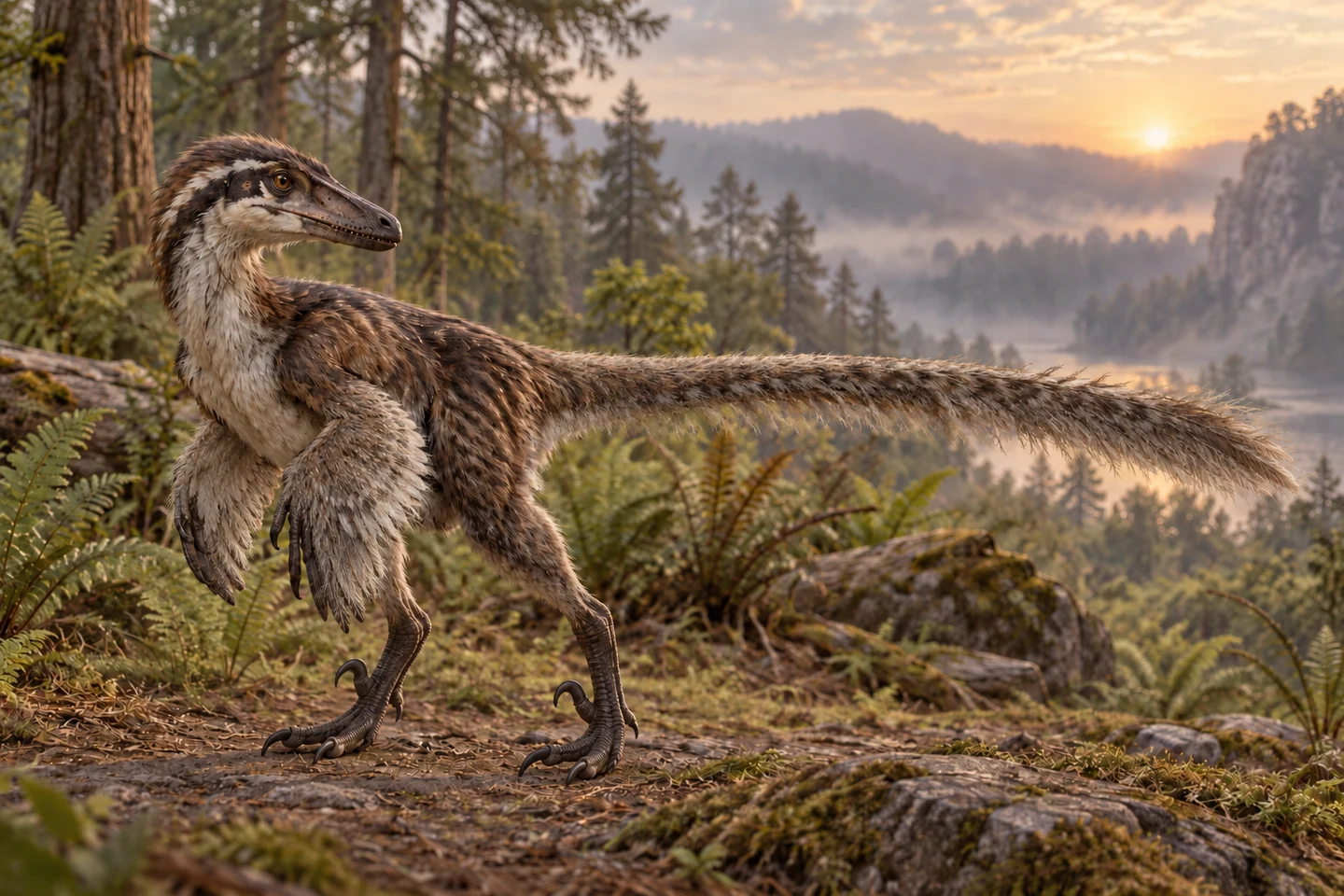
Original cinematic interpretation of Sinornithosaurus millenii. Colors, soft tissues, scenery and missing anatomy are reconstructed artistic choices; this is not a directly observed individual or behavior. The illustration does not demonstrate flight, gliding or venom; feather color and soft tissues remain artistic. The arm and tail covering uses shaggy branching appendages rather than asserting preserved vaned wing or tail feathers. Lighting, coloration and scenery are artistic choices. This image does not document a fossil locality or behavior.
Original artwork · artistic interpretation.
Scientific view: source-informed reconstruction, credited paleoart or specimen-based imagery. Movie-style view: Original artistic interpretation. Reconstructions involve uncertainty.
MEET THE ANIMAL
Sinornithosaurus was a small meat-eating dinosaur from Early Cretaceous China. A museum reference of about two metres offers an approximate sense of size, without identifying a measured adult maximum. Its fossils are especially interesting because researchers can compare skeletal anatomy with evidence of the outer covering, instead of reconstructing appearance from bones alone. [D1]
Preserved darkened appendages show branching, downy feather structures. Some branch into tufts and others along a central filament. In the examined specimen, prominent-shafted vaned wing and tail feathers were not observed. These details should stay tied to that specimen rather than becoming a claim about every feather on every Sinornithosaurus individual. [D3]
An earlier proposal suggested a venom-delivery system, but a later anatomical reassessment found no unambiguous apparatus. Apparently long teeth could reflect displacement during preservation, and grooves alone did not prove venom. Neither a toxin nor a gland was demonstrated. Sinornithosaurus shows why an exciting functional claim needs stronger support than a suggestive tooth shape, and why revised interpretations belong alongside the original fossil observations. [D6]
PREHISTORIC ANIMAL DOSSIER
The animal, the evidence, and the questions still open.
Fossil covering and growth histology are direct observations. A proposed venom apparatus has been challenged, and feathers alone do not reveal display behavior. [D3] [D7] [D6]
Profile scope: Genus — Sinornithosaurus; the S. millenii type and other specimens are separated. [D2] [D7]
Source supported identifies a description documented by the cited source. Inferred marks a reconstruction or functional estimate. Debated marks competing interpretations. Not established means the sources reviewed for this dossier do not support a firm conclusion; it does not mean a behavior never occurred.
A size reference is an estimate, not a population range. Nesting evidence does not by itself establish courtship, mate choice, or lifelong pairing.
About 2 m (museum reference)
Rounded profile value without a named measured individual or maturity assessment; it is not an established adult maximum. [D1]
About 2.9–3 kg (volume model)
Reconstruction for S. millenii IVPP V12811; maturity is not established by the appendix. This is not a population range. [D8]
Carnivory inferred; venom unconfirmed
A reassessment found no unambiguous venom system: apparent fang length can result from displaced teeth, and grooves alone are insufficient. Neither toxin production nor a particular prey menu is demonstrated. [D6]
Yixian Formation, northeastern China
The type comes from the Early Cretaceous Yixian Formation. Its burial record does not prove occupation of only one vegetation or shoreline setting. [D2]
Two-legged reconstruction
The dromaeosaurid skeleton supports hindlimb-based terrestrial movement. Filamentous covering alone does not establish gliding, powered flight or a measured running speed. [D2]
Branching, downy feather structures
Preserved carbonized appendages branch into tufts or along a central filament. Prominent-rachis vaned wing and tail feathers were not observed in the examined specimen. [D3]
Not established here
DNHM D2140 was still growing histologically despite mature-looking bones. This differs from IVPP V12811 and supplies no assigned nest, clutch or sexual-maturity measurement. [D7]
Not established here
Branching covering is preserved, but focused searches did not establish a genus-specific courtship ritual, pairing system or sex-specific feather ornament. [D3]
Not established here
Focused social searches did not establish a Sinornithosaurus group assemblage or coordinated hunting. Findings for other dromaeosaurids are not transferred.
Sources and inspection notes for the claims in this profile.
THE STORY IN THE FOSSILS
A 2010 paper proposed a venom-delivery system. A subsequent anatomical reassessment challenged its dental and skull arguments; the profile therefore does not present venom as an established biological trait. [5] [6]
Another specimen showed that apparently adult-looking skeletal fusion could coexist with continued bone growth. Its histology improves the growth record without identifying a breeding age or mating system. [7]
The dossier identifies the scope of each reference estimate. A mount, an individual fossil and a species-wide adult range are different measurements. Comparison metrics remain unavailable where adult scope has not been established. Unknown does not mean zero.
Sources support the stated claims and scopes. Refer to the evidence notes for uncertainty.
KEEP EXPLORING
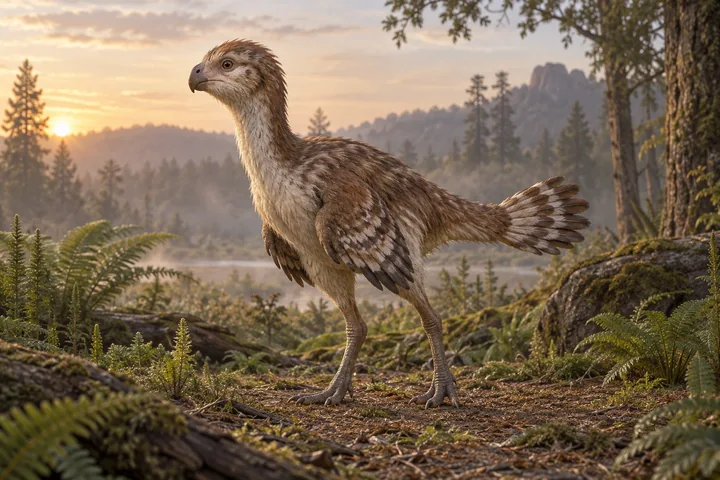
Caudipteryx zoui
Caudipteryx preserves a feather fan on a short tail.
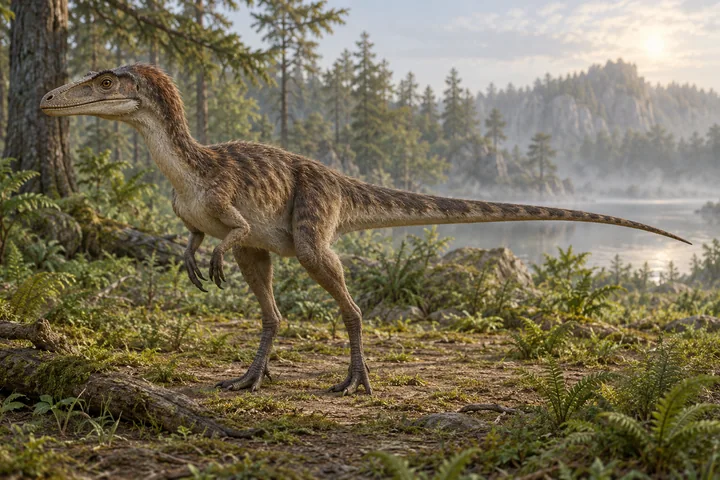
Dilong paradoxus
Dilong was a small tyrannosauroid with long arms; a referred fossil preserves branching skin filaments.
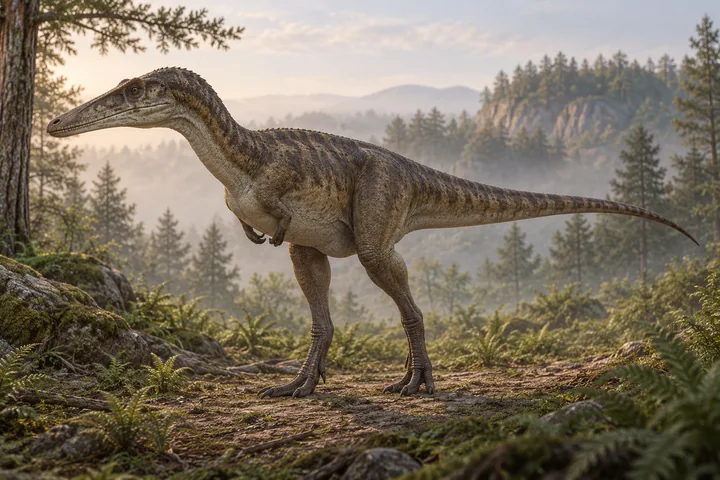
Xiongguanlong baimoensis
Xiongguanlong had a remarkably long, shallow snout and several skeletal features later seen in giant tyrannosaurids.