
Body length
InferredAbout 1.6 m (type reconstruction)
IVPP V14243 was the largest specimen described originally; this growing individual is not an adult maximum. [D1] [D4]
TWO WAYS TO PICTURE THE PAST
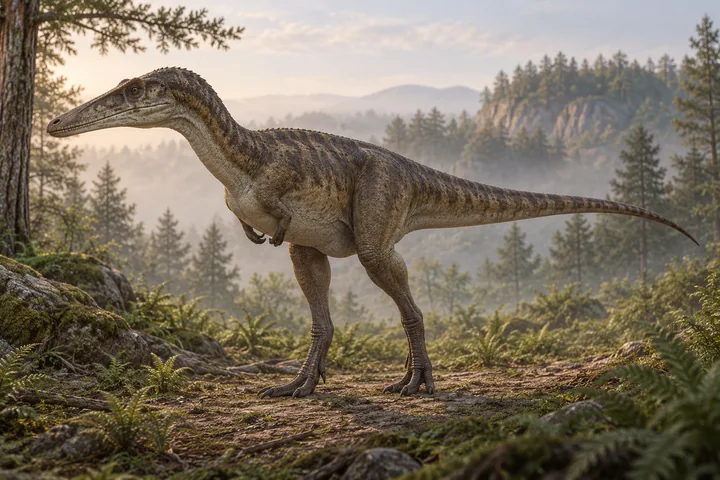
Compare the evidence with the familiar movie image. The illustrations are not to a shared scale.
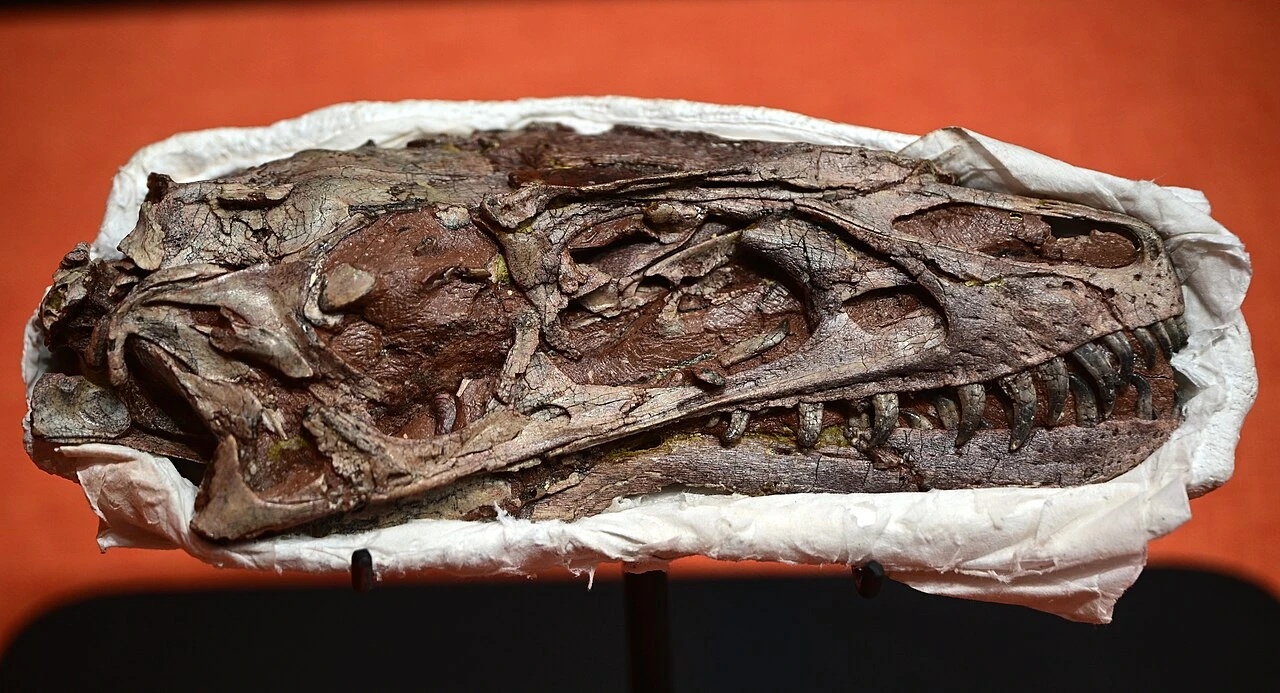
Dilong paradoxus holotype IVPP V14243 skull photographed by JonathanChen at the National Natural History Museum of China in July 2026. Flattening and visible display support are retained; the source provides no element-restoration key. This type-skull view does not show the filaments preserved in the separately referred, species-qualified V11579, or establish an adult whole-body outline. [1]
Dilong paradoxus holotype skull BMNHC.jpg · JonathanChen. CC BY 4.0. Current licensed Commons image converted to WebP and proportionally reduced for the thumbnail, without upsampling. No additional cropping, mirroring, anatomical edits or compositing. Existing source restoration and scale annotations retained. CC BY 4.0 applies to these versions.
The photograph or figure shows the credited fossil material; displayed mounts and labels can include interpretation.
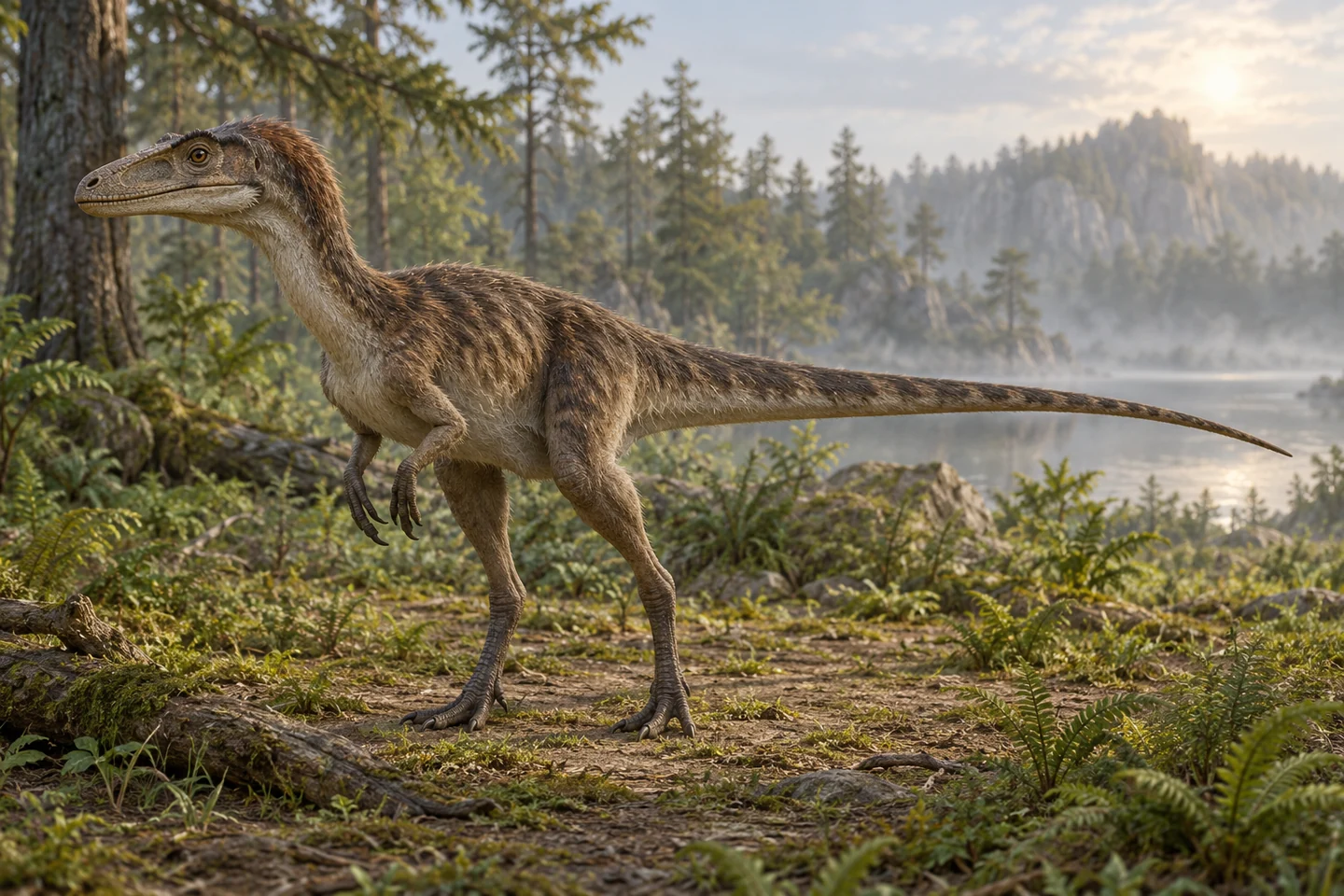
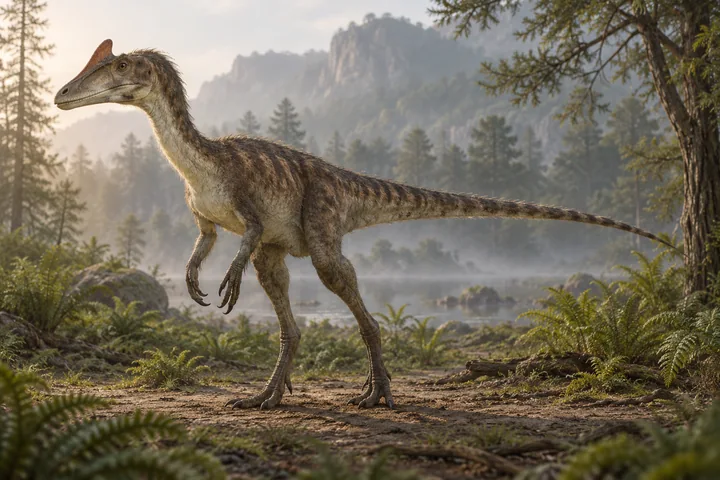
Original cinematic interpretation of Dilong. Long three-fingered arms guide the restoration. Published Dilong material preserves filaments, although the assignment of the feather-bearing specimen to the named species was qualified; distribution and colors remain interpreted. Lighting, colors and scenery are artistic choices; this image does not document directly observed behavior. Lighting, coloration and scenery are artistic choices. This image does not document a fossil locality or behavior.
Original artwork · artistic interpretation.
Scientific view: source-informed reconstruction, credited paleoart or specimen-based imagery. Movie-style view: Original artistic interpretation. Reconstructions involve uncertainty.
MEET THE ANIMAL
Dilong was a small predatory relative of tyrannosaurs from Early Cretaceous China. Its fossils are important to discussions of featherlike coverings in the tyrannosaur family tree. The museum exhibition interprets simple filaments as possible insulation. That is a proposed function for the covering, rather than evidence of a particular temperature tolerance, seasonal coat or courtship display. [D2]
Filaments occur on a separately referred fossil that may represent a second Dilong species. They do not establish identical plumage on every individual. [D1]
A simple filament differs from a fully developed flight feather. Its presence adds information about the animal's covering without demonstrating flight or revealing the colors of a complete living body. Insulation is a reasonable interpretation to investigate, but it should not turn into an invented display or an assumed mating signal. [D2]
Researchers also reconstructed the shape of its brain cavity, which differs from that of giant tyrannosaurids. An endocast is a model of the spaces inside the skull, not the preserved brain behaving in life. Differences in its shape can support anatomical comparisons without directly measuring intelligence, proving a hunting strategy or demonstrating communication within a social group. [D3]
PREHISTORIC ANIMAL DOSSIER
The animal, the evidence, and the questions still open.
The fossils combine a gracile predatory skeleton with evidence of simple feather-like covering. They do not establish uniform plumage, color or an adult maximum. [D2]
Profile scope: Genus — Dilong; D. paradoxus type IVPP V14243 separated from filament-bearing referred V11579, whose species identification was qualified originally. [D1]
Source supported identifies a description documented by the cited source. Inferred marks a reconstruction or functional estimate. Debated marks competing interpretations. Not established means the sources reviewed for this dossier do not support a firm conclusion; it does not mean a behavior never occurred.
A size reference is an estimate, not a population range. Nesting evidence does not by itself establish courtship, mate choice, or lifelong pairing.
About 1.6 m (type reconstruction)
IVPP V14243 was the largest specimen described originally; this growing individual is not an adult maximum. [D1] [D4]
About 10 kg (limb model)
IVPP V14243; estimated circumference, juvenile possibly approaching maturity. [D4]
Small predatory tyrannosauroid
Toothed anatomy supports carnivory. Cranial modelling compares possible feeding performance, rather than establishing prey choice or hunting tactics. [D2] [D5]
Yixian Formation, Liaoning
Type locality Lujiatun and referred Zhangjiagou material lie in northeastern China’s Early Cretaceous fossil record; different specimens retain separate locality and species scope. [D1]
Biped with long forelimbs
The gracile skeleton and three-fingered hand support terrestrial movement and grasping capacity. Exact speed and use of the hand remain inferred. [D1]
Low cranial ridge; branching filaments
V11579 preserves jaw and tail filaments, with species referral uncertain. Full-body feather coverage and color are unestablished. [D1]
Not established here
The type’s juvenile model designation does not establish sexual maturity. No inspected Dilong eggs, nests or parent–young association were found. [D4]
Not established here
Filaments may have provided insulation. The exhibition interpretation does not demonstrate display feathers, sex differences or mating behavior. [D2]
Not established here
An endocast reconstructs spaces within the skull, not social behavior. The reviewed brain study supplies no observed communication, group or family evidence. [D3]
Sources and inspection notes for the claims in this profile.
THE STORY IN THE FOSSILS
The filament-bearing fossil and the measured type are separate specimens. Their evidence should not silently become a single fully preserved adult animal. [1]
A reconstructed brain cavity provides another comparison with giant tyrannosauroids. Differences in brain shape do not document a specific hunting strategy or social life. [3]
The dossier identifies the scope of each reference estimate. A mount, an individual fossil and a species-wide adult range are different measurements. Comparison metrics remain unavailable where adult scope has not been established. Unknown does not mean zero.
Sources support the stated claims and scopes. Refer to the evidence notes for uncertainty.
KEEP EXPLORING
Xiongguanlong baimoensis
Xiongguanlong had a remarkably long, shallow snout and several skeletal features later seen in giant tyrannosaurids.
Guanlong wucaii
Guanlong was a slender predator with long, three-fingered arms and a delicate crest along its skull.
Caudipteryx zoui
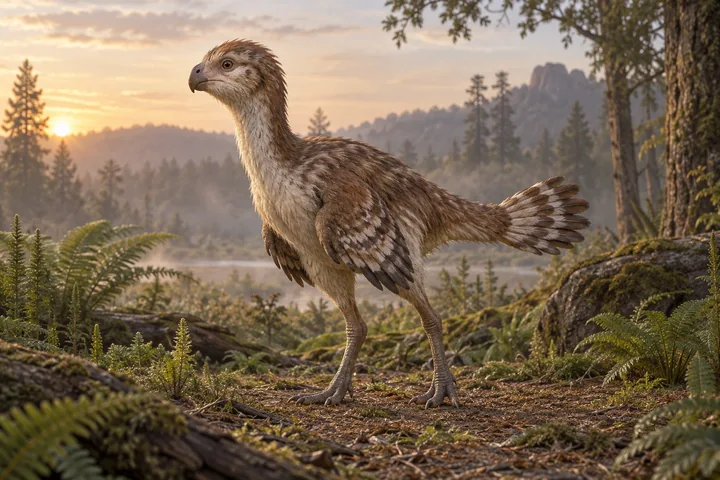
Caudipteryx preserves a feather fan on a short tail.