
Body length
InferredAbout 5 m (museum reconstruction)
Educational whole-body estimate with reconstruction method unspecified. A separately established adult length reference is unavailable here. [D2]
EXHIBIT 180
Xiongguanlong baimoensis
Xiongguanlong had a remarkably long, shallow snout and several skeletal features later seen in giant tyrannosaurids. [2]
TWO WAYS TO PICTURE THE PAST
Compare the evidence with the familiar movie image. The illustrations are not to a shared scale.
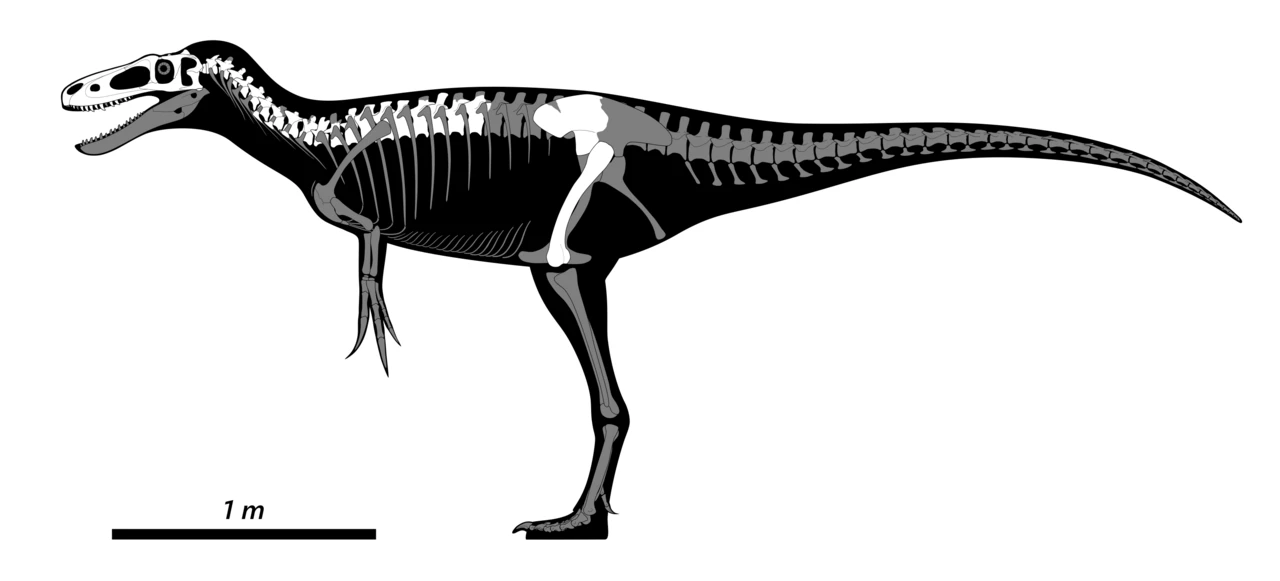
Xiongguanlong baimoensis reconstruction by DefinitelyNOTDilophosaurus, based on type FRDC-GSJB16-2-1. White marks known bones and grey completes missing regions through comparisons. The skull is restored from deformation; lower jaws, hands, feet and much of the tail are hypothetical. The artist’s scale is part of a whole-body reconstruction, not a measurement of a complete fossil or an adult species maximum. [1]
Xiongguanlong Skeletal.png · DefinitelyNOTDilophosaurus. CC BY 4.0. Current licensed Commons image converted to WebP and proportionally reduced for the thumbnail, without upsampling. No additional cropping, mirroring, anatomical edits or compositing. Existing source restoration and scale annotations retained. CC BY 4.0 applies to these versions.
Skeletal mounts and drawings may restore missing parts; the caption identifies the displayed material.
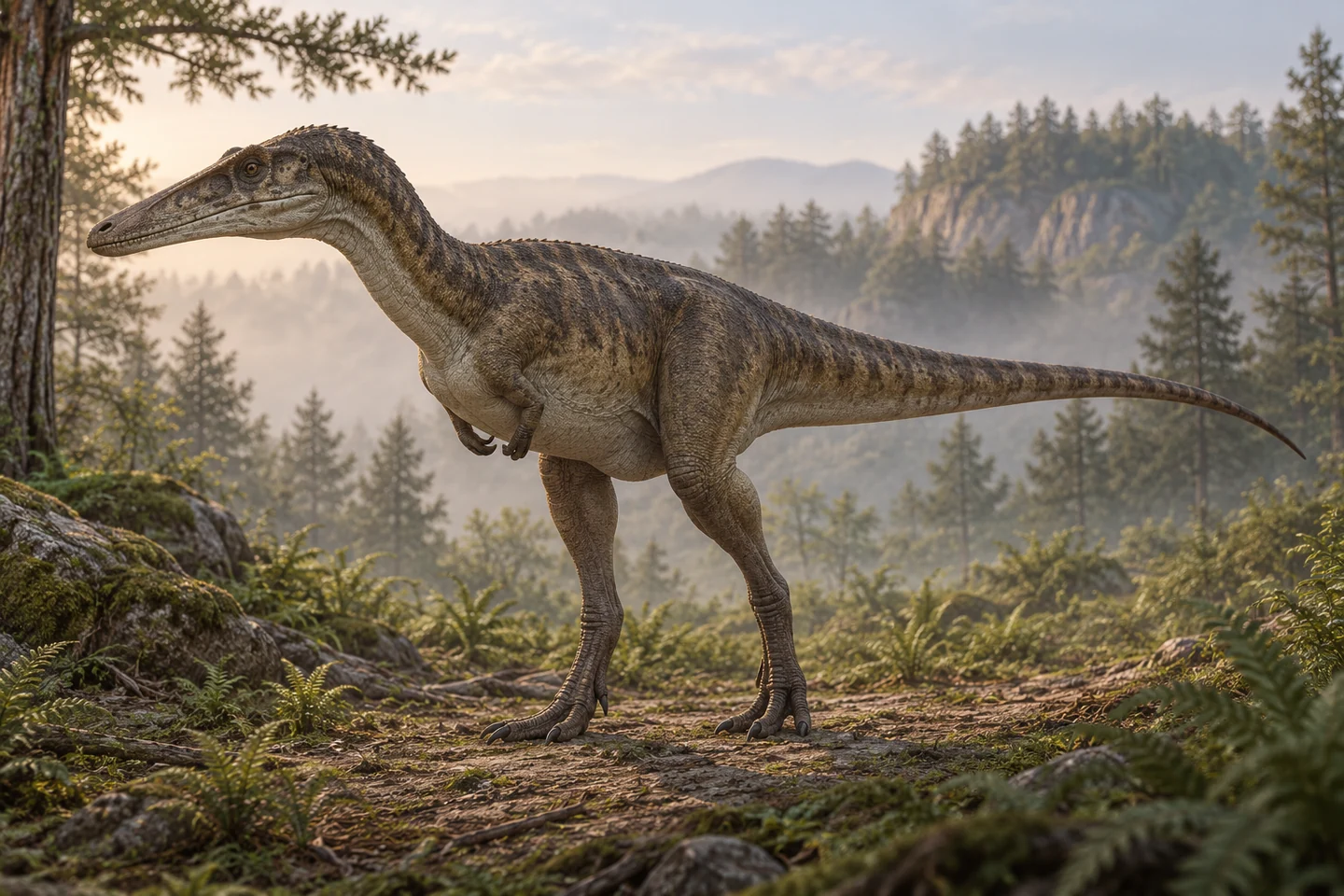
Original cinematic interpretation of Xiongguanlong. The long shallow skull guides this interpretation; missing lower jaw and hands are comparative. Covering, full proportions and living pose remain artistic reconstructions. Lighting, colors and scenery are artistic choices; this image does not document directly observed behavior. Lighting, coloration and scenery are artistic choices. This image does not document a fossil locality or behavior.
Original artwork · artistic interpretation.
Scientific view: source-informed reconstruction, credited paleoart or specimen-based imagery. Movie-style view: Original artistic interpretation. Reconstructions involve uncertainty.
MEET THE ANIMAL
Xiongguanlong was an Early Cretaceous tyrannosauroid from China with an elongated, shallow snout and serrated teeth. Its anatomy supports a carnivorous interpretation, but no particular prey preference is established. The Australian Museum reconstructs a length of about five metres. That is a general whole-body reference with no specified reconstruction method, rather than a separately verified adult length. [D2]
Its discovery helped fill a gap between small early members of the tyrannosaur family tree and the giant forms familiar from later in the Cretaceous. Fossils from these intermediate parts of the record help researchers compare how anatomy changed. Being useful for that comparison does not prove that the individual dinosaur was a direct ancestor of Tyrannosaurus. [D3]
A broad family-tree analysis recognized Xiongguanlong separately from other early tyrannosauroids and placed it outside Tyrannosauridae, the family of the later giants. Related animals can share ancestry while retaining distinct genus identities. The evolutionary relationship provides context for its unusual head, without turning every earlier tyrannosauroid into the same animal or giving them identical diets and behaviors. [D4]
PREHISTORIC ANIMAL DOSSIER
The animal, the evidence, and the questions still open.
Its Early Cretaceous remains help sample the evolutionary gap between small early tyrannosauroids and their giant later relatives. [D3]
Profile scope: Genus — Xiongguanlong; X. baimoensis, type FRDC-GSJB16-2-1. Missing lower jaws, hands and feet remain comparative restorations. [D1]
Source supported identifies a description documented by the cited source. Inferred marks a reconstruction or functional estimate. Debated marks competing interpretations. Not established means the sources reviewed for this dossier do not support a firm conclusion; it does not mean a behavior never occurred.
A size reference is an estimate, not a population range. Nesting evidence does not by itself establish courtship, mate choice, or lifelong pairing.
About 5 m (museum reconstruction)
Educational whole-body estimate with reconstruction method unspecified. A separately established adult length reference is unavailable here. [D2]
About 272 kg (limb regression)
Original model for FRDC-GSJB16-2-1. Nearly closed neurocentral sutures suggest it was close to fully grown; this is an individual estimate. [D1]
Carnivory inferred
Serrated teeth support animal feeding. The long, shallow skull differs from giant tyrannosaurid heads; exact prey preferences remain uncertain. [D2]
Xinminpu Group, Gansu
Grey mudstone at White Ghost Castle in the Yujingzi Basin; probable Aptian–Albian, with precise stratigraphic correlation qualified in the original paper. [D1]
Two-legged reconstruction
The preserved femur and theropod comparisons support terrestrial bipedality. Hands, feet and much of the tail are reconstructed; no running speed is established. [D1]
Elongated snout; smooth nasal bones
The preorbital region exceeds two-thirds of skull length. Its shallow snout lacks the strongly vaulted nasal architecture of giant tyrannosaurids. [D1]
Not established here
Near-complete neurocentral closure informs growth status, rather than breeding age. No inspected eggs, nests or reproductive tissues establish parental behavior. [D1]
Not established here
A smooth, elongated snout is preserved. No reviewed specimen sample tests sex differences, display behavior or mate choice. [D2]
Not established here
The described type is a partial individual, without a demonstrated group assemblage. Focused searches found no genus-specific social evidence. [D1]
Sources and inspection notes for the claims in this profile.
THE STORY IN THE FOSSILS
The discovery supplied an intermediate part of the tyrannosauroid fossil record. It helps reconstruct evolutionary relationships without proving a direct ancestor of Tyrannosaurus. [3] [4]
Its family-tree position is distinct from the later tyrannosaurid radiation. A shared ancestry does not make the genus interchangeable with those giant predators. [4]
The dossier identifies the scope of each reference estimate. A mount, an individual fossil and a species-wide adult range are different measurements. Comparison metrics remain unavailable where adult scope has not been established. Unknown does not mean zero.
Sources support the stated claims and scopes. Refer to the evidence notes for uncertainty.
KEEP EXPLORING
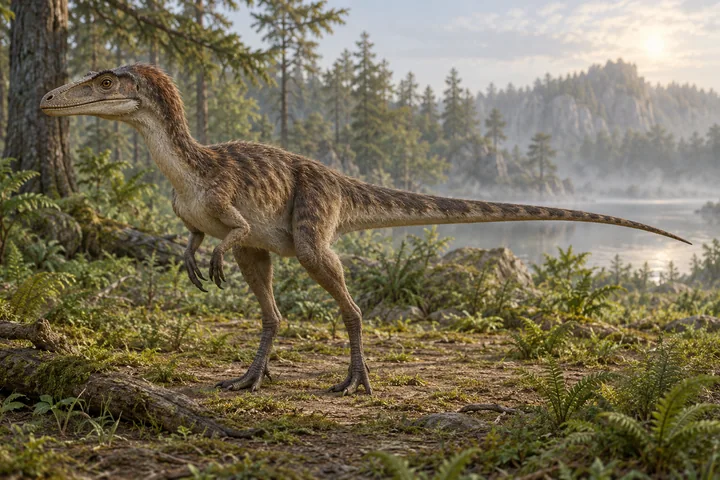
Dilong paradoxus
Dilong was a small tyrannosauroid with long arms; a referred fossil preserves branching skin filaments.
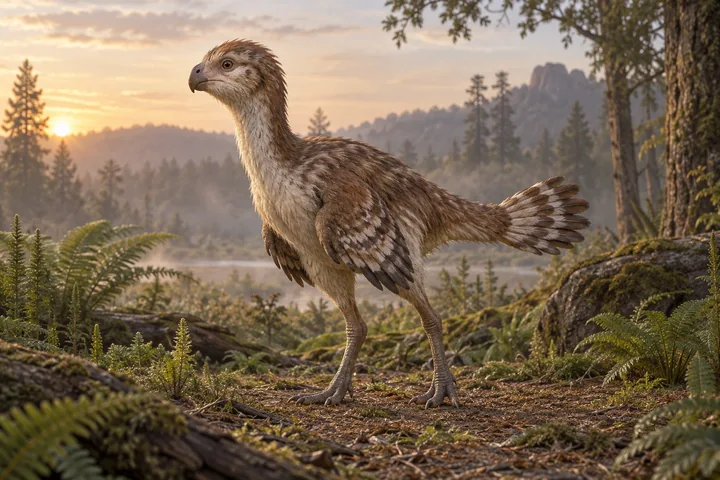
Caudipteryx zoui
Caudipteryx preserves a feather fan on a short tail.
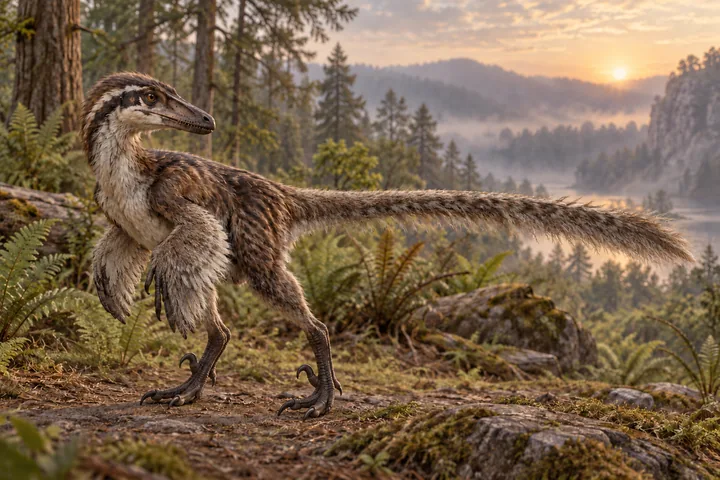
Sinornithosaurus millenii
Sinornithosaurus preserves branching feather structures in stone.