
Body length
InferredAbout 7 m (educational reference)
The museum does not give an explicit measured fossil individual or mature species range for this reference. [D2]
EXHIBIT 217
Muttaburrasaurus langdoni
Dinosaur
Muttaburrasaurus was a large ornithopod with a distinctive rounded muzzle; new research reveals front teeth and complex snout chambers. [1]
TWO WAYS TO PICTURE THE PAST
Compare the evidence with the familiar movie image. The illustrations are not to a shared scale.
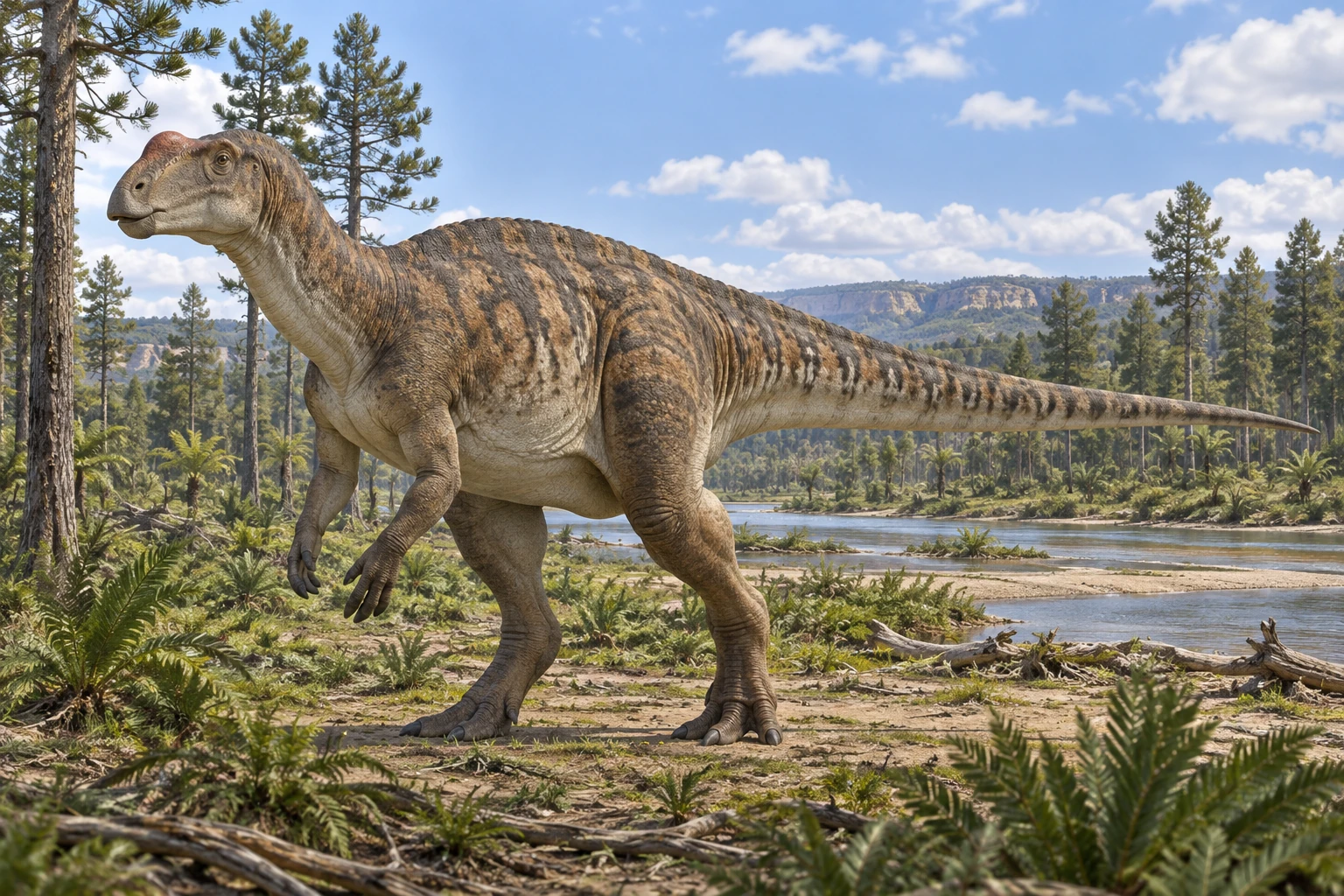
An illustrative reconstruction. Compare its anatomy with the evidence and limitations in the dossier. [1]
Source-informed reconstruction. Appearance evidence [1]. Original illustration; missing anatomy, coloration and scenery include interpretation.
Fossils constrain this life reconstruction. Missing anatomy, coloration and the environmental scene include interpretation; the dossier explains the evidence limits.
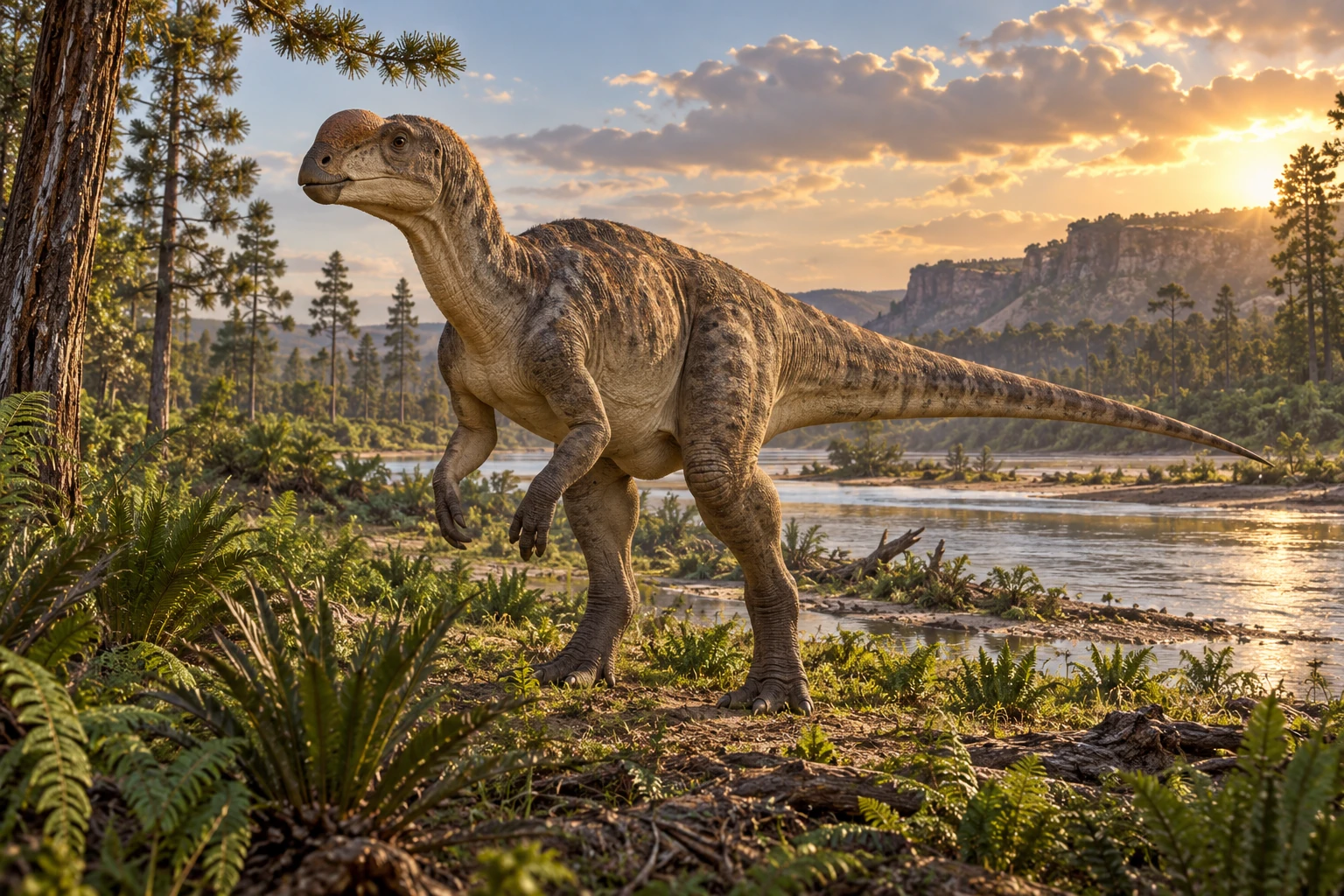
An illustrative reconstruction. Compare its anatomy with the evidence and limitations in the dossier. Lighting, coloration and scenery are artistic choices. This image does not document a fossil locality or behavior.
Original artwork · artistic interpretation.
Scientific view: source-informed reconstruction, credited paleoart or specimen-based imagery. Movie-style view: Original artistic interpretation. Reconstructions involve uncertainty.
MEET THE ANIMAL
Muttaburrasaurus was a large Australian ornithopod, a member of the plant-eating dinosaur group that includes many beaked forms. Its rounded snout made its skull especially distinctive. The main fossil is a partial skeleton from Queensland, while some other material may represent different species. Museum reconstructions give a length of about seven metres, but that convenient reference is not a measured maximum for every member of the genus. [D2]
New research published in 2026 changes parts of its familiar image. Detailed study found that the front upper jaw had five developed tooth positions, rather than being completely toothless. The researchers also identified paired bones forming the roof and chambers of its muzzle. New dating places the type locality in the Cenomanian part of the Late Cretaceous, showing why older museum timelines sometimes need to be updated. [D1]
Its limbs suggest that it could support itself on its hindlegs and perhaps also use all four legs. Researchers have long proposed that the unusual snout might have affected sounds or other senses. Such possibilities are worth investigating, but they do not tell us its actual call or prove a mating display. The difference between a fossil structure and a behavior inferred from it remains important. [D3]
PREHISTORIC ANIMAL DOSSIER
The animal, the evidence, and the questions still open.
A 2026 cranial revision identifies premaxillary teeth and places the type locality in the Cenomanian, revising familiar older portrayals. [D1]
Profile scope: Genus — Muttaburrasaurus langdoni; the Queensland holotype QMF6140 anchors this account. Some other Australian referrals may represent different species. [D2]
Source supported identifies a description documented by the cited source. Inferred marks a reconstruction or functional estimate. Debated marks competing interpretations. Not established means the sources reviewed for this dossier do not support a firm conclusion; it does not mean a behavior never occurred.
A size reference is an estimate, not a population range. Nesting evidence does not by itself establish courtship, mate choice, or lifelong pairing.
About 7 m (educational reference)
The museum does not give an explicit measured fossil individual or mature species range for this reference. [D2]
Not established here
The reviewed cranial study provides no maturity-qualified whole-body mass estimate adopted here. [D1]
Primarily plant feeding inferred
Browsing is supported by cranial anatomy; possible animal foods are hypotheses. No particular meal is preserved in the reviewed account. [D2]
Terrestrial coastal forest landscape
Queensland fossils occur near the former inland sea. Coastline burial does not turn this land dinosaur into a swimming specialist. [D2]
Two-legged capability inferred
Limb proportions support bipedality, with possible four-legged movement. [D3]
Rounded muzzle and front upper teeth
The 2026 revision identifies paired prenasal bones and five developed premaxillary tooth positions, correcting a wholly toothless-front reconstruction. [D1]
Not established here
The reviewed institutional descriptions and focused searches do not identify assigned eggs, nests, clutch size or parental care. [D3]
Not established here
Suggested sound production is not fossil evidence of mating calls, mate choice or sex-specific display. [D3]
Not established here
Cranial sensory models discuss possible conspecific interaction. Vision or hearing capability alone does not establish actual herds. [D1]
Sources and inspection notes for the claims in this profile.
THE STORY IN THE FOSSILS
A rounded snout once encouraged simple explanations about calling. Its internal anatomy is now being examined with detailed cranial scans. [3]
The familiar museum reconstruction represents a large land dinosaur. Where its bones were buried must be distinguished from where it lived. [2]
The dossier identifies the scope of each reference estimate. A mount, an individual fossil and a species-wide adult range are different measurements. Comparison metrics remain unavailable where adult scope has not been established. Unknown does not mean zero.
Sources support the stated claims and scopes. Refer to the evidence notes for uncertainty.
KEEP EXPLORING
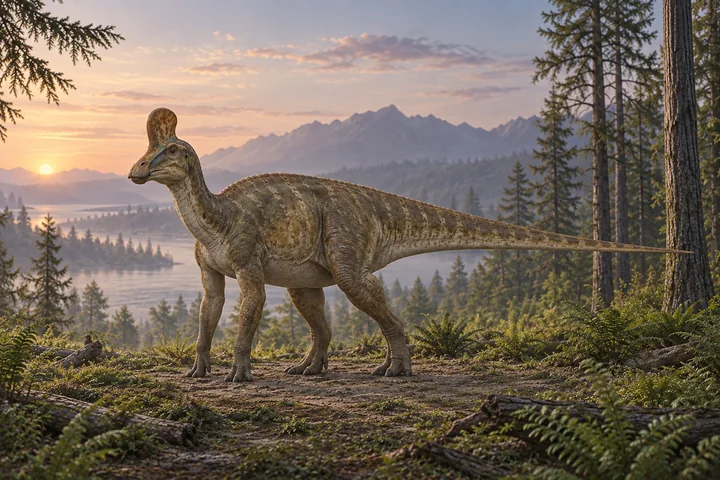
Tsintaosaurus spinorhinus
Tsintaosaurus was a plant-eating hadrosaur whose distinctive crest remains a subject of reconstruction and reassessment.
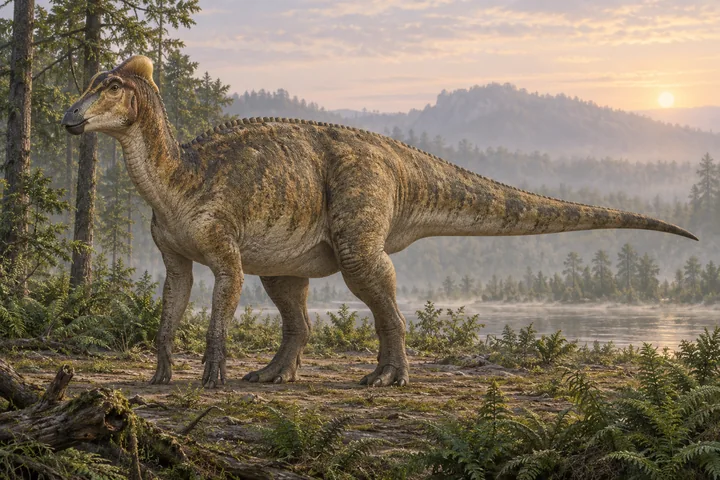
Amurosaurus riabinini
Amurosaurus was a hadrosaur with tooth batteries and skull architecture supporting a hollow crest whose complete shape remains unknown.
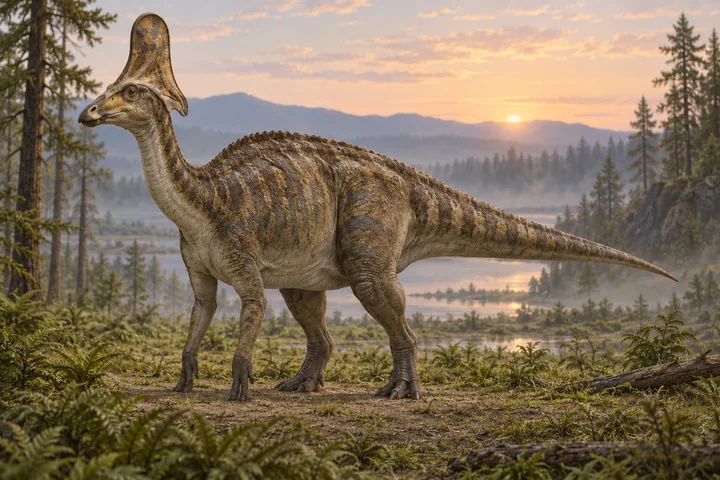
Olorotitan arharensis
Olorotitan was a hollow-crested hadrosaur distinguished by a broad helmet-like crest and an unusually long neck.