
Length
InferredAbout 12 m; museum reference
Educational estimate without specified specimen, life stage or method; excluded from adult comparison. [D6]
TWO WAYS TO PICTURE THE PAST
Compare the evidence with the familiar movie image. The illustrations are not to a shared scale.
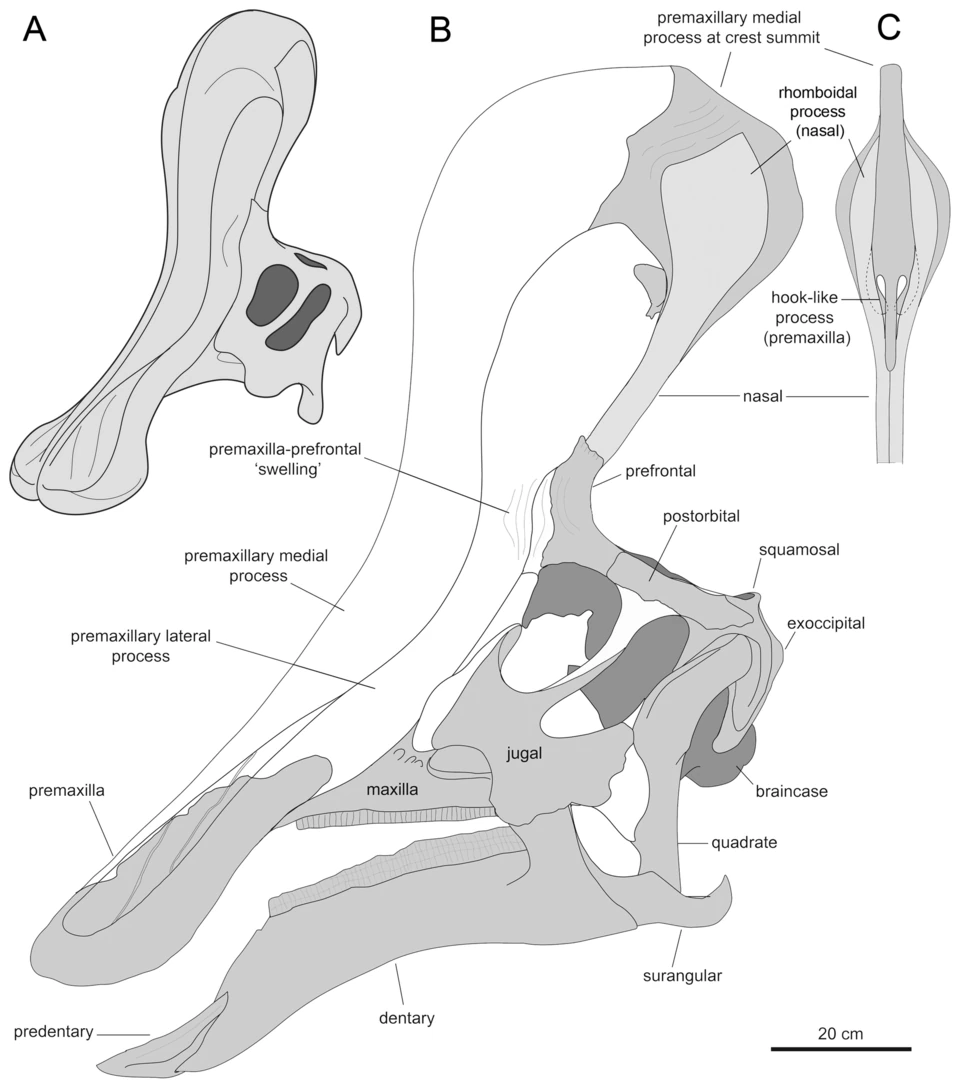
The 2013 T. spinorhinus crest model; gray marks available bones and white marks hypothesized missing parts. A 2020 CT reassessment broadly supports the model but refits the solid nasal spine farther forward. The full outline remains partly restored; living colors and soft tissues are unknown. [3]
Tsintaosaurus spinorhinus.png · Albert Prieto-Márquez and Jonathan R. Wagner. CC BY 2.5. Proportionally resized Commons preview and converted to WebP; no anatomy edits.
Skeletal mounts and drawings may restore missing parts; the caption identifies the displayed material.
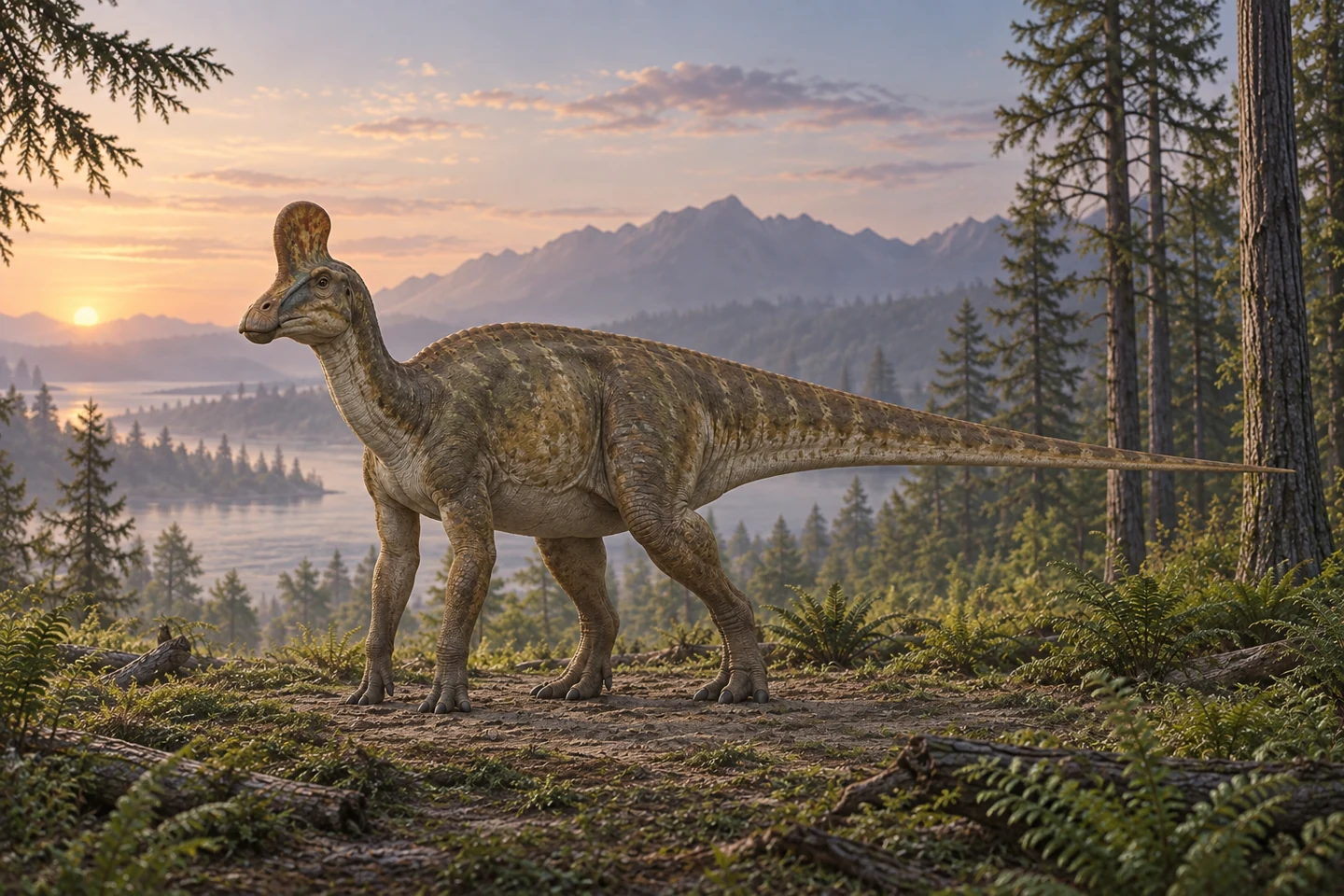
Original cinematic interpretation using the tall crest scenario proposed in 2013. A 2020 CT reassessment broadly supported that concept while refitting the solid nasal spine farther forward; missing crest parts still limit the full outline. Colors, soft tissues and setting are artistic choices. Lighting, coloration and scenery are artistic choices. This image does not document a fossil locality or behavior.
Original artwork · artistic interpretation.
Scientific view: source-informed reconstruction, credited paleoart or specimen-based imagery. Movie-style view: Original artistic interpretation. Reconstructions involve uncertainty.
MEET THE ANIMAL
Tsintaosaurus was a plant-eating dinosaur from Late Cretaceous China, known from skulls and a partial skeleton. The museum gives a general length reference of about twelve metres. Because no individual, growth stage or calculation method is specified, that number should not be read as a measured mature maximum. The herbivore label also does not identify a preferred plant menu. [D6]
Older pictures often showed a narrow rodlike crest. A later anatomical reconstruction interpreted the preserved nasal structure as part of a much broader crest, with missing regions filled in by comparison. The new outline is a scientific proposal based on incomplete bones, not an entire crest discovered intact. It changes the animal's silhouette while retaining uncertainty about its full shape. [D1]
Its Laiyang surroundings included rivers, lakes and floodplain deposits. Fossils from the broader region have sometimes been assigned to the wrong named dinosaur, so researchers compare skull details before making an identification. Nearby fossils and a shared rock formation are valuable context, but do not automatically prove that every specimen belonged to Tsintaosaurus or that all the animals lived together. [D5]
PREHISTORIC ANIMAL DOSSIER
The animal, the evidence, and the questions still open.
The 2013 crest model replaced a narrow rod with a broader structure. A 2020 CT reassessment supported its broad concept while refitting the solid nasal spine farther forward. [D1] [D3]
Profile scope: T. spinorhinus from Laiyang: incomplete cranial specimens and a composite skeleton, with revised nasal-spine fit and partly restored crest anatomy. [D3]
Source supported identifies a description documented by the cited source. Inferred marks a reconstruction or functional estimate. Debated marks competing interpretations. Not established means the sources reviewed for this dossier do not support a firm conclusion; it does not mean a behavior never occurred.
A size reference is an estimate, not a population range. Nesting evidence does not by itself establish courtship, mate choice, or lifelong pairing.
About 12 m; museum reference
Educational estimate without specified specimen, life stage or method; excluded from adult comparison. [D6]
About 2.5 t; published reconstruction
Paul lists a V725-labelled model. Composite material, collection-label inconsistency and unconfirmed maturity prevent an adult-individual comparison. [D7]
Plant eater
Museum classification supports herbivory; a genus-specific menu or preserved meal is not established here. [D6]
Laiyang, Late Cretaceous Wangshi Group
Fossils occur in the Jingangkou/Hongtuya succession; regional deposits record rivers, lakes and floodplain mudflows. [D5]
Probably mainly four-legged
Comparative hadrosaur skeletal correlates favor quadrupedality. This does not establish Tsintaosaurus-specific speeds or a trackway. [D8]
Solid nasal spine within a restored crest
The 2020 CT study identifies solid nasal bone and a more forward fracture fit. It broadly supports the 2013 model but disputes its backward inclination; missing premaxillary parts limit the complete outline. [D3]
Not established here
Laiyang preserves many egg types, but this regional egg fauna is not a demonstrated Tsintaosaurus nest or clutch. [D2]
Not established here
The 2013 study suggests high crests could signal maturity in lambeosaurines. That comparative hypothesis does not demonstrate Tsintaosaurus courtship, sex differences or mate choice. [D1]
Not established here
Disarticulated and composite Laiyang material does not by itself establish a Tsintaosaurus herd or family group. [D2]
Sources and inspection notes for the claims in this profile.
THE STORY IN THE FOSSILS
The 2013 reconstruction interprets the nasal structure as part of a much larger crest, with a separate route for the air passage. Restored portions are hypotheses, not additional recovered bones. [1]
Later CT work distinguishes solid nasal bone from hypothetical crest passages. Its revised fracture fit leans the nasal spine farther forward, while missing premaxillary anatomy leaves the full crest shape partly restored. [3]
The dossier identifies the scope of each reference estimate. A mount, an individual fossil and a species-wide adult range are different measurements. Comparison metrics remain unavailable where adult scope has not been established. Unknown does not mean zero.
Sources support the stated claims and scopes. Refer to the evidence notes for uncertainty.
KEEP EXPLORING
Amurosaurus riabinini
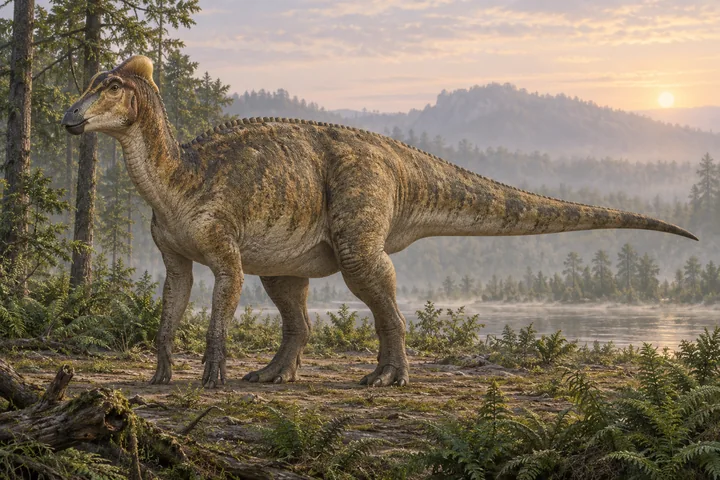
Amurosaurus was a hadrosaur with tooth batteries and skull architecture supporting a hollow crest whose complete shape remains unknown.
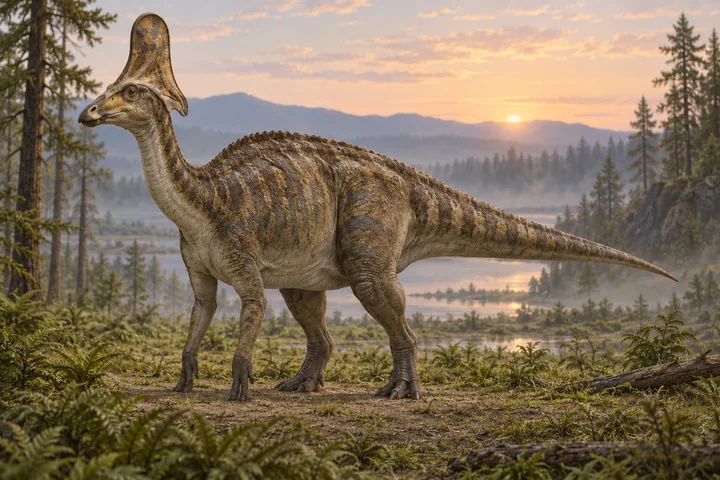
Olorotitan arharensis
Olorotitan was a hollow-crested hadrosaur distinguished by a broad helmet-like crest and an unusually long neck.
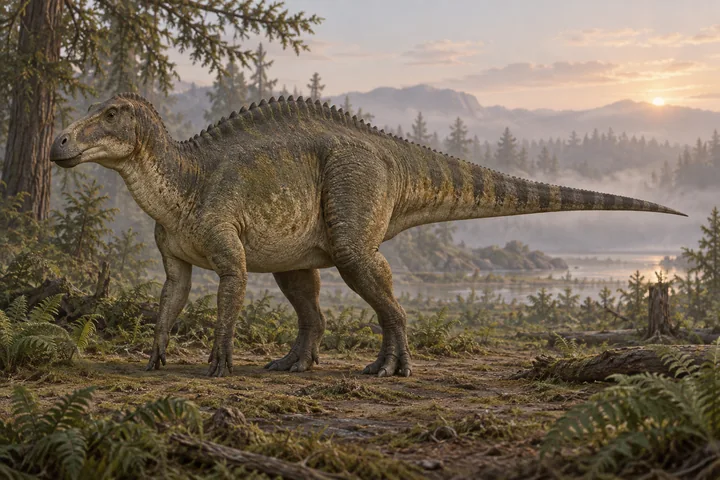
Bactrosaurus johnsoni
Bactrosaurus was a crestless plant-eating hadrosauroid with robust limbs and tooth batteries, represented at several growth stages.