Length
InferredAbout 8 m; adult holotype reconstruction
The 2005 paper calculates AEHM 2/845 at 8 m. Missing parts are restored; this is one old adult, not a measured species maximum. [D3]
EXHIBIT 153
Olorotitan arharensis
Olorotitan was a hollow-crested hadrosaur distinguished by a broad helmet-like crest and an unusually long neck. [1]
TWO WAYS TO PICTURE THE PAST
Compare the evidence with the familiar movie image. The illustrations are not to a shared scale.
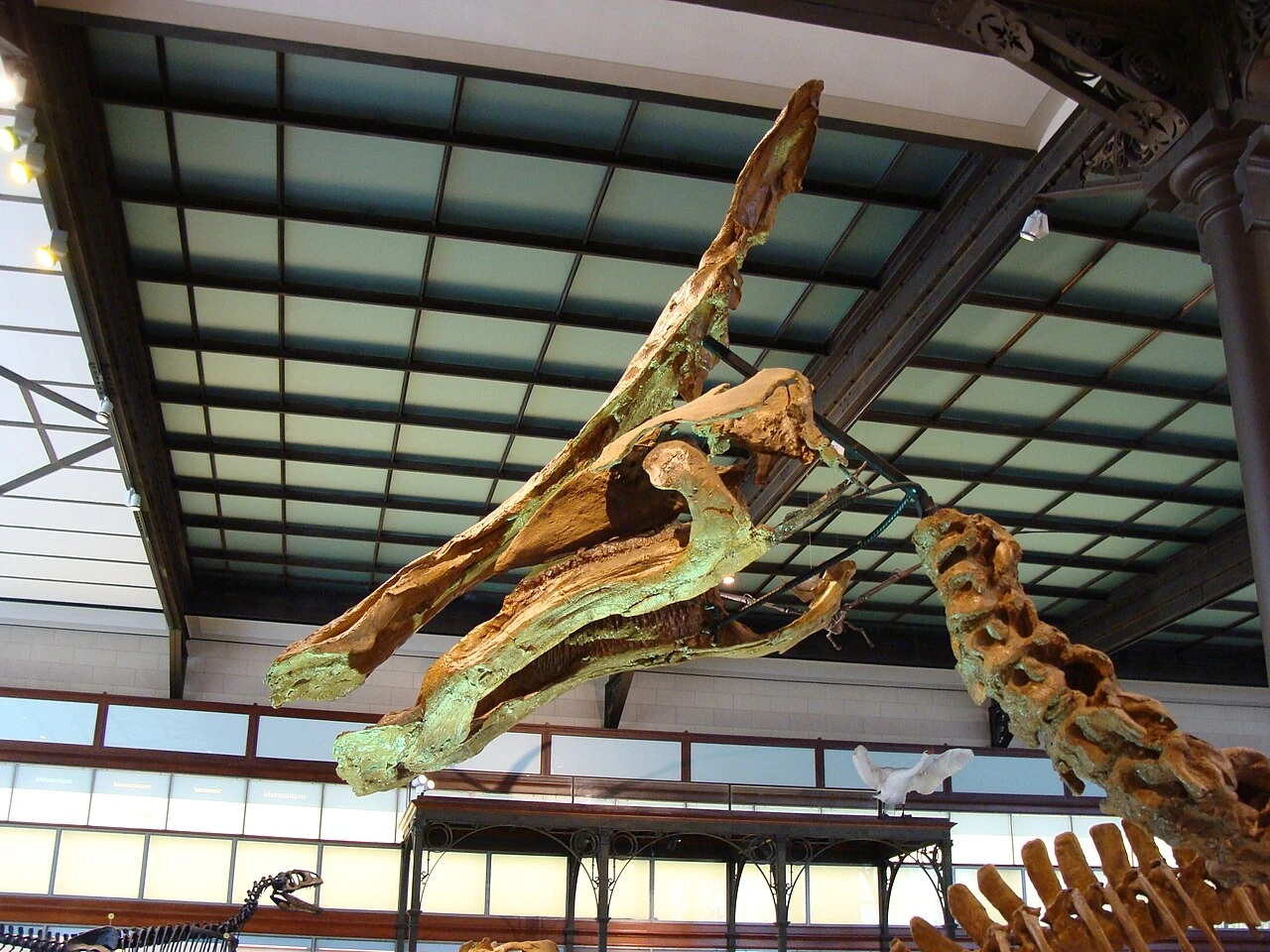
Museum display identified as O. arharensis at the Royal Belgian Institute of Natural Sciences; mounting includes restoration. The source gives no specimen number, and the full nasal crest outline is incompletely preserved in the type. Fossil colors do not establish living colors or soft tissues. [2]
Olorotitan skull.jpg · Eduard Solà. CC BY 3.0. Proportionally resized Commons preview and converted to WebP; no anatomy edits.
Skeletal mounts and drawings may restore missing parts; the caption identifies the displayed material.
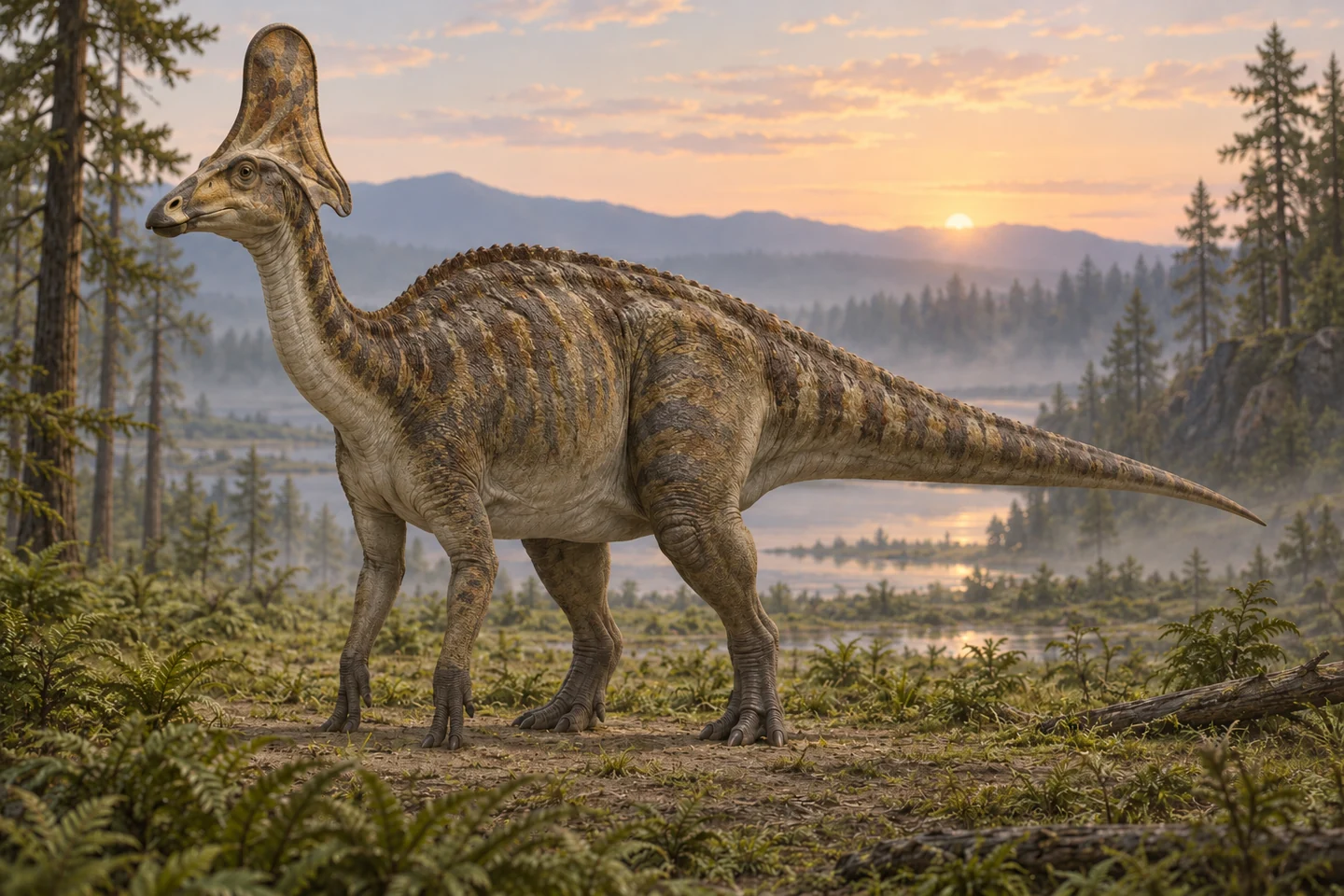
Original cinematic interpretation of the long neck and broad helmet-like crest. The dorsal nasal margin is incomplete, so the full crest outline and all colors and soft tissues remain artistic reconstructions. Lighting, coloration and scenery are artistic choices. This image does not document a fossil locality or behavior.
Original artwork · artistic interpretation.
Scientific view: source-informed reconstruction, credited paleoart or specimen-based imagery. Movie-style view: Original artistic interpretation. Reconstructions involve uncertainty.
MEET THE ANIMAL
Olorotitan was a crested duck-billed dinosaur from Late Cretaceous Russia. Its fossils come from the Kundur area, where deposits record a river basin and powerful sediment flows. One old adult skeleton was reconstructed at about eight metres long. That is a size estimate for a particular incomplete individual, rather than a measured maximum for the species. [D3]
Its neck was especially distinctive, with eighteen cervical vertebrae, the bones between the head and torso. A tall crest extended behind the skull. Portions of that crest are preserved, but its complete edge still needs restoration. These features give Olorotitan a recognizable profile without making every part of a finished illustration equally certain or directly preserved. [D1]
Its jaws contained dental batteries with working teeth and replacements stacked behind them, supporting a plant-eating interpretation. The skeleton also contains fused lower-leg bones that help identify an old individual. Being skeletally adult does not show how it courted or cared for young. Those behaviors require evidence beyond the animal's age and the appearance of its head crest. [D2]
PREHISTORIC ANIMAL DOSSIER
The animal, the evidence, and the questions still open.
Eighteen neck vertebrae and preserved crest portions distinguish it; the complete dorsal crest edge and missing skeletal parts require restoration. [D2]
Profile scope: O. arharensis, principally the articulated but incomplete adult holotype AEHM 2/845 from Kundur. [D2]
Source supported identifies a description documented by the cited source. Inferred marks a reconstruction or functional estimate. Debated marks competing interpretations. Not established means the sources reviewed for this dossier do not support a firm conclusion; it does not mean a behavior never occurred.
A size reference is an estimate, not a population range. Nesting evidence does not by itself establish courtship, mate choice, or lifelong pairing.
About 8 m; adult holotype reconstruction
The 2005 paper calculates AEHM 2/845 at 8 m. Missing parts are restored; this is one old adult, not a measured species maximum. [D3]
About 3.1 t; holotype model
Paul models AEHM 2/845 using reconstructed volume and limb scaling. Missing bones and assumed body contours add uncertainty. [D4]
Plant eater with dental batteries
Several active teeth and stacked replacement teeth form each dentary row; the fossils do not establish a complete plant menu. [D2]
Maastrichtian Kundur alluvial basin
The dinosaur-bearing Udurchukan deposits formed in a gravel-meandering river system; gravity flows contributed to burial. [D3]
Probably mainly four-legged
Comparative hadrosaur skeletal correlates favor quadrupedality. This is a group-level inference; exact Olorotitan gait and speed remain unresolved. [D5]
Helmet-like crest and 18 neck vertebrae
The crest extends behind the skull, but its missing nasal edge is reconstructed. Distal fusion in the preserved lower leg indicates an old individual. [D2]
Not established here
The holotype is osteologically adult. Its age does not demonstrate nests, clutches, incubation behavior or breeding age. [D2]
Not established here
The cranial crest alone does not establish mate choice, sex differences or a courtship ritual. No direct genus-specific evidence was found in this review. [D1]
Not established here
Kundur includes lambeosaur bones of different age classes, but transport and burial processes complicate inference of a living Olorotitan group. [D3]
Sources and inspection notes for the claims in this profile.
THE STORY IN THE FOSSILS
The long neck is a skeletal distinction, not simply a dramatic pose: the type preserves 18 cervical vertebrae. The tall hollow crest is also distinctive, while its complete outline remains partly restored. [1]
Extra articulations between adjacent tail spines were initially highlighted as a way to stiffen the tail. The original description cautions that these unusual contacts could instead reflect pathology. [1]
The dossier identifies the scope of each reference estimate. A mount, an individual fossil and a species-wide adult range are different measurements. Comparison metrics remain unavailable where adult scope has not been established. Unknown does not mean zero.
Sources support the stated claims and scopes. Refer to the evidence notes for uncertainty.
KEEP EXPLORING
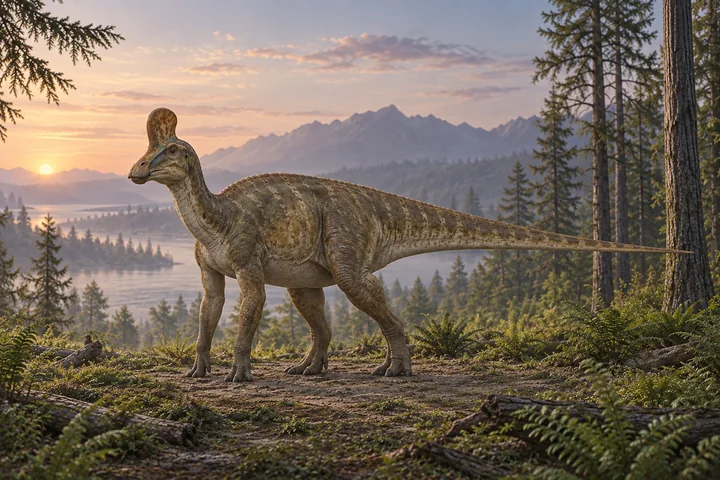
Tsintaosaurus spinorhinus
Tsintaosaurus was a plant-eating hadrosaur whose distinctive crest remains a subject of reconstruction and reassessment.
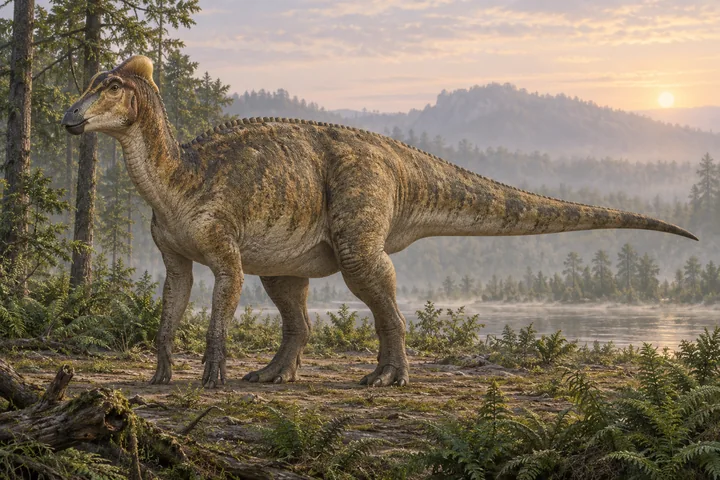
Amurosaurus riabinini
Amurosaurus was a hadrosaur with tooth batteries and skull architecture supporting a hollow crest whose complete shape remains unknown.
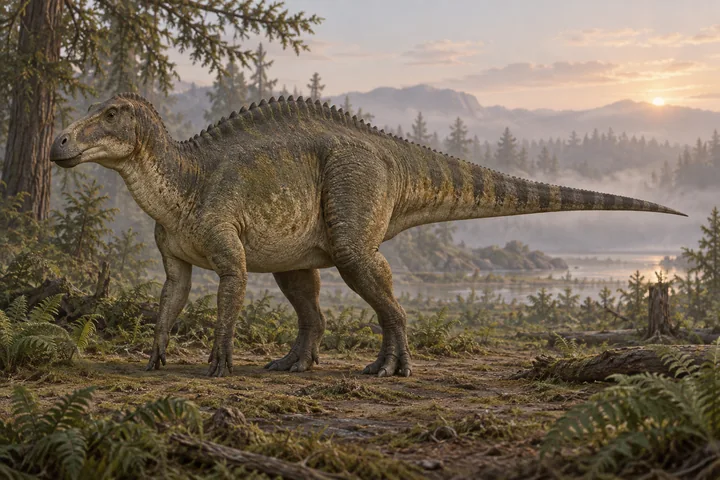
Bactrosaurus johnsoni
Bactrosaurus was a crestless plant-eating hadrosauroid with robust limbs and tooth batteries, represented at several growth stages.