Length
Not establishedNot established here
No complete associated skeleton was available to the inspected endocast study; an individual total-body reconstruction is not supplied there. [D3]
EXHIBIT 152
Amurosaurus riabinini
Amurosaurus was a hadrosaur with tooth batteries and skull architecture supporting a hollow crest whose complete shape remains unknown. [1]
TWO WAYS TO PICTURE THE PAST
Compare the evidence with the familiar movie image. The illustrations are not to a shared scale.
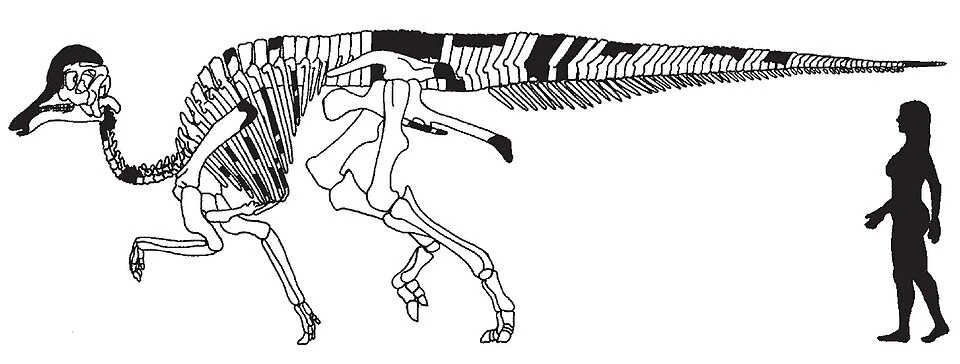
A. riabinini reconstruction from disarticulated material of several individuals. Black elements were not preserved. Crest shape and the illustrated posture are restored comparatively; the silhouette is not a single measured skeleton. Living colors and soft tissues are unknown. [1]
Amurosaurus skeletal.jpg · Pascal Godefroit, Yuri L. Bolotsky and Jimmy Van Itterbeeck. CC BY 2.0. Proportionally resized Commons preview and converted to WebP; no anatomy edits.
Skeletal mounts and drawings may restore missing parts; the caption identifies the displayed material.
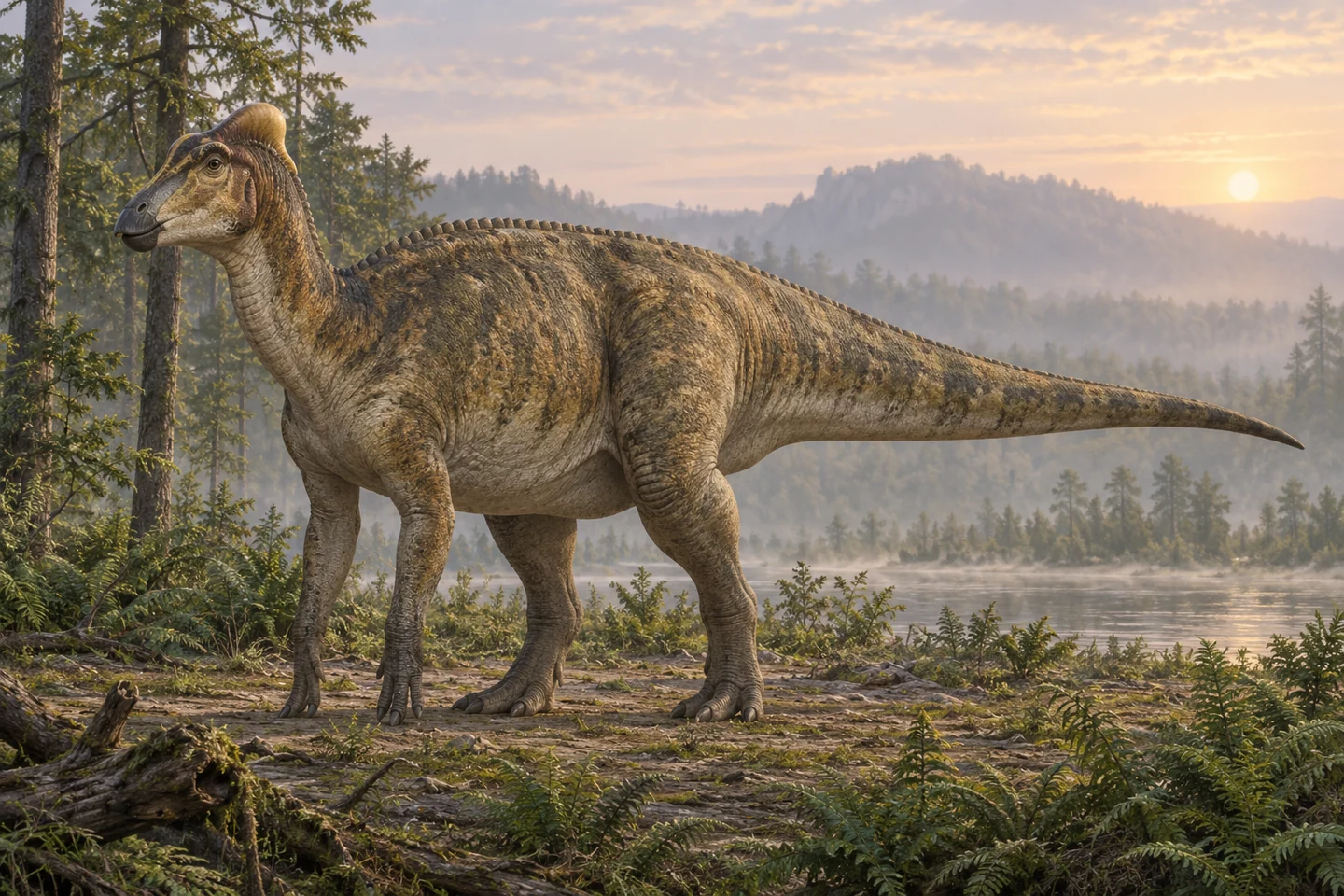
Original cinematic interpretation. The upper crest is missing from the described skull material; its modest outline here is a comparative artistic reconstruction. Colors, soft tissues and setting are illustrative. Lighting, coloration and scenery are artistic choices. This image does not document a fossil locality or behavior.
Original artwork · artistic interpretation.
Scientific view: source-informed reconstruction, credited paleoart or specimen-based imagery. Movie-style view: Original artistic interpretation. Reconstructions involve uncertainty.
MEET THE ANIMAL
Amurosaurus was a plant-eating dinosaur from the end of the Cretaceous in the Amur region of Russia. Its deep jaws carried dental batteries: groups of working teeth backed by stacked replacement teeth. This arrangement helped process vegetation. Parts of the crest-supporting skull are known, but missing upper bones mean that the complete crest outline remains a reconstruction. [D1]
The Blagoveshchensk fossil deposit contains many bones, especially from late juveniles and small subadults. Researchers have considered whether this pattern might reflect grouping by age. However, the remains were disarticulated and reworked by a sediment flow. Transport and burial can change what a bonebed contains, so the age-grouping idea remains tentative rather than a direct snapshot of a herd. [D2]
One assigned forearm bone preserves a fracture that was healing with the pieces misaligned. Scans document the injury and the new bone surrounding it. The animal may have limped or relied on three limbs while moving, but that would describe an injured individual rather than the normal species gait. Survival alone does not demonstrate care from companions. [D5]
PREHISTORIC ANIMAL DOSSIER
The animal, the evidence, and the questions still open.
Many recovered bones illuminate its anatomy, but they do not form one complete skeleton. Transport and age structure complicate behavioral interpretations. [D2]
Profile scope: A. riabinini: Russian type jaws and disarticulated bonebed material, including Chinese material reassigned from Sahaliyania in 2022. [D4]
Source supported identifies a description documented by the cited source. Inferred marks a reconstruction or functional estimate. Debated marks competing interpretations. Not established means the sources reviewed for this dossier do not support a firm conclusion; it does not mean a behavior never occurred.
A size reference is an estimate, not a population range. Nesting evidence does not by itself establish courtship, mate choice, or lifelong pairing.
Not established here
No complete associated skeleton was available to the inspected endocast study; an individual total-body reconstruction is not supplied there. [D3]
About 4.8 t; adult-sized composite model
The quadrupedal circumference model combines femur AEHM 1/1002 with unassociated humerus AEHM 1/997. Its separate bipedal calculation gives2.03t; these are method alternatives, not a species range. [D3]
Plant eater with tooth batteries
The described jaws carry stacked replacement teeth and multiple active teeth for processing vegetation; exact preferred plants remain uncertain. [D1]
Maastrichtian river-basin settings
Udurchukan deposits at Blagoveshchensk record a basin with rivers and lakes; denser bank-side vegetation is a published environmental interpretation. [D2]
Weight-bearing forelimbs; injury could disrupt gait
A fractured ulna was healing with misaligned parts. Authors infer limping and possible three-limb walking for that injured animal, not the normal species gait. [D5]
Deep jaw and a crest-supporting skull roof
The upper nasal and premaxillary crest bones were absent in the 2004 material. A complete crest silhouette remains a comparative restoration. [D1]
Not established here
Wulaga fibulae were interpreted as probably adult using size and histology. Skeletal adulthood does not identify nesting, parental care or age at first breeding. [D4]
Not established here
Endocast work discusses visual and vocal communication hypotheses for lambeosaurines; it does not demonstrate Amurosaurus mating rituals or sex-specific crest form. [D3]
Possible age-segregated grouping
The bonebed favors late juveniles and small subadults. The proposed exclusion of younger animals from adult herds is tentative; the transported assemblage also limits interpretation. [D2]
Sources and inspection notes for the claims in this profile.
THE STORY IN THE FOSSILS
The Blagoveshchensk deposit holds abundant Amurosaurus material, but the carcasses were largely disarticulated before a sediment gravity flow reworked them. A bonebed is therefore more complicated than a snapshot of one living herd. [2]
A 2022 reassessment identified shared jaw, skull-roof and limb features in Chinese fossils previously named Sahaliyania. That proposed synonymy broadens the material assigned to Amurosaurus without adding another distinct genus to this catalog. [4]
The dossier identifies the scope of each reference estimate. A mount, an individual fossil and a species-wide adult range are different measurements. Comparison metrics remain unavailable where adult scope has not been established. Unknown does not mean zero.
Sources support the stated claims and scopes. Refer to the evidence notes for uncertainty.
KEEP EXPLORING
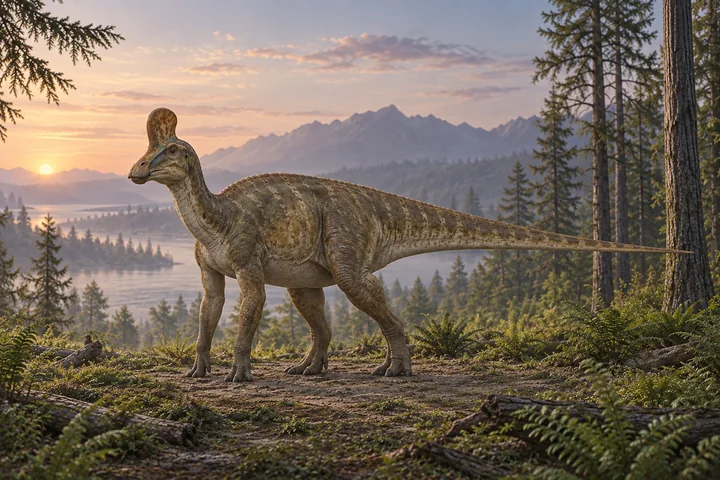
Tsintaosaurus spinorhinus
Tsintaosaurus was a plant-eating hadrosaur whose distinctive crest remains a subject of reconstruction and reassessment.
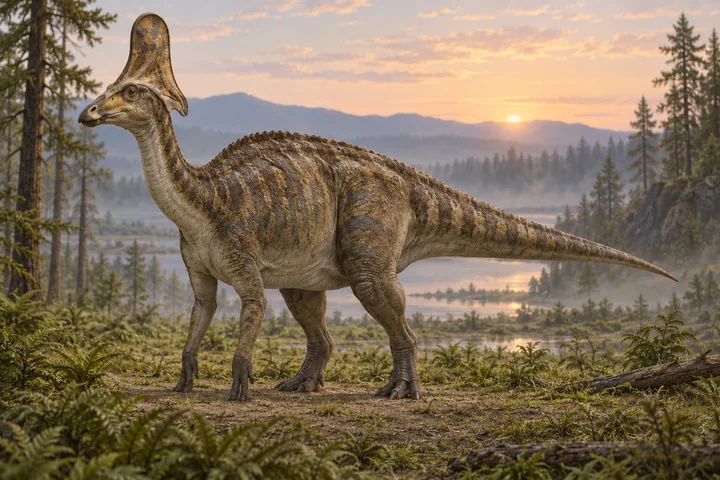
Olorotitan arharensis
Olorotitan was a hollow-crested hadrosaur distinguished by a broad helmet-like crest and an unusually long neck.
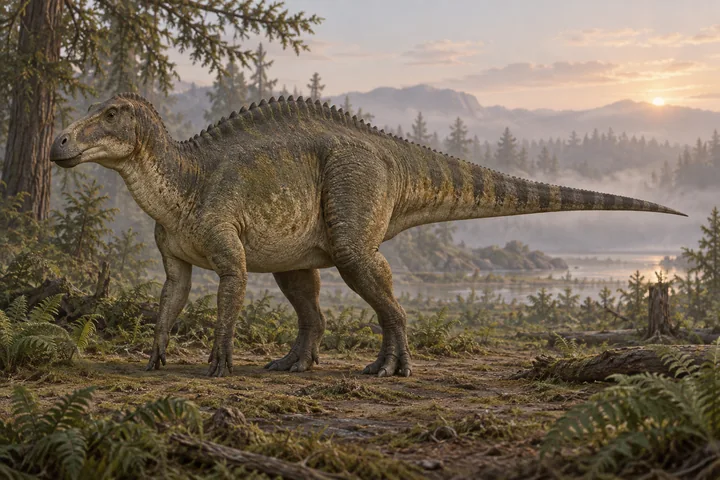
Bactrosaurus johnsoni
Bactrosaurus was a crestless plant-eating hadrosauroid with robust limbs and tooth batteries, represented at several growth stages.