
Length
InferredAbout 1 m (literature reference)
The 2017 introduction gives a size reference, not an adult range; the Bristol juvenile measures only 23 cm. [D1]
EXHIBIT 273
Pelagosaurus typus
Marine reptile
A slender-snouted marine crocodylomorph whose bones suggest an amphibious life along shallow Jurassic seas. [2]
TWO WAYS TO PICTURE THE PAST
Compare the evidence with the familiar movie image. The illustrations are not to a shared scale.
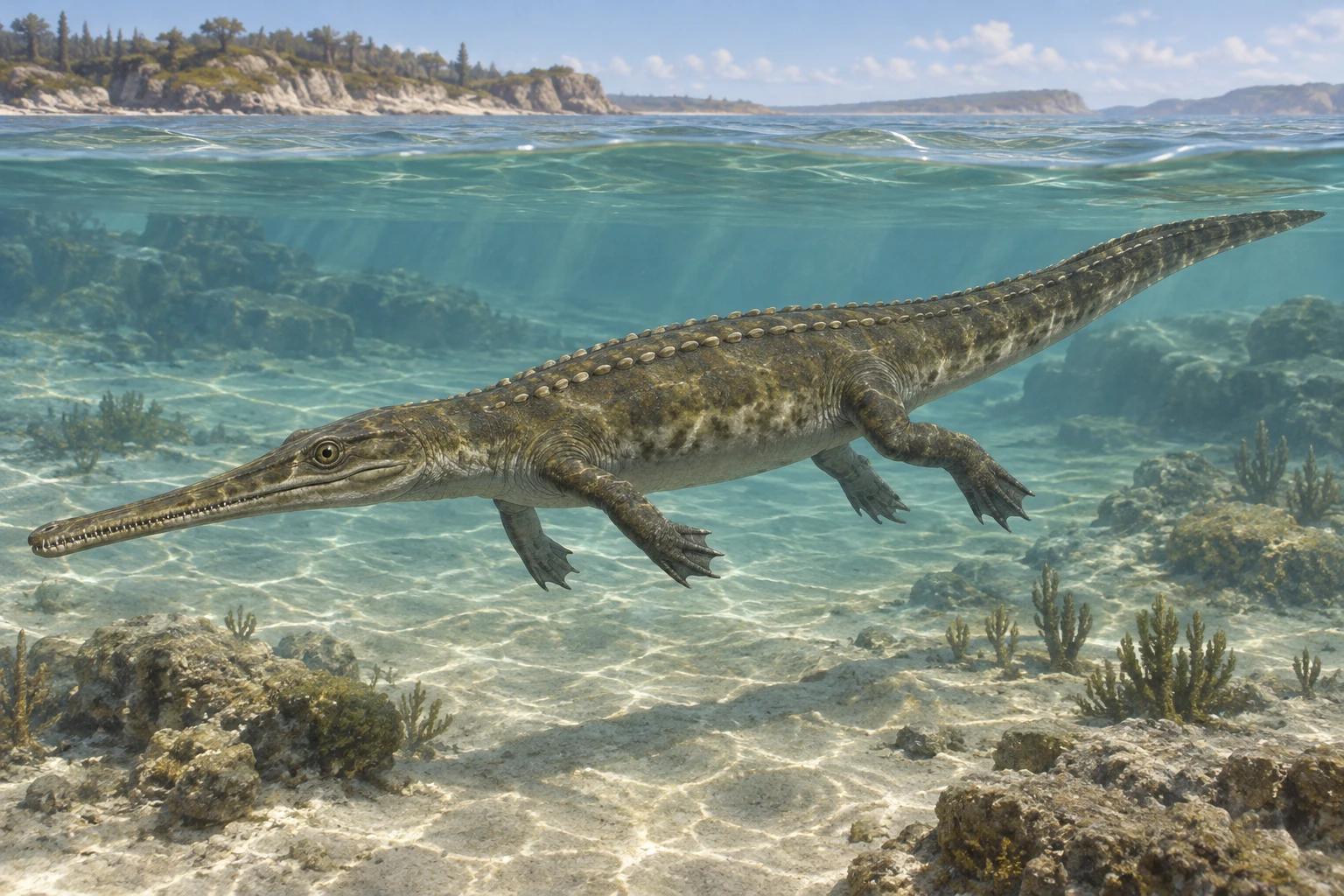
An illustrative reconstruction. Compare its anatomy with the evidence and limitations in the dossier. [1]
Source-informed reconstruction. Appearance evidence [1]. Original illustration; missing anatomy, coloration and scenery include interpretation.
Fossils constrain this life reconstruction. Missing anatomy, coloration and the environmental scene include interpretation; the dossier explains the evidence limits.
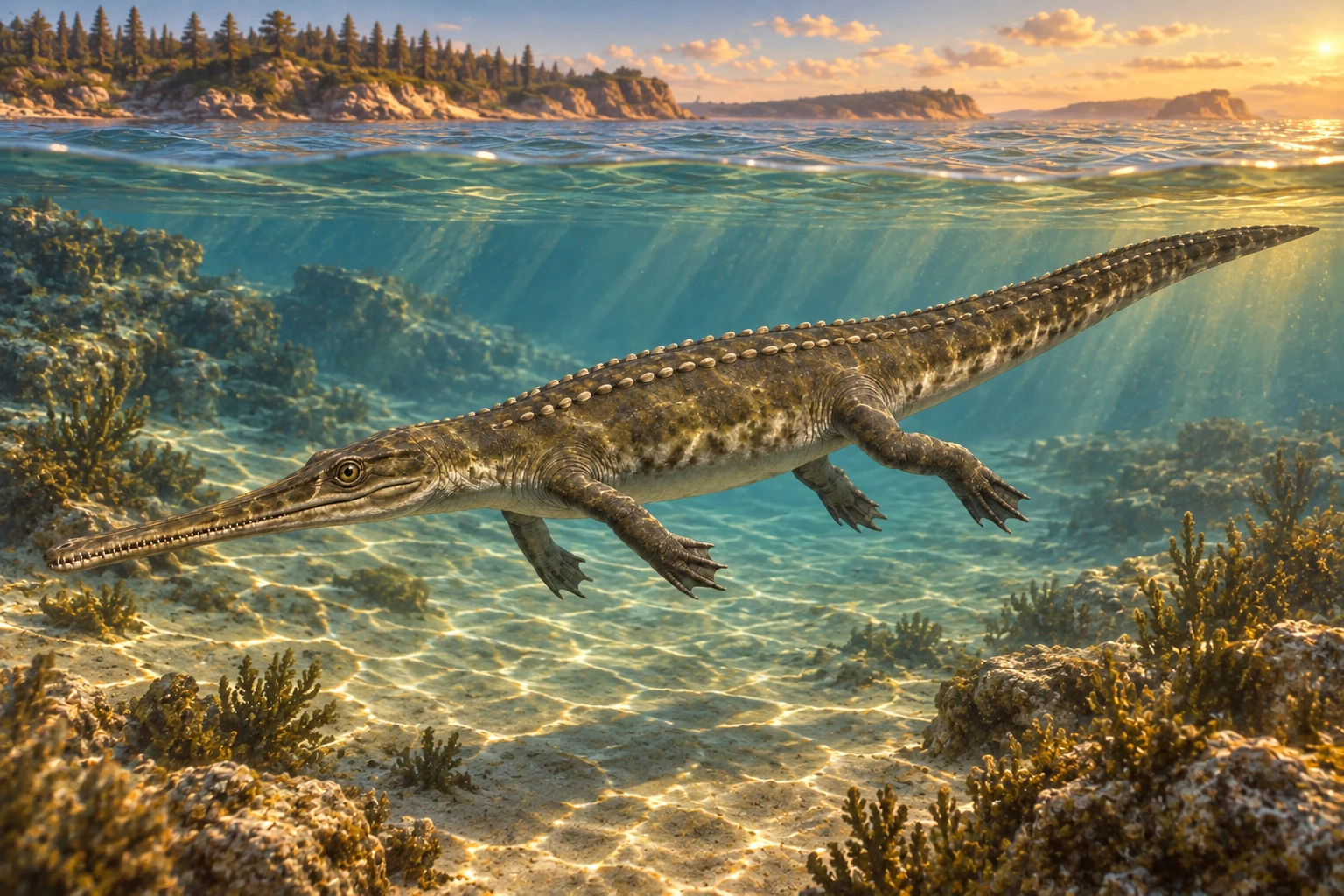
An illustrative reconstruction. Compare its anatomy with the evidence and limitations in the dossier. Lighting, coloration and scenery are artistic choices. This image does not document a fossil locality or behavior.
Original artwork · artistic interpretation.
Scientific view: source-informed reconstruction, credited paleoart or specimen-based imagery. Movie-style view: Original artistic interpretation. Reconstructions involve uncertainty.
MEET THE ANIMAL
Pelagosaurus typus was a slender-snouted relative of crocodiles from Early Jurassic seas. Researchers scanned a fossil skull to examine spaces once occupied by the brain and other tissues. Some cavities suggest salt glands, structures that would help an animal handle salty water. [D1]
Its story includes a remarkably small juvenile fossil from Strawberry Bank in Somerset. The University of Bristol describes fossils preserved in three dimensions and collected by Charles Moore. A young animal’s skeleton helps show a life stage, but it does not prove that a parent stayed nearby. [D3]
A newer study examined bone structure and estimated physiological traits. It favored an amphibious animal using shallow sea water and suggested slow swimming or patient waiting while hunting. Quick sideways movements of the narrow head might have helped catch fish. These are tested interpretations, not observed behavior. [D2]
Museum records preserve another part of the puzzle: old names. One historical fossil was called Mosellaesaurus rostrominor. The museum now records that name as a synonym of Pelagosaurus typus. Following those records helps avoid displaying the same animal twice under different labels and keeps the history of the discovery visible. [D4]
PREHISTORIC ANIMAL DOSSIER
The animal, the evidence, and the questions still open.
CT anatomy suggests salt glands. A 2025 physiological model favors amphibious habits and slow foraging rather than unqualified pursuit swimming. [D2]
Profile scope: One genus exhibit for P. typus; BRLSIM1413 skull, juvenile BRLSIM1418 and modeled subadult MNHN.F.RJN470 are separate individuals. [D1] [D2] [D3]
Source supported identifies a description documented by the cited source. Inferred marks a reconstruction or functional estimate. Debated marks competing interpretations. Not established means the sources reviewed for this dossier do not support a firm conclusion; it does not mean a behavior never occurred.
A size reference is an estimate, not a population range. Nesting evidence does not by itself establish courtship, mate choice, or lifelong pairing.
About 1 m (literature reference)
The 2017 introduction gives a size reference, not an adult range; the Bristol juvenile measures only 23 cm. [D1]
6.435 kg (subadult model)
MNHN.F.RJN470 femoral-volume regression gives 5.112–8.137 kg uncertainty; not a species-wide adult range. [D2]
Fish
Narrow jaws suggest fish feeding; exact menu unestablished. [D2]
Shallow marine; amphibious interpreted
Bone compactness, possible salt glands and osteoderms support shallow-water foraging with terrestrial activity; these are interpretations. [D2]
Slow swimming or waiting proposed
The 2025 metabolic model favors patient foraging with rapid sideways head capture; neither speed nor behavior was directly observed. [D2]
Long narrow snout and lateral eyes
CT skull anatomy and preserved skeletons show a gracile crocodylomorph; salt-gland tissues themselves are inferred from cavities. [D1]
Not established here
Focused searches and reviewed CT anatomy do not document attributable eggs, nests or a pregnancy. [D1]
Not established here
The inspected museum taxonomy and fossil history provide no direct courtship or mating-display evidence. [D4]
Not established here
A juvenile fossil proves a life stage, not a family group, parental care or pair bond. [D3]
Sources and inspection notes for the claims in this profile.
THE STORY IN THE FOSSILS
Endocranial scans address skull cavities and possible salt glands. [1]
Later physiological estimates test lifestyle and hunting activity, with model uncertainty. [2]
Moore’s Strawberry Bank fossils preserve three-dimensional animals. Reexamining old collections can expose information that an excavation’s original account did not investigate. [3]
The dossier identifies the scope of each reference estimate. A mount, an individual fossil and a species-wide adult range are different measurements. Comparison metrics remain unavailable where adult scope has not been established. Unknown does not mean zero.
Sources support the stated claims and scopes. Refer to the evidence notes for uncertainty.
KEEP EXPLORING
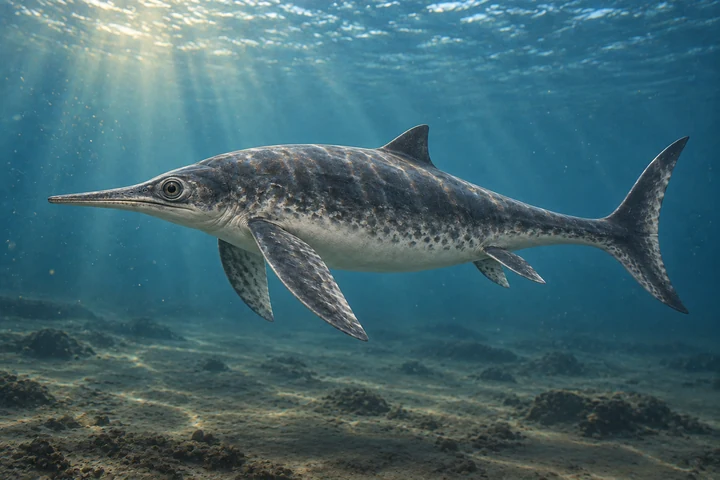
Stenopterygius quadriscissus
Marine reptile
A fish-shaped marine reptile with direct pregnancy fossils and teeth that changed as it grew.
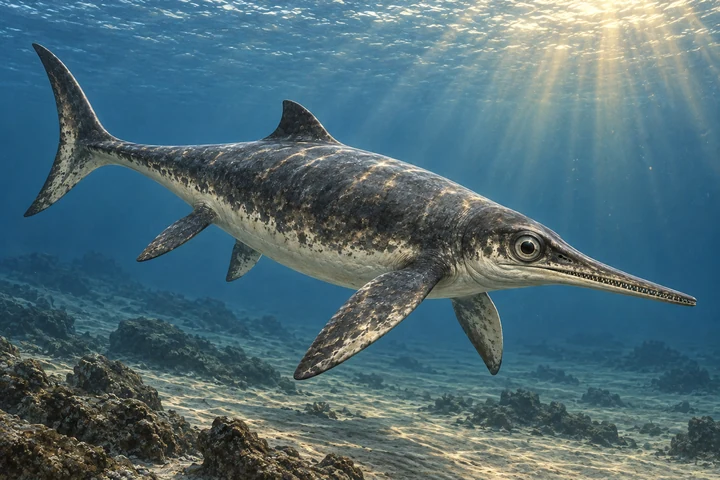
Temnodontosaurus platyodon
Marine reptile
An Early Jurassic ichthyosaur whose jaws and teeth reveal specialized prey-processing anatomy.
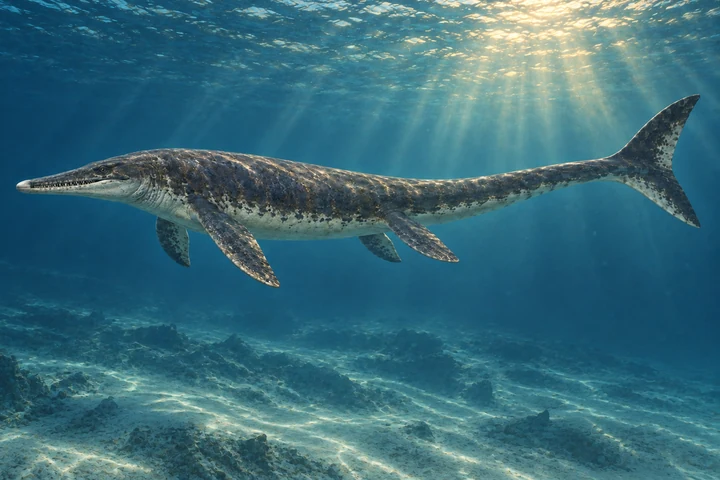
Tylosaurus proriger
Marine reptile
A marine lizard with an elongated adult snout tip, whose fossil identities are still being revised.