
Length
Not establishedNot established here
Reviewed skull studies do not provide a validated T. platyodon adult length range; larger genus-wide estimates are excluded. [D2]
EXHIBIT 272
Temnodontosaurus platyodon
Marine reptile
An Early Jurassic ichthyosaur whose jaws and teeth reveal specialized prey-processing anatomy. [1]
TWO WAYS TO PICTURE THE PAST
Compare the evidence with the familiar movie image. The illustrations are not to a shared scale.
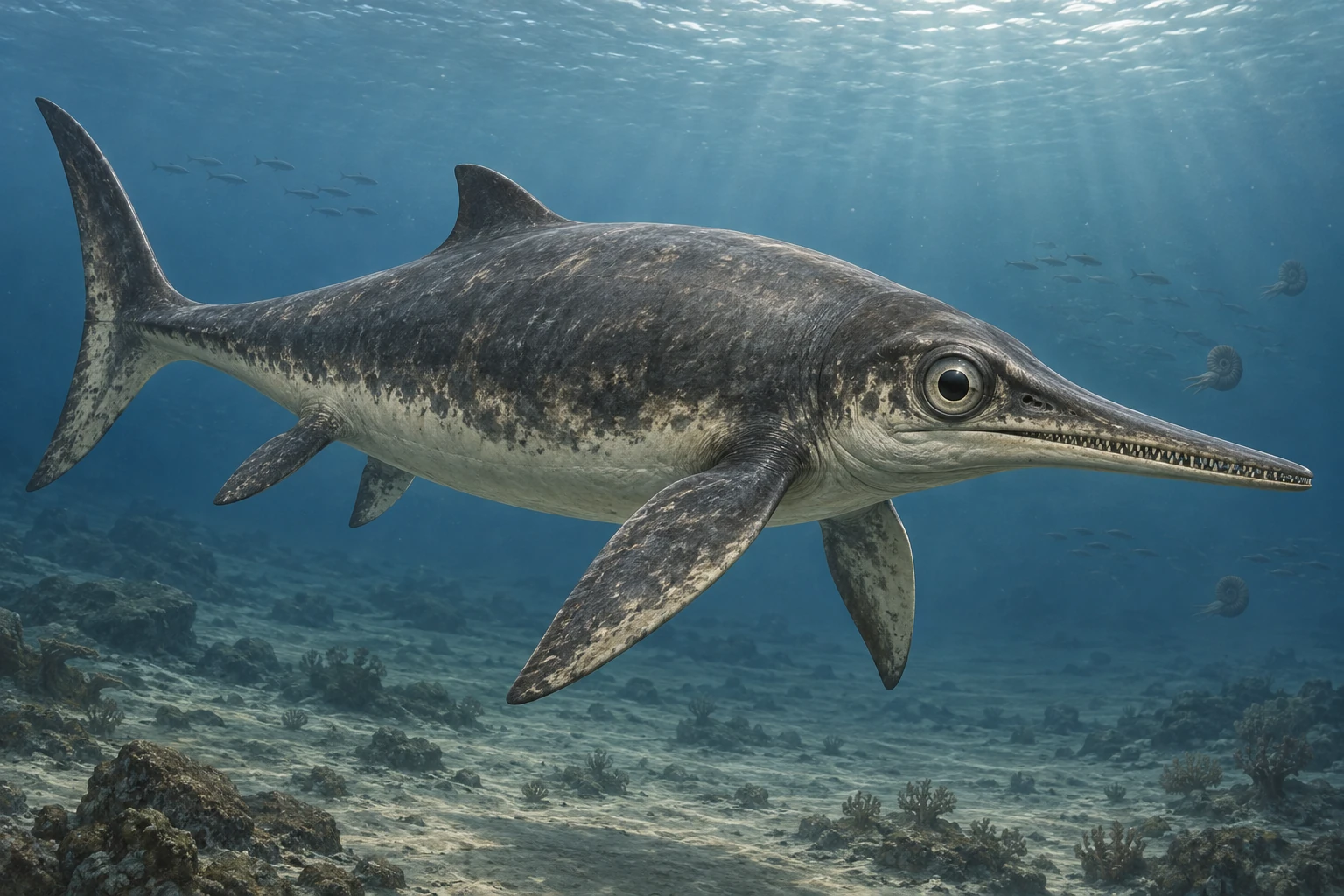
An illustrative reconstruction. Compare its anatomy with the evidence and limitations in the dossier. [1]
Source-informed reconstruction. Appearance evidence [1]. Original illustration; missing anatomy, coloration and scenery include interpretation.
Fossils constrain this life reconstruction. Missing anatomy, coloration and the environmental scene include interpretation; the dossier explains the evidence limits.
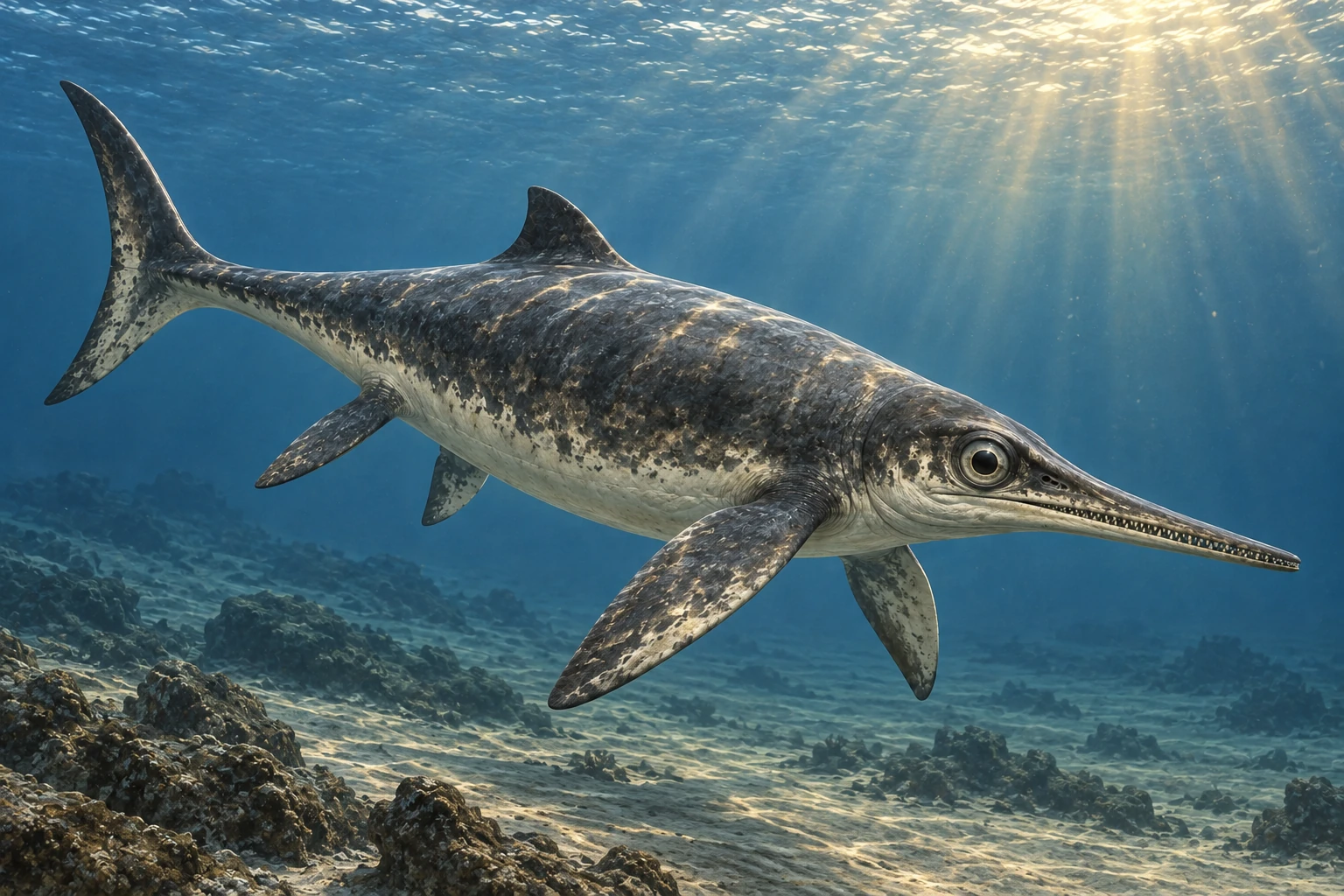
An illustrative reconstruction. Compare its anatomy with the evidence and limitations in the dossier. Lighting, coloration and scenery are artistic choices. This image does not document a fossil locality or behavior.
Original artwork · artistic interpretation.
Scientific view: source-informed reconstruction, credited paleoart or specimen-based imagery. Movie-style view: Original artistic interpretation. Reconstructions involve uncertainty.
MEET THE ANIMAL
Temnodontosaurus platyodon was an ichthyosaur from Early Jurassic seas. Its long, sturdy jaws and different tooth shapes attracted researchers studying how marine reptiles captured and processed prey. Teeth near the front and back of the mouth supplied different anatomical clues. [D1]
The study also reports cephalopod hooklets associated with this species. These tiny structures come from relatives of squid and offer evidence beyond tooth shape. Other species placed in Temnodontosaurus have different feeding evidence, so a meal linked to one species should not automatically become another species’ menu. [D1]
The museum recounts the famous Lyme Regis discovery connected with Mary Anning and her brother Joseph. Discoveries like this helped people recognize extraordinary marine animals in rocks. Their fossils can remain scientifically useful long after excavation, as researchers return with new questions and methods. [D3]
Scientists are still checking which species belong together in this genus. That is why this exhibit focuses on the type species, the one that anchors the name. A striking feature found in a different, unassigned specimen cannot simply be added to its picture. Careful identification keeps the animal’s story connected to the right evidence. [D2]
PREHISTORIC ANIMAL DOSSIER
The animal, the evidence, and the questions still open.
Dental comparisons and reported gut remains inform feeding. They do not establish a type-species mass range, courtship or social organization. [D1]
Profile scope: One genus exhibit restricted to the type species T. platyodon; uncertain species assignments and the 2025 unassigned flipper are excluded. [D2]
Source supported identifies a description documented by the cited source. Inferred marks a reconstruction or functional estimate. Debated marks competing interpretations. Not established means the sources reviewed for this dossier do not support a firm conclusion; it does not mean a behavior never occurred.
A size reference is an estimate, not a population range. Nesting evidence does not by itself establish courtship, mate choice, or lifelong pairing.
Not established here
Reviewed skull studies do not provide a validated T. platyodon adult length range; larger genus-wide estimates are excluded. [D2]
Not established here
The inspected craniodental study does not supply a validated body-mass model for the type species. [D1]
Cephalopods; other prey unresolved
The study reports dense cephalopod hooklets associated with T. platyodon; vertebrate prey in T. trigonodon is separate evidence. [D1]
Early Jurassic marine Britain
The museum recounts the Lyme Regis discovery associated with the type species; exact swimming depth is unknown. [D3]
Ichthyosaur swimming
Marine ichthyosaur comparisons support swimming. A newly studied unassigned flipper cannot establish T. platyodon’s special surface structures or silence. [D3]
Robust elongate snout and differentiated teeth
T. platyodon has distinct front/rear tooth forms; broader Temnodontosaurus species have different skull shapes. [D1]
Live-bearing expected by comparison
Ichthyosaur pregnancies support comparison; no attributable T. platyodon pregnancy was inspected here. [D5]
Not established here
Focused searches and the reviewed taxonomy supply no direct mating-display evidence for the type species. [D2]
Not established here
Cranial comparisons do not demonstrate group living, pair bonds or parental care. [D2]
Sources and inspection notes for the claims in this profile.
THE STORY IN THE FOSSILS
Tooth mechanics and gut remains answer different feeding questions; neither establishes a complete diet. [1]
The London museum describes a newly studied flipper without assigning it to T. platyodon. Its unusual structures should remain attached to that specimen rather than becoming decoration on every reconstruction. [3]
The dossier identifies the scope of each reference estimate. A mount, an individual fossil and a species-wide adult range are different measurements. Comparison metrics remain unavailable where adult scope has not been established. Unknown does not mean zero.
Sources support the stated claims and scopes. Refer to the evidence notes for uncertainty.
KEEP EXPLORING
Stenopterygius quadriscissus
Marine reptile
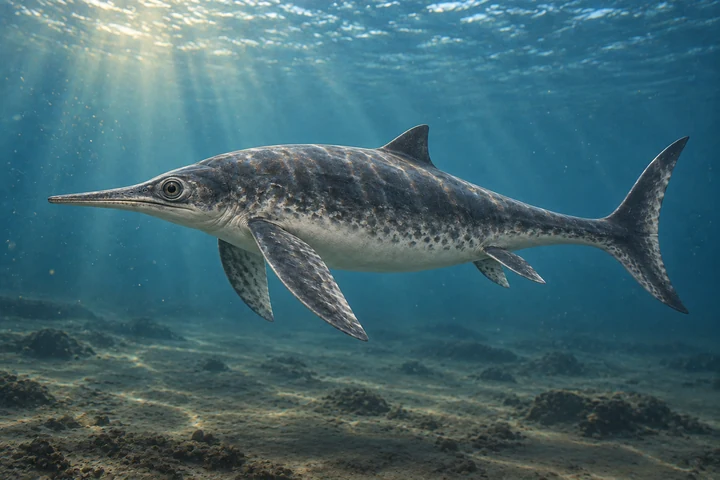
A fish-shaped marine reptile with direct pregnancy fossils and teeth that changed as it grew.
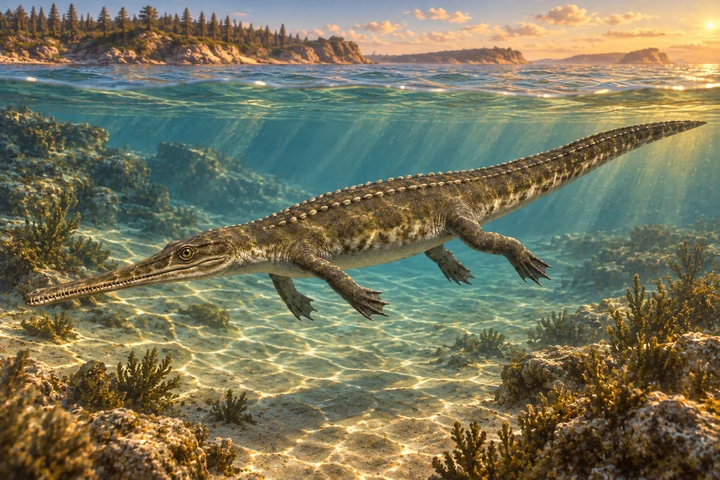
Pelagosaurus typus
Marine reptile
A slender-snouted marine crocodylomorph whose bones suggest an amphibious life along shallow Jurassic seas.
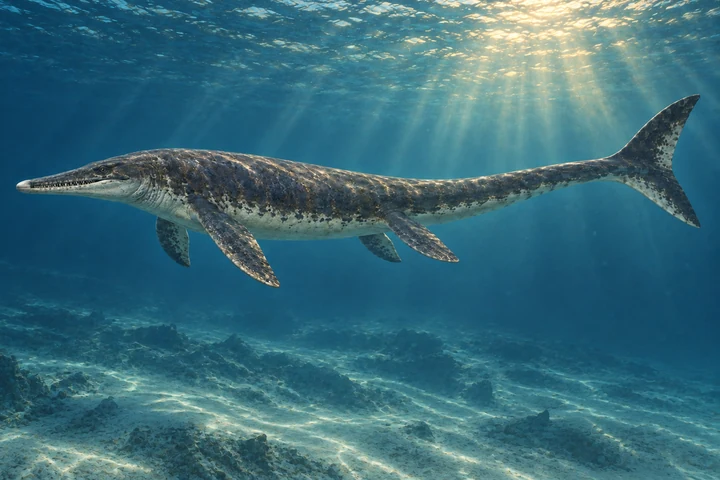
Tylosaurus proriger
Marine reptile
A marine lizard with an elongated adult snout tip, whose fossil identities are still being revised.