
Length
Source supportedGenus reference up to about 3.5 m
The dental study gives an approximate genus reference, not a measured S. quadriscissus adult population range. [D2]
EXHIBIT 230
Stenopterygius quadriscissus
Marine reptile
A fish-shaped marine reptile with direct pregnancy fossils and teeth that changed as it grew. [4]
TWO WAYS TO PICTURE THE PAST
Compare the evidence with the familiar movie image. The illustrations are not to a shared scale.
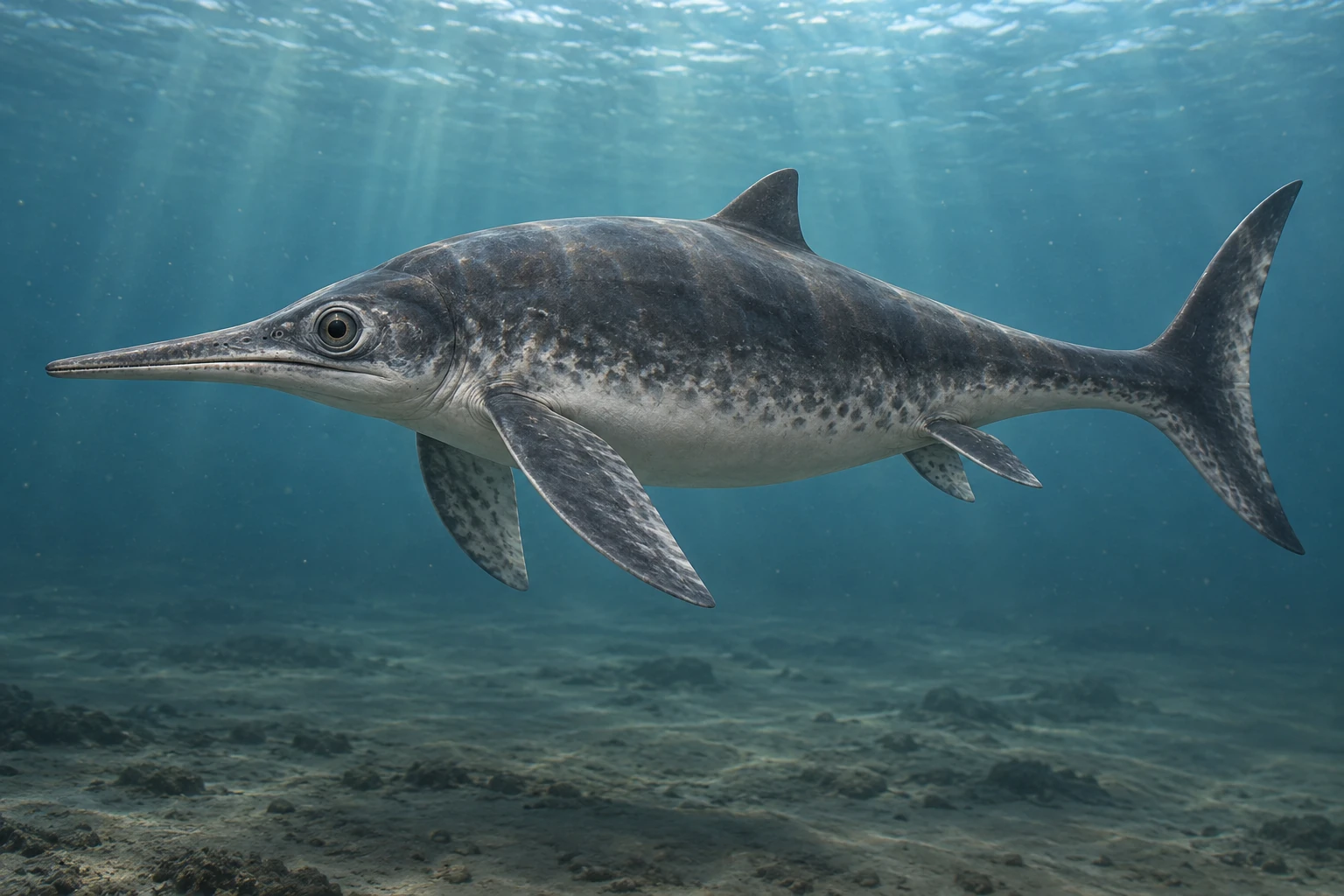
An illustrative reconstruction. Compare its anatomy with the evidence and limitations in the dossier. [2]
Source-informed reconstruction. Appearance evidence [2]. Original illustration; missing anatomy, coloration and scenery include interpretation.
Fossils constrain this life reconstruction. Missing anatomy, coloration and the environmental scene include interpretation; the dossier explains the evidence limits.
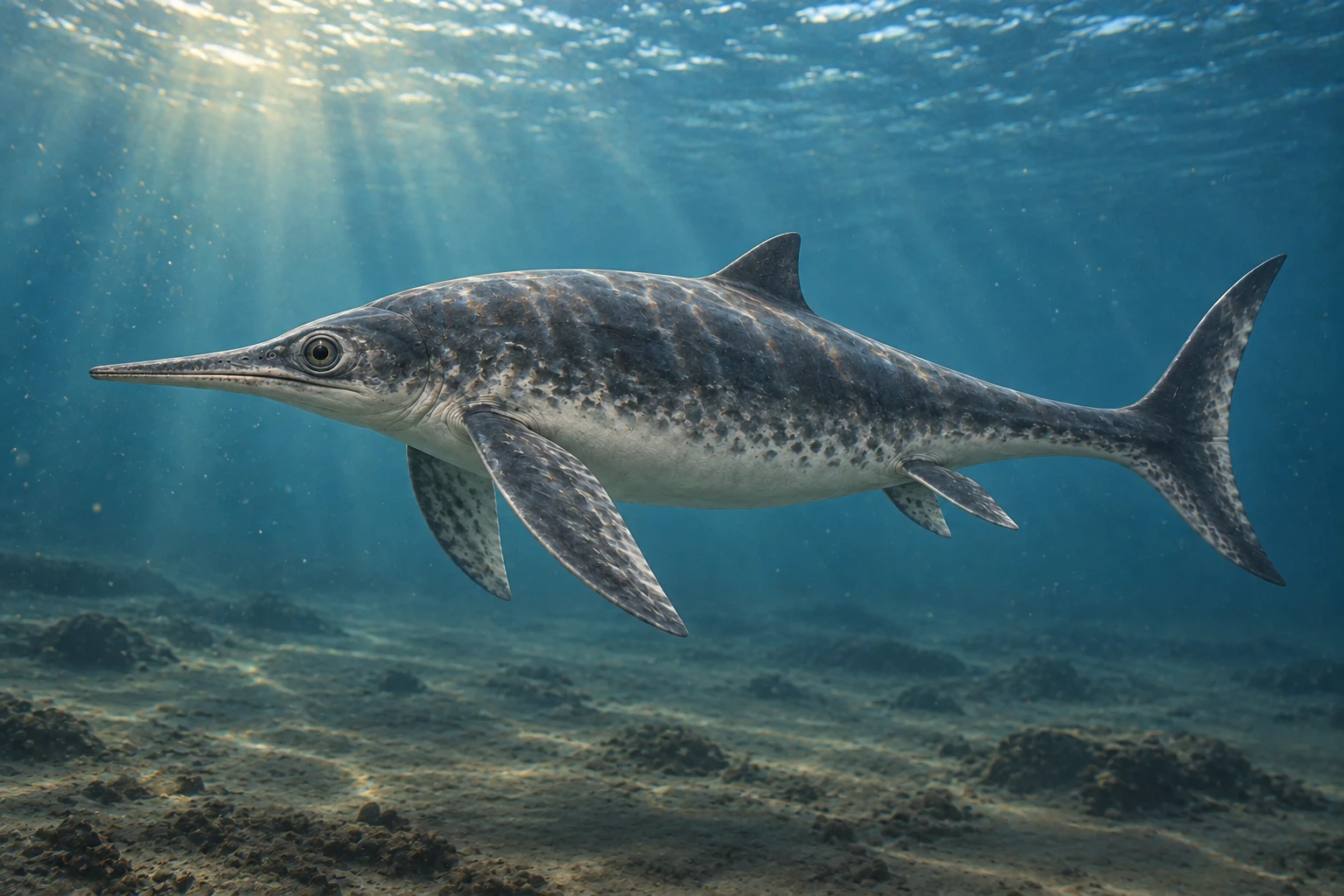
An illustrative reconstruction. Compare its anatomy with the evidence and limitations in the dossier. Lighting, coloration and scenery are artistic choices. This image does not document a fossil locality or behavior.
Original artwork · artistic interpretation.
Scientific view: source-informed reconstruction, credited paleoart or specimen-based imagery. Movie-style view: Original artistic interpretation. Reconstructions involve uncertainty.
MEET THE ANIMAL
Stenopterygius was an ichthyosaur, a marine reptile whose body converged on a fish-like swimming shape. The species represented here is S. quadriscissus from Early Jurassic Germany. Its name belongs to a distinct genus, even though scientists historically placed some of these fossils in Ichthyosaurus. [D1]
Growing jaws changed its teeth. Juveniles had relatively larger teeth, while some adults had teeth so small that they did not project above the jaw groove. Belemnite hooklets preserved in stomach regions show that these animals ate cephalopods, even when conspicuous teeth were reduced. [D2]
One spectacular genus-identified fossil, MH432, preserves evidence of smooth skin and blubber. Pigment structures suggest countershading: a darker back and lighter underside. This supports a specimen-based color pattern, but the precise hues and markings of every species or individual are still unknown. [D3]
Pregnant fossils provide direct evidence of live birth in Stenopterygius. Researchers have re-examined the direction in which embryos faced, finding a more complicated pattern than a simple rule that all ichthyosaurs were born tail-first. Birth evidence does not establish later parental care or group hunting. [D5]
PREHISTORIC ANIMAL DOSSIER
The animal, the evidence, and the questions still open.
Preserved embryos make growth visible before birth. Skull development can be studied across fossil individuals rather than guessed from a single adult. [D4]
Profile scope: Genus exhibit represented by S. quadriscissus from Toarcian Germany; other Stenopterygius species and genus-identified soft tissues are qualified separately. [D1]
Source supported identifies a description documented by the cited source. Inferred marks a reconstruction or functional estimate. Debated marks competing interpretations. Not established means the sources reviewed for this dossier do not support a firm conclusion; it does not mean a behavior never occurred.
A size reference is an estimate, not a population range. Nesting evidence does not by itself establish courtship, mate choice, or lifelong pairing.
Genus reference up to about 3.5 m
The dental study gives an approximate genus reference, not a measured S. quadriscissus adult population range. [D2]
Not established here
The inspected prenatal study describes skull development without an adopted comparable adult body-mass estimate. [D4]
Cephalopod feeding directly supported
Belemnite hooklets occur as stomach contents, including in specimens with extremely reduced adult teeth; detailed feeding mechanics remain proposed. [D2]
Toarcian marine basin
Posidonia Shale specimens come from a shallow sea in southwestern Germany; oxygen-poor bottom conditions aided burial and preservation. [D2]
Streamlined ichthyosaur swimmer
Derived ichthyosaur body proportions support marine swimming; precise speed and stroke frequency are not established here. [D1]
Dentition changes with growth
S. quadriscissus teeth become relatively smaller as jaws grow; some adults were functionally toothless rather than uniformly fang-toothed. [D2]
Live birth directly supported
Pregnant Stenopterygius fossils preserve embryos. A reanalysis finds varied fetal orientations rather than a universal tail-first rule. [D5]
Not established here
Prenatal skulls reveal growth, not courtship colors, mating gestures or a breeding season. [D4]
Not established here
Pregnancy documents a mother and embryos, not cooperative hunting or lasting groups after birth. [D4]
Sources and inspection notes for the claims in this profile.
THE STORY IN THE FOSSILS
MH432 preserves traces of scaleless skin and insulating blubber. Pigment-bearing structures suggest a darker back and lighter belly in this genus-identified individual. The finding does not supply a complete color map for every S. quadriscissus. [3]
Pregnancy fossils can preserve developing skulls at several stages. Comparing those skulls helps reveal when bones appear and meet, while keeping embryos separate from small postnatal individuals. [4]
The dossier identifies the scope of each reference estimate. A mount, an individual fossil and a species-wide adult range are different measurements. Comparison metrics remain unavailable where adult scope has not been established. Unknown does not mean zero.
Sources support the stated claims and scopes. Refer to the evidence notes for uncertainty.
KEEP EXPLORING
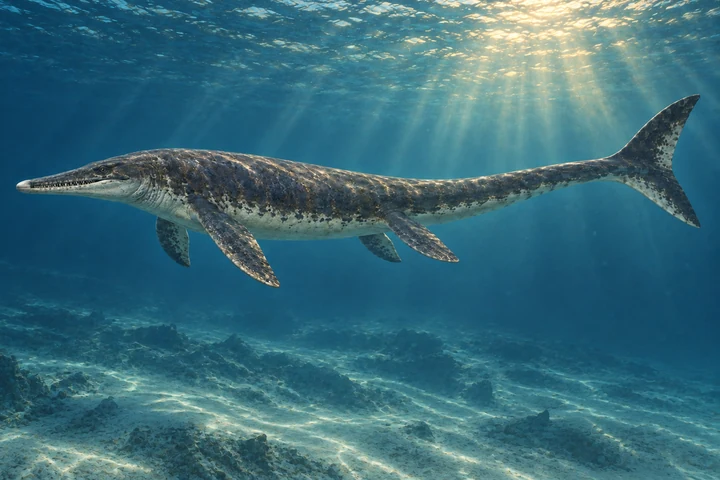
Tylosaurus proriger
Marine reptile
A marine lizard with an elongated adult snout tip, whose fossil identities are still being revised.
Platecarpus tympaniticus
Marine reptile
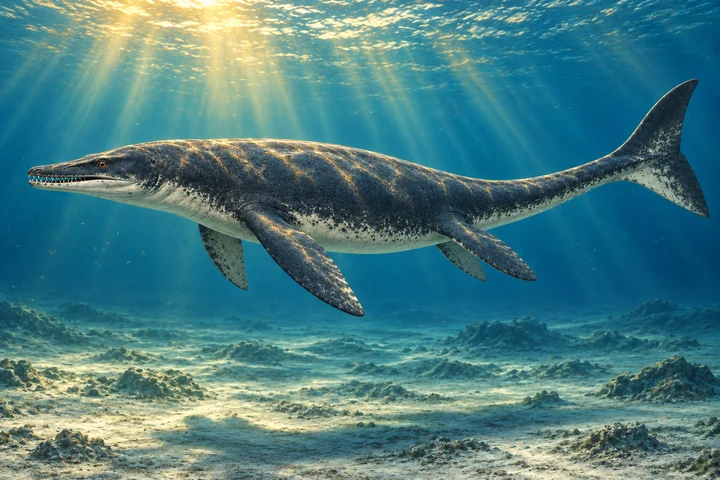
A streamlined mosasaur known from an exceptional fossil preserving skin traces and digested fish.
Pliosaurus kevani
Marine reptile
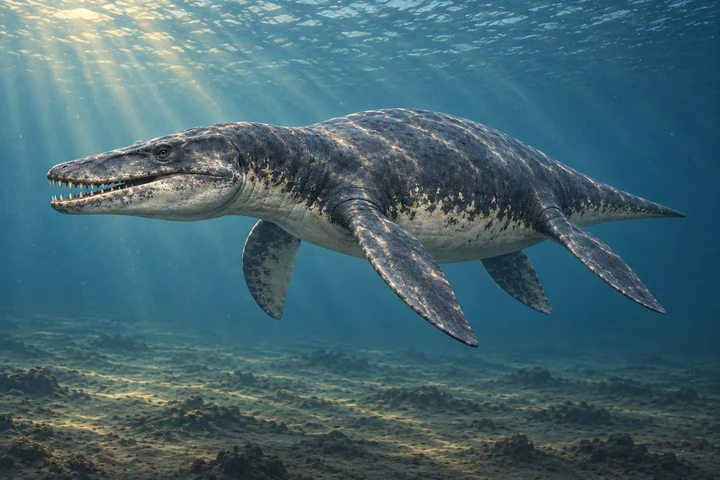
A large-skulled pliosaur whose Dorset holotype provides a detailed view of a Jurassic marine predator.