
Length
InferredAbout 5 m (museum reference)
Genus-level educational reference, without stated specimen or maturity. It is not the approximately 2 m juveniles in the behavioral assemblages. [D1]
EXHIBIT 93
Pinacosaurus
Pinacosaurus was an Asian armored plant-eater whose juvenile assemblages and preserved larynx reveal unusual details of its biology.
TWO WAYS TO PICTURE THE PAST
Compare the evidence with the familiar movie image. The illustrations are not to a shared scale.
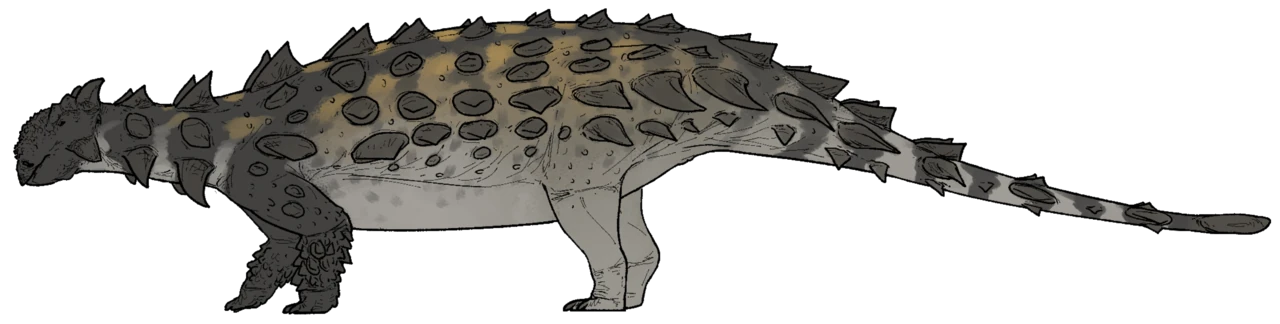
Life reconstruction of Pinacosaurus grangeri by Connor Ashbridge. Living colors, patterns, full armor layout and soft-tissue proportions are interpretive; this drawing is not a measured individual or an illustration of bonebed behavior. [4]
Life reconstruction of Pinacosaurus grangeri · Connor Ashbridge. CC BY 4.0. Commons-listed 1280 px preview converted to WebP; smaller responsive copy proportionally resized. Artwork preserved.
Scientific reconstruction is an interpretation; source credit does not certify every anatomical detail.
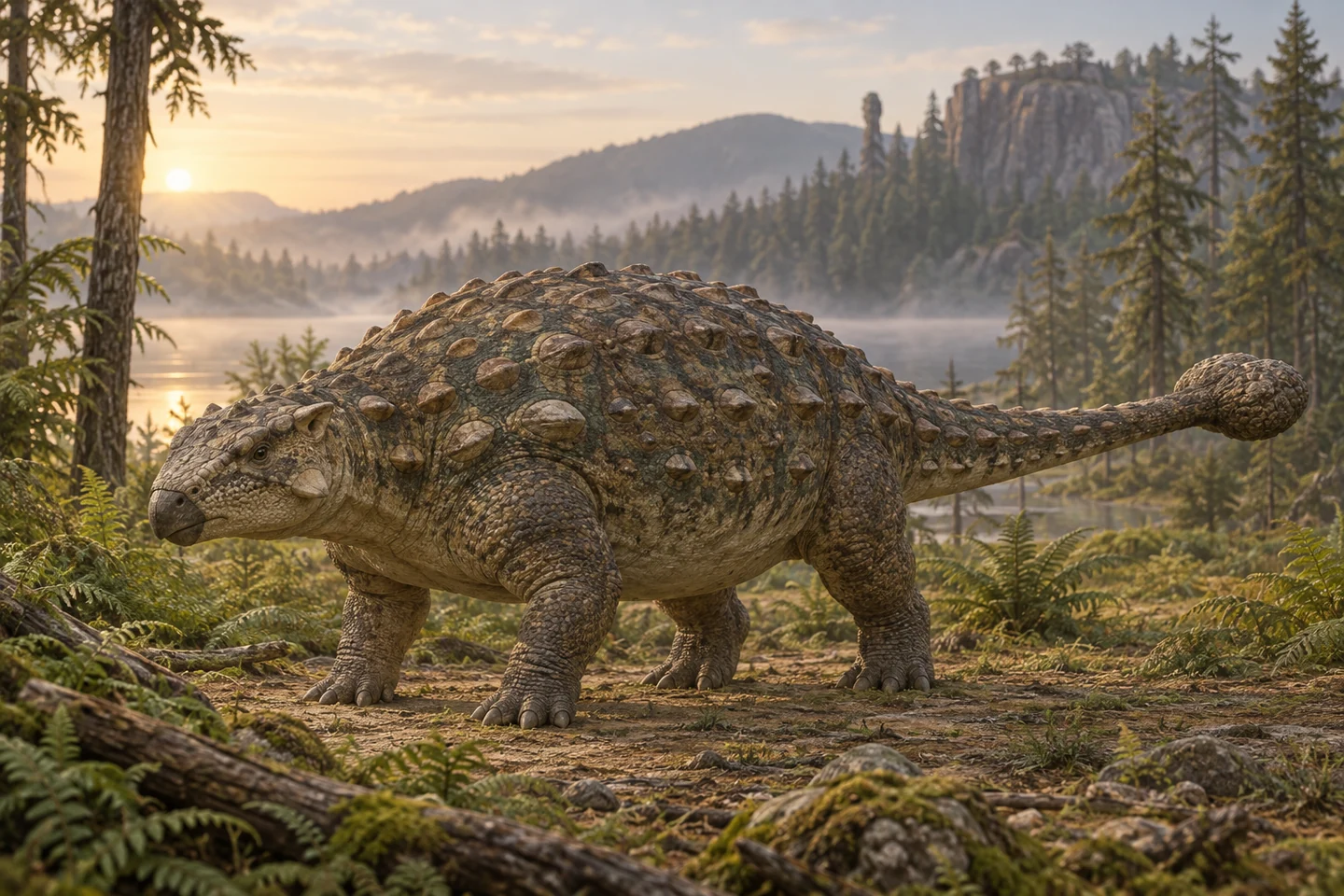
Original cinematic interpretation of Pinacosaurus grangeri. Coloration, soft tissues and scenery are artistic choices; reconstructed proportions do not establish a measured individual. Lighting, coloration and scenery are artistic choices. This image does not document a fossil locality or behavior.
Original artwork · artistic interpretation.
Scientific view: source-informed reconstruction, credited paleoart or specimen-based imagery. Movie-style view: Original artistic interpretation. Reconstructions involve uncertainty.
MEET THE ANIMAL
Pinacosaurus was a plant-eating armored dinosaur from Late Cretaceous Mongolia and China. A museum reference of about five metres introduces its scale, but many especially informative fossils belong to young animals. Their size and anatomy should be kept separate from a general adult reconstruction. The genus supplies unusual clues about both the body and sound production. [D1]
Articulated young skeletons preserve the limbs in their connected positions. Five-fingered hands and three-toed feet help reconstruct how the animal stood on four legs. Collections of immature animals have also suggested grouping, although researchers could not determine whether those animals normally gathered or clustered during environmental stress. Their association does not establish a permanent herd structure. [D2]
A young Pinacosaurus grangeri preserves bones of the larynx, part of the throat involved in sound production. Comparison with living relatives suggests that it could modify its voice in a bird-like way. That is a functional interpretation of anatomy, not a recording of its call. The fossil cannot tell us its exact sounds or whether it used a particular call to attract a mate. [D4]
PREHISTORIC ANIMAL DOSSIER
The animal, the evidence, and the questions still open.
Skull ornamentation changed during growth, complicating identification from immature fossils.
Profile scope: Genus: Pinacosaurus. Behavioral, laryngeal, cranial and mass-model evidence concerns P. grangeri; museum length is an unassigned genus reference.
Source supported identifies a description documented by the cited source. Inferred marks a reconstruction or functional estimate. Debated marks competing interpretations. Not established means the sources reviewed for this dossier do not support a firm conclusion; it does not mean a behavior never occurred.
A size reference is an estimate, not a population range. Nesting evidence does not by itself establish courtship, mate choice, or lifelong pairing.
About 5 m (museum reference)
Genus-level educational reference, without stated specimen or maturity. It is not the approximately 2 m juveniles in the behavioral assemblages. [D1]
About 710 kg for a 4.8 m reconstruction
Seebacher’s polynomial-volume model identifies P. grangeri, reconstructed after Carpenter (1990), but supplies no specimen number or maturity assessment. It is not an adult population range. [D6]
Plant-eater
The museum identifies a plant diet; particular food plants are not established by this review. [D1]
Mongolia and northern China
P. grangeri occurs in Campanian Djadokhta and Wulansuhai strata. The Chinese formation includes river, lake-delta and dune deposits. [D5]
Four-legged walking inferred
Articulated limbs, five-fingered hands and three-toed feet inform its quadrupedal reconstruction. No running speed is established. [D2]
Armor and an unusually preserved larynx
Juvenile P. grangeri preserves laryngeal bones. Their comparison with living archosaurs suggests vocal modification, without identifying its actual calls. [D4]
Not established here
Juvenile concentrations do not establish nest structure, clutch size, incubation or parental care.
Not established here
A 2026 study proposes possible sex-related skull-horn differences, but also allows individual variation; no courtship sequence is established. [D5]
Juvenile clustering may reflect gregariousness
Repeated immature assemblages support grouping as a possibility. The authors could not resolve ordinary social grouping versus clustering under environmental stress. [D2]
Sources and inspection notes for the claims in this profile.
THE STORY IN THE FOSSILS
Pinacosaurus offers more than an armored silhouette. Juvenile remains preserve hands and feet in articulation, making this genus valuable for reconstructing how ankylosaurs stood and walked. [2]
Its fossil larynx provides a rare anatomical clue to sound production. The proposed vocal function does not reveal the exact sound or demonstrate a particular courtship call. [4]
The dossier identifies the scope of each reference estimate. A mount, an individual fossil and a species-wide adult range are different measurements. Comparison metrics remain unavailable where adult scope has not been established. Unknown does not mean zero.
Sources support the stated claims and scopes. Refer to the evidence notes for uncertainty.
KEEP EXPLORING
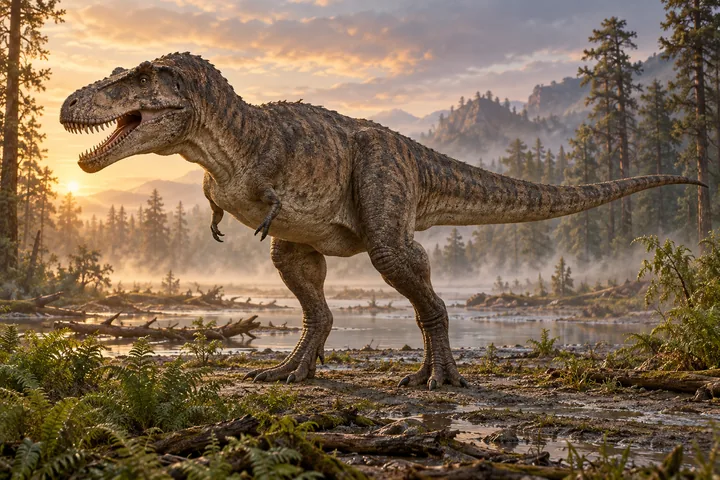
Tarbosaurus bataar
Tarbosaurus bataar was a large Asian tyrannosaur. Its relatively slender skull distinguishes it from its North American relative Tyrannosaurus rex.
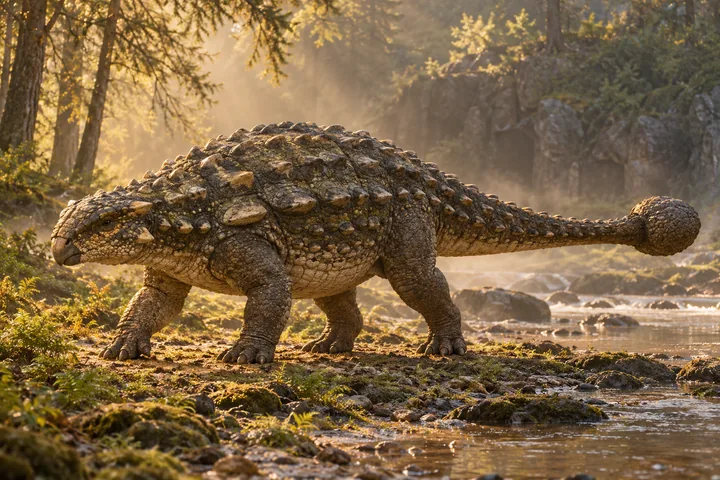
Ankylosaurus
Ankylosaurus was an armoured plant eater from the final Cretaceous of North America. Its tail club is distinctive, but no complete skeleton has yet been found.
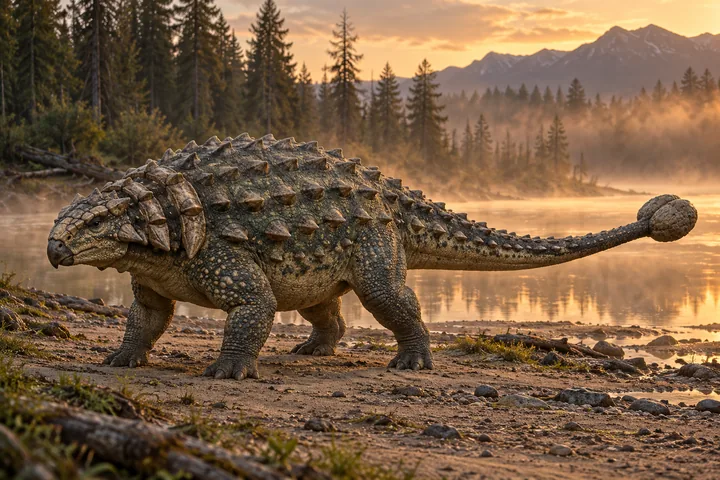
Euoplocephalus
Euoplocephalus was a club-tailed, armoured plant eater of Late Cretaceous Alberta. Re-examining its fossils revealed that several animals once grouped under its name belonged to distinct genera.