
Length
InferredAbout 7 m (museum reference)
The directory's rounded genus estimate lacks specimen and growth-stage details. Its broader taxonomic usage should not define a precise adult E. tutus range. [D1] [D2]
EXHIBIT 42
Euoplocephalus
Neck armour helps separate this ankylosaur from former look-alike referrals.
TWO WAYS TO PICTURE THE PAST
Compare the evidence with the familiar movie image. The illustrations are not to a shared scale.

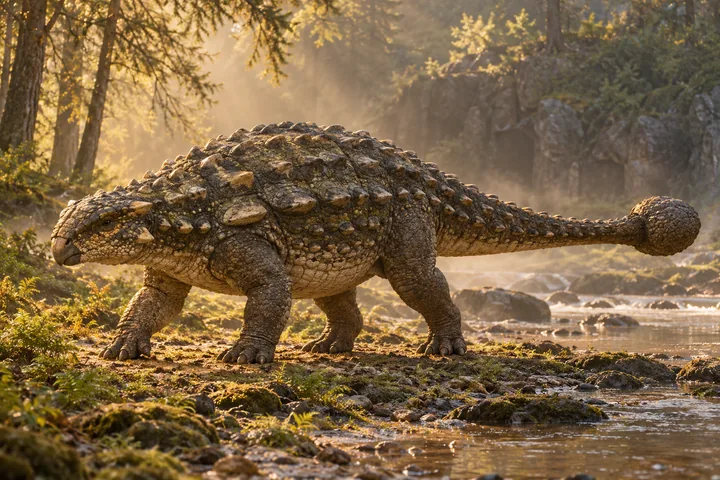
The artist identifies this reconstruction as Euoplocephalus. Fossil-informed anatomy: Low beaked quadruped with bony back armour, neck half-rings including keeled medial osteoderms, and terminal tail club. File identifies the genus only. Armour placement, colour and soft-tissue contours involve reconstruction; no source-page accuracy warning was found. [1] [2]
Euoplocephalus TD.png — TotalDino. CC BY 4.0. Remote source artwork displayed without additional cropping; Wikimedia supplies any display-size derivative.
Scientific picture served by Wikimedia · internet connection required.
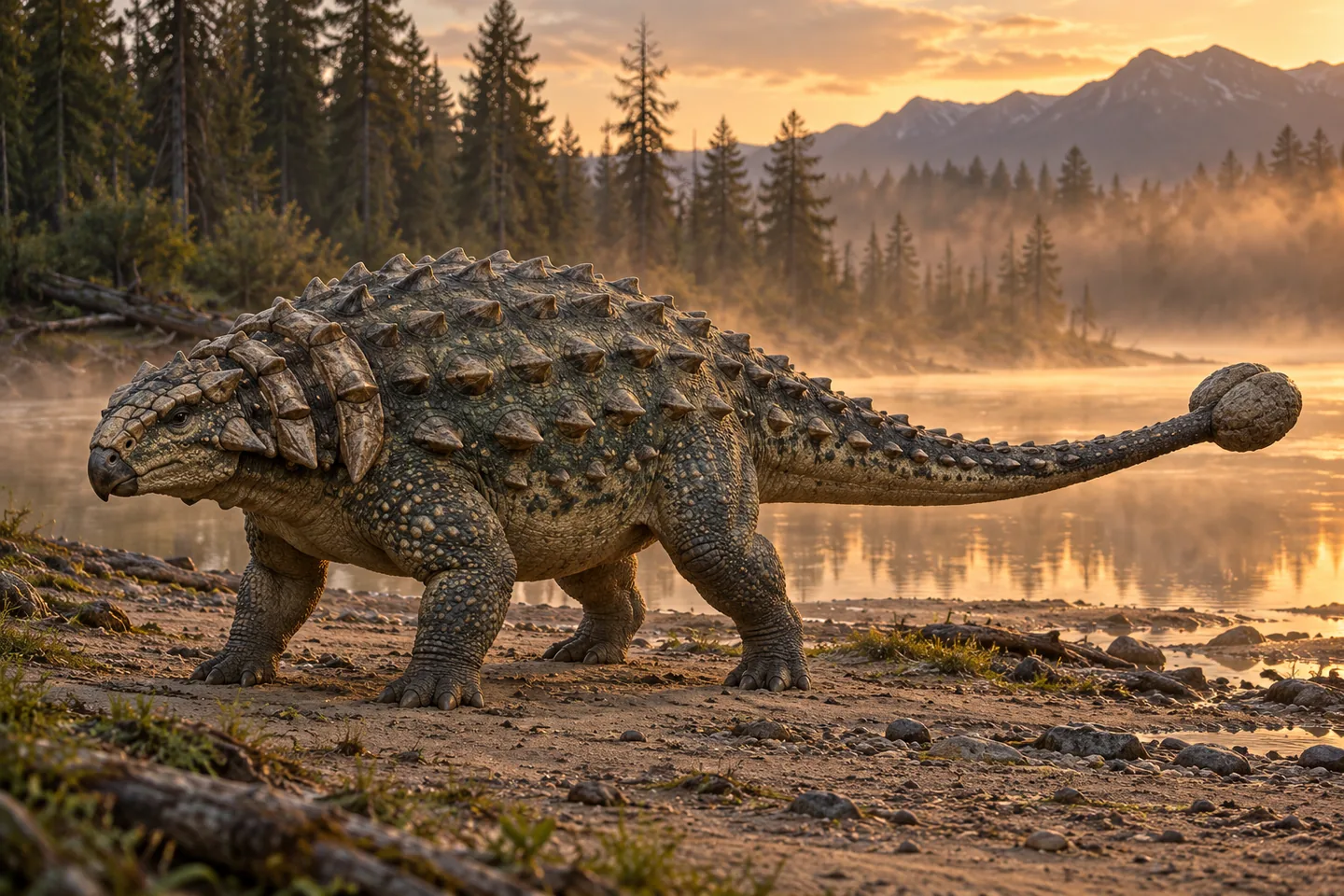
Cinematic armoured quadruped with tail club and keeled neck armour; keep features within Euoplocephalus referrals rather than copying Scolosaurus armour wholesale. Dramatic lighting, surface detail and scenery are artistic choices. This is an original cinema-inspired picture, rather than a frame from a film or a documented fossil locality.
Original artwork · artistic interpretation.
Scientific view: credited paleoart interpreting fossil evidence, served online by Wikimedia. Movie-style view: Original artistic interpretation. Colors, soft tissues and settings involve reconstruction.
MEET THE ANIMAL
Euoplocephalus belonged to the ankylosaurs, squat, armored plant-eating dinosaurs. Its fossil record is also part of a scientific detective story about how many different dinosaurs once lived in Alberta. Researchers must compare skull armor, tail clubs and the ages of the rocks, because animals that look broadly similar can still belong to different kinds. [S1]
During the twentieth century, fossils once assigned to several named armored dinosaurs were grouped together under Euoplocephalus. Victoria Arbour revisited museum collections and compared their features in detail. She found that particular patterns of skull armor corresponded with particular tail-club shapes. Consistent combinations in fossils from the same geological intervals supported recognizing more than one kind of animal. [S1]
That work changed the picture of armored-dinosaur diversity. Some closely related forms shared the same general habitat rather than replacing one another across a single long stretch of time. Their coexistence raises questions about how they divided food and other resources. Euoplocephalus remains an important dinosaur in that story, but an old fossil label must be checked before every associated specimen is counted as evidence for it. [S1]
PREHISTORIC ANIMAL DOSSIER
The animal, the evidence, and the questions still open.
Euoplocephalus was an armoured ankylosaur with a tail club. A specimen review separated several previously combined genera, so older broad reconstructions and distribution claims require careful checking.
Profile scope: Genus: Euoplocephalus; taxonomic revision concerns E. tutus in a narrowed sense.
Source supported identifies a description documented by the cited source. Inferred marks a reconstruction or functional estimate. Debated marks competing interpretations. Not established means the sources reviewed for this dossier do not support a firm conclusion; it does not mean a behavior never occurred.
A size reference is an estimate, not a population range. Nesting evidence does not by itself establish courtship, mate choice, or lifelong pairing.
About 7 m (museum reference)
The directory's rounded genus estimate lacks specimen and growth-stage details. Its broader taxonomic usage should not define a precise adult E. tutus range. [D1] [D2]
About 2,000 kg (museum reference)
This museum estimate lacks a specimen or calculation method. Historical grouping of other ankylosaurs complicates genus-level size claims. [D1] [D2]
Plant eater with a beak
The directory identifies herbivory and chewing teeth. Exact plant preferences are not established here. [D1]
Alberta's Dinosaur Park Formation
The revised E. tutus material occurs chiefly in the lower Dinosaur Park Formation. Older Horseshoe Canyon and Montana referrals include other genera. [D2]
Four-legged walking
Quadrupedal movement is reconstructed from the skeleton; no specific speed is established here. [D1]
Tail club and keeled neck armour
The first neck half-ring has distinctive keeled middle osteoderms. This feature helps separate E. tutus from historically combined ankylosaurs. [D2]
Not established here
The reviewed sources do not establish nest structure, incubation or parental care for Euoplocephalus.
Not established here
The reviewed sources do not establish a courtship sequence or mating system for Euoplocephalus.
Not established here
The reviewed sources do not establish usual group size or lasting social organization for Euoplocephalus.
Sources and inspection notes for the claims in this profile.
THE STORY IN THE FOSSILS
Euoplocephalus combined a beak and chewing teeth with back armour and a bony tail club. A 2013 review distinguishes it partly by keeled osteoderms near the middle of the first neck half-ring, alongside differences in ornament behind the eye sockets. [1] [2]
That review separated Anodontosaurus, Scolosaurus and Dyoplosaurus from fossils historically lumped together as Euoplocephalus. The narrower identification places Euoplocephalus chiefly in the lower Dinosaur Park Formation. This changes how we interpret its distribution and prevents a composite of several ankylosaurs becoming one reconstruction. [2]
We have not established a comparable adult total-length estimate for this taxon in this draft. Specimen measurements in the text describe those individuals. A numerical age interval has not been reviewed here. Unknown does not mean zero.
Sources and evidence notes for this exhibit.
KEEP EXPLORING
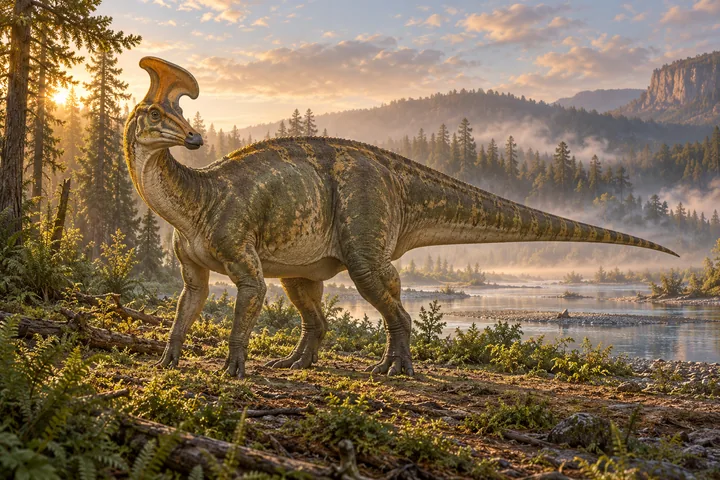
Lambeosaurus
A hatchet-shaped crest with hollow nasal passages.
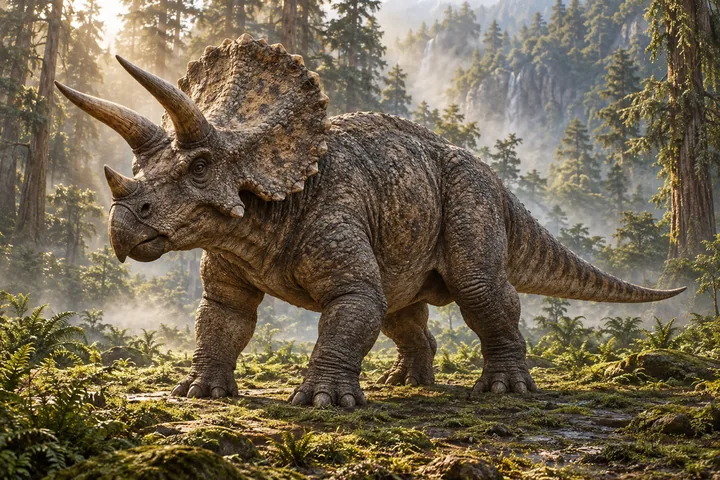
Triceratops horridus
Three horns, a broad frill, and a plant-eater beneath the formidable silhouette.