
Length
InferredAbout 9 m (museum reference)
NHM's rounded genus estimate lacks specimen and maturity details. Larger numbers on the older San Diego page are not used as a verified Lambeosaurus size range. [D1]
EXHIBIT 47
Lambeosaurus
A hatchet-shaped crest with hollow nasal passages.
TWO WAYS TO PICTURE THE PAST
Compare the evidence with the familiar movie image. The illustrations are not to a shared scale.

The artist identifies this reconstruction as Lambeosaurus. Fossil-informed anatomy: Duck-billed hadrosaur with toothless cropping snout, dental batteries, a hatchet-shaped hollow crest and long balancing tail. Source description identifies the genus rather than a named species. Colour and crest soft tissue are artistic interpretation. [1] [2]
Lambeosaurus TD.png — TotalDino. CC BY-SA 4.0. Remote source artwork displayed without additional cropping; Wikimedia supplies any display-size derivative.
Scientific picture served by Wikimedia · internet connection required.
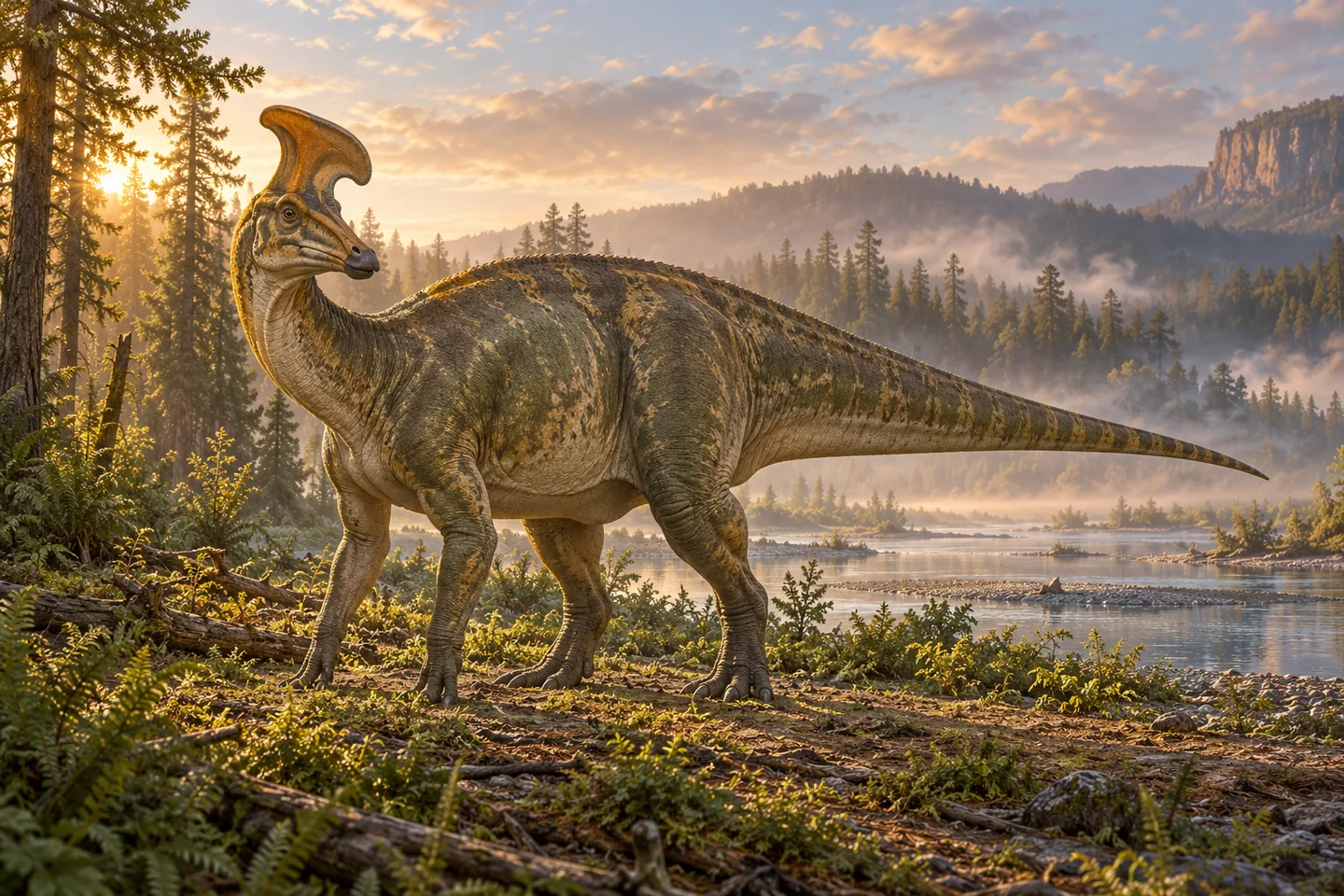
Cinematic Lambeosaurus with a recognizable hatchet-shaped crest, duck-like toothless snout, shorter forelimbs and long tail; speculative colours, no invented crest openings. Dramatic lighting, surface detail and scenery are artistic choices. This is an original cinema-inspired picture, rather than a frame from a film or a documented fossil locality.
Original artwork · artistic interpretation.
Scientific view: credited paleoart interpreting fossil evidence, served online by Wikimedia. Movie-style view: Original artistic interpretation. Colors, soft tissues and settings involve reconstruction.
MEET THE ANIMAL
Lambeosaurus was a duck-billed plant eater from Late Cretaceous Alberta. Its flat teeth were suited to processing vegetation, while a conspicuous hollow crest rose above its head. The Pacific Museum of Earth presents a reconstruction using the hind legs for movement and all four limbs for feeding on low plants. Those poses interpret anatomy rather than recording the proportions of time spent in each stance. [S1]
The crest has been linked with recognition and noisemaking, giving this dinosaur more than an unusual silhouette. Such proposed functions do not identify its calls or prove how it selected mates. The museum’s specimen, George, was found in Alberta and prepared before being mounted at the university. A display is a reconstruction of fossils, not a frozen instant of a dinosaur’s everyday behavior. [S1]
CT research on an adult Lambeosaurus lambei skull revealed especially elaborate loops in the nasal passages. These were more complex than older reconstructions suggested. Longer passageways may have helped produce lower-frequency sounds than in Corythosaurus, but this remains a functional interpretation of skull anatomy. Evidence from growing animals also needs to be distinguished from the mature crest. [S2]
PREHISTORIC ANIMAL DOSSIER
The animal, the evidence, and the questions still open.
Lambeosaurus combined a hatchet-shaped hollow crest with a toothless front beak and replaceable cheek teeth. Crest display and sound resonance are functional hypotheses, not a recovered record of its behavior.
Profile scope: Genus: Lambeosaurus; anatomical description covers L. lambei. Older broad geographic and giant-size claims are not adopted.
Source supported identifies a description documented by the cited source. Inferred marks a reconstruction or functional estimate. Debated marks competing interpretations. Not established means the sources reviewed for this dossier do not support a firm conclusion; it does not mean a behavior never occurred.
A size reference is an estimate, not a population range. Nesting evidence does not by itself establish courtship, mate choice, or lifelong pairing.
About 9 m (museum reference)
NHM's rounded genus estimate lacks specimen and maturity details. Larger numbers on the older San Diego page are not used as a verified Lambeosaurus size range. [D1]
Not established here
The reviewed sources do not establish a verified body-mass estimate for Lambeosaurus. The older museum page's giant-size scope is insufficiently resolved for this dossier.
Plant eater with replaceable cheek teeth
The feeding apparatus supports herbivory. Replacement teeth maintained the closely packed chewing surfaces; a precise menu is not established here. [D2] [D1]
Late Cretaceous Canadian fossil localities
The reviewed NHM directory records Canadian remains. This does not establish a preferred habitat or support the older page's much broader geographic list. [D1]
Two- and four-legged movement reconstructed
The museum reconstructs hind-leg running and possible four-legged feeding. Its tail is interpreted as a counterbalance; speed is not established here. [D2]
Hatchet-shaped hollow crest and duck-like beak
The crest contains extended nasal passages. A front beak precedes dense batteries of replaceable teeth. [D2]
Not established here
The reviewed sources do not establish nest structure, incubation or parental care for Lambeosaurus. General hadrosaur nesting descriptions are not treated as Lambeosaurus-specific evidence.
Crest display proposed
The museum lists mate display among several possible crest functions, alongside recognition and sound resonance. This does not establish mate choice, pair bonds or a courtship sequence. [D2]
Not established here
The reviewed sources do not establish usual group size or lasting social organization for Lambeosaurus. General hadrosaur grouping evidence is not automatically assigned to this genus.
Sources and inspection notes for the claims in this profile.
THE STORY IN THE FOSSILS
Lambeosaurus had a flattened duck-like snout without front teeth and a prominent hatchet-shaped bony crest. Hollow nasal passages ran through that crest. Behind the beak, numerous small teeth were packed together for processing plants, with replacement teeth renewing the chewing surfaces as others wore out. [2]
Its crest was more than a solid ornament: the internal passages connect it to the breathing apparatus. Proposed functions include visual recognition and display, and resonance of calls. Those possibilities are inferred from anatomy; a fossil crest does not preserve a recording of the animal’s voice. [2]
We have not established a comparable adult total-length estimate for this taxon in this draft. Specimen measurements in the text describe those individuals. The cited dates are approximately 76–74 million years ago. Unknown does not mean zero.
Sources and evidence notes for this exhibit.
KEEP EXPLORING
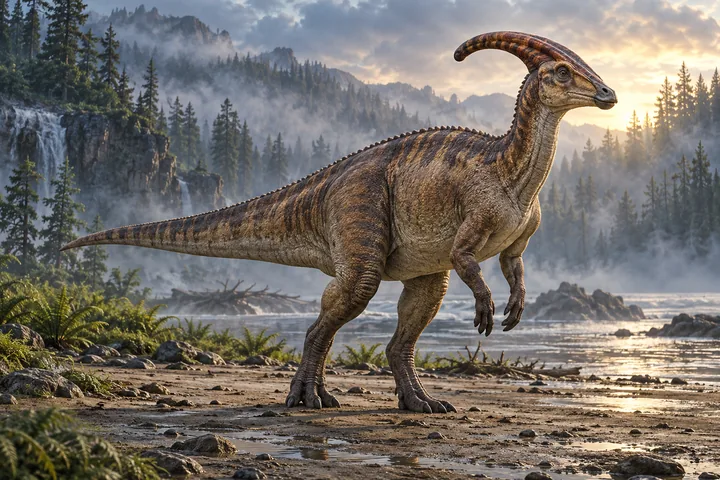
Parasaurolophus walkeri
A hollow crest and a skeleton that records an injured animal's life.

Euoplocephalus
Neck armour helps separate this ankylosaur from former look-alike referrals.
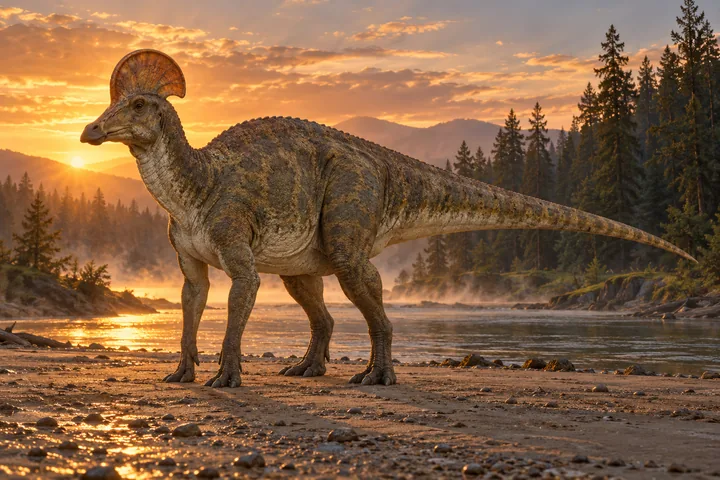
Corythosaurus
A helmet-like crest enclosing elaborate nasal passages.