
Length
InferredAbout 10 m (museum reference)
A rounded museum reference, not a measured population range; the page does not specify the specimen, method or growth stage. [D1]
EXHIBIT 46
Corythosaurus
A helmet-like crest enclosing elaborate nasal passages.
TWO WAYS TO PICTURE THE PAST
Compare the evidence with the familiar movie image. The illustrations are not to a shared scale.

The artist identifies this reconstruction as Corythosaurus casuarius. This view illustrates one form within the genus, rather than every species or individual. Fossil-informed anatomy: Duck-billed hadrosaur with a tall crescent-shaped helmet crest, elaborate internal nasal tubes and a tendon-supported backbone. Crest colour, soft tissue and display pattern are artistic interpretation. Depicts C. casuarius; other species and ages can differ in crest shape. [1] [2]
Corythosaurus TD.png — TotalDino. CC BY 4.0. Remote source artwork displayed without additional cropping; Wikimedia supplies any display-size derivative.
Scientific picture served by Wikimedia · internet connection required.
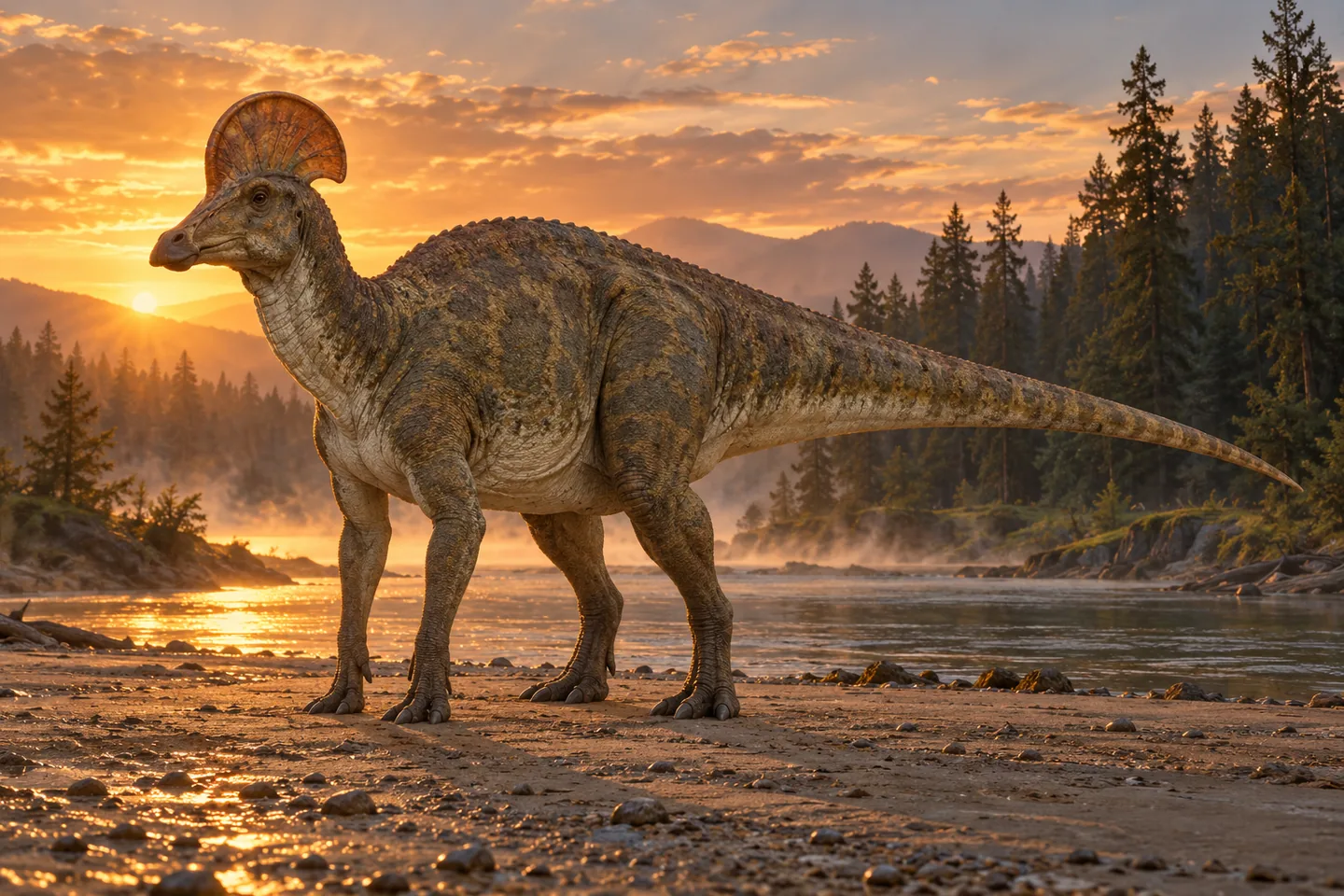
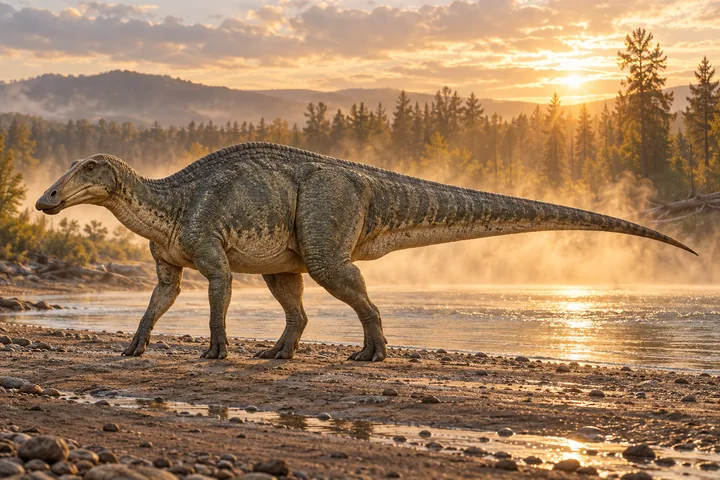
Cinematic duck-billed Corythosaurus with a crescent helmet crest and substantial hindlimbs; keep crest shape faithful, scaled texture restrained and colour speculative. Dramatic lighting, surface detail and scenery are artistic choices. This is an original cinema-inspired picture, rather than a frame from a film or a documented fossil locality.
Original artwork · artistic interpretation.
Scientific view: credited paleoart interpreting fossil evidence, served online by Wikimedia. Movie-style view: Original artistic interpretation. Colors, soft tissues and settings involve reconstruction.
MEET THE ANIMAL
Corythosaurus was a Late Cretaceous plant-eating dinosaur with a helmet-like crest, known from Canadian fossils. The museum provides a general length reference of about ten metres. That rounded figure lacks a named individual and growth stage, so it should not be treated as a verified mature maximum. The herbivore label also leaves its precise plant preferences unresolved. [D1]
The crest was hollow and carried winding nasal passages. A recent study scanned adult skulls of two Corythosaurus species to look inside without relying only on their outer shape. Their internal arrangements were very similar, while differences from related Lambeosaurus were clearer. Mature fossils mattered because comparisons based mostly on young animals could confuse growth changes with differences between kinds of dinosaur. [S1]
Researchers interpret elaborate crests as structures involved in visual display and the amplification of sounds. Their anatomy helps test those possibilities, but cannot reconstruct a specific call or courtship sequence. The result is a dinosaur with a distinctive head and a potentially important communication system, whose exact social interactions remain beyond what these skulls alone reveal. [S1]
PREHISTORIC ANIMAL DOSSIER
The animal, the evidence, and the questions still open.
Corythosaurus carried a crescent-shaped hollow crest enclosing elaborate nasal passages. An Alberta skeleton collected in 1912 preserves both skin impressions and calcified tendons.
Profile scope: Genus: Corythosaurus; preserved skin and tendons refer to the AMNH Alberta specimen.
Source supported identifies a description documented by the cited source. Inferred marks a reconstruction or functional estimate. Debated marks competing interpretations. Not established means the sources reviewed for this dossier do not support a firm conclusion; it does not mean a behavior never occurred.
A size reference is an estimate, not a population range. Nesting evidence does not by itself establish courtship, mate choice, or lifelong pairing.
About 10 m (museum reference)
A rounded museum reference, not a measured population range; the page does not specify the specimen, method or growth stage. [D1]
Not established here
The reviewed sources do not establish a verified body-mass estimate for Corythosaurus.
Plant eater
The directory identifies herbivory. Specific foods are not established in these reviewed genus and specimen profiles. [D1]
Late Cretaceous Alberta fossil setting
The AMNH specimen was collected in Alberta. Fossil location alone does not establish a preferred environment. [D2]
Hind-leg walking and running reconstructed
AMNH describes hadrosaurs, including its Corythosaurus display, as using the hind legs for walking and running. This does not establish an exclusive gait. [D2]
Hollow helmet-like crest and preserved tendons
Nasal passages extend into the crescent-shaped crest. Skin impressions and calcified tendons associated with the back vertebrae are preserved in the museum specimen. [D2]
Not established here
The reviewed sources do not establish nest structure, incubation or parental care for Corythosaurus.
Not established here
The reviewed sources do not establish a courtship sequence or mating system for Corythosaurus. A hollow crest alone does not demonstrate a mating display.
Not established here
The reviewed sources do not establish usual group size or lasting social organization for Corythosaurus.
Sources and inspection notes for the claims in this profile.
THE STORY IN THE FOSSILS
Corythosaurus’s crescent-shaped bony helmet encloses extended tubes that form elaborate nasal passages. It belongs to the hadrosaur group, whose broad snouts inspired the name duck-billed dinosaurs. The American Museum of Natural History describes these animals as walking and running on their hind legs. [2]
The museum’s Corythosaurus was collected in Alberta in 1912. Besides bone, it preserves skin impressions and a mesh of calcified tendons associated with the tall vertebrae. These remains add surface texture and structural detail to a dinosaur otherwise most easily recognized by its distinctive skull. [2]
We have not established a comparable adult total-length estimate for this taxon in this draft. Specimen measurements in the text describe those individuals. The cited dates are approximately 76–74 million years ago. Unknown does not mean zero.
Sources and evidence notes for this exhibit.
KEEP EXPLORING
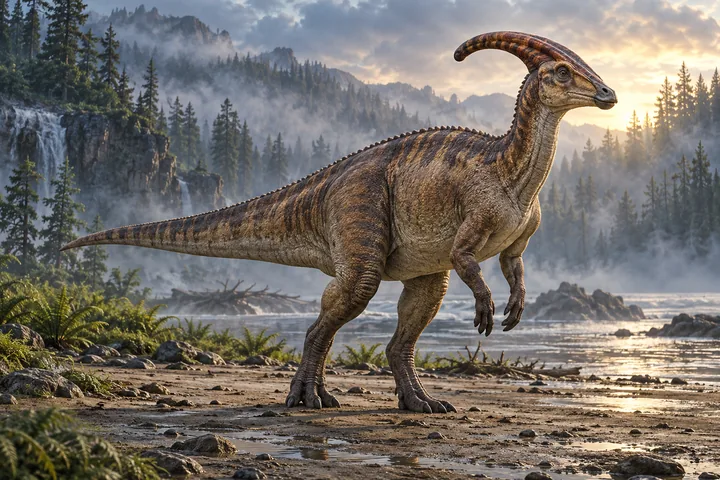
Parasaurolophus walkeri
A hollow crest and a skeleton that records an injured animal's life.
Edmontosaurus
Replaceable tooth batteries behind a cropping beak.