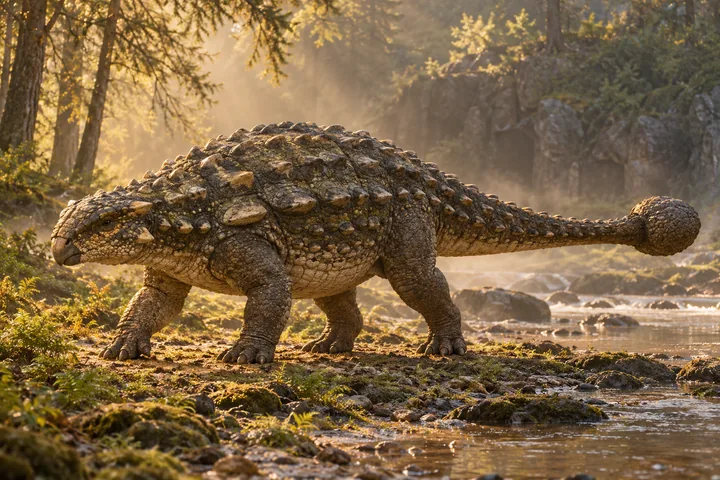
Length
InferredAbout 13 m (museum reference)
The directory gives a rounded genus reference without specimen or maturity. Dakota was likely a subadult and must not define an adult-size range. [D1] [D2]
EXHIBIT 44
Edmontosaurus
Replaceable tooth batteries behind a cropping beak.
TWO WAYS TO PICTURE THE PAST
Compare the evidence with the familiar movie image. The illustrations are not to a shared scale.

The artist identifies this reconstruction as Edmontosaurus sp. (NDGS 2000). This view illustrates one form within the genus, rather than every species or individual. Fossil-informed anatomy: Broad flattened cropping beak, large tooth batteries, long hindlimbs, shorter forelimbs, long balancing tail and scaled skin. The published figure identifies Edmontosaurus sp.; do not relabel as a species. Skin-preserving specimen informs the reconstruction, but unpreserved parts and coloration are inferred. [1] [2]
Edmontosaurus sp. reconstruction.PNG — Natee Puttapipat; published by Stephanie K. Drumheller, Clint A. Boyd, Becky M. S. Barnes, Mindy L. Householder. CC BY 4.0. Remote source artwork displayed without additional cropping; Wikimedia supplies any display-size derivative.
Scientific picture served by Wikimedia · internet connection required.
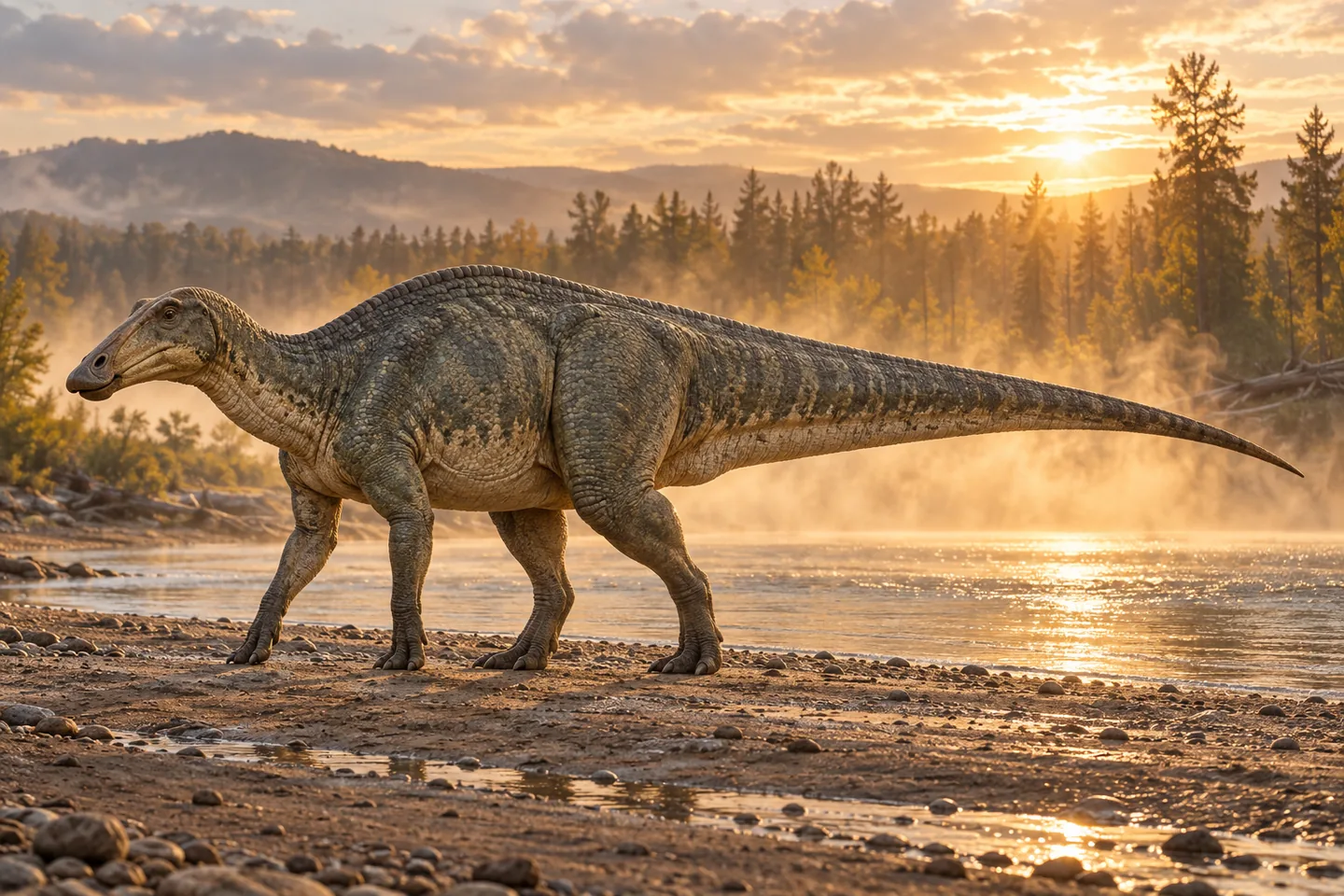
Cinematic duck-billed hadrosaur with broad toothless beak, substantial hindlimbs, shorter forelimbs and long tail; scales visible, colours explicitly speculative. Dramatic lighting, surface detail and scenery are artistic choices. This is an original cinema-inspired picture, rather than a frame from a film or a documented fossil locality.
Original artwork · artistic interpretation.
Scientific view: credited paleoart interpreting fossil evidence, served online by Wikimedia. Movie-style view: Original artistic interpretation. Colors, soft tissues and settings involve reconstruction.
MEET THE ANIMAL
Edmontosaurus was a large plant-eating dinosaur known from North Dakota’s Cretaceous rocks. A broad, toothless beak gave its face the duck-billed outline that names its wider family. Behind the beak, batteries of small teeth formed grinding surfaces. New teeth replaced worn ones, maintaining an apparatus capable of processing tough vegetation without establishing a single preferred food. [S1]
The individual nicknamed Dakota preserves extensive fossilized skin. Its tail, arm, foot and large body block reveal parts of the animal’s outer covering that ordinary skeletons cannot show. Preparation is slow because delicate skin can fold, wrinkle or tear, and workers cannot safely assume where it continues beneath the rock. Preserved texture offers evidence beyond an artist’s imagined appearance. [S2]
The broader skeletal reconstruction includes strong legs and ankles, supporting land movement, and broad toes with hoof-like nails. General accounts of nesting and herds elsewhere in the duck-billed dinosaur family should not automatically supply a social system for every Edmontosaurus species. Comparing bone anatomy with particular skin specimens keeps the genus distinct from the life story of one fossil individual. [S1]
PREHISTORIC ANIMAL DOSSIER
The animal, the evidence, and the questions still open.
Edmontosaurus used a cropping beak and batteries of replaceable teeth to process vegetation. Fossilized skin in the North Dakota specimen Dakota adds scale texture to the skeletal profile.
Profile scope: Genus: Edmontosaurus; Dakota is a Hell Creek individual, not an adult size standard.
Source supported identifies a description documented by the cited source. Inferred marks a reconstruction or functional estimate. Debated marks competing interpretations. Not established means the sources reviewed for this dossier do not support a firm conclusion; it does not mean a behavior never occurred.
A size reference is an estimate, not a population range. Nesting evidence does not by itself establish courtship, mate choice, or lifelong pairing.
About 13 m (museum reference)
The directory gives a rounded genus reference without specimen or maturity. Dakota was likely a subadult and must not define an adult-size range. [D1] [D2]
About 3,400 kg (museum reference)
A rounded museum reference, not a measured population range; the page does not specify the specimen, method or growth stage. [D1]
Plant material processed by tooth batteries
Beak and interlocking grinding teeth support herbivory. The directory reports conifer material in stomachs; that does not establish the exclusive diet of the genus. [D1] [D2]
Hell Creek coastal plain and wetlands
Dakota's setting is reconstructed as a warm deltaic coastal plain with woodlands, ponds and swamps. This locality should not represent every Edmontosaurus species or habitat. [D2]
Two- and four-legged movement reconstructed
The directory allows bipedal and quadrupedal movement. The older Dakota report's preliminary speed estimates are not adopted here. [D1] [D2]
Duck-like beak, tooth batteries, scaly skin
Dakota preserves scales of different sizes, while the jaws have many replaceable teeth. Preserved skin texture does not establish a living colour pattern. [D2]
Not established here
The reviewed sources do not establish nest structure, incubation or parental care for Edmontosaurus.
Not established here
The reviewed sources do not establish a courtship sequence or mating system for Edmontosaurus.
Not established here
The reviewed sources do not establish usual group size or lasting social organization for Edmontosaurus.
Sources and inspection notes for the claims in this profile.
THE STORY IN THE FOSSILS
The toothless front of the jaws carried a cropping beak; batteries of many small interlocking teeth formed grinding surfaces farther back. Worn teeth were replaced throughout life. This combination allowed Edmontosaurus to process coarse plant material, with conifer remains reported from preserved stomach contents. [1] [2]
North Dakota’s Dakota specimen comes from the Hell Creek Formation, deposited across a coastal plain with rivers, woodlands and wetlands. Its preserved skin includes scales of different sizes. The geological survey described Dakota as a likely subadult, so its individual dimensions cannot define the size of an adult. [2]
We have not established a comparable adult total-length estimate for this taxon in this draft. Specimen measurements in the text describe those individuals. The cited dates are approximately 76–66 million years ago. Unknown does not mean zero.
Sources and evidence notes for this exhibit.
KEEP EXPLORING
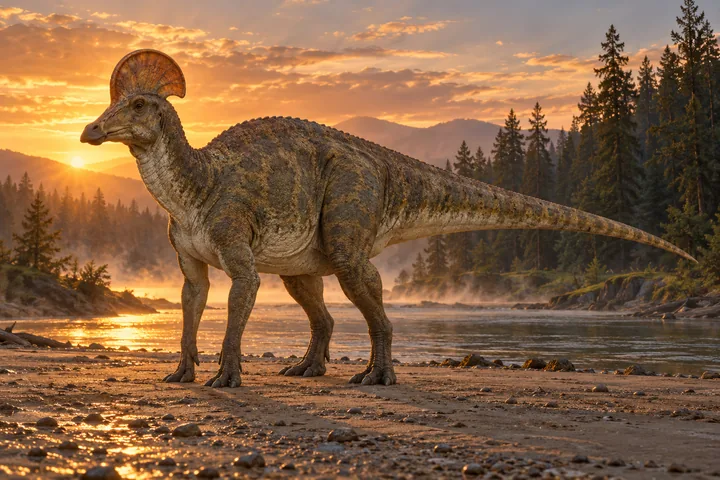
Corythosaurus
A helmet-like crest enclosing elaborate nasal passages.
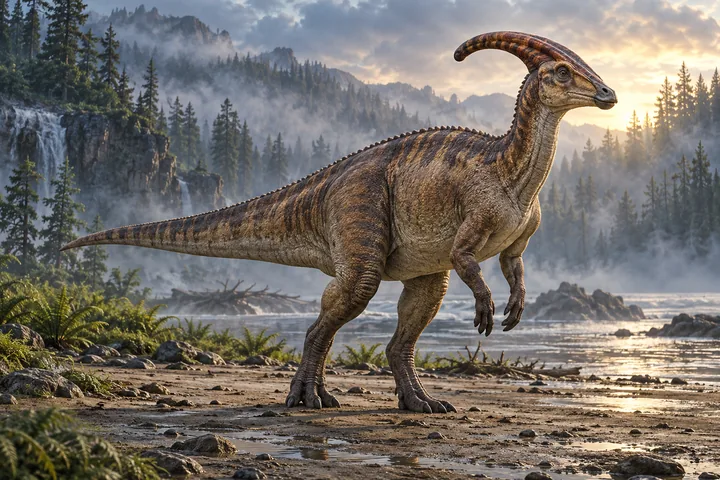
Parasaurolophus walkeri
A hollow crest and a skeleton that records an injured animal's life.