
Body length
InferredAbout 4 m (educational reference)
Museum value lacks individual scope. Larger adult lengths were modeled from French limb material, with growth-stage interpretation requiring caution. [D2] [D3]
EXHIBIT 215
Rhabdodon priscus and R. septimanicus
Dinosaur
Rhabdodon was a European ornithopod whose ridged teeth helped process plant material. [1]
TWO WAYS TO PICTURE THE PAST
Compare the evidence with the familiar movie image. The illustrations are not to a shared scale.
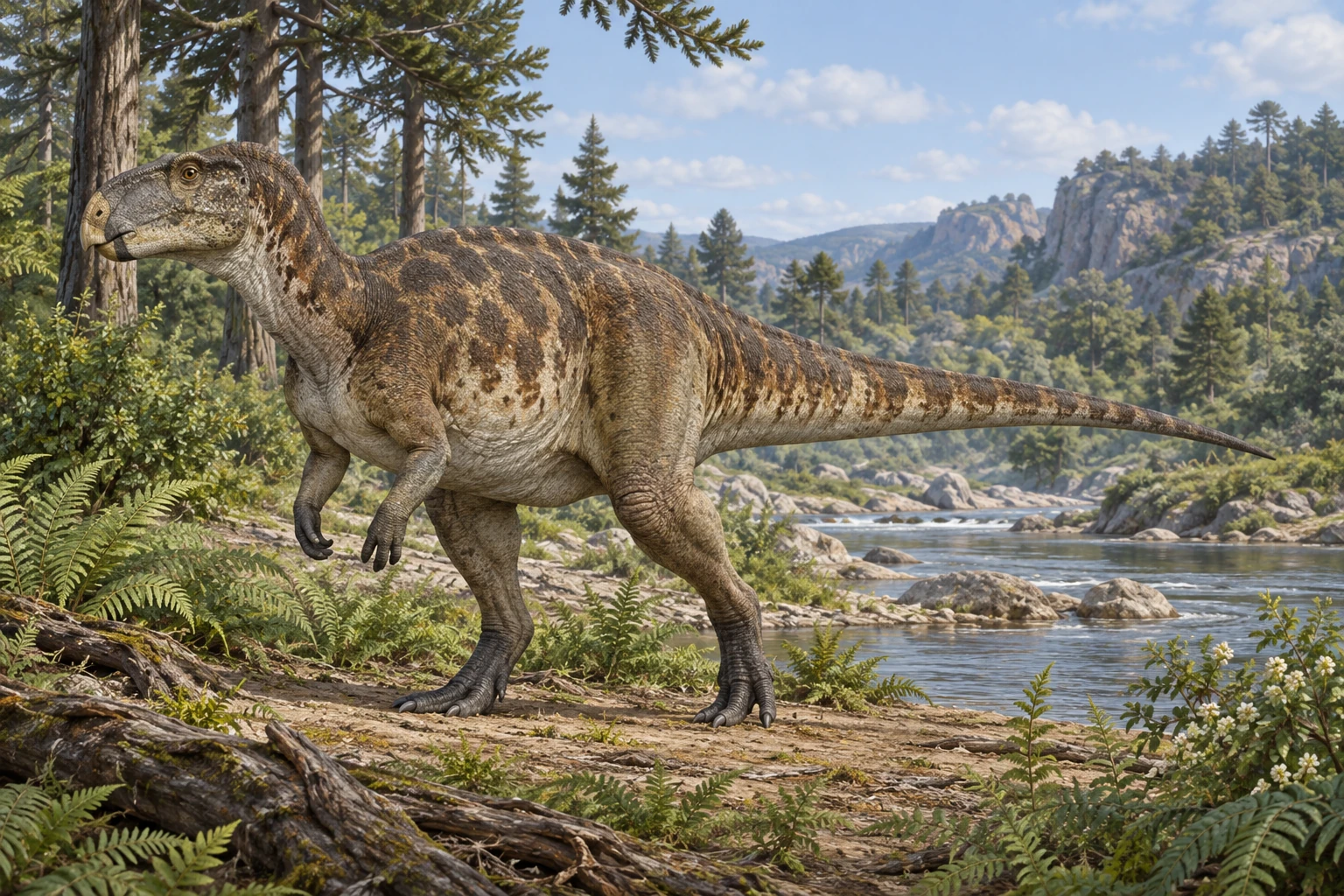
An illustrative reconstruction. Compare its anatomy with the evidence and limitations in the dossier. [1]
Source-informed reconstruction. Appearance evidence [1]. Original illustration; missing anatomy, coloration and scenery include interpretation.
Fossils constrain this life reconstruction. Missing anatomy, coloration and the environmental scene include interpretation; the dossier explains the evidence limits.
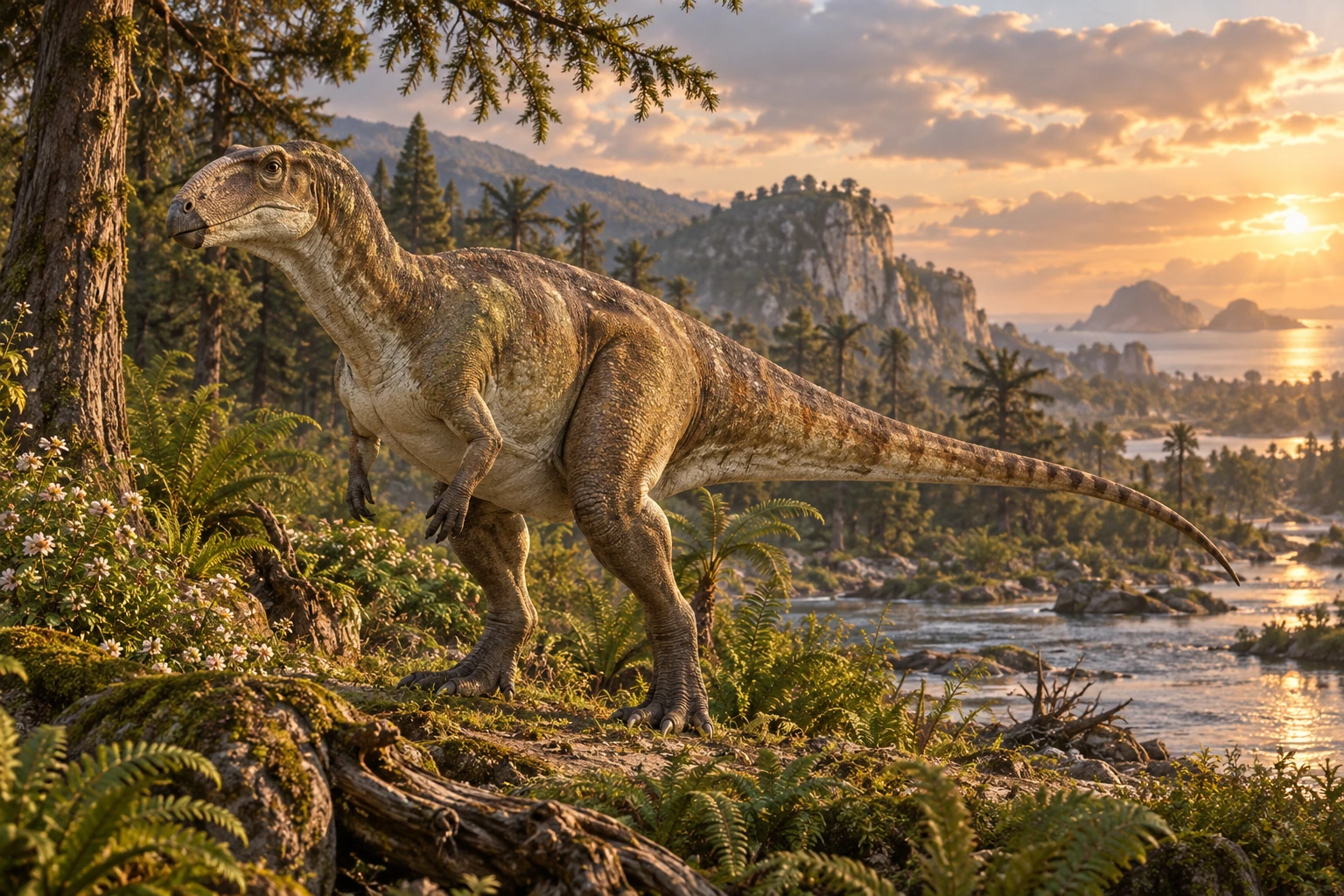
An illustrative reconstruction. Compare its anatomy with the evidence and limitations in the dossier. Lighting, coloration and scenery are artistic choices. This image does not document a fossil locality or behavior.
Original artwork · artistic interpretation.
Scientific view: source-informed reconstruction, credited paleoart or specimen-based imagery. Movie-style view: Original artistic interpretation. Reconstructions involve uncertainty.
MEET THE ANIMAL
Rhabdodon was a plant-eating dinosaur from Late Cretaceous Europe. Its relatives occupied an archipelago, a region made up of islands separated by water. Current research places well-supported Rhabdodon records mainly in France and Spain. It had a stocky build and probably walked mostly on two legs. Historical fossils from other European countries are now assigned to different genera rather than all being pooled under one name. [D1]
Teeth provide an important clue to its diet. Research on rhabdodontids, the family containing Rhabdodon, shows teeth arranged for strong shearing action. Their working surfaces could cut through plant material somewhat like the blades of scissors. Researchers have suggested that fibrous plants suited these jaws. That proposal describes what the teeth could process; it does not show exactly which plant an individual dinosaur ate for its final meal. [D5]
Another clue lies inside the bones. Thin slices studied under a microscope preserve changes in growth and bone remodeling. A detailed comparison found that Rhabdodon maintained rapid growth for longer than some relatives. Such evidence helps researchers distinguish young animals from more mature ones. It also explains why a convenient museum length should not be mistaken for a measured adult maximum or a complete species size range. [D4]
PREHISTORIC ANIMAL DOSSIER
The animal, the evidence, and the questions still open.
Thin sections of bone reveal growth patterns, but skeletal maturation is different from an established breeding age. [D4]
Profile scope: Genus — Rhabdodon; principally R. priscus, also encompassing the debated species R. septimanicus. Other rhabdodontid genera remain distinct. [D1]
Source supported identifies a description documented by the cited source. Inferred marks a reconstruction or functional estimate. Debated marks competing interpretations. Not established means the sources reviewed for this dossier do not support a firm conclusion; it does not mean a behavior never occurred.
A size reference is an estimate, not a population range. Nesting evidence does not by itself establish courtship, mate choice, or lifelong pairing.
About 4 m (educational reference)
Museum value lacks individual scope. Larger adult lengths were modeled from French limb material, with growth-stage interpretation requiring caution. [D2] [D3]
Not established here
The inspected histological study does not supply a maturity-qualified mass estimate adopted for this genus. [D4]
Plant shearing inferred
Rhabdodontid teeth and wear support strong slicing; particular fibrous plants are a feeding hypothesis, not an identified Rhabdodon meal. [D5]
Late Cretaceous European island landscapes
Secure reviewed genus records emphasize France and Spain. Wider family distributions should not be counted as Rhabdodon occurrences. [D1]
Habitual bipedality inferred
The reviewed rhabdodontid body plan supports walking on the hindlimbs; no measured Rhabdodon speed is adopted. [D1]
Stocky body and ridged teeth
A relatively large triangular skull and differentiated upper/lower tooth ridges characterize the reviewed family anatomy. [D1]
Not established here
Bone-growth studies do not identify Rhabdodon eggs, nests, clutch size or demonstrated parental care. [D4]
Not established here
The reviewed growth research and focused searches provide no taxon-specific mate-choice behavior or sex-colored display. [D4]
Not established here
Multi-individual associations discussed for related rhabdodontids cannot automatically establish herds in this genus. [D1]
Sources and inspection notes for the claims in this profile.
THE STORY IN THE FOSSILS
The genus name refers to its teeth. Their shape and wear give a mechanical explanation for plant processing without preserving a complete menu. [5]
Size estimates depend on identifying growth stage as well as scaling bones. A larger fossil is not automatically an older one. [4]
The dossier identifies the scope of each reference estimate. A mount, an individual fossil and a species-wide adult range are different measurements. Comparison metrics remain unavailable where adult scope has not been established. Unknown does not mean zero.
Sources support the stated claims and scopes. Refer to the evidence notes for uncertainty.
KEEP EXPLORING
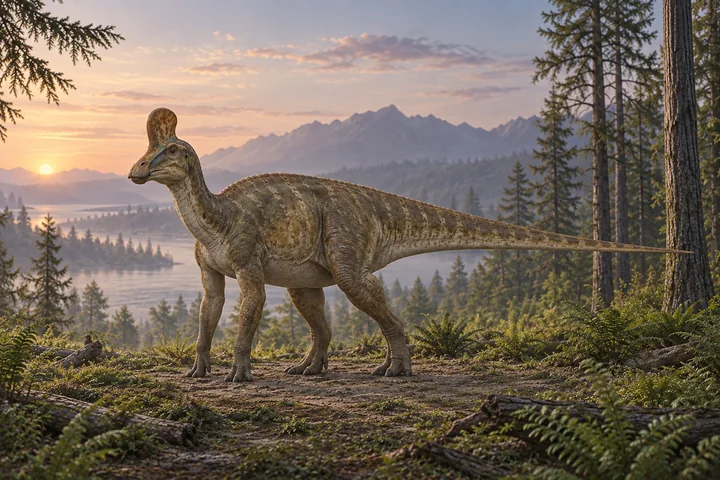
Tsintaosaurus spinorhinus
Tsintaosaurus was a plant-eating hadrosaur whose distinctive crest remains a subject of reconstruction and reassessment.
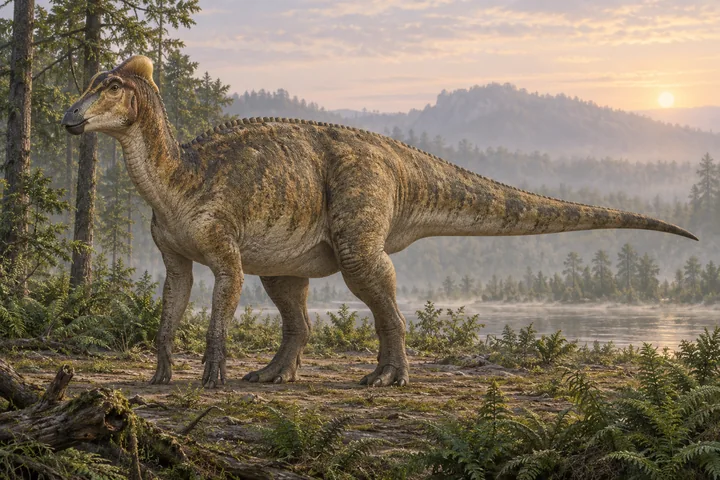
Amurosaurus riabinini
Amurosaurus was a hadrosaur with tooth batteries and skull architecture supporting a hollow crest whose complete shape remains unknown.
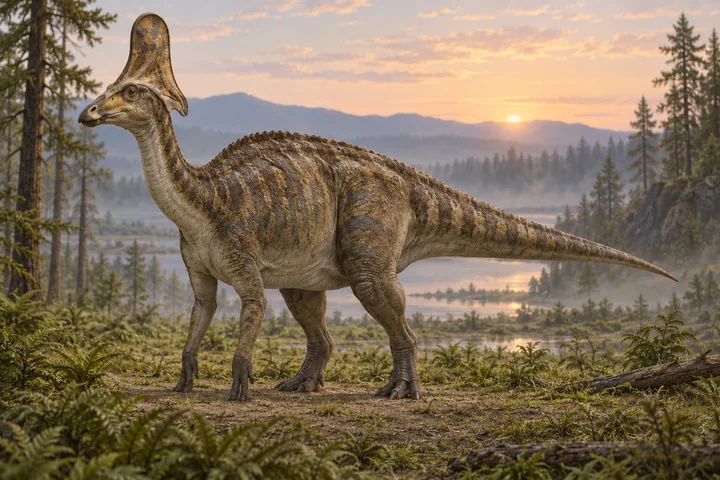
Olorotitan arharensis
Olorotitan was a hollow-crested hadrosaur distinguished by a broad helmet-like crest and an unusually long neck.