EXPLORE PREHISTORY 220 prehistoric animal profiles · Scientific & movie-style image galleries

EXHIBIT 121

Saurornitholestes

Saurornitholestes langstoni

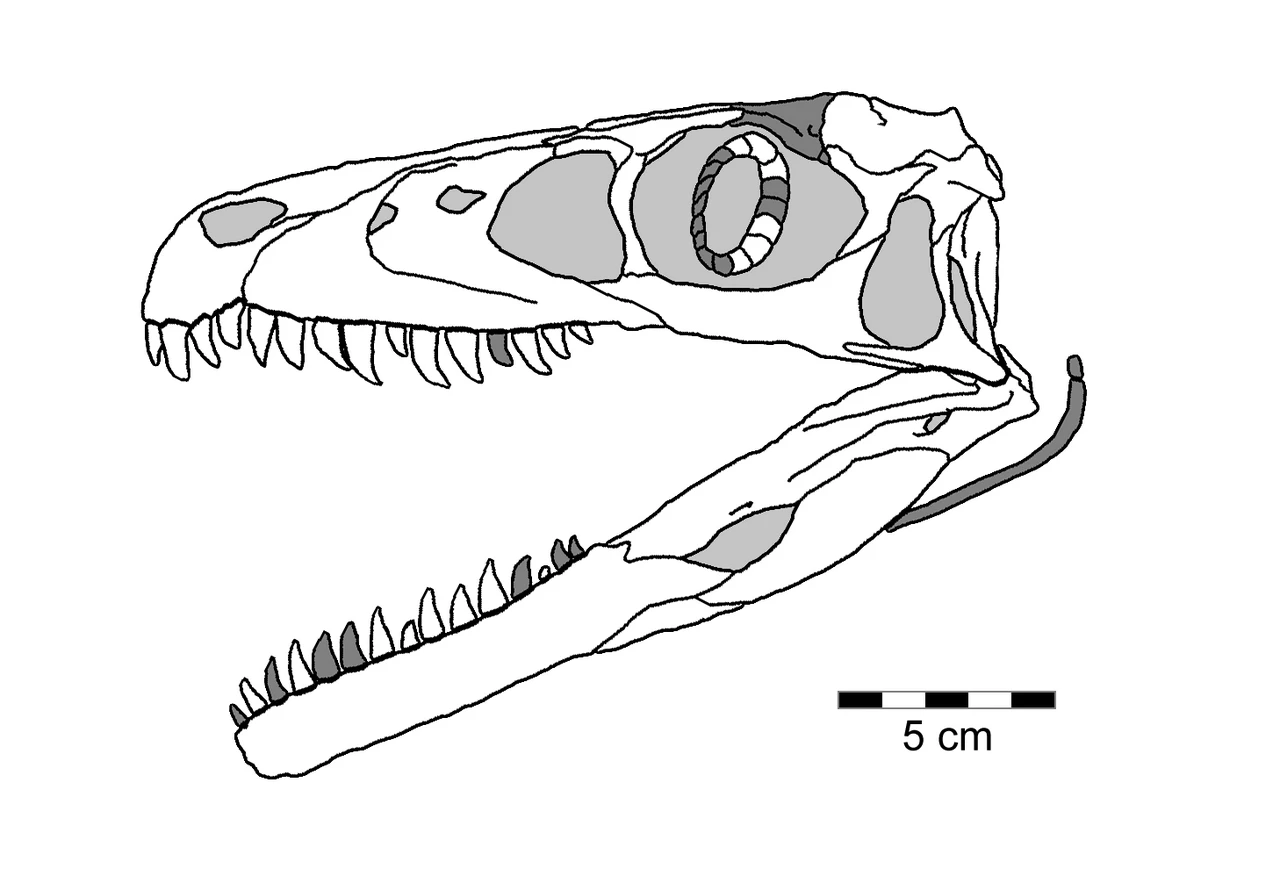
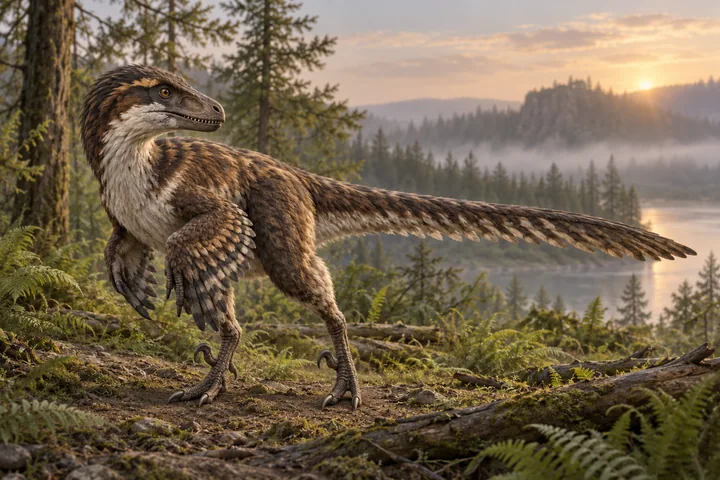
Saurornitholestes has a shorter, deeper skull than Velociraptor. [1]

Evidence profile
PERIODLate Cretaceous[2]
DIETCarnivoreEvidence and uncertainty in the dossier
TOTAL LENGTHSee the dossierEstimate scope matters
FOSSILS FOUNDCanada, USA[3]
CompareRead the dossierView the sources

MEET THE ANIMAL

Meet Saurornitholestes

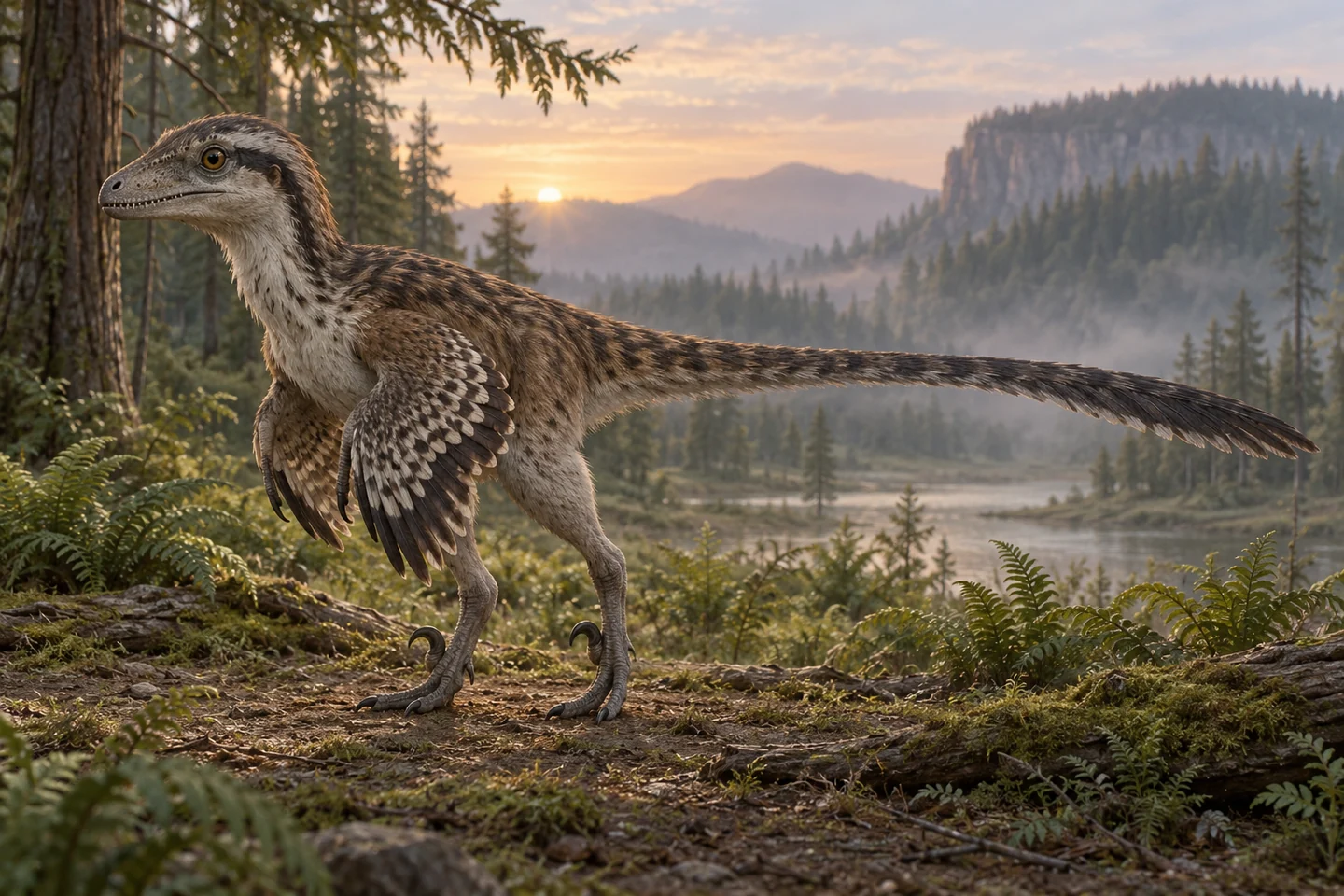
Saurornitholestes langstoni has a shorter, deeper skull than Velociraptor, despite their familiar raptor resemblance. An unusual front tooth has been proposed as a tool for preening, or tending a body covering. That suggested function is not direct evidence of feathers in the studied fossil. Anatomical comparisons can make a familiar-looking dinosaur more distinct while leaving some details unresolved. [D1]

A 2026 conference report describes feeding traces on a Cryodrakon pterosaur bone, including an embedded Saurornitholestes tooth. This is evidence of feeding contact with that bone. It does not establish whether the dinosaur killed the pterosaur or fed on an animal already dead. The preliminary report supplies a concrete interaction without recording the whole sequence that produced it. [D6]

The genus also has a qualified New Mexican record. Saurornitholestes sullivani was named from one skull bone, but later authors questioned whether it belonged in the genus. That uncertainty should remain separate from the well-supported Alberta material. Shared names do not guarantee equivalent evidence: a nearly complete skeleton and a single referred bone answer different questions about the animals they represent. [D3] [D4]

PREHISTORIC ANIMAL DOSSIER

A life in profile.

The animal, the evidence, and the questions still open.

A nearly complete Canadian skeleton improves its anatomy. A pterosaur bone with an embedded tooth provides feeding evidence, without showing how the pterosaur died. [D1] [D6]

Profile scope: Genus — Saurornitholestes; anatomical detail focuses on S. langstoni, with the questioned S. sullivani referral separated. [D4]

Time
Late Cretaceous
Fossil locations in this exhibit
Canada, USA
How to read the evidence

Source supported identifies a description documented by the cited source. Inferred marks a reconstruction or functional estimate. Debated marks competing interpretations. Not established means the sources reviewed for this dossier do not support a firm conclusion; it does not mean a behavior never occurred.

A size reference is an estimate, not a population range. Nesting evidence does not by itself establish courtship, mate choice, or lifelong pairing.

Body length

Inferred

A little under 2 m (restored individual)

The 2019/2020 paper restores S. langstoni UALVP55700, including its missing tail tip. Histology describes it as almost mature and at least eight years old; this is not an adult maximum. [D2]
Body mass

Inferred

About 18 kg (limb-scaling model)

S. langstoni TMP1988.121.0039, from measured femoral circumference; maturity is unestablished, and this is not UALVP55700. [D7]

Diet and feeding

Source supported

Direct pterosaur feeding contact

A conference redescription reports nine tibial traces and an embedded S. langstoni tooth in the Cryodrakon type. Feeding on the bone does not establish active predation rather than scavenging. [D6]

Habitat and setting

Source supported

Dinosaur Park and qualified New Mexican records

S. langstoni is represented in Alberta. S. sullivani was named from a single frontal in New Mexico's Kirtland Formation; its generic assignment remains questioned. [D3] [D4]

Movement

Inferred

Two-legged dromaeosaurid reconstruction

The near-complete skeleton supports hindlimb locomotion. The skull description does not establish a top speed or prove a particular sickle-claw attack sequence. [D2]

Recognizable anatomy

Source supported

Shorter, deeper skull and unusual front tooth

Cranial differences distinguish it from Velociraptor. The proposed preening function of one premaxillary tooth is an interpretation, not direct proof of feathers in this fossil. [D1]

Reproduction & life together

Reproduction and nesting

Not established

Not established here

Almost-mature histology in UALVP55700 does not identify sexual maturity. Focused searches did not establish an assigned egg clutch, nest or parental-care sequence. [D2]

Mating and courtship

Not established

Not established here

Reviewed skull/frontal studies do not document mate choice, pairing or a courtship ritual. No sex-specific display structure was securely established.

Social behavior

Not established

Not established here

Neither an embedded tooth nor an illustrated pair establishes cooperative hunting. Focused social searches found no secure genus-specific demonstration of a stable pack. [D6]

Dossier research & sources

Sources and inspection notes for the claims in this profile.

  1. Paleontologists discover complete Saurornitholestes langstoni specimenUniversity of Alberta · Accessed 2026-10-02Institutional author interview inspected: new S. langstoni skeleton, shorter/deeper skull than Velociraptor and proposed preening function of an unusual tooth. This is not direct fossil plumage evidence. · Inspected: page
  2. Cranial Anatomy of New Specimens of Saurornitholestes langstoni (Dinosauria, Theropoda, Dromaeosauridae) from the Dinosaur Park Formation (Campanian) of AlbertaThe Anatomical Record · Accessed 2026-10-02Original full paper inspected, online 2019/issue 2020: UALVP 55700 nearly complete skeleton, length a little under 2 m, histology almost mature at least 8 years, skull/dental anatomy and distinction between Dinosaur Park Zapsalis-like teeth and the Montana type. · Inspected: page
  3. A new dromaeosaurid (Theropoda: Dromaeosauridae) from the Late Cretaceous of New MexicoNew Mexico Museum of Natural History and Science Bulletin 67 / author-posted original paper · Accessed 2026-10-02Original paper sections inspected: S. sullivani, single frontal SMPVP 1270, Kirtland Formation De-na-zin Member and skull comparisons. An illustration of a pair attacking prey is not pack evidence. · Inspected: excerpt
  4. Osteology and reassessment of Dineobellator notohesperus, a southern eudromaeosaur from the latest Cretaceous of New MexicoThe Anatomical Record / author-posted original paper · Accessed 2026-10-02Original author-posted paper relevant diversity/S. sullivani sections inspected. Authors question whether its frontal belongs in Saurornitholestes; no replacement genus is adopted in that passage. · Inspected: excerpt
  5. Dinevenator, a New Genus of Troodontid Dinosaur from the Late Cretaceous of New Mexico, United StatesFossils · Accessed 2026-10-02Original 2026 publisher-indexed abstract and taxonomic sections inspected: Saurornitholestes robustus reassigned to troodontid Dinevenator robustus. A species transfer is not whole-genus synonymy. · Inspected: excerpt
  6. Characterizing dromaeosaurid feeding traces, and repeated occurrence on azhdarchid bonesCanadian Society of Vertebrate Palaeontology 2026 / Vertebrate Anatomy Morphology Palaeontology 14 · Accessed 2026-10-02Caleb Brown original conference abstract, pp 20–21, inspected in abstract volume. Cryodrakon type TMP 1992.083.0002 tibial traces include an embedded S. langstoni tooth; preliminary evidence establishes feeding contact, not active killing. · Inspected: abstract
  7. Rates of Dinosaur Body Mass Evolution Indicate 170 Million Years of Sustained Ecological Innovation on the Avian Stem Lineage — Dataset S1PLOS Biology · Accessed 2026-10-02Original Dataset S 1 inspected: S. langstoni TMP 88.121.39, measured femoral circumference 63 mm, modeled 18.0442 kg. This is not UALVP 55700 and adult maturity is not independently demonstrated. · Inspected: page
  8. Pennaraptoran SystematicsBulletin of the American Museum of Natural History440 / IVPP institutional copy · Accessed 2026-10-02Original2020 chapter PDF relevant systematic passage inspected directly, printedp17/PDFp11. Bambiraptor and Saurornitholestes distinction rests on few traits known to change ontogenetically. The chapter also retains both in phylogenetic trees; uncertainty is reserved, not declared settled synonymy. Volume DOI10.1206/0003-0090.440.1.1. · Inspected: excerpt

THE STORY IN THE FOSSILS

Feeding contact preserved in a bone.

A Saurornitholestes tooth lodged in a Cryodrakon bone anchors a rare feeding interaction. A 2026 conference abstract adds a detailed account of the traces, while the animal’s method of obtaining that food remains unresolved. [6]

UALVP55700’s restored length and TMP1988.121.0039’s modeled mass describe different individuals. [2] [7]

A note on scale and time

The dossier identifies the scope of each reference estimate. A mount, an individual fossil and a species-wide adult range are different measurements. Comparison metrics remain unavailable where adult scope has not been established. Unknown does not mean zero.

Sources & editorial notes

Sources support the stated claims and scopes. Refer to the evidence notes for uncertainty.

  1. Paleontologists discover complete Saurornitholestes langstoni specimenUniversity of Alberta · Accessed 2026-10-02Institutional author interview inspected: new S. langstoni skeleton, shorter/deeper skull than Velociraptor and proposed preening function of an unusual tooth. This is not direct fossil plumage evidence. · Inspected: page
  2. Cranial Anatomy of New Specimens of Saurornitholestes langstoni (Dinosauria, Theropoda, Dromaeosauridae) from the Dinosaur Park Formation (Campanian) of AlbertaThe Anatomical Record · Accessed 2026-10-02Original full paper inspected, online 2019/issue 2020: UALVP 55700 nearly complete skeleton, length a little under 2 m, histology almost mature at least 8 years, skull/dental anatomy and distinction between Dinosaur Park Zapsalis-like teeth and the Montana type. · Inspected: page
  3. A new dromaeosaurid (Theropoda: Dromaeosauridae) from the Late Cretaceous of New MexicoNew Mexico Museum of Natural History and Science Bulletin 67 / author-posted original paper · Accessed 2026-10-02Original paper sections inspected: S. sullivani, single frontal SMPVP 1270, Kirtland Formation De-na-zin Member and skull comparisons. An illustration of a pair attacking prey is not pack evidence. · Inspected: excerpt
  4. Osteology and reassessment of Dineobellator notohesperus, a southern eudromaeosaur from the latest Cretaceous of New MexicoThe Anatomical Record / author-posted original paper · Accessed 2026-10-02Original author-posted paper relevant diversity/S. sullivani sections inspected. Authors question whether its frontal belongs in Saurornitholestes; no replacement genus is adopted in that passage. · Inspected: excerpt
  5. Dinevenator, a New Genus of Troodontid Dinosaur from the Late Cretaceous of New Mexico, United StatesFossils · Accessed 2026-10-02Original 2026 publisher-indexed abstract and taxonomic sections inspected: Saurornitholestes robustus reassigned to troodontid Dinevenator robustus. A species transfer is not whole-genus synonymy. · Inspected: excerpt
  6. Characterizing dromaeosaurid feeding traces, and repeated occurrence on azhdarchid bonesCanadian Society of Vertebrate Palaeontology 2026 / Vertebrate Anatomy Morphology Palaeontology 14 · Accessed 2026-10-02Caleb Brown original conference abstract, pp 20–21, inspected in abstract volume. Cryodrakon type TMP 1992.083.0002 tibial traces include an embedded S. langstoni tooth; preliminary evidence establishes feeding contact, not active killing. · Inspected: abstract
  7. Rates of Dinosaur Body Mass Evolution Indicate 170 Million Years of Sustained Ecological Innovation on the Avian Stem Lineage — Dataset S1PLOS Biology · Accessed 2026-10-02Original Dataset S 1 inspected: S. langstoni TMP 88.121.39, measured femoral circumference 63 mm, modeled 18.0442 kg. This is not UALVP 55700 and adult maturity is not independently demonstrated. · Inspected: page
  8. Pennaraptoran SystematicsBulletin of the American Museum of Natural History440 / IVPP institutional copy · Accessed 2026-10-02Original2020 chapter PDF relevant systematic passage inspected directly, printedp17/PDFp11. Bambiraptor and Saurornitholestes distinction rests on few traits known to change ontogenetically. The chapter also retains both in phylogenetic trees; uncertainty is reserved, not declared settled synonymy. Volume DOI10.1206/0003-0090.440.1.1. · Inspected: excerpt

FOLLOW YOUR CURIOSITY

Who will you meet next?

KEEP EXPLORING

More from the collection

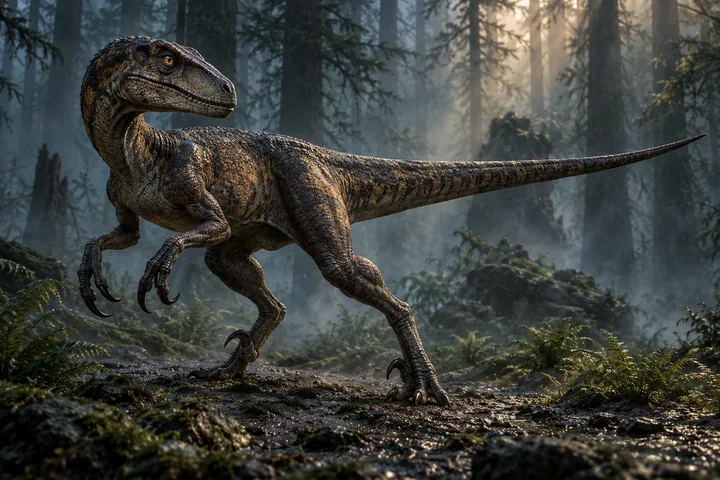
Scaly featherless raptor in a dark forest, with a long level tail, grasping hands and a raised curved toe claw.
Movie-style interpretation
Late Cretaceous

Velociraptor

Velociraptor mongoliensis

Velociraptor mongoliensis was a lightly built meat-eater from Late Cretaceous Mongolia. Its long limbs, teeth and enlarged foot claws made it distinctive, while the Fighting Dinosaurs specimen records a remarkable interaction with a horned dinosaur.