
Body length
InferredAbout 1.2 m (museum reference)
This rounded profile number has no named individual or maturity assessment. It is not a verified maximum for the species. [D1]
EXHIBIT 82
Scutellosaurus lawleri
Scutellosaurus paired small bony armor with a lightly built body and predominantly bipedal movement.
TWO WAYS TO PICTURE THE PAST
Compare the evidence with the familiar movie image. The illustrations are not to a shared scale.
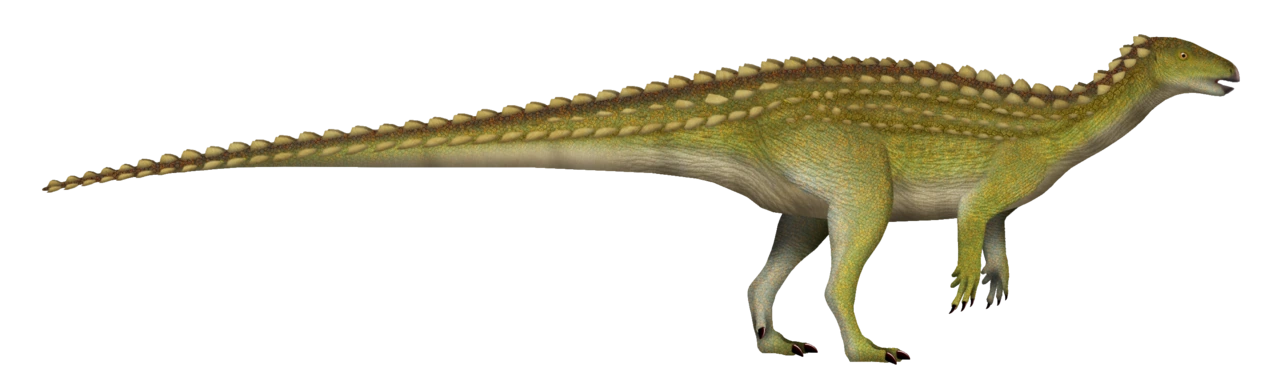
Life reconstruction of Scutellosaurus lawleri by TotalDino. Its fossils include numerous small osteoderms, but their complete arrangement, soft tissues and colors require interpretation. [2]
Scutellosaurus TD.png · TotalDino. CC BY 4.0. Commons-listed 1280px current preview resized proportionally for the thumbnail and converted to WebP; no anatomical edits. Same source license applies.
Scientific reconstruction is an interpretation; source credit does not certify every anatomical detail.
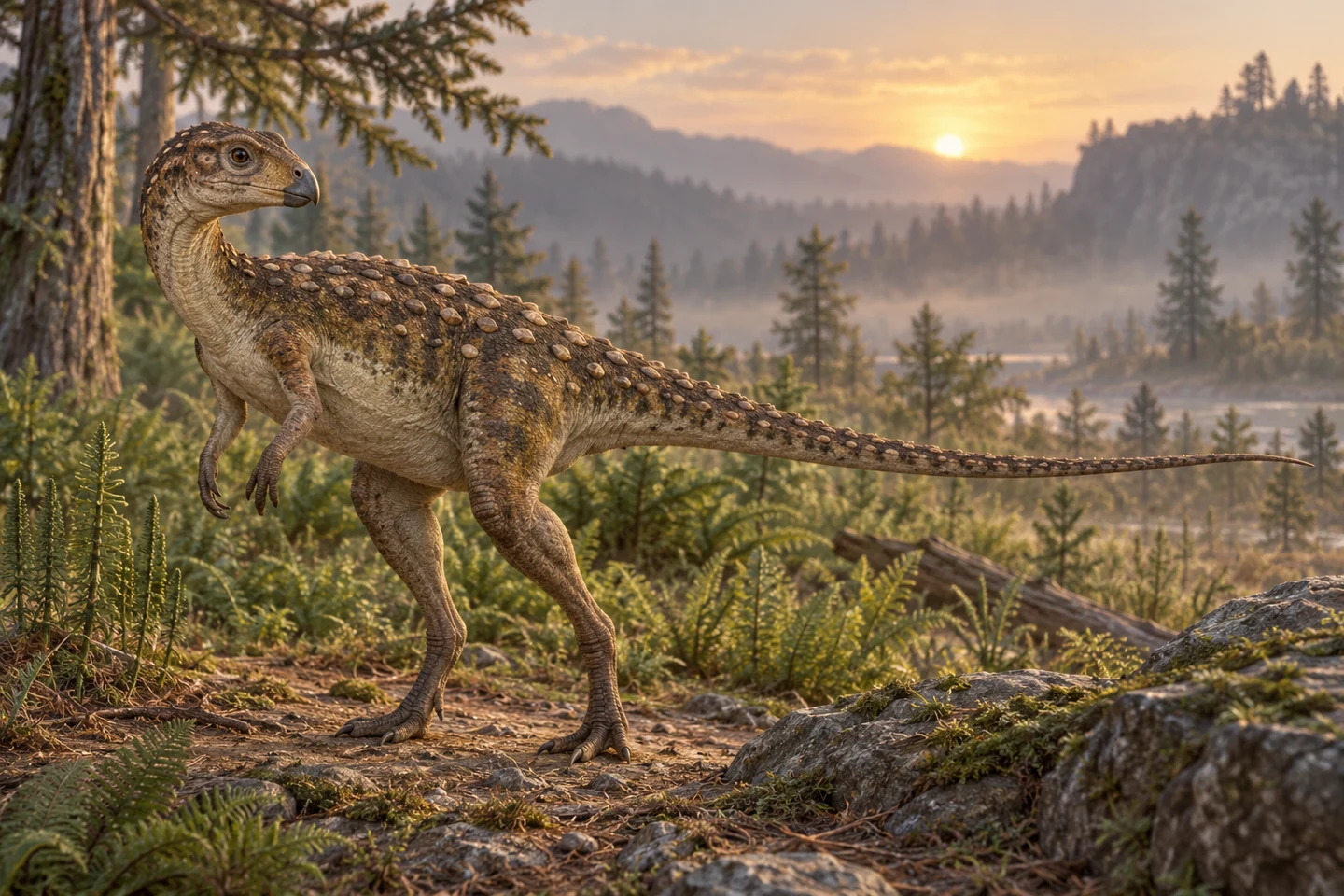
Original cinematic interpretation of Scutellosaurus lawleri. Coloration, soft tissues and scenery are artistic choices; reconstructed proportions do not establish a measured individual. Lighting, coloration and scenery are artistic choices. This image does not document a fossil locality or behavior.
Original artwork · artistic interpretation.
Scientific view: source-informed reconstruction, credited paleoart or specimen-based imagery. Movie-style view: Original artistic interpretation. Reconstructions involve uncertainty.
MEET THE ANIMAL
Scutellosaurus was a small plant-eating dinosaur from Early Jurassic Arizona. Its fossils occur in the Kayenta Formation. Unlike the heavy armored dinosaurs familiar from many reconstructions, it had a slender body and numerous small bony scutes. Its appearance makes it especially useful for understanding an early form of the armored dinosaur body plan. [D1] [D4]
The scutes are osteoderms, bones formed within the skin. Their individual shapes are preserved more clearly than their full arrangement on a living animal. A reconstruction should therefore avoid turning Scutellosaurus into a small copy of a later dinosaur with tall plates or a large tail club. Its own skeletal and armor evidence need to guide the outline. [D2]
Researchers used computer models to test two-legged and four-legged movement. The models allow four-legged movement without showing a performance advantage over two legs. The result separates possible movement from likely usual posture. It depends on restored anatomy and muscle properties, rather than a fossil recording the animal moving. [D3]
PREHISTORIC ANIMAL DOSSIER
The animal, the evidence, and the questions still open.
Its fossils and locomotor models document an early stage in armored dinosaur evolution.
Profile scope: Species — Scutellosaurus lawleri; specimen estimates are distinguished from species size.
Source supported identifies a description documented by the cited source. Inferred marks a reconstruction or functional estimate. Debated marks competing interpretations. Not established means the sources reviewed for this dossier do not support a firm conclusion; it does not mean a behavior never occurred.
A size reference is an estimate, not a population range. Nesting evidence does not by itself establish courtship, mate choice, or lifelong pairing.
About 1.2 m (museum reference)
This rounded profile number has no named individual or maturity assessment. It is not a verified maximum for the species. [D1]
About 4.65 kg for one reconstructed model
The estimate concerns a model based on holotype MNA.V.175 with missing parts reconstructed. Maturity was not established for this comparison; it is not a measured individual or normal adult range. [D3]
Plant-eating
The museum identifies Scutellosaurus as herbivorous. Tooth and jaw anatomy informs feeding interpretation; the reviewed sources do not identify particular habitual foods. [D1]
Kayenta Formation, Arizona
Numerous specimens place the species in these Lower Jurassic continental deposits. Occurrence does not establish a single preferred habitat or that all specimens lived together. [D4]
Predominantly bipedal
Computer models permit four-legged motion, but do not find a performance advantage over bipedal movement. The result depends on reconstructed anatomy and muscle properties, rather than preserved movement. [D3]
Small osteoderms and a long-tailed skeleton
Fossils preserve numerous small bony scutes and slender proportions. Their complete arrangement remains uncertain; reconstruction should not add tall plates, a tail club or heavy ankylosaur-like armor. [D2]
Not established here
The reviewed anatomy, histology and locomotor sources do not establish species-specific eggs, nest structure, reproductive timing or parental care.
Not established here
No mating ritual, pairing system or sex-specific display is demonstrated in the inspected species studies.
Not established here
The inspected sources describe numerous individuals across collections and localities, but do not establish a social aggregation, herd organization or solitary living.
Sources and inspection notes for the claims in this profile.
THE STORY IN THE FOSSILS
Its numerous small osteoderms make Scutellosaurus recognizably armored, yet its slender skeleton differs from later massive thyreophorans. Those scutes preserve individual shapes more securely than their complete layout on a living body. [2]
A locomotor model asks whether this animal could walk on four legs. Possibility and preference differ: the simulations allow quadrupedal motion while favoring bipedal performance. Reconstructed muscle properties remain part of that conclusion. [3]
The dossier identifies the scope of each reference estimate. A mount, an individual fossil and a species-wide adult range are different measurements. Comparison metrics remain unavailable where adult scope has not been established. Unknown does not mean zero.
Sources support the stated claims and scopes. Refer to the evidence notes for uncertainty.
KEEP EXPLORING
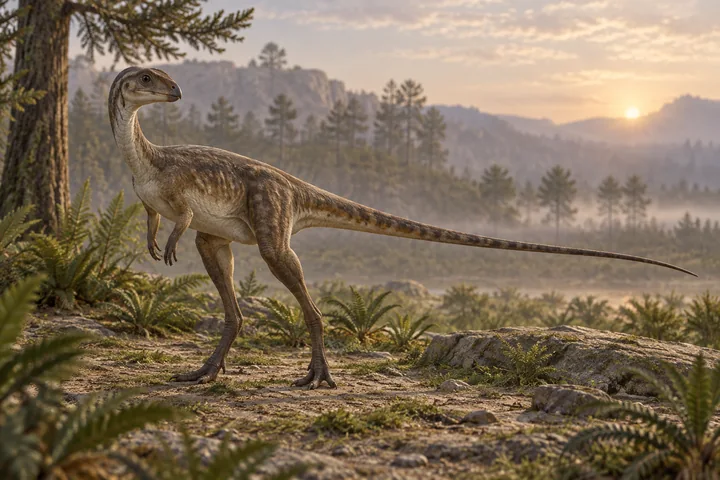
Lesothosaurus diagnosticus
Lesothosaurus was a small early ornithischian.
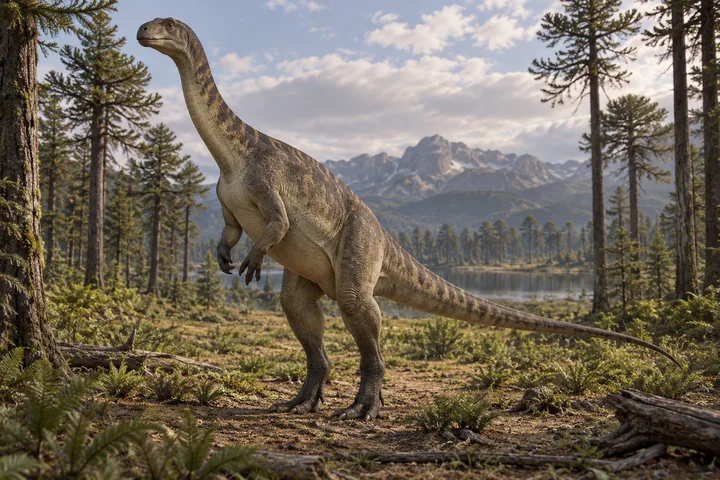
Mussaurus patagonicus
Mussaurus grew from tiny hatchlings into large sauropodomorphs. Eggs and clustered skeletons from Patagonia provide unusually rich evidence for nesting and age-related social organization.
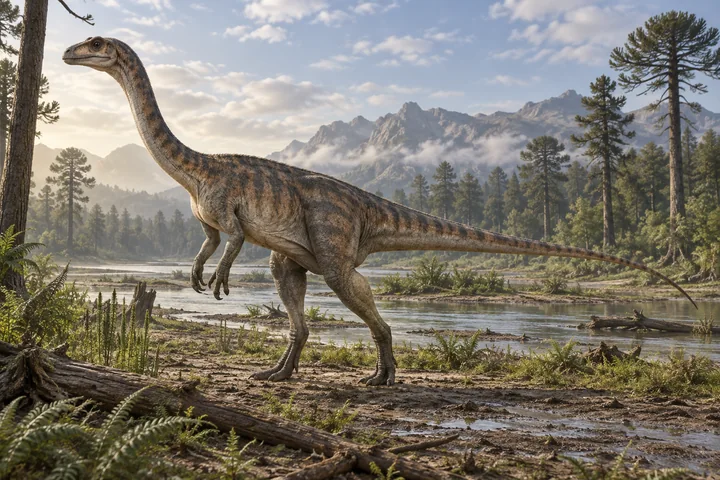
Massospondylus carinatus
Massospondylus was a southern African sauropodomorph with a long neck and a prominent thumb claw. Preserved eggs, embryos and nesting grounds illuminate reproduction while young-animal posture remains debated.