
Body length
Not establishedNot established here
No directly comparable adult total-length estimate was established in the inspected primary sources. Hatchling measurements must not stand in for adults.
EXHIBIT 61
Mussaurus patagonicus
Mussaurus grew from tiny hatchlings into large sauropodomorphs. Eggs and clustered skeletons from Patagonia provide unusually rich evidence for nesting and age-related social organization.
TWO WAYS TO PICTURE THE PAST
Compare the evidence with the familiar movie image. The illustrations are not to a shared scale.
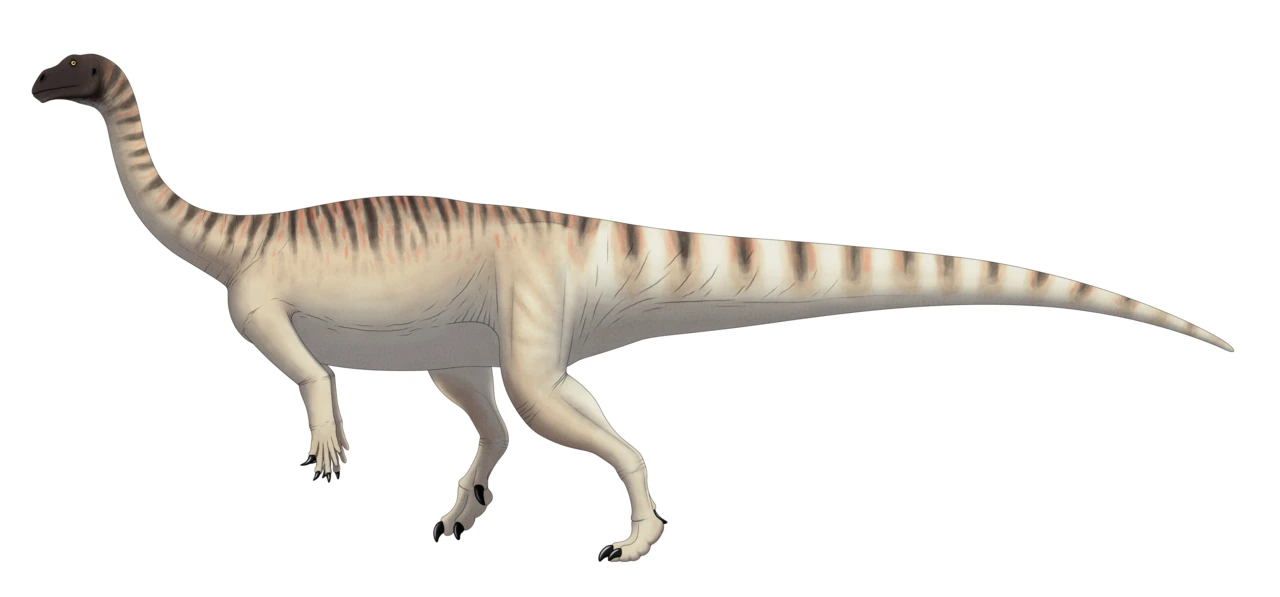
Adult Mussaurus patagonicus reconstruction by Sauropodomorph, based on the skeletal reconstruction in Otero and colleagues' 2019 study. Missing parts and soft tissues are restored; pale colors and striping are speculative. [2]
Mussaurus patagonicus life restoration.png · Sauropodomorph at English Wikipedia. CC BY-SA 4.0. Commons-listed 1280px preview converted to WebP; 640px thumbnail generated. Composition and colors unchanged.
Scientific reconstruction is an interpretation; source credit does not certify every anatomical detail.
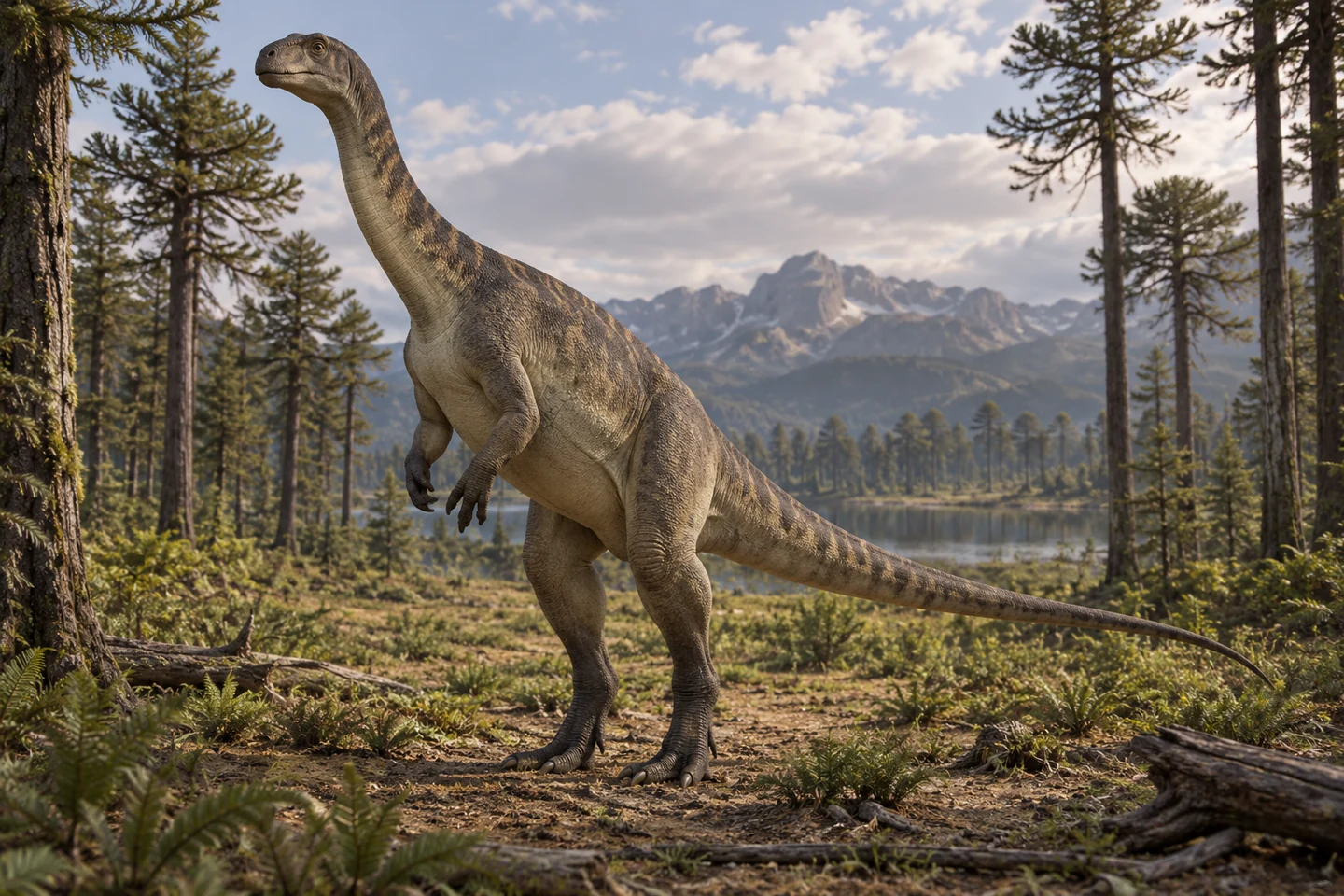
Original cinematic interpretation of Mussaurus. Anatomy, soft tissues and colors are reconstructed choices. Lighting, coloration and scenery are artistic choices. This image does not document a fossil locality or behavior.
Original artwork · artistic interpretation.
Scientific view: source-informed reconstruction, credited paleoart or specimen-based imagery. Movie-style view: Original artistic interpretation. Reconstructions involve uncertainty.
MEET THE ANIMAL
Mussaurus patagonicus was a plant-eating early dinosaur from Patagonia, Argentina. Its name means mouse lizard because the first small skeletons were initially mistaken for miniature dinosaurs. Larger fossils later revealed a very different adult animal. At one Early Jurassic locality, eggs, embryos, young animals and adults give researchers an exceptional opportunity to compare several stages of life in the same dinosaur. [S1]
Digital models suggest that young Mussaurus used four legs, while adults shifted toward walking on two. The change followed a rearward movement of the centre of mass as proportions developed. A hatchling’s head, neck, tail and limbs cannot simply be enlarged to create an adult. These movement results are interpretations of restored growth-stage models, rather than observed walking. [D2]
More than a hundred eggs were recovered, and X-ray scans identified embryos inside some. Nearby skeletons were grouped by age, with young animals clustered separately from adults. Researchers interpreted the arrangement as communal nesting and an organized social structure. That explanation concerns this fossil locality; it does not reveal mating rituals or prove that every Mussaurus population lived identically. The physical arrangement and the proposed living behavior remain distinct kinds of evidence. [S1]
PREHISTORIC ANIMAL DOSSIER
The animal, the evidence, and the questions still open.
Mussaurus offers a rare profile across growth: embryos, hatchlings, juveniles and adults occur at the same Patagonian fossil locality.
Profile scope: Species — Mussaurus patagonicus; local assemblage behavior and reconstructed growth stages, not a universal species-wide life history.
Source supported identifies a description documented by the cited source. Inferred marks a reconstruction or functional estimate. Debated marks competing interpretations. Not established means the sources reviewed for this dossier do not support a firm conclusion; it does not mean a behavior never occurred.
A size reference is an estimate, not a population range. Nesting evidence does not by itself establish courtship, mate choice, or lifelong pairing.
Not established here
No directly comparable adult total-length estimate was established in the inspected primary sources. Hatchling measurements must not stand in for adults.
About 1.5 tonnes (large sampled adult)
The largest sampled individual's limb-scaling estimate is about 1,505 kg. Histology indicates slowed growth; this is not a species-wide range. [D1]
Plant eating
The research team's museum account identifies these early sauropodomorphs as herbivores; specific plants eaten are not established. [D3]
Laguna Colorada, Patagonia
The assemblage occurs in Argentina's Santa Cruz Province; sediments indicate a seasonal setting near a floodplain pond. [D1]
Four-legged young; bipedal adults inferred
Growth-stage digital models shift the centre of mass rearward. Adult models combine individuals and reconstruct missing parts. [D2]
A body plan transformed by growth
The fossil series records changing head, neck, tail and limb proportions; adult form cannot simply be scaled from a hatchling. [D2]
Eggs, embryos and a nesting assemblage
More than 100 eggs include diagnostic embryos. Colonial nesting is an interpretation of their spatial and stratigraphic association. [D1]
Not established here
The nesting assemblage does not reveal mating rituals, mate choice, pair bonds or the sex composition of groups.
Age-grouped aggregation; herd structure inferred
Clusters include similar-aged juveniles, with other age classes nearby. Authors infer social cohesion and age segregation at this locality. [D1]
Sources and inspection notes for the claims in this profile.
THE STORY IN THE FOSSILS
Mussaurus was first understood from very young animals. Later adult finds and digital models revealed dramatic growth and a proposed transition from four-legged young to bipedal adults. [2]
The rich Laguna Colorada assemblage includes eggs and multiple age classes. Its patterned associations support a local social-life interpretation, while courtship and individual parenting remain unresolved. [1]
The dossier identifies the scope of each reference estimate. A mount, an individual fossil and a species-wide adult range are different measurements. Comparison metrics remain unavailable where adult scope has not been established. Unknown does not mean zero.
Sources support the stated claims and scopes. Refer to the evidence notes for uncertainty.
KEEP EXPLORING
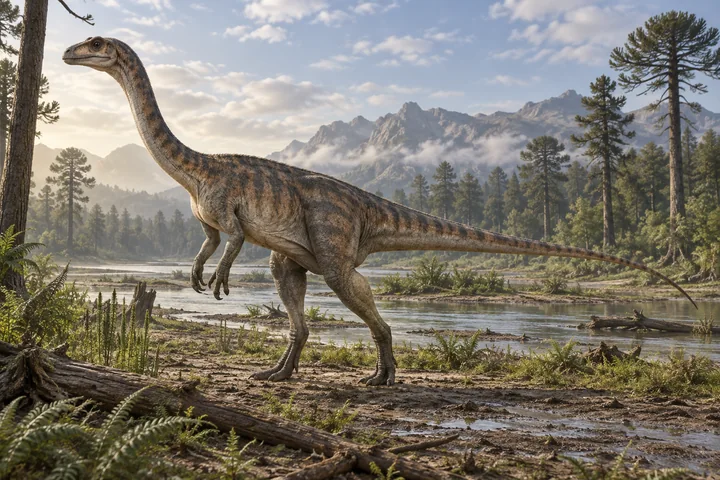
Massospondylus carinatus
Massospondylus was a southern African sauropodomorph with a long neck and a prominent thumb claw. Preserved eggs, embryos and nesting grounds illuminate reproduction while young-animal posture remains debated.
Lufengosaurus huenei
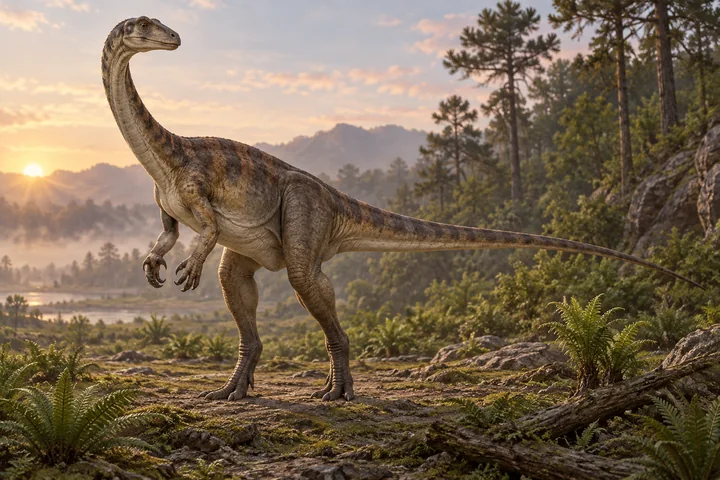
Lufengosaurus combines well-known adult skeletons with embryonic and hatchling evidence that tests hypotheses of dependence.
Heterodontosaurus tucki
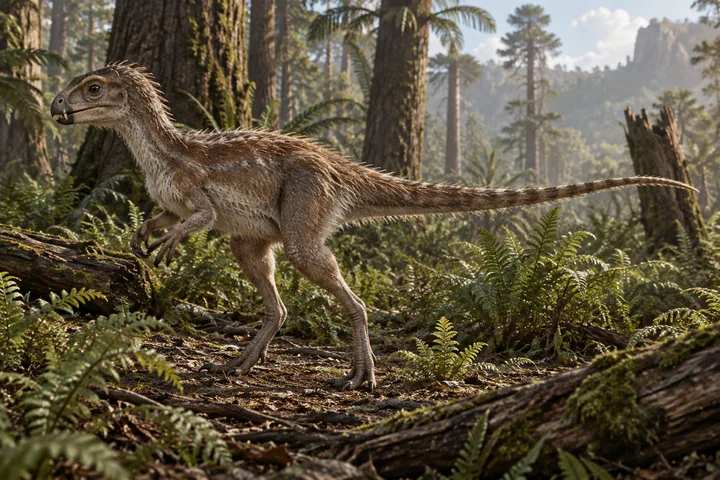
Heterodontosaurus was a small southern African ornithischian with contrasting tooth types. Its tusk-like teeth, chewing adaptations and unusual chest anatomy open different windows onto its biology.