
Body length
InferredAbout 1.2 m (museum reference)
The museum's rounded reconstruction reference is not a species-wide range or an individually assessed maturity measurement. [D1]
EXHIBIT 63
Heterodontosaurus tucki
Heterodontosaurus was a small southern African ornithischian with contrasting tooth types. Its tusk-like teeth, chewing adaptations and unusual chest anatomy open different windows onto its biology.
TWO WAYS TO PICTURE THE PAST
Compare the evidence with the familiar movie image. The illustrations are not to a shared scale.
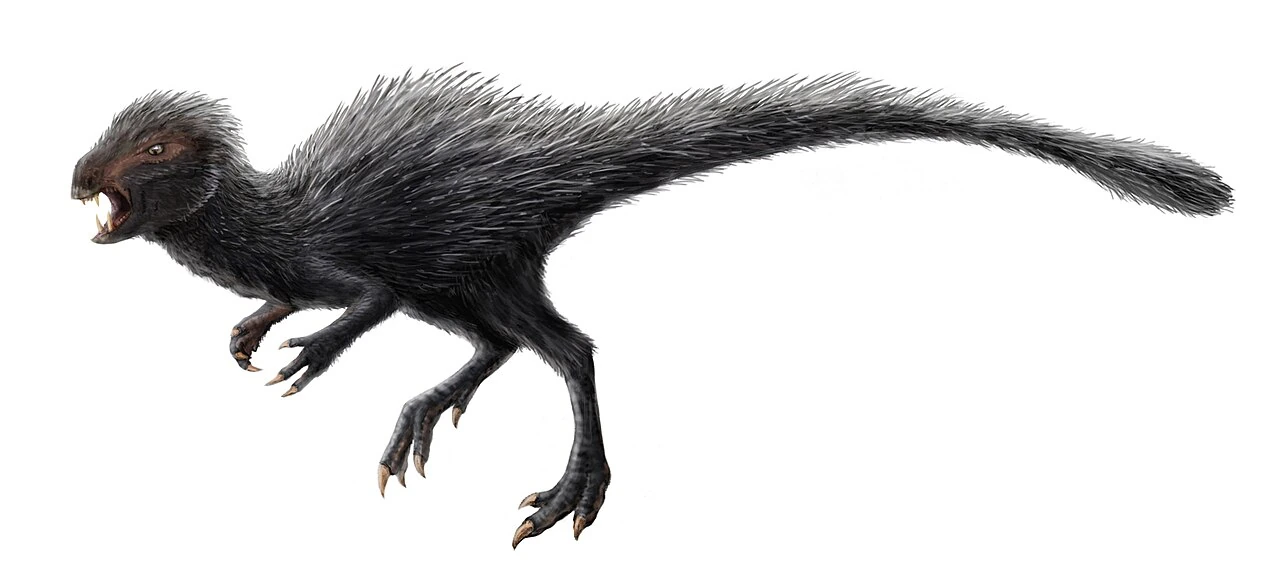
Life reconstruction of Heterodontosaurus tucki by FunkMonk. The bristly covering is inferred from the related Tianyulong, rather than preserved on this species. Missing parts, soft tissues and colors are reconstructed. [2]
Heterodontosaurus restoration.jpg · FunkMonk. CC BY-SA 3.0. Commons-listed 1280px preview converted to WebP; 640px thumbnail generated. Composition and colors unchanged.
Scientific reconstruction is an interpretation; source credit does not certify every anatomical detail.
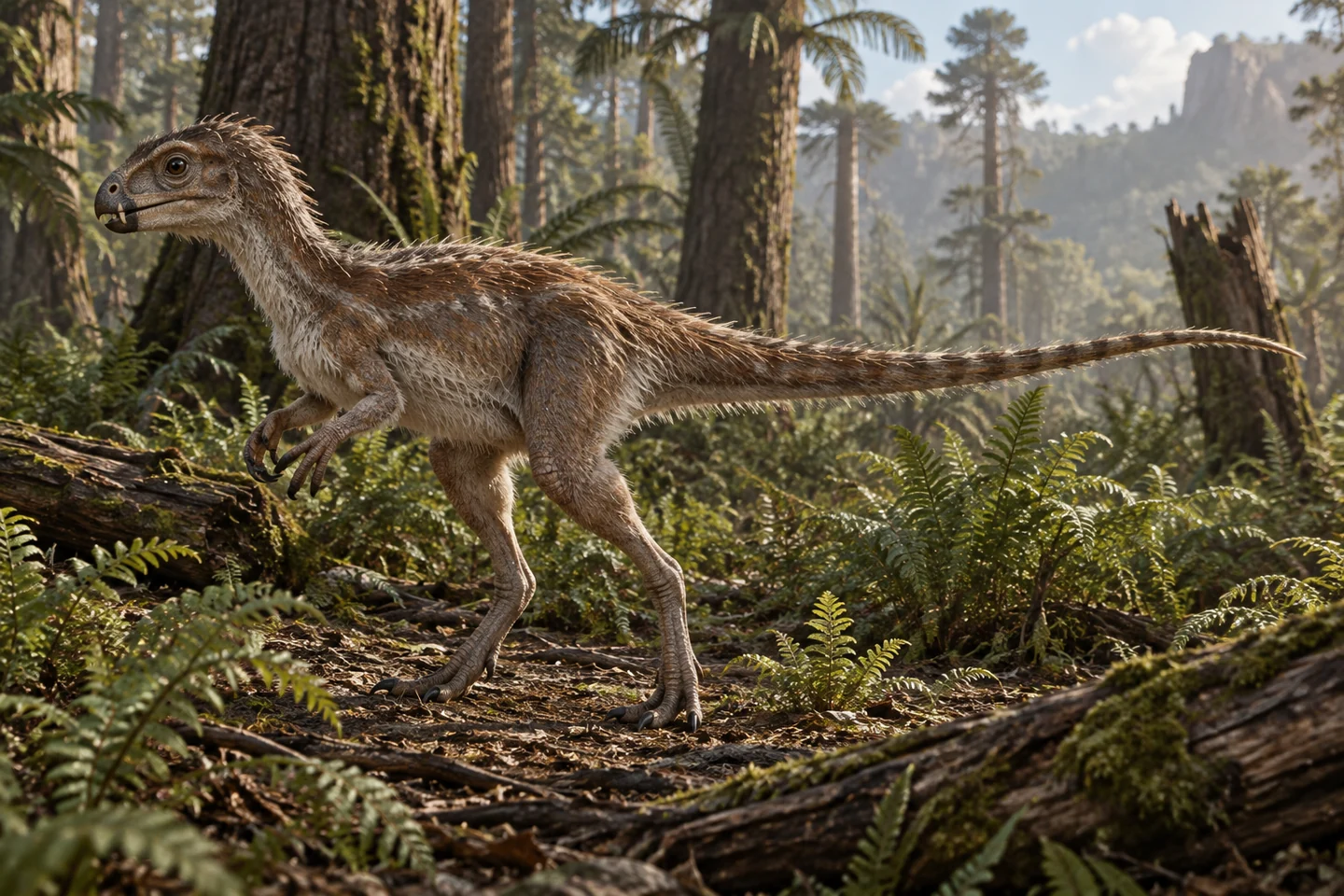
Original cinematic interpretation of Heterodontosaurus. Anatomy, soft tissues and colors are reconstructed choices. Lighting, coloration and scenery are artistic choices. This image does not document a fossil locality or behavior.
Original artwork · artistic interpretation.
Scientific view: source-informed reconstruction, credited paleoart or specimen-based imagery. Movie-style view: Original artistic interpretation. Reconstructions involve uncertainty.
MEET THE ANIMAL
Heterodontosaurus tucki lived in Early Jurassic southern Africa. Even a juvenile skull carried well-developed tusk-like teeth. That discovery matters because it shows that these impressive teeth were not restricted to fully grown animals. Their presence in a young individual makes a simple explanation as an adult sexual display less convincing. [D3]
Its name reflects the different kinds of teeth in its mouth. Tusk-like teeth contrasted with specialized cheek teeth used for processing food. A detailed review interpreted tooth wear and feeding anatomy as support for mainly or entirely plant-eating heterodontosaurids. The family-level dietary argument should still be distinguished from what is preserved in a particular Heterodontosaurus individual. Fierce-looking tusks alone are not proof of hunting. [D2]
Another specimen preserves unusual chest anatomy, including paddle-shaped ribs near the breastbone and ribs in the belly region. Researchers use these features to investigate how the animal breathed. The skeleton also underpins a two-legged body reconstruction, without recording a running speed. These fossils make Heterodontosaurus more than a distinctive face: they provide clues to the workings of its body as well. [D4]
PREHISTORIC ANIMAL DOSSIER
The animal, the evidence, and the questions still open.
Heterodontosaurus combined tusk-like teeth with specialized cheek teeth. Its striking appearance does not, by itself, reveal courtship or a predatory lifestyle.
Profile scope: Species — Heterodontosaurus tucki; distinguishes specimen anatomy, broader heterodontosaurid dietary arguments and uncertain behavioral interpretations.
Source supported identifies a description documented by the cited source. Inferred marks a reconstruction or functional estimate. Debated marks competing interpretations. Not established means the sources reviewed for this dossier do not support a firm conclusion; it does not mean a behavior never occurred.
A size reference is an estimate, not a population range. Nesting evidence does not by itself establish courtship, mate choice, or lifelong pairing.
About 1.2 m (museum reference)
The museum's rounded reconstruction reference is not a species-wide range or an individually assessed maturity measurement. [D1]
Not established here
A suitably scoped body-mass estimate was not established from the inspected sources.
Predominantly plant eating proposed
The reviewed monograph interprets tooth wear and feeding anatomy as evidence for mainly or exclusively herbivorous heterodontosaurids. [D2]
Early Jurassic South Africa
The juvenile skull was described from southern Africa's Stormberg succession; local occurrence does not establish one preferred microhabitat. [D3]
Two-legged body plan
The preserved skeleton underlies a bipedal reconstruction. No measured running speed is established here. [D4]
Different teeth; an unusual chest
Tusk-like teeth contrast with specialized cheek teeth; AM 4766 preserves paddle-shaped sternal ribs and belly ribs. [D2] [D4]
Not established here
The reviewed sources do not establish eggs, nests, clutch size or species-specific parental care.
Not established here
Well-developed tusk-like teeth occur in a juvenile, undermining their use as straightforward evidence of a mature sexual display. [D3]
Not established here
No stable group structure, cooperative behavior or solitary-living pattern is established in the reviewed sources.
Sources and inspection notes for the claims in this profile.
THE STORY IN THE FOSSILS
Heterodontosaurus carries contrasting tooth types, including conspicuous tusk-like teeth. Juvenile material shows that these features were not restricted to fully grown individuals, weakening a simple courtship-display explanation. [3]
A remarkably preserved skeleton, AM 4766, adds another perspective: chest and belly bones suggest breathing mechanics different from those usually reconstructed for other dinosaurs. The bones are observed; their respiratory function is inferred. [4]
The dossier identifies the scope of each reference estimate. A mount, an individual fossil and a species-wide adult range are different measurements. Comparison metrics remain unavailable where adult scope has not been established. Unknown does not mean zero.
Sources support the stated claims and scopes. Refer to the evidence notes for uncertainty.
KEEP EXPLORING
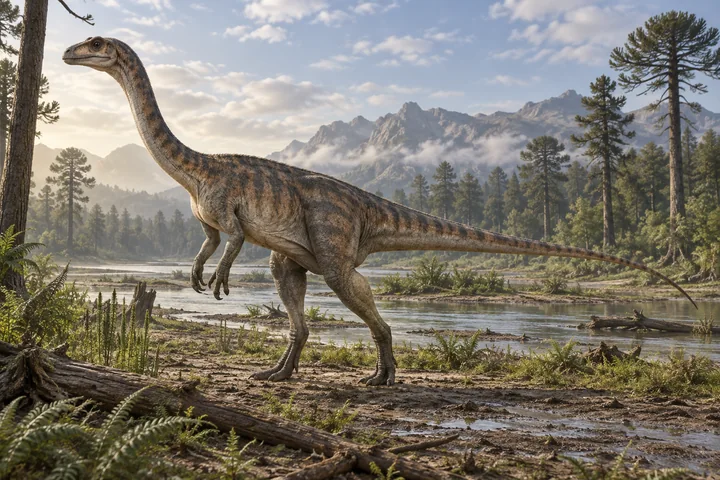
Massospondylus carinatus
Massospondylus was a southern African sauropodomorph with a long neck and a prominent thumb claw. Preserved eggs, embryos and nesting grounds illuminate reproduction while young-animal posture remains debated.
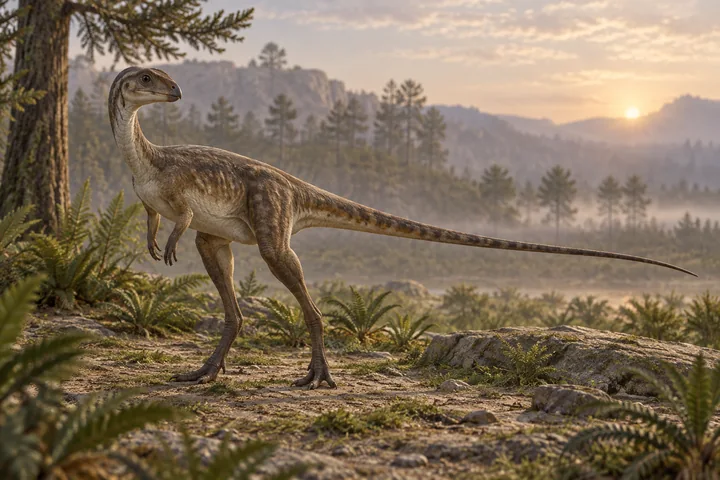
Lesothosaurus diagnosticus
Lesothosaurus was a small early ornithischian.
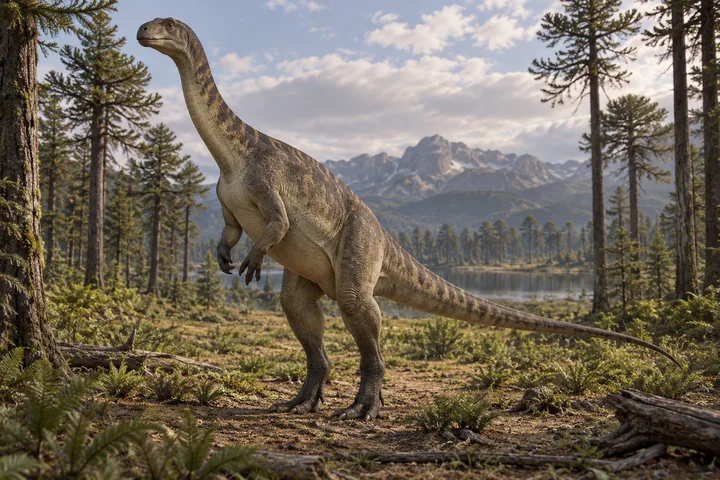
Mussaurus patagonicus
Mussaurus grew from tiny hatchlings into large sauropodomorphs. Eggs and clustered skeletons from Patagonia provide unusually rich evidence for nesting and age-related social organization.