
Body length
InferredUp to about 5 m (adult reference)
Wits describes full adults reaching about five metres. This rounded upper reference is not a measured population range. [D1]
EXHIBIT 62
Massospondylus carinatus
Massospondylus was a southern African sauropodomorph with a long neck and a prominent thumb claw. Preserved eggs, embryos and nesting grounds illuminate reproduction while young-animal posture remains debated.
TWO WAYS TO PICTURE THE PAST
Compare the evidence with the familiar movie image. The illustrations are not to a shared scale.
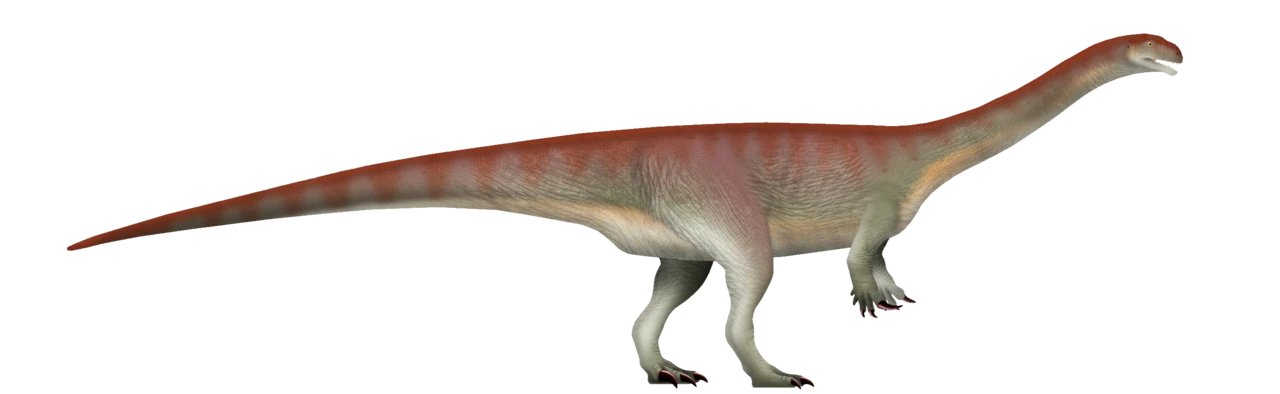
Life reconstruction of Massospondylus carinatus by TotalDino, using the current revised artwork. Missing anatomy and soft tissues are reconstructed; the reddish back and pale underside are speculative colors. [3]
Massospondylus TD.png · TotalDino. CC BY 4.0. Commons-listed 1280px preview converted to WebP; 640px thumbnail generated. Composition and colors unchanged.
Scientific reconstruction is an interpretation; source credit does not certify every anatomical detail.
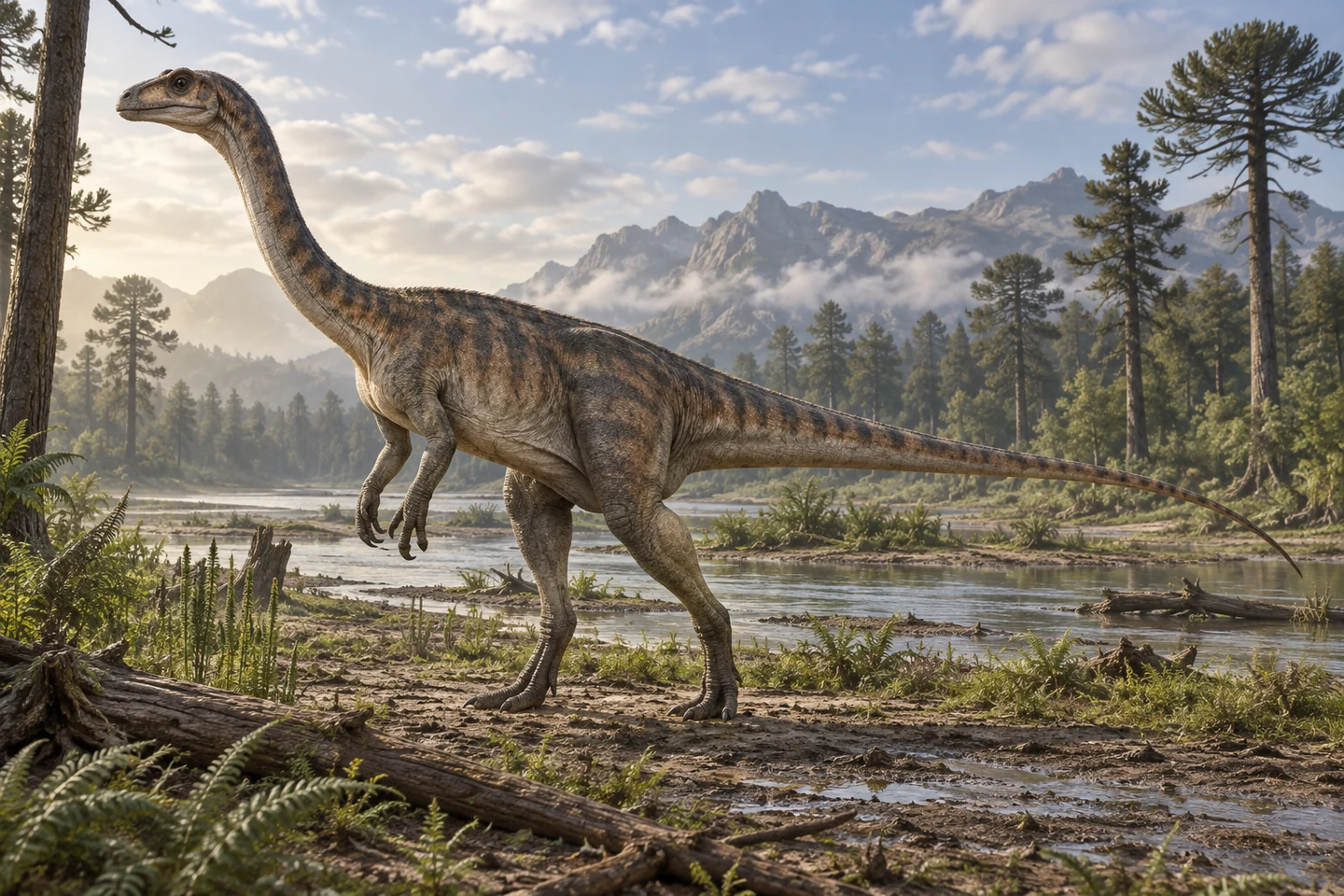
Original cinematic interpretation of Massospondylus. Anatomy, soft tissues and colors are reconstructed choices. Lighting, coloration and scenery are artistic choices. This image does not document a fossil locality or behavior.
Original artwork · artistic interpretation.
Scientific view: source-informed reconstruction, credited paleoart or specimen-based imagery. Movie-style view: Original artistic interpretation. Reconstructions involve uncertainty.
MEET THE ANIMAL
Massospondylus carinatus was a plant-eating dinosaur from Early Jurassic southern Africa. Eggs found in South Africa’s Golden Gate Highlands National Park preserve tiny embryos, giving researchers evidence from before hatching as well as from larger animals. These fossils are delicate. Their size makes ordinary preparation difficult, and a baby’s developing skull cannot be treated as a scaled-down adult head. [S1]
Powerful X-rays from a synchrotron, a facility that generates an intense beam, allowed scientists to reconstruct the embryos’ skulls in three dimensions. They compared the developing bones with those of living reptile relatives. This analysis suggested that the embryos were substantially earlier in development than previously thought, rather than almost ready to hatch. Their apparent maturity was a conclusion to test, not something obvious from finding an egg. [S1]
The developing jaws contained two kinds of teeth. Researchers interpreted one simple set as temporary teeth that would be lost before hatching; the other resembled the teeth used later. The embryos consequently record a changing body inside the egg, not just the starting point of a familiar adult skeleton. Their preservation reveals development in detail while leaving the behavior of the adults around these particular eggs unresolved. [S1]
PREHISTORIC ANIMAL DOSSIER
The animal, the evidence, and the questions still open.
Eggs and embryos provide unusually detailed evidence for Massospondylus reproduction. They also show why size, posture and anatomy must be described for particular life stages.
Profile scope: Species — Massospondylus carinatus, with explicitly identified genus-level embryonic and hatchling evidence used in the 2025 growth study.
Source supported identifies a description documented by the cited source. Inferred marks a reconstruction or functional estimate. Debated marks competing interpretations. Not established means the sources reviewed for this dossier do not support a firm conclusion; it does not mean a behavior never occurred.
A size reference is an estimate, not a population range. Nesting evidence does not by itself establish courtship, mate choice, or lifelong pairing.
Up to about 5 m (adult reference)
Wits describes full adults reaching about five metres. This rounded upper reference is not a measured population range. [D1]
Not established here
The inspected sources do not establish a suitably scoped adult body-mass estimate for comparison.
Plant eating
Quantitative dental models consistently predict herbivory in Massospondylus; a preserved meal is not the basis of that result. [D4]
Southern African fossil occurrences
Embryos come from South Africa; the genus-assigned hatchling has a tentative Lesotho locality. Fossil occurrences do not establish one preferred habitat. [D3]
Bipedal adults; early posture debated
A 2025 study favors four-legged young transitioning to bipeds, challenging earlier analyses. Some studied early material is assigned only to the genus. [D3]
Long neck and prominent thumb claw
Growth changes neck proportions and thumb-claw shape. The 2025 study distinguishes embryonic, hatchling and mature anatomy. [D3]
Egg clutches and embryos
The South African nesting ground includes at least ten nests across several levels, some with up to 34 eggs. [D2]
Not established here
Nest and embryo evidence does not establish species-specific courtship, mating rituals or pair bonding.
Colonial nesting and site reuse inferred
Multiple nests and levels suggest recurring group nesting. This does not establish year-round herds or the identity of caregivers. [D2]
Sources and inspection notes for the claims in this profile.
THE STORY IN THE FOSSILS
Massospondylus eggs preserve embryonic skeletons recognizable as this early sauropodomorph. The broader nesting ground records repeated egg-laying activity rather than a single isolated clutch. [1] [2]
A 2025 anatomical study returns to an ongoing question: did young Massospondylus use four legs before becoming bipedal? Its new material supports a transition, while the dossier preserves the uncertainty and genus-level assignments. [3]
The dossier identifies the scope of each reference estimate. A mount, an individual fossil and a species-wide adult range are different measurements. Comparison metrics remain unavailable where adult scope has not been established. Unknown does not mean zero.
Sources support the stated claims and scopes. Refer to the evidence notes for uncertainty.
KEEP EXPLORING
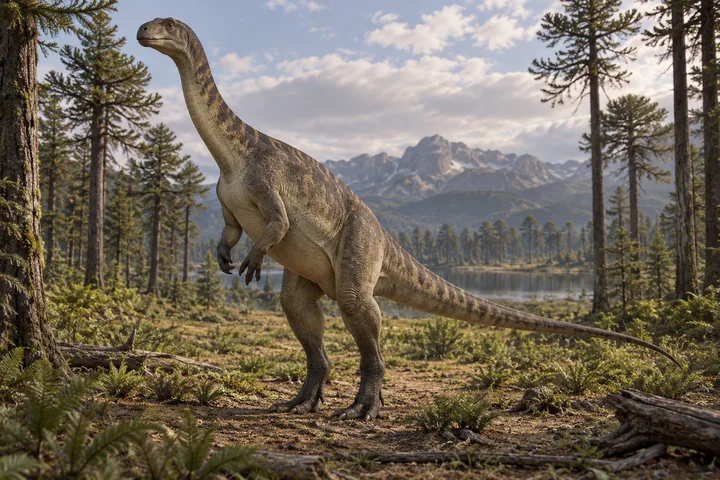
Mussaurus patagonicus
Mussaurus grew from tiny hatchlings into large sauropodomorphs. Eggs and clustered skeletons from Patagonia provide unusually rich evidence for nesting and age-related social organization.
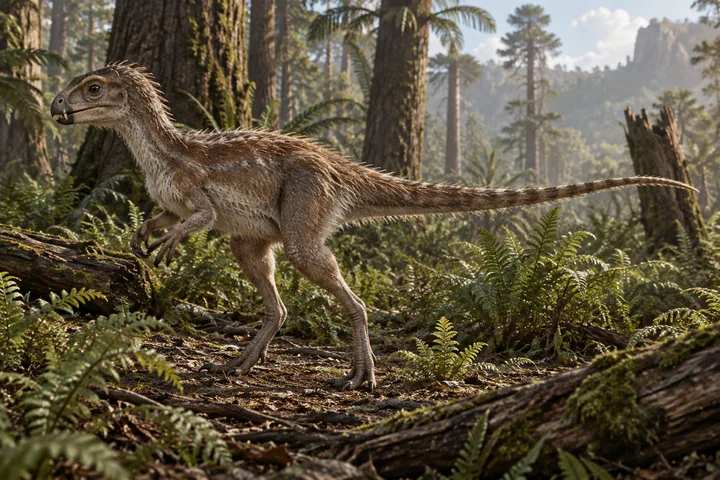
Heterodontosaurus tucki
Heterodontosaurus was a small southern African ornithischian with contrasting tooth types. Its tusk-like teeth, chewing adaptations and unusual chest anatomy open different windows onto its biology.
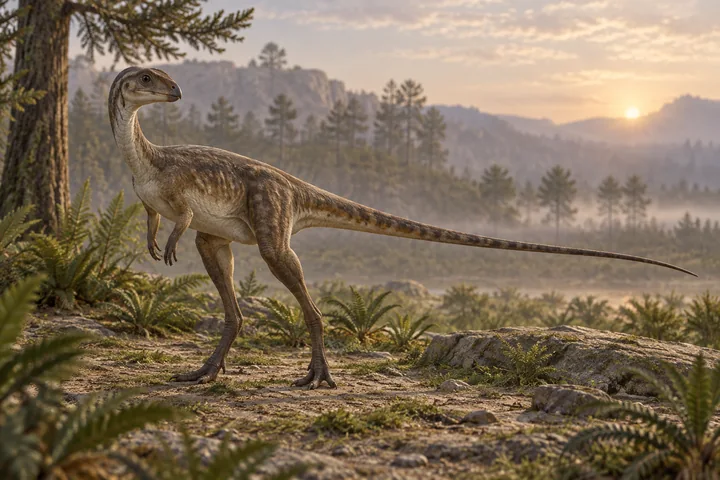
Lesothosaurus diagnosticus
Lesothosaurus was a small early ornithischian.