
Body length
InferredAbout 7.6 m (museum reference)
Rounded reconstruction with no identified maturity basis; not a species maximum. [D1]
TWO WAYS TO PICTURE THE PAST
Compare the evidence with the familiar movie image. The illustrations are not to a shared scale.
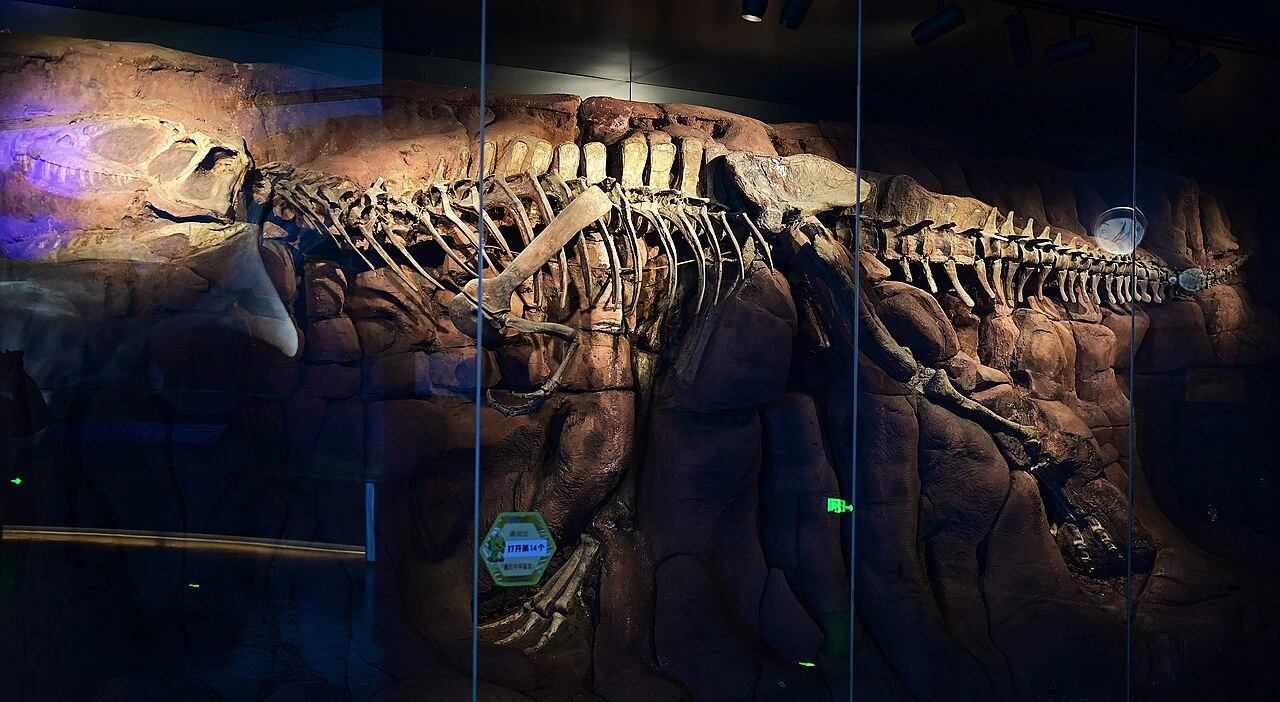
Holotype skeletal display identified as Sinraptor dongi, IVPP 10600, at Baoding Natural History Museum, photographed by Jonathan Chen. The original description documents missing tail and forearm elements; complete-looking displays include restoration. The Commons identification does not inventory original versus restored bones. [2]
Sinraptor dongi Holotype.jpg · Jonathan Chen. CC BY 4.0. Current Commons image converted to WebP and proportionally resized for the thumbnail; no cropping, mirroring, anatomical edits or compositing. Original scale bars and annotations retained where present. Same source license applies.
Skeletal mounts and drawings may restore missing parts; the caption identifies the displayed material.
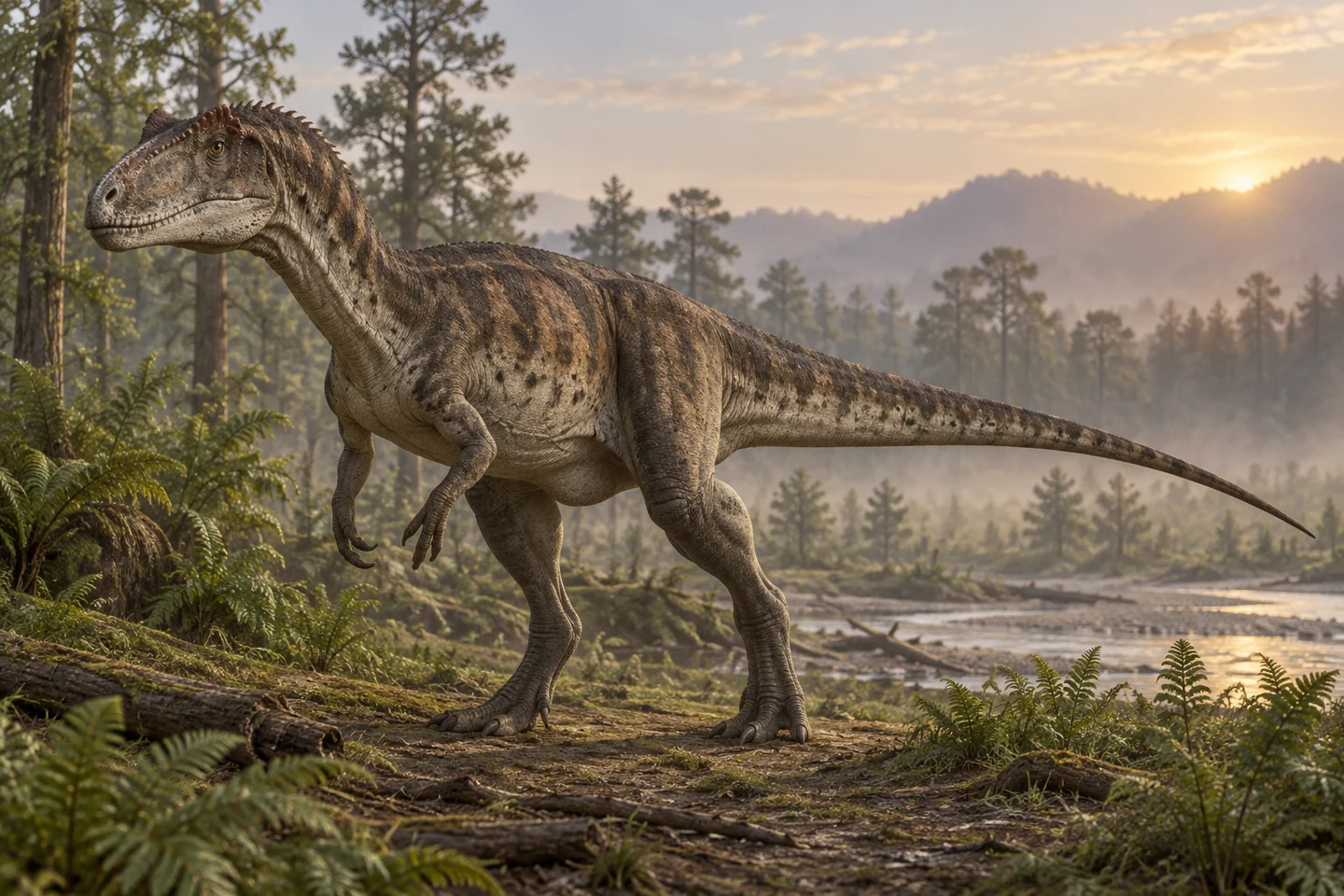
Original cinematic interpretation of Sinraptor dongi. Colors, soft tissues, scenery and missing anatomy are reconstructed artistic choices; this is not a directly observed individual or behavior. Lighting, coloration and scenery are artistic choices. This image does not document a fossil locality or behavior.
Original artwork · artistic interpretation.
Scientific view: source-informed reconstruction, credited paleoart or specimen-based imagery. Movie-style view: Original artistic interpretation. Reconstructions involve uncertainty.
MEET THE ANIMAL
Sinraptor was a Chinese theropod, one of the dinosaurs reconstructed standing and moving on its hind legs. Its body outline included a long balancing tail. A museum reference of about 7.6 metres gives an approximate sense of scale, without establishing a confirmed adult maximum. A restored skeleton helps visualize the animal but does not record a running speed. [D1]
Museum reconstructions supply a whole-body picture even when a fossil preserves only part of the animal. That distinction matters when imagining how Sinraptor moved: the outline, posture, and missing body parts are reconstructed rather than observed alive. A readable picture and an exact measurement of a living animal are different forms of information. [D1]
Its head preserves healed injuries interpreted as tooth strikes. Healing shows that the animal survived at least some of the damage. The lesions support an inference of aggressive biting, but the attacker and motive remain uncertain. They do not demonstrate territorial boundaries, pack dominance, or fighting over mates. A scar can preserve evidence of contact without preserving the social reason behind it. [D4]
PREHISTORIC ANIMAL DOSSIER
The animal, the evidence, and the questions still open.
Teeth support carnivory; healed wounds suggest interactions whose motives remain uncertain. [D2] [D4]
Profile scope: Species focus — Sinraptor dongi. [D2]
Source supported identifies a description documented by the cited source. Inferred marks a reconstruction or functional estimate. Debated marks competing interpretations. Not established means the sources reviewed for this dossier do not support a firm conclusion; it does not mean a behavior never occurred.
A size reference is an estimate, not a population range. Nesting evidence does not by itself establish courtship, mate choice, or lifelong pairing.
About 7.6 m (museum reference)
Rounded reconstruction with no identified maturity basis; not a species maximum. [D1]
About 1,010 kg for IVPP 10600
Seebacher's polynomial body-volume model uses a 7 m reconstruction after the original description. Maturity is unstated; volume and body outline are reconstructed rather than weighed. [D3]
Cutting dentition suited to predation
Compressed serrated crowns and robust front teeth support a predatory feeding interpretation. Dental shape does not identify particular meals or prove a preferred prey species. [D2]
Oxfordian Shishugou Formation
The S. dongi holotype comes from upper Shishugou continental deposits in Xinjiang. Nearby herbivores and smaller theropods establish a fossil community, not its entire geographic range. [D2]
Two-legged theropod reconstruction
The skeleton is reconstructed with hindlimb support and a long tail. No directly measured speed or single hunting gait is established. [D1]
Nearly complete skull; incomplete body
The holotype retains distinctive jaw and tooth anatomy, while the tail and several forearm bones are missing. Complete mounts supply restored elements. [D2]
Not established here
Focused egg, nesting and growth searches did not establish Sinraptor clutch size, incubation, parental care or breeding maturity in the reviewed material.
Not established here
Facial injuries do not identify mate competition. Reviewed sources and focused searches do not establish sexual dimorphism, mate choice or a courtship display.
Survived aggressive biting
Healed cranial tooth-strike lesions support nonfatal attacks, potentially by other theropods or conspecifics. Proposed pack dominance or territorial disputes are hypotheses; injuries alone do not prove packs. [D4]
Sources and inspection notes for the claims in this profile.
THE STORY IN THE FOSSILS
Sinraptor's front and side teeth have different shapes. The dental study interprets the front teeth as better able to withstand contact with bone, while compressed side crowns could open cutting wounds. These are functional interpretations of preserved teeth. [2]
Healing around facial lesions shows survival after injury. The attacker and motive remain uncertain: a scar preserves contact, not the social rules behind it. [4]
The dossier identifies the scope of each reference estimate. A mount, an individual fossil and a species-wide adult range are different measurements. Comparison metrics remain unavailable where adult scope has not been established. Unknown does not mean zero.
Sources support the stated claims and scopes. Refer to the evidence notes for uncertainty.
KEEP EXPLORING
Yangchuanosaurus shangyouensis
Yangchuanosaurus had a tall toothed skull and nasal ornament.
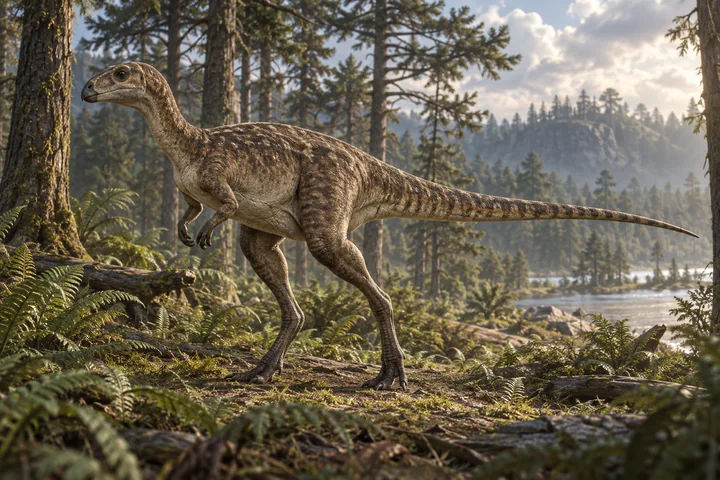
Dryosaurus altus
Dryosaurus altus was a small bipedal plant-eater from the Late Jurassic of western North America. Revised identifications separate it from famous Utah skeletons assigned to Dryosaurus elderae.
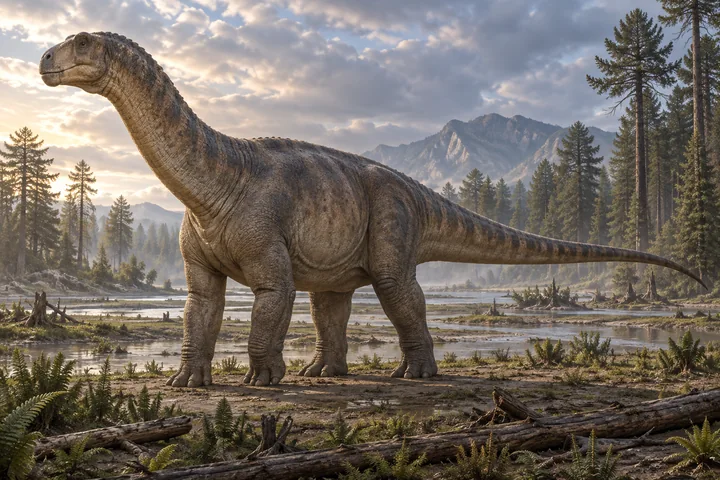
Camarasaurus
Camarasaurus was a Late Jurassic North American sauropod with broad teeth, a boxy skull and air-filled vertebrae.