
Body length
Inferred15–20 m; museum genus reference
NHMU gives this educational interval without specifying individual species, specimens or life stages. It is not a complete genus-wide biological range. [D1]
EXHIBIT 69
Camarasaurus
Camarasaurus was a Late Jurassic North American sauropod with broad teeth, a boxy skull and air-filled vertebrae.
TWO WAYS TO PICTURE THE PAST
Compare the evidence with the familiar movie image. The illustrations are not to a shared scale.
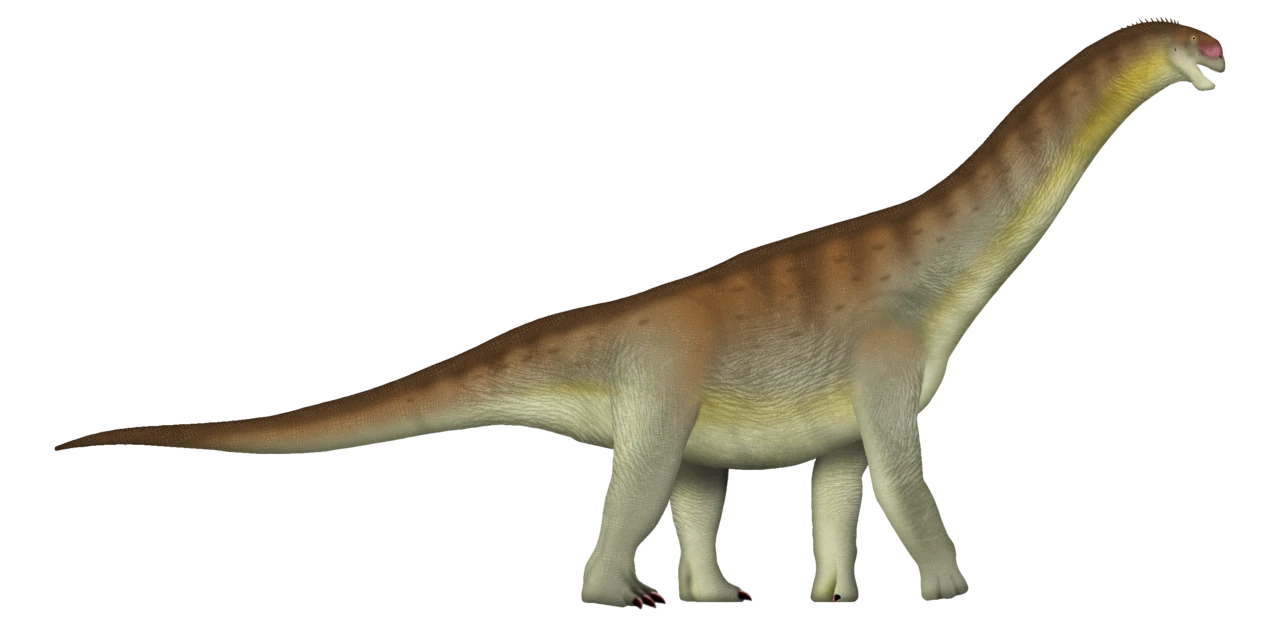
Artist reconstruction identified as Camarasaurus supremus within this genus exhibit. Colours and soft tissues are interpretive; its proportions are not a size reference for every species. [1]
Camarasaurus TD.png · TotalDino. CC BY-SA 4.0. Resized proportionally and converted to WebP; no anatomical edits. Same source license applies.
Scientific reconstruction is an interpretation; source credit does not certify every anatomical detail.
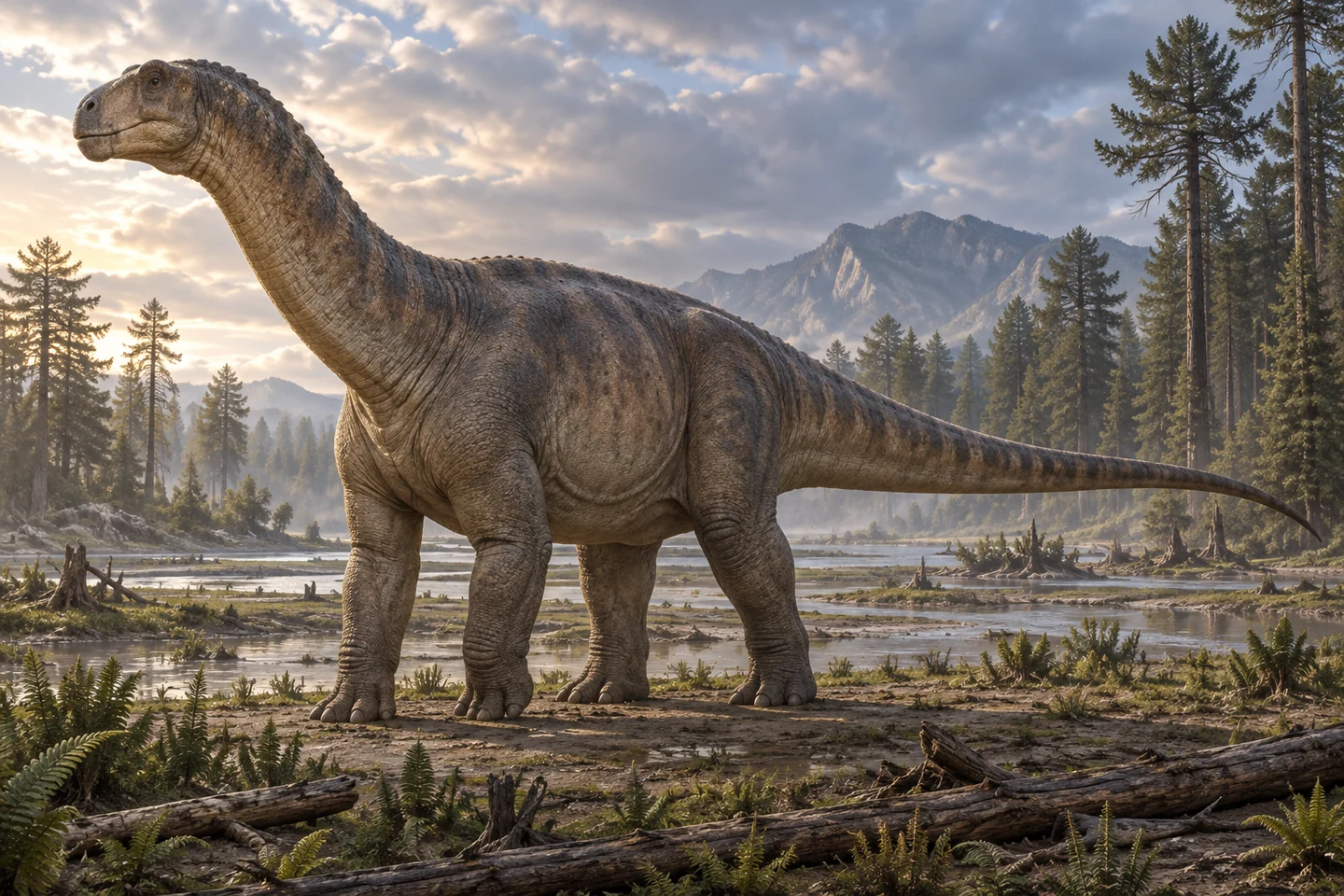
Original cinematic interpretation of Camarasaurus. Anatomy, soft tissues and colors are reconstructed choices. Lighting, coloration and scenery are artistic choices. This image does not document a fossil locality or behavior.
Original artwork · artistic interpretation.
Scientific view: source-informed reconstruction, credited paleoart or specimen-based imagery. Movie-style view: Original artistic interpretation. Reconstructions involve uncertainty.
MEET THE ANIMAL
Camarasaurus was a plant-eating sauropod from Late Jurassic North America. Camarasaurus lentus lived in what is now northeastern Utah, with fossils in the Morrison Formation. Its robust spoon-shaped teeth were suited to processing vegetation. Chambers in its vertebrae, or backbone bones, helped give the dinosaur its name and may have contained parts of an air-sac system. [S1]
A young skeleton from the Carnegie Quarry preserved its head, neck, limbs, and ribs together. Such a skeleton is articulated: its bones remained in their connected order. The front legs supplied important evidence that sauropods carried their limbs beneath the body, rather than sprawling outward like many modern reptiles. Even a juvenile could therefore improve reconstructions of this large dinosaur group. [S1]
The specimen remains partly within its original sandstone block at the Carnegie Museum. Preparators adjusted some displaced bones for display, and documented the changes. The result helps show the animal's structure while preserving a record of what was actually found. Camarasaurus offers a useful distinction between fossil anatomy, the position of a buried animal, and the restored pose chosen for a museum exhibit. [S1]
PREHISTORIC ANIMAL DOSSIER
The animal, the evidence, and the questions still open.
Camarasaurus teeth processed plants; their chemistry offers clues to movement.
Profile scope: Genus: Camarasaurus. Museum measurements are genus references; the isotope study samples Camarasaurus sp. and C. lentus, not every species.
Source supported identifies a description documented by the cited source. Inferred marks a reconstruction or functional estimate. Debated marks competing interpretations. Not established means the sources reviewed for this dossier do not support a firm conclusion; it does not mean a behavior never occurred.
A size reference is an estimate, not a population range. Nesting evidence does not by itself establish courtship, mate choice, or lifelong pairing.
15–20 m; museum genus reference
NHMU gives this educational interval without specifying individual species, specimens or life stages. It is not a complete genus-wide biological range. [D1]
Up to about 18 tonnes; museum reference
NHMU lists up to 18,143 kg, equivalent to its 20 US tons. The species, adult specimen and modelling method are not specified. [D1]
Plant-eater; broad cropping teeth
NHMU describes large chisel- or spoon-shaped teeth suited to browsing vegetation. Preferred food species are not demonstrated here. [D1]
Morrison basin river floodplains
The isotope study places its sampled fossils in Late Jurassic western North American lowlands with seasonal dryness; its movements beyond them are inferred. [D3]
Four-legged; migration inferred locally
Four-legged movement is supported by anatomy. Tooth chemistry in selected populations suggests travel between lowland and upland water sources; the authors do not claim every population migrated. [D2] [D3]
Boxy skull; air-filled neck vertebrae
NHMU describes a short rounded snout, broad teeth and chambered neck bones. Its neck and tail were relatively shorter than in many other sauropods. [D1]
Not established here
The reviewed sources do not establish genus-wide clutch size, nesting layout or parental care.
Not established here
The reviewed sources do not establish sex differences, mate attraction displays or a mating system.
Not established here
The isotope study concerns movement and drinking water, not herd membership. It does not establish group structure. [D3]
Sources and inspection notes for the claims in this profile.
THE STORY IN THE FOSSILS
Camarasaurus shared the Morrison landscape with other large sauropods but had its own feeding toolkit: a boxy head and closely set broad teeth. Hollow spaces in its neck bones reduced the weight of the supporting skeleton. [1]
Tooth chemistry offers a second window into its life. A study of selected Camarasaurus fossils interpreted oxygen isotope changes as evidence of seasonal movement between lowlands and uplands. The result concerns particular sampled populations; it does not prove that all Camarasaurus lived in migrating herds. [3]
The dossier identifies the scope of each reference estimate. A mount, an individual fossil and a species-wide adult range are different measurements. Comparison metrics remain unavailable where adult scope has not been established. Unknown does not mean zero.
Sources support the stated claims and scopes. Refer to the evidence notes for uncertainty.
KEEP EXPLORING
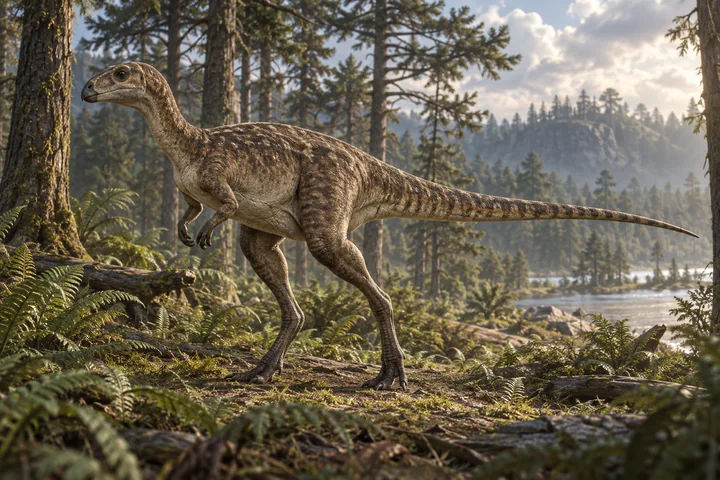
Dryosaurus altus
Dryosaurus altus was a small bipedal plant-eater from the Late Jurassic of western North America. Revised identifications separate it from famous Utah skeletons assigned to Dryosaurus elderae.
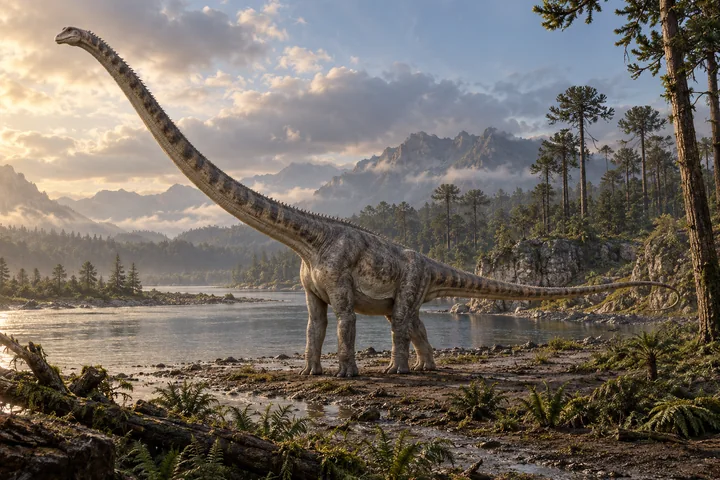
Mamenchisaurus
Mamenchisaurus includes long-necked Chinese sauropods. Differing species and recent research require revision of the traditional genus.
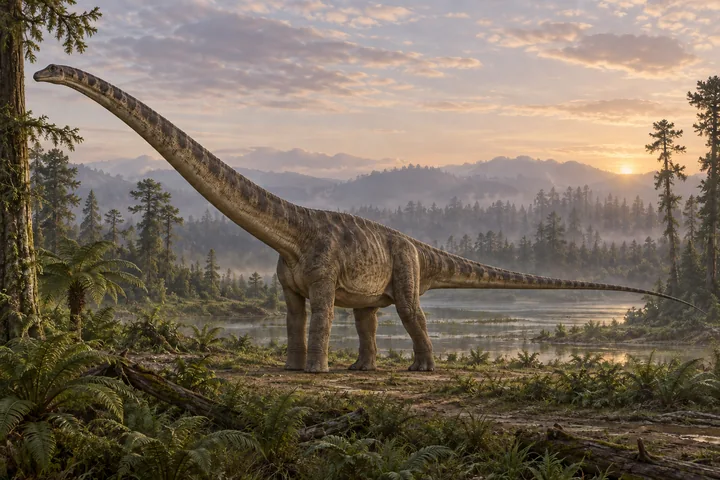
Barosaurus lentus
Barosaurus was a long-necked plant-eater. Its dramatic New York display is an imagined encounter built from skeletal casts.