
Body length
InferredAbout 24 m; museum reference
The directory gives no named specimen, maturity assessment or reconstruction method. This whole-body reference is not a measured adult maximum. [D2]
TWO WAYS TO PICTURE THE PAST
Compare the evidence with the familiar movie image. The illustrations are not to a shared scale.
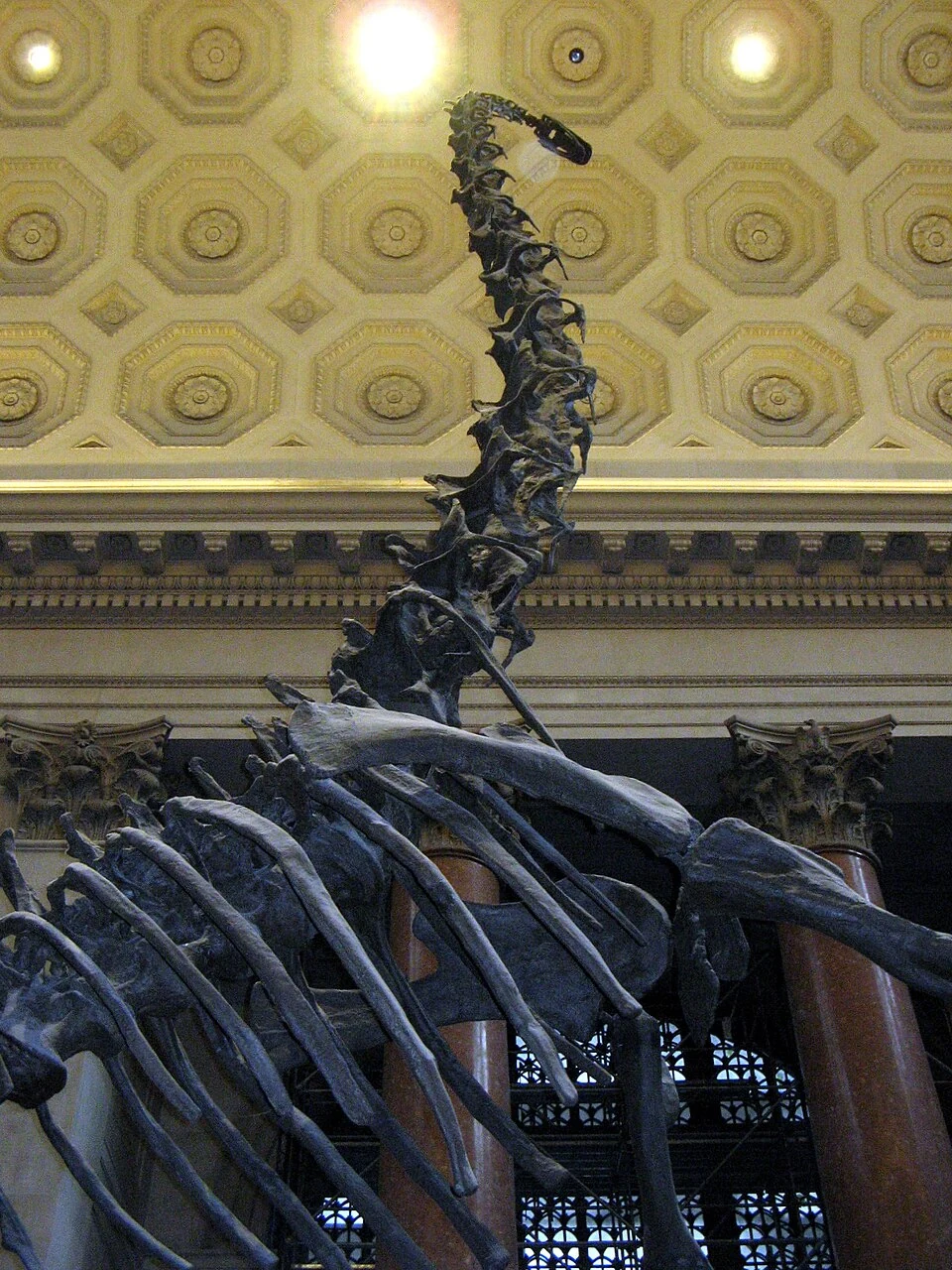
Barosaurus cast display at the American Museum of Natural History. Mostly based on AMNH 6341, with comparative skeletal components; rearing and protective-parent interpretation are part of an imagined museum scene. [1]
View of the Barosaurus skeleton from below · olekinderhook. CC BY 3.0. Resized proportionally and converted to WebP; no anatomical edits. Same source license applies.
Skeletal mounts and drawings may restore missing parts; the caption identifies the displayed material.
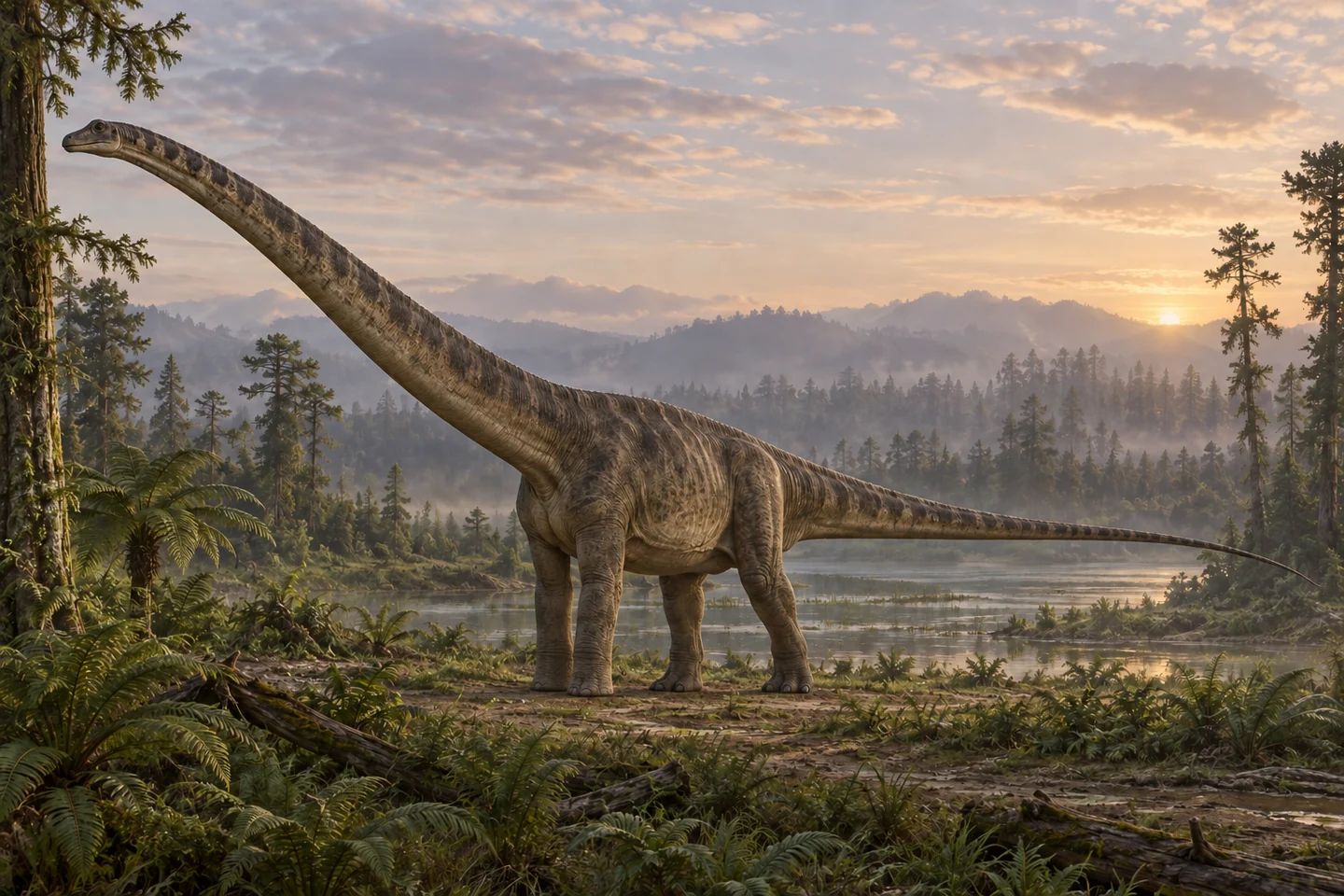
Original cinematic interpretation of Barosaurus lentus. Colors, soft tissues, scenery and missing anatomy are reconstructed artistic choices; this is not a directly observed individual or behavior. Fine manus detail remains illustrative rather than an exact hand reconstruction. Lighting, coloration and scenery are artistic choices. This image does not document a fossil locality or behavior.
Original artwork · artistic interpretation.
Scientific view: source-informed reconstruction, credited paleoart or specimen-based imagery. Movie-style view: Original artistic interpretation. Reconstructions involve uncertainty.
MEET THE ANIMAL
Barosaurus was a plant-eating sauropod from the Late Jurassic. A museum reference of about twenty-four metres gives a rough introduction to its scale. It does not identify a particular measured adult or establish a maximum. Exact food choices and a fixed feeding height are also less certain than the general plant-eating interpretation. [D2]
The American Museum of Natural History displays a Barosaurus raised on its hind legs in an imagined encounter. That scene makes the animal's size and long neck memorable, but the museum presents it as an interpretation. The display cannot prove that Barosaurus regularly reared or protected young in exactly that way. [D4]
A 2026 submitted manuscript discusses how the mount was assembled from casts of a Barosaurus specimen and comparative material. Its submitted status should not be confused with accepted evidence for a habitual gait. Construction history can explain how an impressive pose was made possible without recording the dinosaur performing it. Barosaurus demonstrates why a dramatic exhibit is best read alongside the evidence beneath the scene. [D5]
PREHISTORIC ANIMAL DOSSIER
The animal, the evidence, and the questions still open.
The type skeleton YPM 429 and referred AMNH 6341 preserve a distinctive diplodocid. Elongated neck vertebrae are real evidence; a complete living posture requires reconstruction. [D1]
Profile scope: Genus profile centered on the North American Barosaurus lentus. African material historically called Barosaurus africanus is treated as Tornieria and excluded. [D1]
Source supported identifies a description documented by the cited source. Inferred marks a reconstruction or functional estimate. Debated marks competing interpretations. Not established means the sources reviewed for this dossier do not support a firm conclusion; it does not mean a behavior never occurred.
A size reference is an estimate, not a population range. Nesting evidence does not by itself establish courtship, mate choice, or lifelong pairing.
About 24 m; museum reference
The directory gives no named specimen, maturity assessment or reconstruction method. This whole-body reference is not a measured adult maximum. [D2]
About 11.6 tonnes; AMNH 6341 model
Paul’s appendix reports a skeletal-volume and long-bone-scaled estimate. Maturity is unspecified; this modeled animal is not an adult population range. [D3]
Plants
The museum identifies herbivory. Exact feeding height, plant selection and the amount eaten daily remain unresolved in the reviewed material. [D2]
Western United States, Morrison Formation
The reviewed North American specimens come from Upper Jurassic Morrison deposits. Tanzanian fossils once included in Barosaurus belong outside this genus profile. [D1]
Quadrupedal reconstruction; rearing unresolved
A normal four-legged body is reconstructed from the postcranial skeleton. The AMNH rearing cast depicts an imagined encounter and cannot establish a habitual gait or frequency of rearing. [D1] [D4]
Elongated, complex neck vertebrae
YPM 429 and AMNH 6341 share diagnostic cervical features. Fossils preserve bony joints and supporting ridges, while missing elements and soft tissues complicate a complete neck reconstruction. [D1]
Not established here
The reviewed genus-specific sources do not identify assigned nests, egg dimensions, clutch size or incubation behavior.
Not established here
Reviewed anatomy and focused searches do not establish neck displays, calls, mate choice or sex-specific skeletal differences.
Not established here
The museum’s adult-and-young scene is an imagined encounter. It does not demonstrate parenting, stable family groups or herd organization. [D4]
Sources and inspection notes for the claims in this profile.
THE STORY IN THE FOSSILS
The New York mount makes a compelling scene, but casts and reconstruction make its pose possible. The museum explicitly presents the encounter as imagined. [4]
A 2026 submitted manuscript describes most of the display as casts of AMNH 6341, supplemented by comparative bones. Its account explains construction history; it does not demonstrate habitual rearing. [5]
The dossier identifies the scope of each reference estimate. A mount, an individual fossil and a species-wide adult range are different measurements. Comparison metrics remain unavailable where adult scope has not been established. Unknown does not mean zero.
Sources support the stated claims and scopes. Refer to the evidence notes for uncertainty.
KEEP EXPLORING
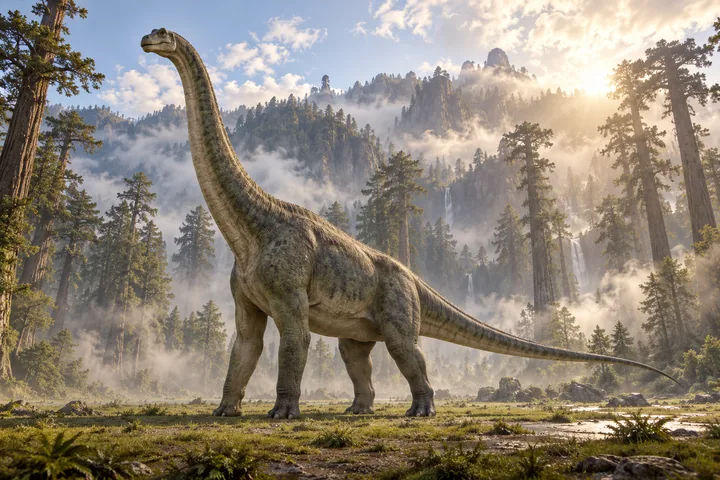
Brachiosaurus altithorax
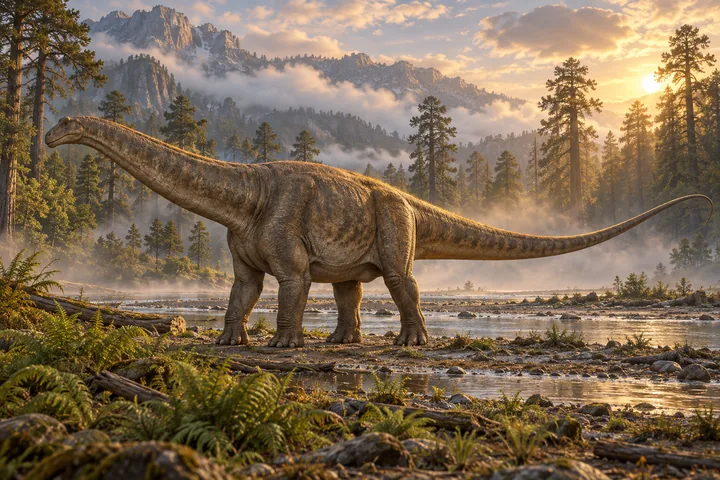
Brachiosaurus altithorax was a giant sauropod from Late Jurassic North America. Its name-bearing skeleton is incomplete, and many familiar reconstructions borrow details from the separate African dinosaur Giraffatitan.
Apatosaurus
Apatosaurus was a plant-eating sauropod from the Late Jurassic of North America. Its discovery history includes a famous skeleton displayed with a Camarasaurus head before a narrow Apatosaurus skull was restored.
Brontosaurus
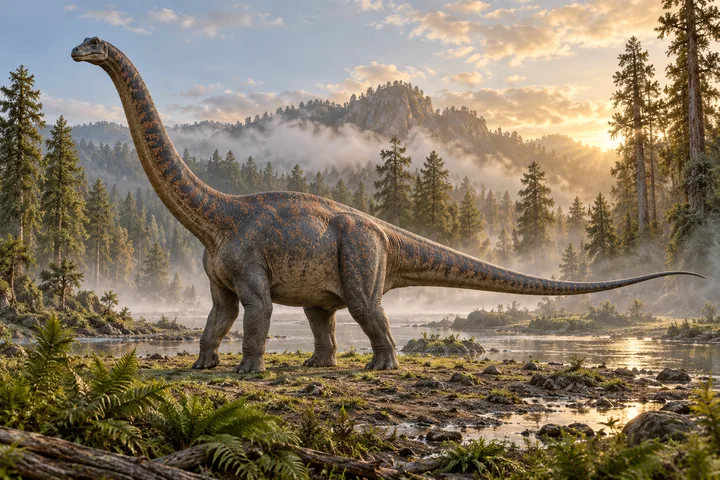
Brontosaurus was a long-necked Late Jurassic sauropod from the USA. A 2015 study argued that its bones differ consistently from Apatosaurus, restoring a genus long absorbed under that name.