
Body length
InferredAbout 8 m (museum reference)
Rounded species-profile size without an identified individual or maturity assessment; it is not an established adult maximum. [D1]
EXHIBIT 99
Yangchuanosaurus shangyouensis
Yangchuanosaurus had a tall toothed skull and nasal ornament. [1]
TWO WAYS TO PICTURE THE PAST
Compare the evidence with the familiar movie image. The illustrations are not to a shared scale.
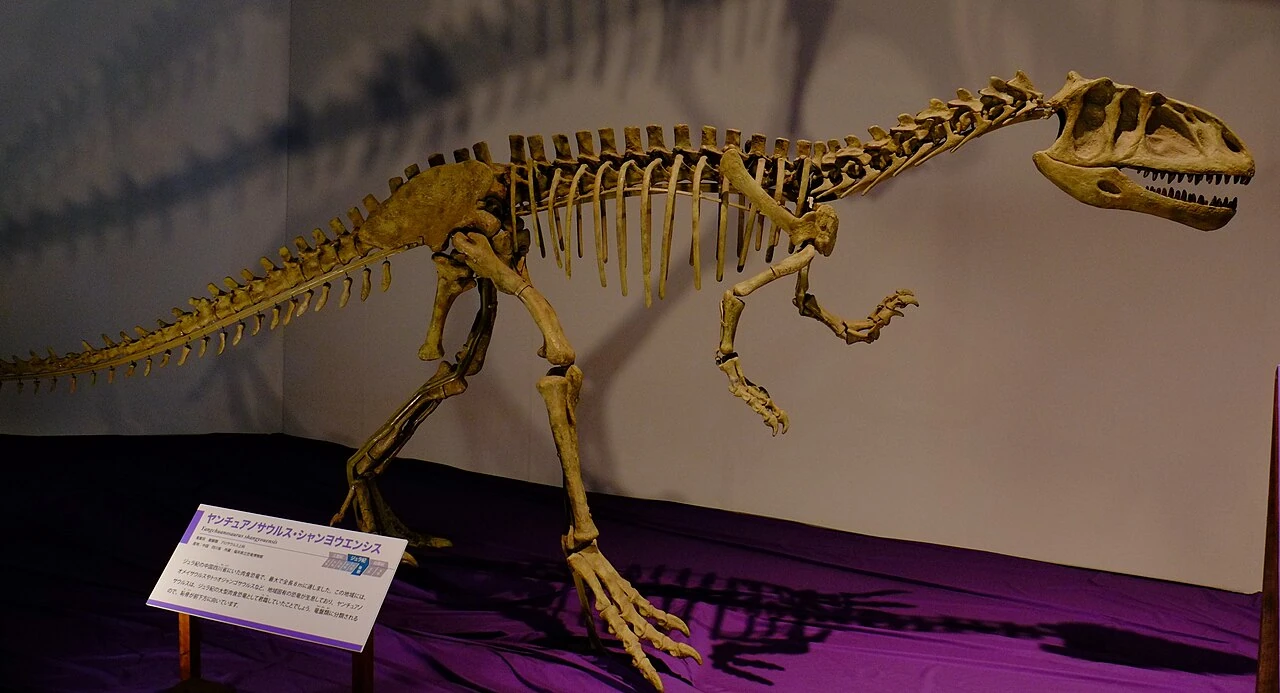
Yangchuanosaurus skeletal display photographed by ★Kumiko★. Its visible label identifies Y. shangyouensis; the Commons record identifies the genus without a specimen inventory. Full mounts restore missing elements and stance, and are not evidence of skin, coloration or an undistorted original individual. [1]
Yangchuanosaurus skeleton.jpg · ★Kumiko★. CC BY-SA 2.0. Current Commons image converted to WebP and proportionally resized for the thumbnail; no cropping, mirroring, anatomical edits or compositing. Original scale bars and annotations retained where present. Same source license applies.
Skeletal mounts and drawings may restore missing parts; the caption identifies the displayed material.
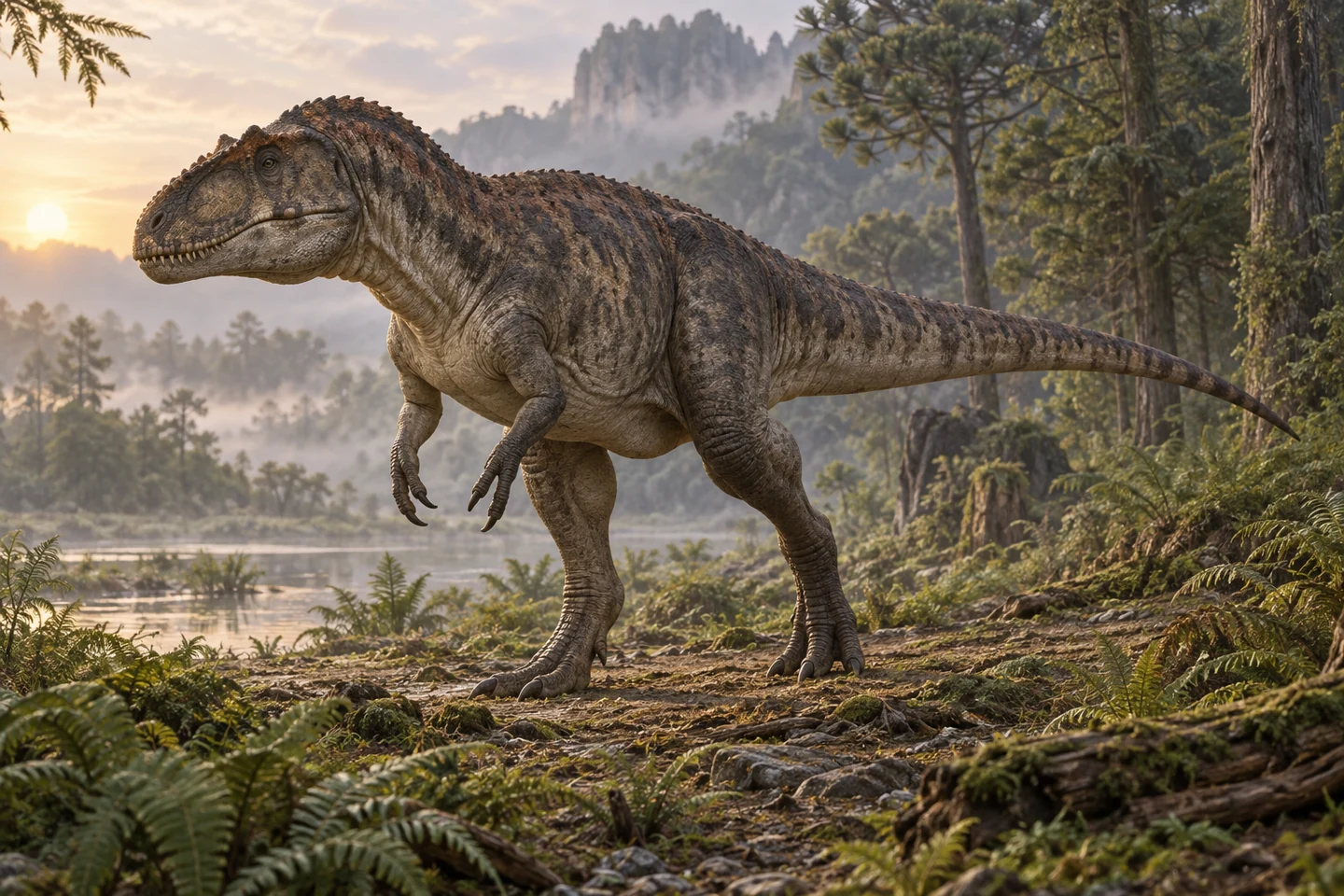
Original cinematic interpretation of Yangchuanosaurus shangyouensis. Colors, soft tissues, scenery and missing anatomy are reconstructed artistic choices; this is not a directly observed individual or behavior. Lighting, coloration and scenery are artistic choices. This image does not document a fossil locality or behavior.
Original artwork · artistic interpretation.
Scientific view: source-informed reconstruction, credited paleoart or specimen-based imagery. Movie-style view: Original artistic interpretation. Reconstructions involve uncertainty.
MEET THE ANIMAL
Yangchuanosaurus shangyouensis was a meat-eating dinosaur with a tall skull and curved cutting teeth. Its short arms and long tail fit a two-legged reconstruction. A ridge with bumps along the nose made its head distinctive, but a skull ornament does not by itself identify sex or demonstrate a mating display. [D1]
Comparative research keeps Yangchuanosaurus separate from named relatives such as Sinraptor. Similar skulls or neighboring branches of a family tree are not automatic proof that two dinosaur names describe the same animal. Studying the details of bones is necessary before assigning a fossil to a genus or species, especially when historical labels have changed. [D3]
Its fossils belong to Late Jurassic China, making this predator part of an ancient Asian dinosaur community. Museum profiles identify it as a carnivorous theropod: a member of the dinosaur branch that includes many meat eaters. That broad feeding identity cannot supply a precise prey menu. It also leaves the details of nesting, courtship and daily social relationships unresolved. [S1]
PREHISTORIC ANIMAL DOSSIER
The animal, the evidence, and the questions still open.
This exhibit centers on Y. shangyouensis; historical names and disputed referrals are distinguished. [D2] [D3]
Profile scope: Species focus — Yangchuanosaurus shangyouensis. [D2]
Source supported identifies a description documented by the cited source. Inferred marks a reconstruction or functional estimate. Debated marks competing interpretations. Not established means the sources reviewed for this dossier do not support a firm conclusion; it does not mean a behavior never occurred.
A size reference is an estimate, not a population range. Nesting evidence does not by itself establish courtship, mate choice, or lifelong pairing.
About 8 m (museum reference)
Rounded species-profile size without an identified individual or maturity assessment; it is not an established adult maximum. [D1]
About 1,230 kg for CV 00215
Polynomial body-volume estimate for a 7.9 m reconstruction. Seebacher lists the holotype under the historical combination Metriacanthosaurus shangyouensis; maturity is unstated. This is one model, not a species average. [D4]
Meat-eating, with cutting teeth
Curved serrated teeth support carnivory. Suggested sauropod prey in popular reconstructions is not a documented stomach content or confirmed meal in the reviewed sources. [D1]
Upper Shaximiao deposits near Yongchuan
CV 00215 and CV 00216 are from the Shangshaximiao Formation of China. The 2012 account places these occurrences in the Late Jurassic; it does not establish an exclusive habitat. [D2]
Bipedal stance with a balancing tail
The museum reconstruction infers two-legged movement. Preserved body proportions do not supply an experimentally measured running speed. [D1]
Tall skull, nasal ridges and sharp teeth
The museum describes a nasal ridge with bumps, short arms and a long tail. Full displays restore missing anatomy and pose; coloration remains unknown. [D1]
Not established here
Focused egg, nest and reproductive searches did not establish an assigned Yangchuanosaurus clutch, incubation duration, care or breeding maturity.
Not established here
Cranial ornament does not by itself identify sex, mate choice or a display ritual. None was established by the focused search and reviewed taxonomic material.
Not established here
The reviewed museum and specimen accounts do not establish permanent groups or coordinated hunting. More than one fossil individual is not sufficient evidence of a living pack.
Sources and inspection notes for the claims in this profile.
THE STORY IN THE FOSSILS
The species once called Yangchuanosaurus magnus was distinguished largely by size and some cranial differences. The 2012 revision interprets those differences as variation within Y. shangyouensis and includes both holotypes in that species. [2]
Not every similar Chinese skeleton can be folded into this profile. A 2025 study places disputed 'Szechuanosaurus' material near Yangchuanosaurus but emphasizes that it needs detailed restudy. Similarity is not an automatic species assignment. [3]
The dossier identifies the scope of each reference estimate. A mount, an individual fossil and a species-wide adult range are different measurements. Comparison metrics remain unavailable where adult scope has not been established. Unknown does not mean zero.
Sources support the stated claims and scopes. Refer to the evidence notes for uncertainty.
KEEP EXPLORING
Sinraptor dongi
Sinraptor's teeth and healed facial injuries illuminate a predator.
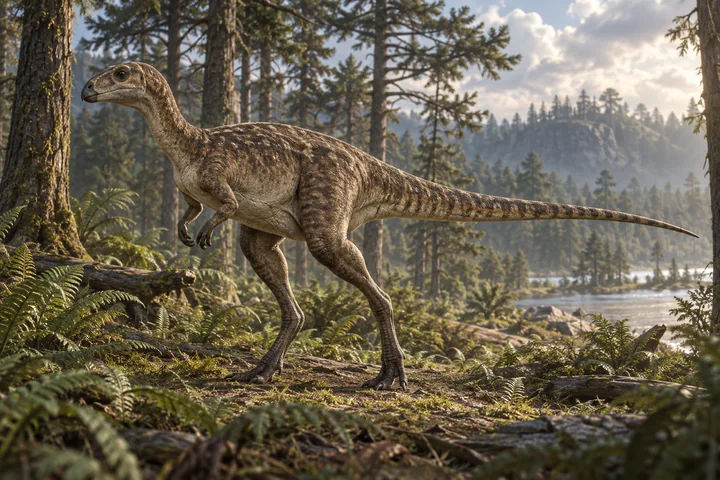
Dryosaurus altus
Dryosaurus altus was a small bipedal plant-eater from the Late Jurassic of western North America. Revised identifications separate it from famous Utah skeletons assigned to Dryosaurus elderae.
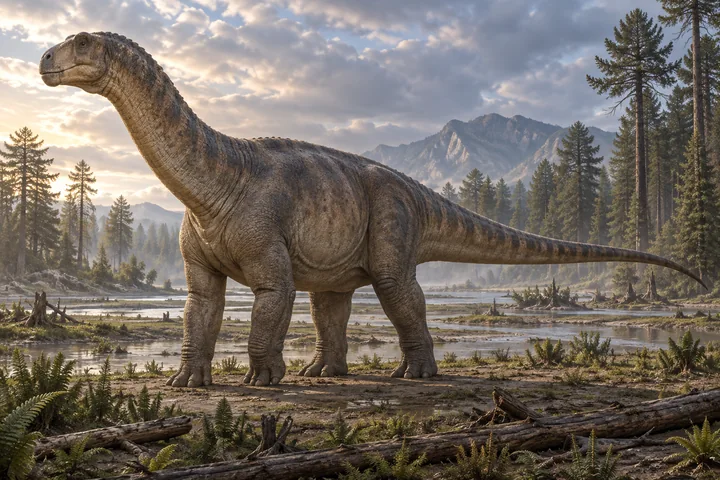
Camarasaurus
Camarasaurus was a Late Jurassic North American sauropod with broad teeth, a boxy skull and air-filled vertebrae.