
Body length
Not establishedNot established here
The inspected partial skeleton account does not establish a comparable whole-body length or species range. [D2]
EXHIBIT 219
Yi qi
Dinosaur
Yi was a small feathered dinosaur with wrist-supported wing membranes, a different construction from a bird’s feathered wings. [1]
TWO WAYS TO PICTURE THE PAST
Compare the evidence with the familiar movie image. The illustrations are not to a shared scale.
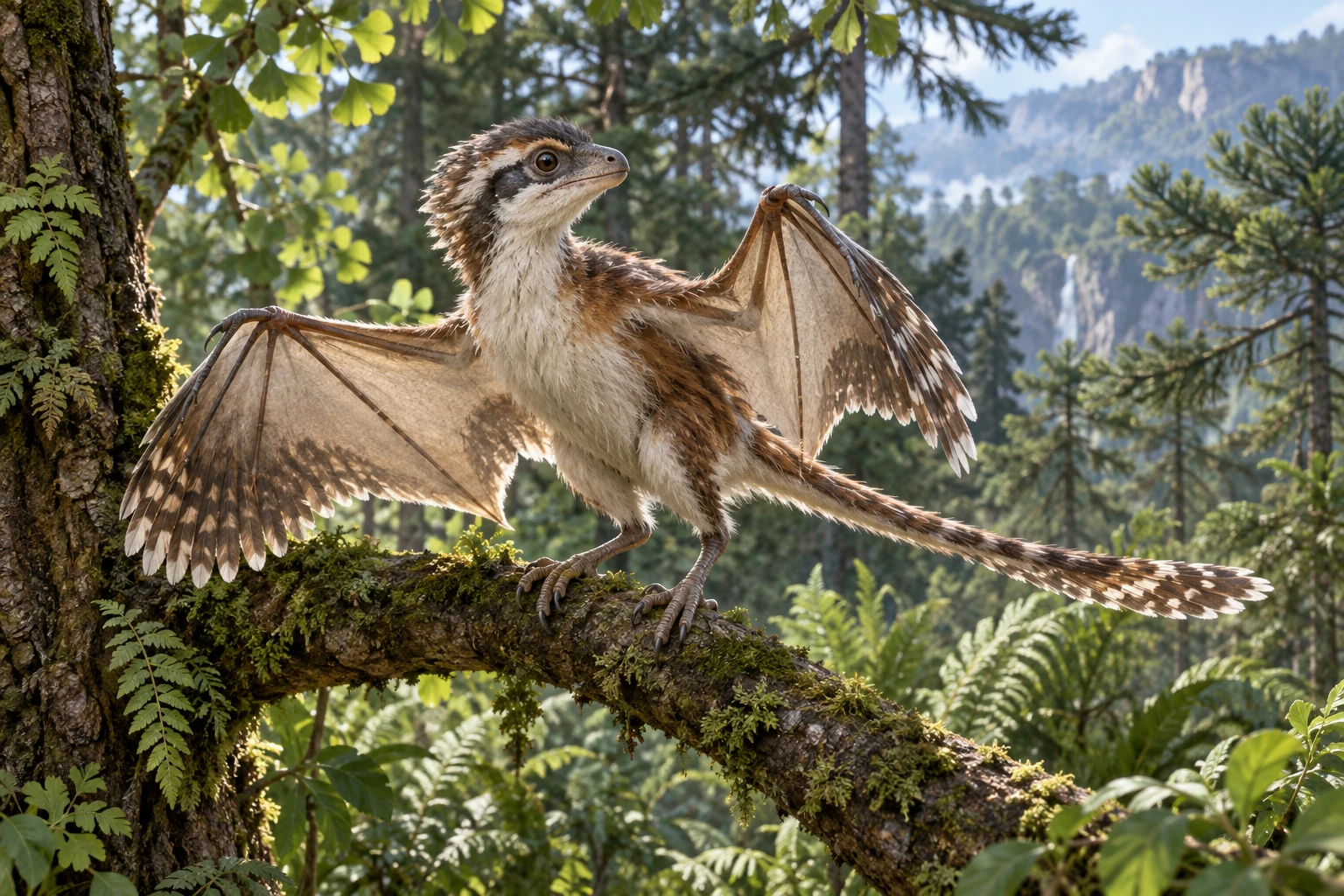
An illustrative reconstruction. Compare its anatomy with the evidence and limitations in the dossier. [2]
Source-informed reconstruction. Appearance evidence [2]. Original illustration; missing anatomy, coloration and scenery include interpretation.
Fossils constrain this life reconstruction. Missing anatomy, coloration and the environmental scene include interpretation; the dossier explains the evidence limits.
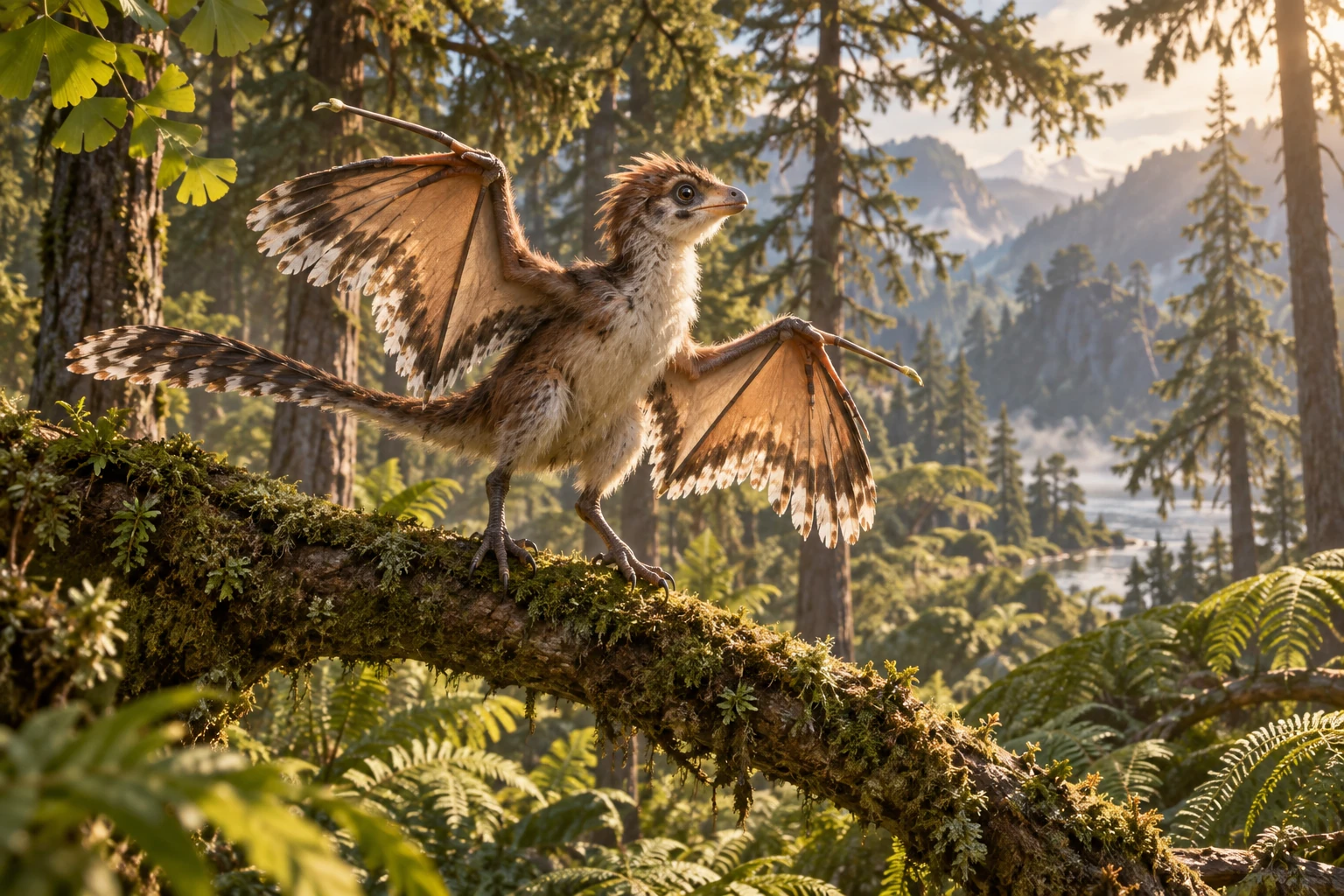
An illustrative reconstruction. Compare its anatomy with the evidence and limitations in the dossier. Lighting, coloration and scenery are artistic choices. This image does not document a fossil locality or behavior.
Original artwork · artistic interpretation.
Scientific view: source-informed reconstruction, credited paleoart or specimen-based imagery. Movie-style view: Original artistic interpretation. Reconstructions involve uncertainty.
MEET THE ANIMAL
Yi was a small dinosaur from Jurassic China with an unusual combination of feathers and wing membranes. It belonged to the scansoriopterygids, a group of small theropods. Rod-like structures extended from its wrists beside the long fingers. These supports make its wing construction different from a bird’s feathered flight surfaces. The fossil is incomplete, so artists must reconstruct some missing body parts and membrane boundaries. [D1]
The type specimen is estimated to have weighed about three hundred and eighty grams. Researchers calculated that value using an equation; they could not put the living dinosaur on a scale. Closed joints between parts of its vertebrae suggest that it was an adult. The fossil also preserves stiff, simple feathers and sheet-like tissue, which provide clues to the covering and unusual surfaces of its body. [D2]
Later researchers tested possible wings in aerodynamic models. The results suggest that Yi was unlikely to fly by powering strong wingbeats. Gliding was possible but limited, and the outcome depended on the reconstructed wing shape. A wooded setting offers possible launch points and short gaps to cross. These calculations help test a way of moving, while leaving the animal’s exact movements and preferred habitat uncertain. [D3]
PREHISTORIC ANIMAL DOSSIER
The animal, the evidence, and the questions still open.
Closed vertebral sutures suggest adulthood in the type; its approximately 380 g mass is an empirical estimate. [D2]
Profile scope: Genus — Yi qi; partial skeleton STM31-2 from the Middle–Upper Jurassic Tiaojishan Formation of Hebei, China. [D1]
Source supported identifies a description documented by the cited source. Inferred marks a reconstruction or functional estimate. Debated marks competing interpretations. Not established means the sources reviewed for this dossier do not support a firm conclusion; it does not mean a behavior never occurred.
A size reference is an estimate, not a population range. Nesting evidence does not by itself establish courtship, mate choice, or lifelong pairing.
Not established here
The inspected partial skeleton account does not establish a comparable whole-body length or species range. [D2]
About 380 g (type-individual model)
An empirical equation estimates STM31-2; vertebral fusion suggests adulthood. This is not a weighed animal or species range. [D2]
Not established here
The catalog’s omnivore grouping is provisional. The reviewed fossil account does not demonstrate a specific meal. [D1]
Northern Chinese Jurassic forest setting
Forest-gap gliding is a proposed ecological scenario; burial setting does not fix the precise canopy habitat. [D3]
Limited gliding modeled
Powered flight is unlikely in the tested models; exact wing outline affects calculated performance. [D3]
Wrist rods and wing membranes
Filamentous feathers accompany sheet-like tissue; reconstructed complete membrane boundaries remain uncertain. [D2]
Not established here
The reviewed partial skeleton and focused searches do not identify assigned eggs, nests or parental care. [D1]
Not established here
No reviewed fossil establishes display gestures, mating posture or sex-specific coloration. [D1]
Not established here
The described specimen does not demonstrate a flock, communal roost or cooperative behavior. [D1]
Sources and inspection notes for the claims in this profile.
THE STORY IN THE FOSSILS
Its wings combined membranes and unusual wrist supports. Missing tissue still makes the complete wing boundary a reconstruction. [2]
The small mass estimate belongs to the type specimen, whose adulthood is inferred from fused vertebral joints. [2]
The dossier identifies the scope of each reference estimate. A mount, an individual fossil and a species-wide adult range are different measurements. Comparison metrics remain unavailable where adult scope has not been established. Unknown does not mean zero.
Sources support the stated claims and scopes. Refer to the evidence notes for uncertainty.
KEEP EXPLORING
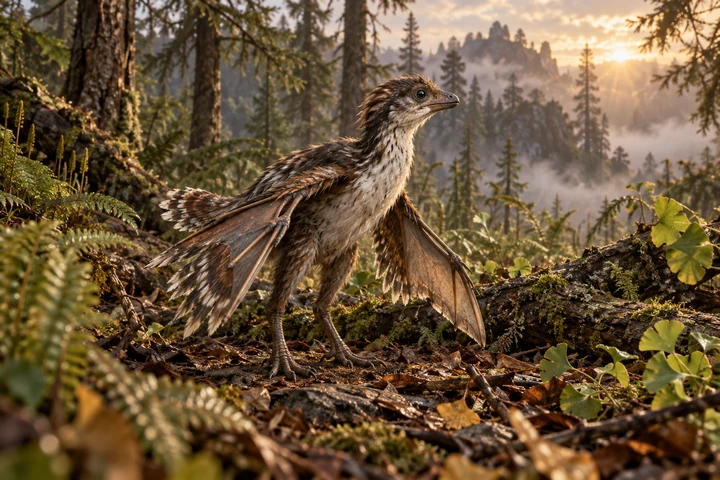
Ambopteryx longibrachium
Dinosaur
Ambopteryx was a small feathered dinosaur with membranous wings, a shortened tail and preserved clues to an animal meal.
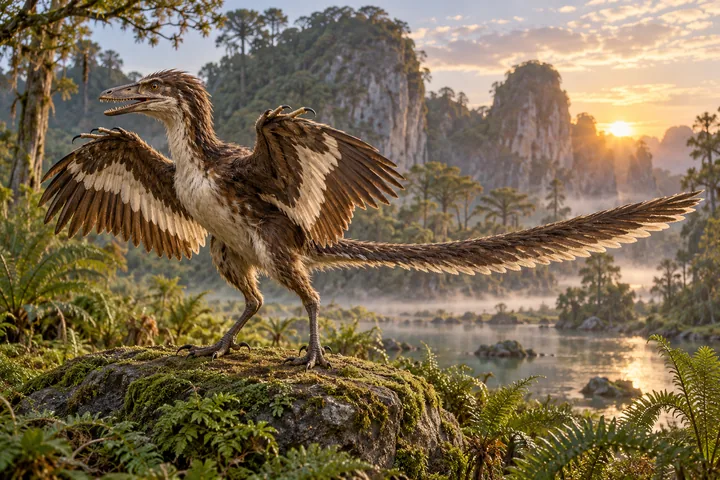
Archaeopteryx
Archaeopteryx preserves an early combination of bird-like and other theropod features. Its Late Jurassic fossils from Germany continue to reveal details of early flight.
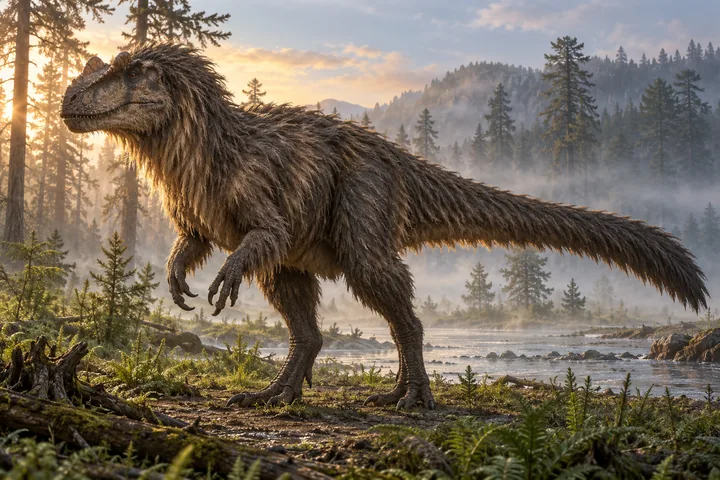
Yutyrannus huali
Yutyrannus huali was an early tyrannosauroid from China. Its fossils combine a crested skull and three-fingered hands with preserved feather filaments.