
Body length
InferredAbout 32 cm (type reference)
Institutional report gives a whole-animal reference without detailed measurement method or maturity scope; not a species maximum. [D2]
EXHIBIT 220
Ambopteryx longibrachium
Dinosaur
Ambopteryx was a small feathered dinosaur with membranous wings, a shortened tail and preserved clues to an animal meal. [1]
TWO WAYS TO PICTURE THE PAST
Compare the evidence with the familiar movie image. The illustrations are not to a shared scale.
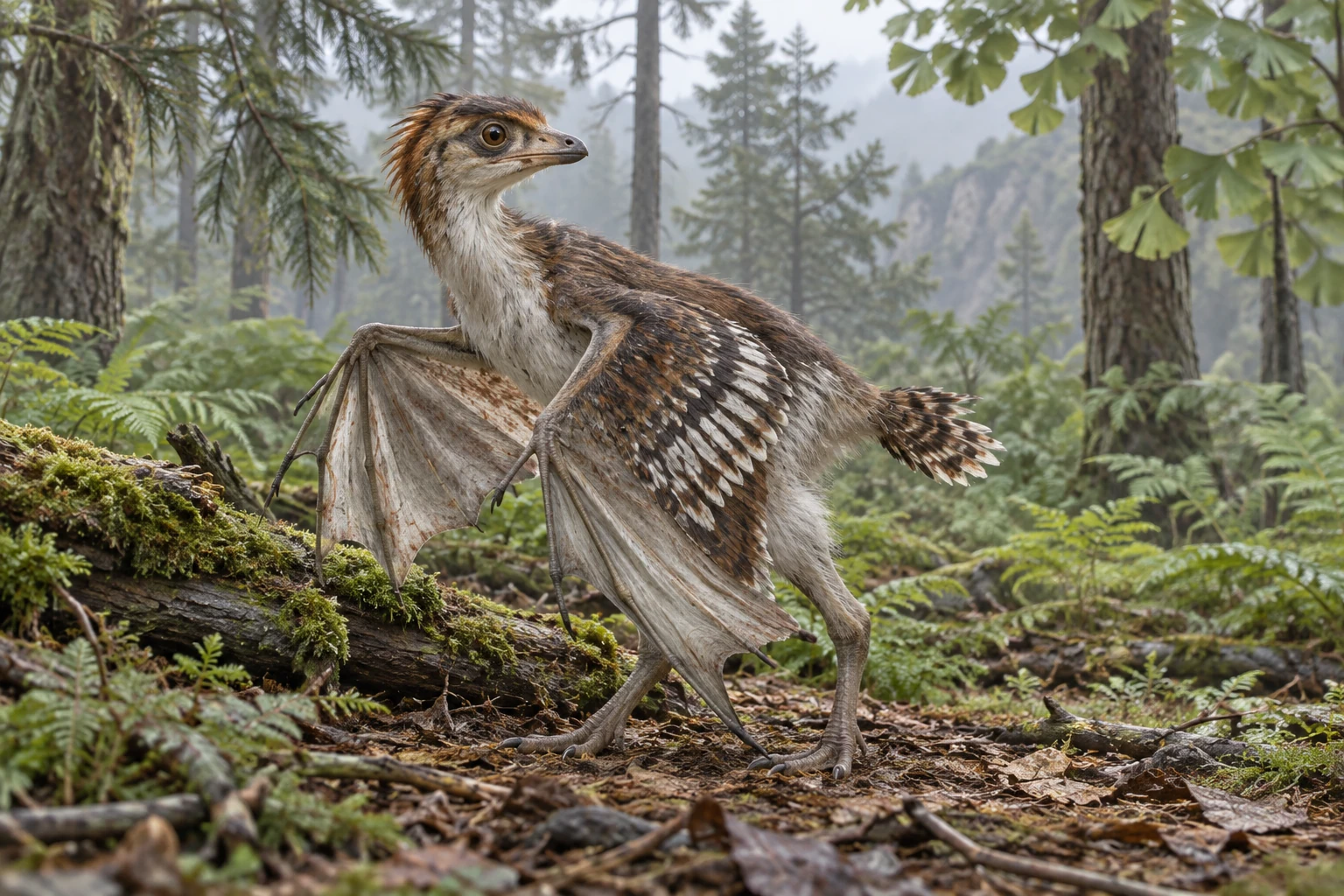
An illustrative reconstruction. Compare its anatomy with the evidence and limitations in the dossier. [1]
Source-informed reconstruction. Appearance evidence [1]. Original illustration; missing anatomy, coloration and scenery include interpretation.
Fossils constrain this life reconstruction. Missing anatomy, coloration and the environmental scene include interpretation; the dossier explains the evidence limits.
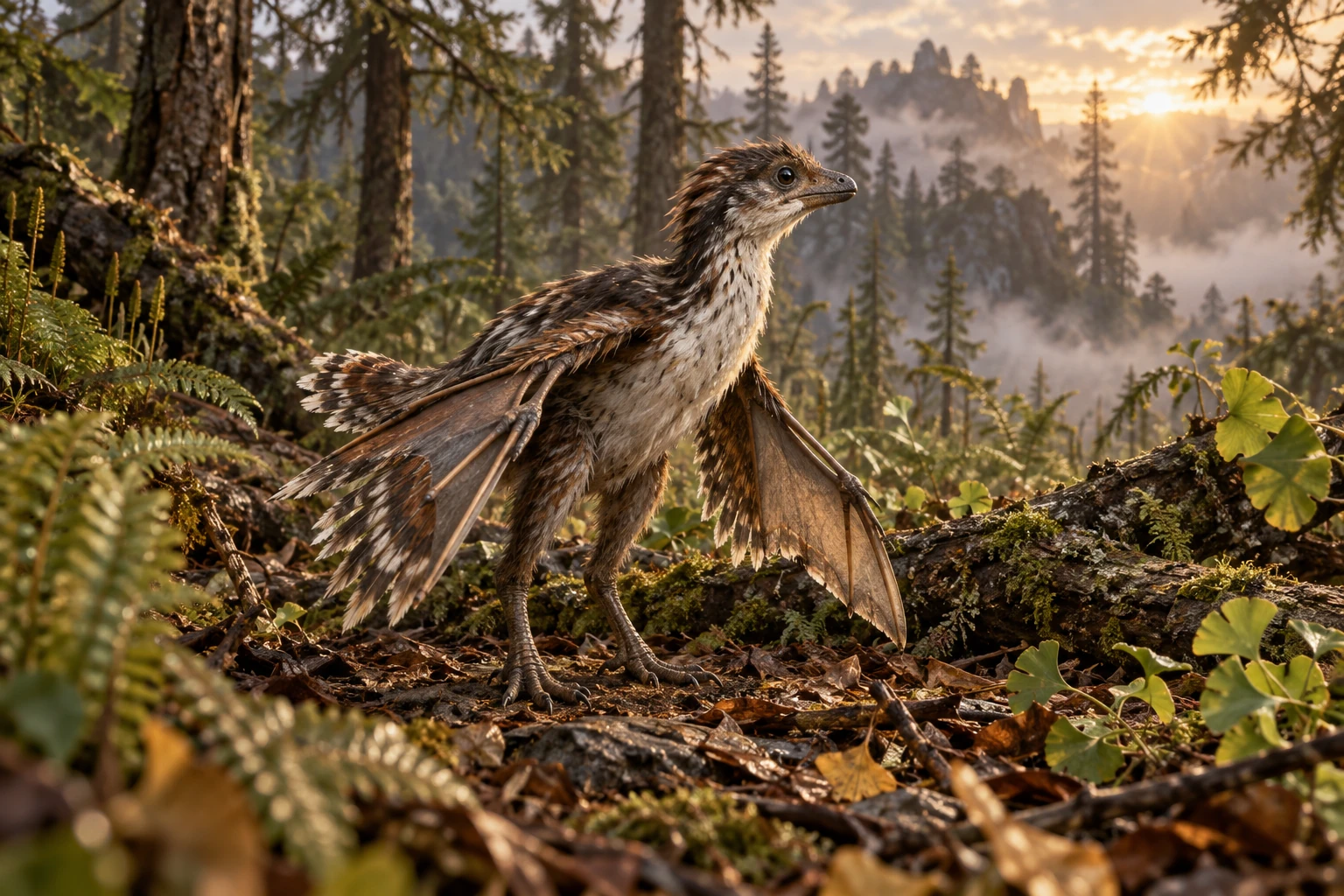
An illustrative reconstruction. Compare its anatomy with the evidence and limitations in the dossier. Lighting, coloration and scenery are artistic choices. This image does not document a fossil locality or behavior.
Original artwork · artistic interpretation.
Scientific view: source-informed reconstruction, credited paleoart or specimen-based imagery. Movie-style view: Original artistic interpretation. Reconstructions involve uncertainty.
MEET THE ANIMAL
Ambopteryx was a small Late Jurassic dinosaur from Liaoning in China. An institutional report gives the featured fossil an estimated length of about thirty-two centimetres and mass of roughly three hundred grams. Its stomach area preserved stones and suspected undigested bones. Those remains suggest that animal food formed part of its diet, although they do not identify a particular prey animal or reveal every food it ate. [D2]
Like the related Yi, it had membranous wings supported by unusually long forelimbs and rods projecting from the wrists. It also had feathers and a shortened tail ending in a fused structure called a pygostyle. This combination makes it a dinosaur with a distinctive wing design. It should not be drawn simply as a bat or as a small bird with ordinary feathered flight wings. [D1]
Its way of moving was probably more complicated than a life spent only in treetops. A study of its foot claws found features suited to movement on the ground, without the opposing toes used by many modern grasping birds. Its forelimbs may still have helped it climb. Researchers therefore compare different parts of its body together, rather than letting the presence of wings decide its entire lifestyle. [D4]
PREHISTORIC ANIMAL DOSSIER
The animal, the evidence, and the questions still open.
Ground-adapted feet complicate an exclusively tree-dwelling portrayal, even though forelimbs may have assisted climbing. [D4]
Profile scope: Genus — Ambopteryx longibrachium; holotype IVPP V24192 from Late Jurassic Liaoning, China, distinct from Yi. [D1]
Source supported identifies a description documented by the cited source. Inferred marks a reconstruction or functional estimate. Debated marks competing interpretations. Not established means the sources reviewed for this dossier do not support a firm conclusion; it does not mean a behavior never occurred.
A size reference is an estimate, not a population range. Nesting evidence does not by itself establish courtship, mate choice, or lifelong pairing.
About 32 cm (type reference)
Institutional report gives a whole-animal reference without detailed measurement method or maturity scope; not a species maximum. [D2]
About 306 g (type reference)
This is an estimated size reported for the featured specimen, not a measured adult species range. [D2]
Animal food consumed; omnivory proposed
Unidentified bony gut contents accompany stomach stones. Stones alone do not prove plant eating or identify prey. [D1]
Liaoning Jurassic forest landscape
Ground-adapted feet and possible climbing forelimbs argue against automatically restricting it to a high-canopy habitat. [D4]
Climbing and limited gliding inferred
Aerodynamic models do not support likely powered flight. Walking/climbing ecology also depends on foot and forelimb comparisons. [D3]
Membrane wings and shortened tail
Long forelimbs and styliform wrist rods supported membranes; the short tail ends in a pygostyle. [D1]
Not established here
The reviewed skeleton and focused searches do not identify assigned nests, eggs, clutch size or parental care. [D1]
Not established here
Wing anatomy is not proof of a mating display, display sound or sex-specific color pattern. [D1]
Not established here
The described specimen does not establish communal nesting, flocking or cooperative feeding. [D2]
Sources and inspection notes for the claims in this profile.
THE STORY IN THE FOSSILS
Its foot study used claw form rather than preserved toe-pad skin. The distinction matters when reconstructing how it gripped a surface. [4]
The reported gut bones indicate animal food, but their identity and the complete diet remain uncertain. [2]
The dossier identifies the scope of each reference estimate. A mount, an individual fossil and a species-wide adult range are different measurements. Comparison metrics remain unavailable where adult scope has not been established. Unknown does not mean zero.
Sources support the stated claims and scopes. Refer to the evidence notes for uncertainty.
KEEP EXPLORING
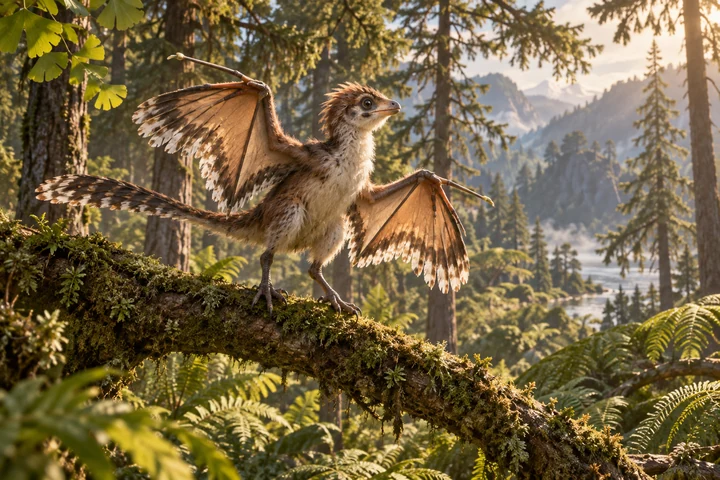
Yi qi
Dinosaur
Yi was a small feathered dinosaur with wrist-supported wing membranes, a different construction from a bird’s feathered wings.
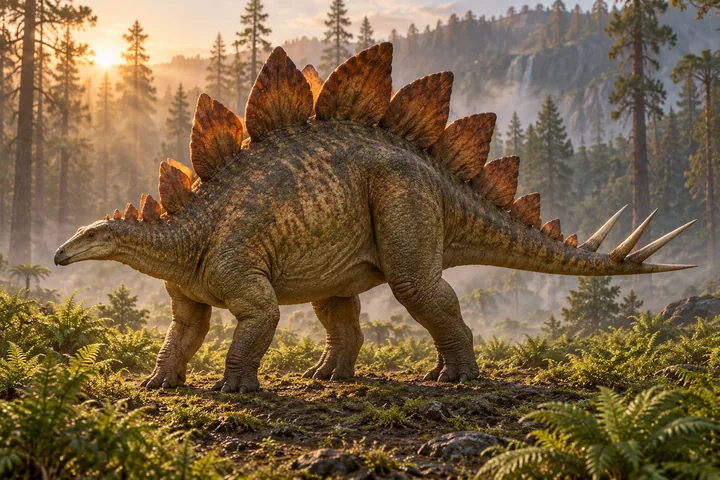
Stegosaurus stenops
Stegosaurus stenops was a plated, plant-eating dinosaur of the Late Jurassic. The remarkably complete specimen Sophie lets researchers examine its skeleton in three dimensions and reconstruct how its jaws processed vegetation.
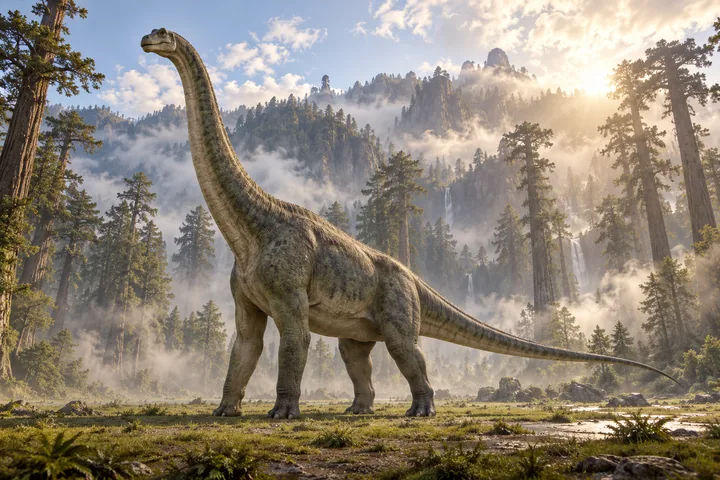
Brachiosaurus altithorax
Brachiosaurus altithorax was a giant sauropod from Late Jurassic North America. Its name-bearing skeleton is incomplete, and many familiar reconstructions borrow details from the separate African dinosaur Giraffatitan.