
Body length
InferredAbout 0.5 m; museum reference
NHM gives this rounded genus reference. It does not represent the dimensions of every specimen or species. [D1]
EXHIBIT 27
Archaeopteryx
Feathered wings combined with teeth and a long bony tail.
TWO WAYS TO PICTURE THE PAST
Compare the evidence with the familiar movie image. The illustrations are not to a shared scale.

The artist identifies this reconstruction as Archaeopteryx. Fossil-informed anatomy: Small feathered paravian with broad wings, clawed hands, toothed jaws and a long feathered bony tail; avoid a modern short-tailed bird silhouette. Feather form is supported by fossils; color pattern and some soft tissues are interpretive. [1] [2]
Archaeopteryx TD.png — TotalDino. CC BY-SA 4.0. Remote source artwork displayed without additional cropping; Wikimedia supplies any display-size derivative.
Scientific picture served by Wikimedia · internet connection required.
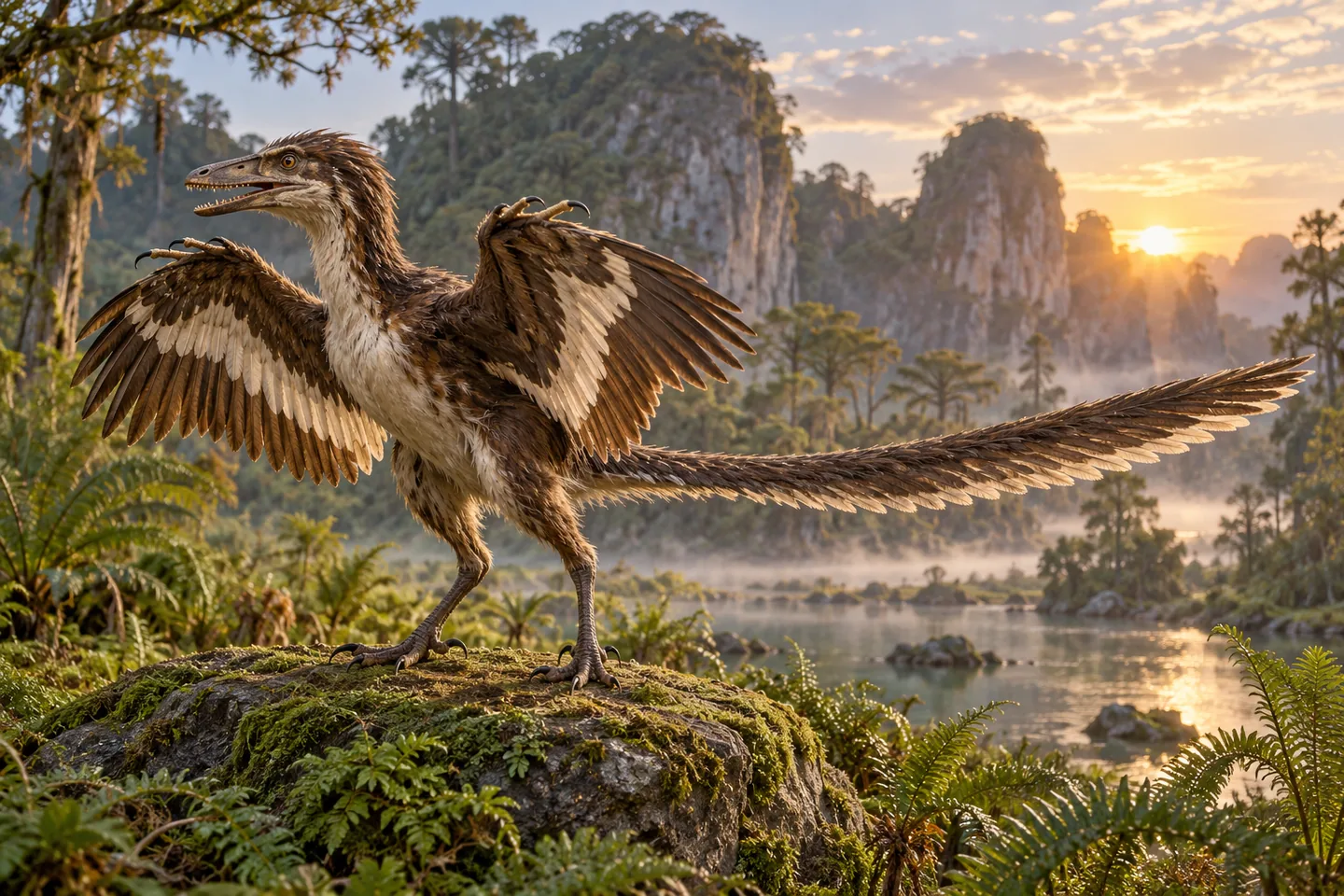
Cinematic Archaeopteryx with feathered wings, small toothed head, visible hand claws and long bony feathered tail; limestone-island vegetation, lifted wings. Dramatic lighting, surface detail and scenery are artistic choices. This is an original cinema-inspired picture, rather than a frame from a film or a documented fossil locality.
Original artwork · artistic interpretation.
Scientific view: credited paleoart interpreting fossil evidence, served online by Wikimedia. Movie-style view: Original artistic interpretation. Colors, soft tissues and settings involve reconstruction.
MEET THE ANIMAL
Archaeopteryx lived about 150 million years ago, during the Late Jurassic. One exceptionally preserved fossil from the Solnhofen limestone of Germany now belongs to Chicago's Field Museum. Studying it required patience: its hollow bones were so fragile that preparators used scans to locate hidden pieces before carefully removing the surrounding rock. Ultraviolet light also revealed details difficult to see in ordinary light. [S1]
The specimen preserves feathers along the upper arm that help fill the gap between the wing and the body. Researchers interpreted this arrangement as a continuous surface useful for generating lift. Preserved foot pads and other details also help investigate life on the ground and possible climbing. Each feature supplies part of the picture, rather than a complete account of its daily routine. [S1]
A separate study examined the internal geometry of wing bones in three Archaeopteryx fossils. Their structure supported active flight, with a wing stroke different from that of modern birds. This means Archaeopteryx could have used powered flapping without having the full modern bird flight system. The conclusion is an anatomical inference, rather than a measured flight speed or endurance. [D2]
PREHISTORIC ANIMAL DOSSIER
The animal, the evidence, and the questions still open.
Archaeopteryx combined feathered wings with teeth and a long bony tail in Late Jurassic Europe. Its mosaic of bird-like and other theropod features makes it central to research on early dinosaur flight.
Profile scope: Genus: Archaeopteryx; mass and flight inference refer to three studied specimens.
Source supported identifies a description documented by the cited source. Inferred marks a reconstruction or functional estimate. Debated marks competing interpretations. Not established means the sources reviewed for this dossier do not support a firm conclusion; it does not mean a behavior never occurred.
A size reference is an estimate, not a population range. Nesting evidence does not by itself establish courtship, mate choice, or lifelong pairing.
About 0.5 m; museum reference
NHM gives this rounded genus reference. It does not represent the dimensions of every specimen or species. [D1]
158–456 g across three study specimens
The flight study reports reconstructed masses of 158, 254 and 456 g for its fifth, seventh and ninth specimens. These model estimates are not an adult species range. [D2]
Probably small animals
NHM proposes small reptiles, mammals or insects from its teeth and ecosystem context. These proposed foods are not reported gut contents. [D1]
Lagoon-associated subtropical islands of Europe
NHM reconstructs the Solnhofen area as lagoons surrounded by subtropical islands. Fossil burial in lagoon limestone does not make Archaeopteryx an aquatic animal. [D1]
Bipedal; short flapping flight inferred
Wing-bone geometry in three specimens resembles birds using short-distance flapping. The study infers a flight stroke different from that of modern birds. [D2] [D1]
Feathered wings; teeth; long bony tail
These features are preserved in skeletons and feather impressions, rather than inferred solely from modern birds. [D1]
Not established here
The reviewed sources do not establish taxon-specific nest structure, clutch size or parental care.
Not established here
The reviewed sources do not establish a mating ritual, pair bond or breeding season for this taxon.
Not established here
The reviewed sources do not establish a taxon-specific group structure or social hierarchy.
Sources and inspection notes for the claims in this profile.
THE STORY IN THE FOSSILS
Archaeopteryx had broad feathered wings, small teeth and a long bony tail. Its fossils come from limestone near Solnhofen, where lagoons lay among subtropical islands. These preserved skeletons and feather impressions made it a key animal in discussions of the evolutionary origin of birds. [1]
In 2025, study of the Chicago specimen revealed upper-arm feathers called tertials. Researchers argued that they filled an aerodynamic gap between wing and body, supporting flight. Preserved tissues in the hands and feet also added evidence for time spent walking on the ground. [2]
We have not established a comparable adult total-length estimate for this taxon in this draft. Specimen measurements in the text describe those individuals. The cited dates are approximately 149–145 million years ago. Approximate museum catalogue reference interval for the genus, not an exact duration for every species. Unknown does not mean zero.
Sources and evidence notes for this exhibit.
KEEP EXPLORING
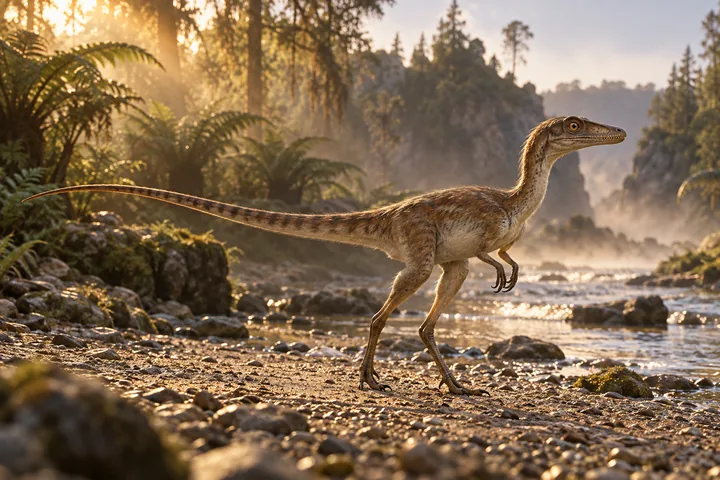
Compsognathus
A small predator whose last meal survived inside its fossil.
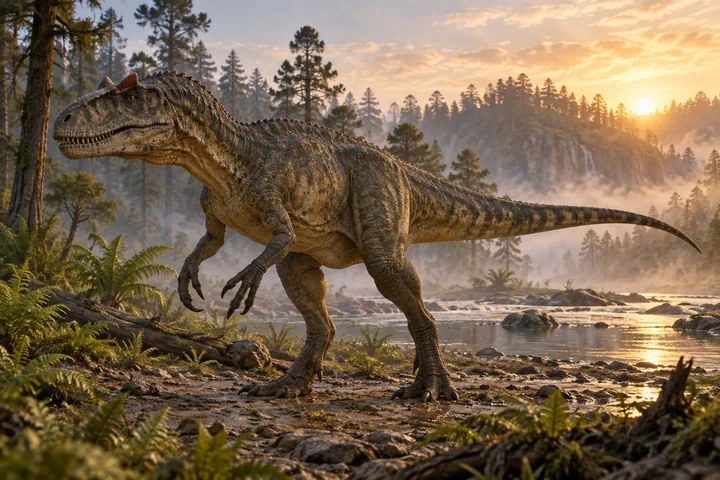
Allosaurus
Allosaurus combined three-fingered hands with small horns above its eyes.
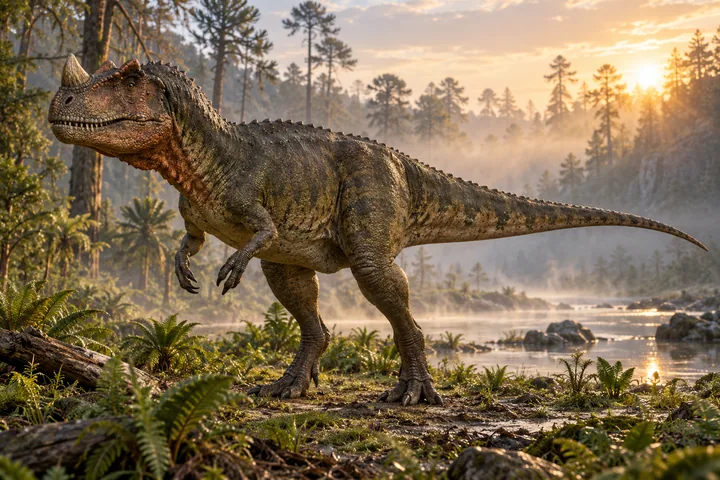
Ceratosaurus
Ceratosaurus had a nose horn and small bony armor pieces along its back.