
Body length
InferredMuseum references differ: about 0.7–1.5 m
NHM lists 0.7 m; MNHN describes up to 1.5 m and a larger French specimen. These references are not a statistically established adult size range. [D1] [D2]
EXHIBIT 35
Compsognathus
A small predator whose last meal survived inside its fossil.
TWO WAYS TO PICTURE THE PAST
Compare the evidence with the familiar movie image. The illustrations are not to a shared scale.

The artist identifies this reconstruction as Compsognathus. Fossil-informed anatomy: Small bipedal theropod with long tail and hind limbs, short three-fingered clawed arms and recurved teeth; any down is inferred. The file identifies the genus only. Integument, colours and soft tissue are reconstructed; no accuracy warning appears on the read page. [1] [2]
Compsognathus TD.png — TotalDino. CC BY 4.0. Remote source artwork displayed without additional cropping; Wikimedia supplies any display-size derivative.
Scientific picture served by Wikimedia · internet connection required.
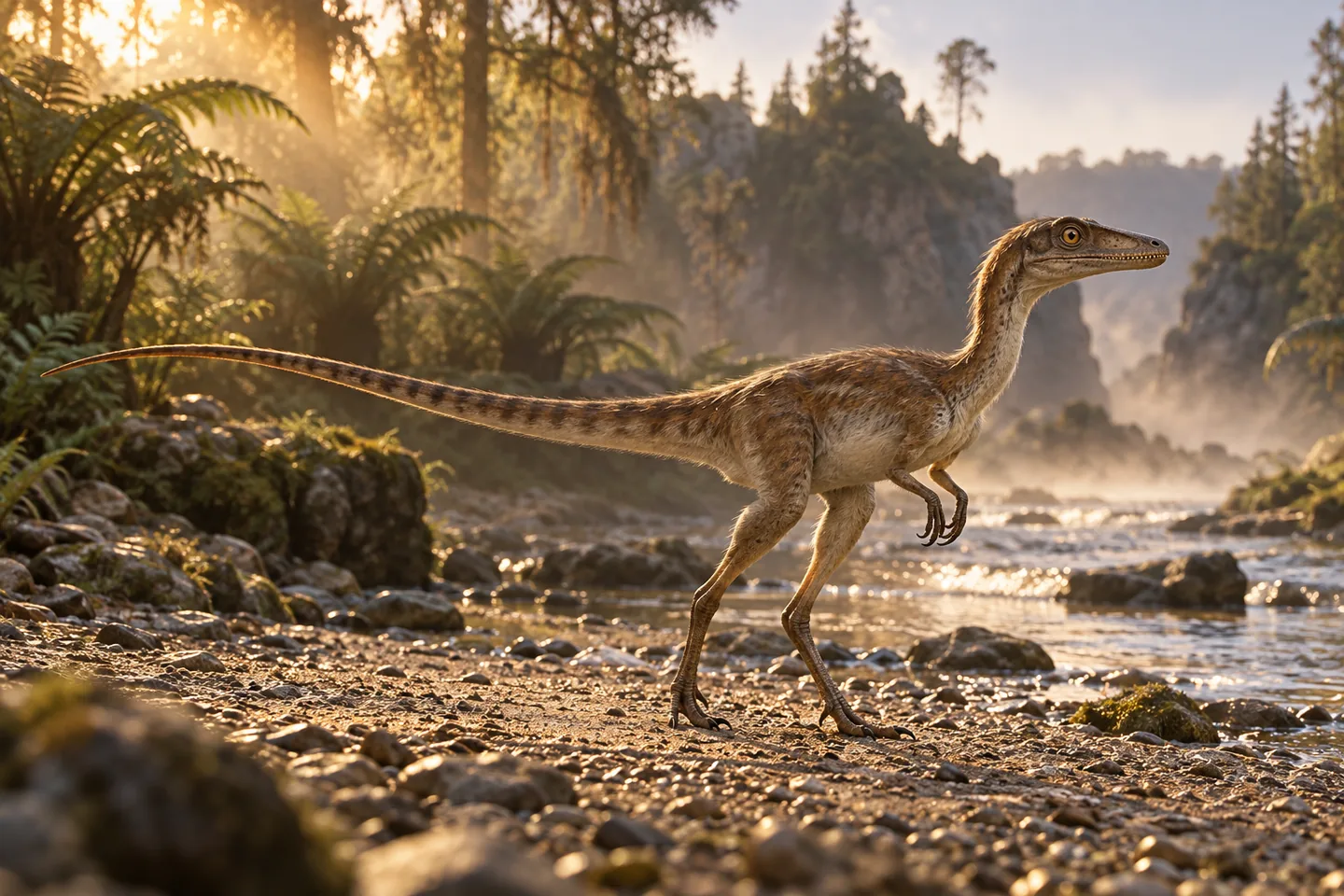
Cinematic Compsognathus, small slender predator with long tail, short clawed arms and plausible subtle inferred down; alert stance among Jurassic island plants. Dramatic lighting, surface detail and scenery are artistic choices. This is an original cinema-inspired picture, rather than a frame from a film or a documented fossil locality.
Original artwork · artistic interpretation.
Scientific view: credited paleoart interpreting fossil evidence, served online by Wikimedia. Movie-style view: Original artistic interpretation. Colors, soft tissues and settings involve reconstruction.
MEET THE ANIMAL
Compsognathus was a small meat-eating dinosaur that lived in Europe during the Late Jurassic. It walked on two legs and had teeth suited to eating animals. Fossils from Germany and France form an important part of its record, giving scientists skeletons to compare rather than just scattered teeth. [D1]
The French fossil is nearly complete, although the end of its tail and some finger bones are missing. Parts survive as bones and others as impressions in the rock. This distinction matters: an impression can preserve the shape of a missing bone, but crushing or damage may alter how a feature appears. Studying such fossils involves recognizing what is preserved as well as what is absent. [S1]
The larger French animal was originally given a separate species name. A detailed re-examination found its anatomy nearly identical to that of the German Compsognathus longipes. Differences could be explained by growth, variation within one species and preservation. The study supported treating both as the same species. Compsognathus therefore illustrates why two differently sized fossils do not automatically represent two different kinds of dinosaur. [S1]
PREHISTORIC ANIMAL DOSSIER
The animal, the evidence, and the questions still open.
Compsognathus was a small European theropod with long hindlimbs and a long tail. The Canjuers specimen preserves small reptile remains in its torso, documenting a meal rather than a speculative prey list.
Profile scope: Genus: Compsognathus; specimen comparisons concern C. longipes.
Source supported identifies a description documented by the cited source. Inferred marks a reconstruction or functional estimate. Debated marks competing interpretations. Not established means the sources reviewed for this dossier do not support a firm conclusion; it does not mean a behavior never occurred.
A size reference is an estimate, not a population range. Nesting evidence does not by itself establish courtship, mate choice, or lifelong pairing.
Museum references differ: about 0.7–1.5 m
NHM lists 0.7 m; MNHN describes up to 1.5 m and a larger French specimen. These references are not a statistically established adult size range. [D1] [D2]
About 3–3.5 kg; museum references
NHM supplies 3 kg and MNHN gives no more than 3.5 kg. Estimation methods and directly comparable specimen scopes are not supplied. [D1] [D2]
Carnivore; small reptile remains preserved
MNHN describes small rhynchocephalian remains in the Canjuers specimen's rib region. That meal does not define every prey item across the genus. [D2]
Late Jurassic Europe; limestone fossil sites
The reviewed museum account identifies Solnhofen and Canjuers fossils. Preserving sediment alone does not resolve a narrow habitat preference. [D2]
Walked and ran on two legs
The museums describe bipedal locomotion; the long hindlimbs support a running reconstruction. Precise speed is unestablished. [D1] [D2]
Long hindlimbs, long tail, curved teeth
MNHN documents these skeletal features and notes that feathers have not been preserved on the European specimens. A downy covering is an inference from relatives. [D2]
Not established here
The reviewed sources do not establish taxon-specific nest structure, clutch size or parental care.
Not established here
The reviewed sources do not establish a mating ritual, pair bond or breeding season for this taxon.
Not established here
The reviewed sources do not establish a taxon-specific group structure or social hierarchy.
Sources and inspection notes for the claims in this profile.
THE STORY IN THE FOSSILS
Compsognathus had long hind limbs, shorter clawed forelimbs and a long tail. Recurved, serrated teeth suited capturing small prey. The remarkably complete Canjuers specimen, discovered in southern France in the early 1970s, became an especially valuable record of this small European dinosaur. [2]
Small reptile remains preserved near the ribs of the Canjuers fossil record its last meal. The museum also explains that the curved neck and tail position developed after death. Such details help distinguish evidence about feeding from the effects of decomposition and preservation. [2]
We have not established a comparable adult total-length estimate for this taxon in this draft. Specimen measurements in the text describe those individuals. The cited dates are approximately 150 million years ago. The MNHN account gives approximately 150 Ma. The NHM catalogue’s 145–140 Ma interval conflicts with its Late Jurassic label and is not used; equal endpoints do not establish a full temporal range. Unknown does not mean zero.
Sources and evidence notes for this exhibit.
KEEP EXPLORING
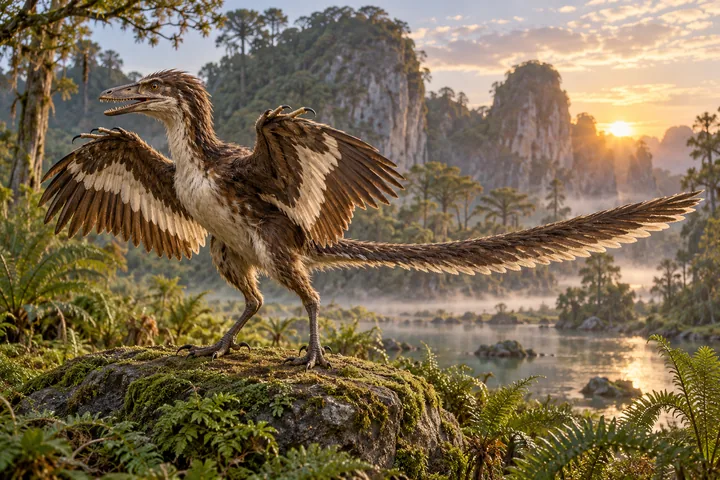
Archaeopteryx
Feathered wings combined with teeth and a long bony tail.
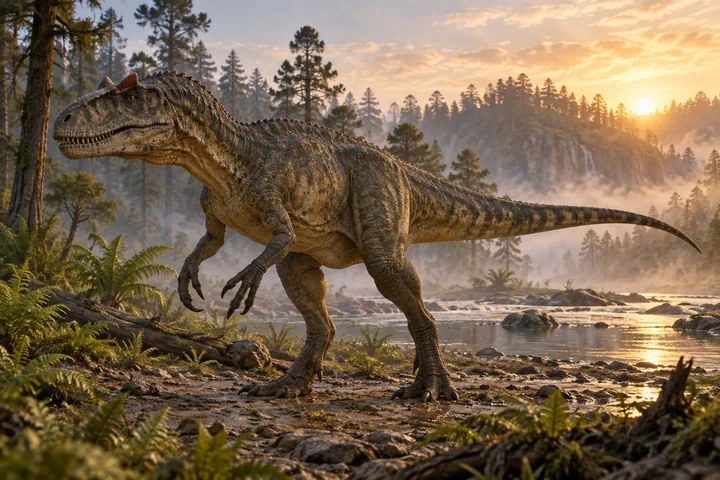
Allosaurus
Allosaurus combined three-fingered hands with small horns above its eyes.
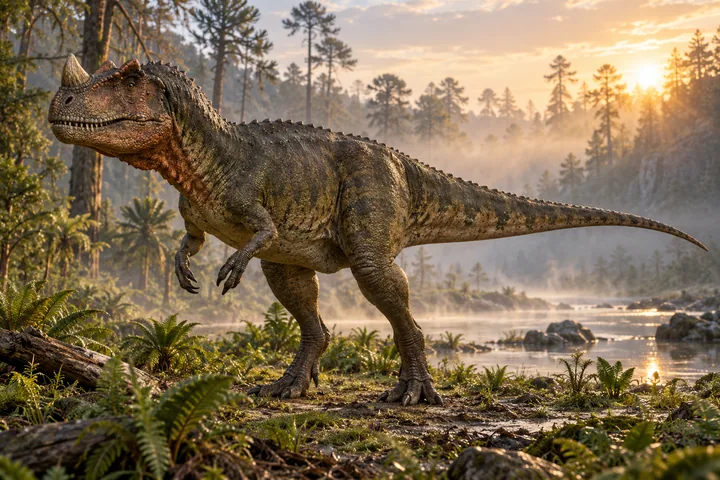
Ceratosaurus
Ceratosaurus had a nose horn and small bony armor pieces along its back.