
Body length
Not establishedNot established here
No total body length adopted. The incomplete skeleton does not yield a securely specimen-bound length or an established adult range. [D3]
EXHIBIT 258
Yuxisaurus kopchicki
Dinosaur
A stocky early armored dinosaur from Yunnan that helps document the early spread of shield-bearing dinosaurs. [2]
TWO WAYS TO PICTURE THE PAST
Compare the evidence with the familiar movie image. The illustrations are not to a shared scale.
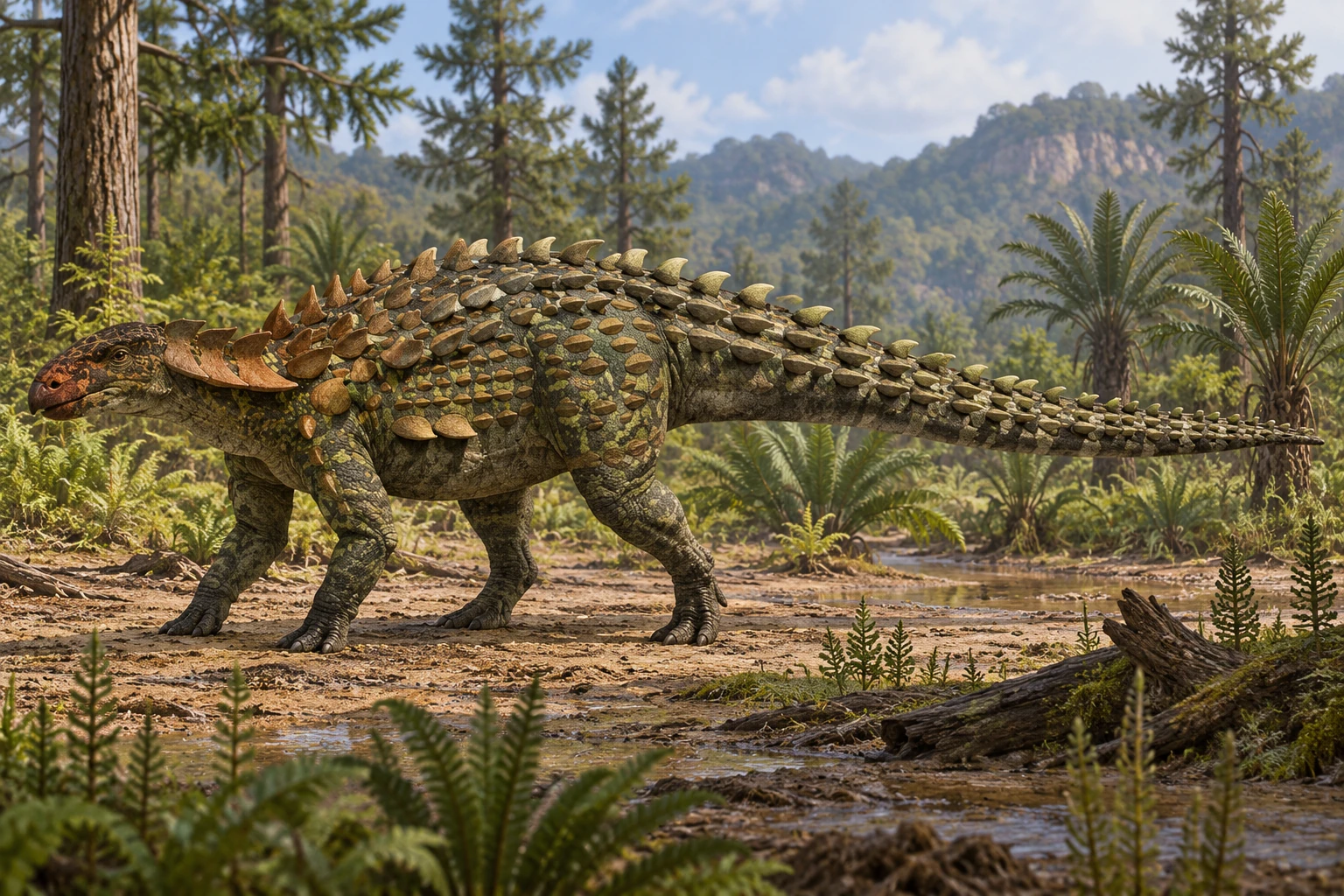
An illustrative reconstruction. Compare its anatomy with the evidence and limitations in the dossier. [1]
Source-informed reconstruction. Appearance evidence [1]. Original illustration; missing anatomy, coloration and scenery include interpretation.
Fossils constrain this life reconstruction. Missing anatomy, coloration and the environmental scene include interpretation; the dossier explains the evidence limits.
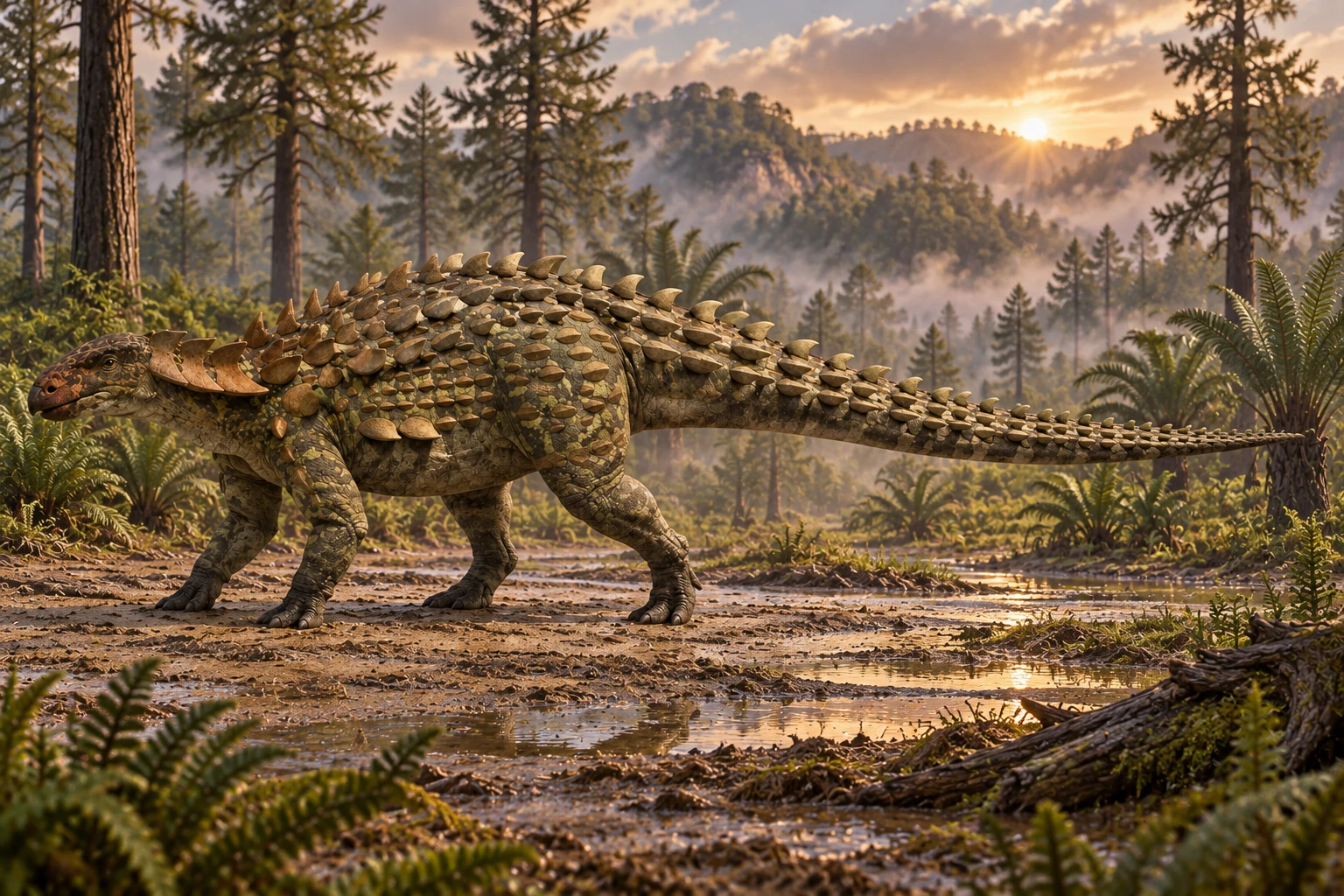
An illustrative reconstruction. Compare its anatomy with the evidence and limitations in the dossier. Lighting, coloration and scenery are artistic choices. This image does not document a fossil locality or behavior.
Original artwork · artistic interpretation.
Scientific view: source-informed reconstruction, credited paleoart or specimen-based imagery. Movie-style view: Original artistic interpretation. Reconstructions involve uncertainty.
MEET THE ANIMAL
Yuxisaurus lived in southwestern China during the Early Jurassic, long before the best-known giant armored dinosaurs. Its discovery helped show that early shield-bearing dinosaurs were already spreading and developing different body shapes. It was a stocky animal with spiked armor, and its fossils added another plant eater to a region better known for long-necked dinosaurs and their relatives. [D2]
Researchers identified it from one incomplete skeleton containing skull pieces, vertebrae, limb bones and many armor elements. More than 120 pieces of bony armor were recovered. These remains provide real identifying features, but they do not reveal the complete original arrangement of every plate. A drawing must therefore combine what was found with clearly limited reconstruction of the missing parts. [D1]
Its heavy build suggests it usually moved on four legs. Some researchers also consider occasional movement on two legs possible, although this is an interpretation of its anatomy. We do not have assigned eggs, nests or a recorded courtship display for this specimen. The find is valuable because it explains part of armored-dinosaur history, while leaving many details of everyday life open. [D3]
PREHISTORIC ANIMAL DOSSIER
The animal, the evidence, and the questions still open.
Yuxisaurus lies near the early radiation of armored dinosaurs; its discovery adds regional evidence without identifying a direct ancestor. [D2]
Profile scope: The exhibit concerns the incomplete holotype CVEB 21701 of Yuxisaurus kopchicki. [D1]
Source supported identifies a description documented by the cited source. Inferred marks a reconstruction or functional estimate. Debated marks competing interpretations. Not established means the sources reviewed for this dossier do not support a firm conclusion; it does not mean a behavior never occurred.
A size reference is an estimate, not a population range. Nesting evidence does not by itself establish courtship, mate choice, or lifelong pairing.
Not established here
No total body length adopted. The incomplete skeleton does not yield a securely specimen-bound length or an established adult range. [D3]
Not established here
No dependable body mass adopted. Reviewed descriptions provide skeletal anatomy, rather than a calibrated complete-body mass estimate. [D3]
Plant feeding inferred.
Its triangular, denticulate, ridged tooth crown is consistent with herbivory; exact foods and a preserved meal are unavailable. [D1]
Terrestrial Fengjiahe Formation in Yunnan.
The fossil is from Early Jurassic strata in a sauropodomorph-dominated fauna; a detailed preferred habitat remains unresolved. [D2] [D1]
Primarily quadrupedal movement is inferred.
The robust skeleton favors four-legged posture; possible two-legged movement is an interpretation, not observed behavior. [D3]
Stocky body with numerous armor elements.
More than 120 osteoderms were recovered; their complete arrangement and missing body outline remain partly reconstructed. [D1]
Not established here
Assigned eggs and nests are unknown here. The reviewed single incomplete skeleton and focused searches do not establish taxon-specific reproductive remains. [D3]
Not established here
No established courtship display. Armor alone does not identify a sex difference, breeding signal or mating ritual. [D2]
Not established here
Group organization remains unknown. Sociality discussed for other early armored dinosaurs cannot be transferred to this single Yuxisaurus individual. [D1]
Sources and inspection notes for the claims in this profile.
THE STORY IN THE FOSSILS
The specimen preserves skull portions, limb bones and many separate armor pieces. Their combination, including distinctive skull features, allowed researchers to diagnose a new genus from southwestern China. [3]
The discovery broadens the geographic picture of early armored dinosaurs. It shows that this body plan was already varied, while leaving the group's exact place of origin unsettled. [2]
The dossier identifies the scope of each reference estimate. A mount, an individual fossil and a species-wide adult range are different measurements. Comparison metrics remain unavailable where adult scope has not been established. Unknown does not mean zero.
Sources support the stated claims and scopes. Refer to the evidence notes for uncertainty.
KEEP EXPLORING
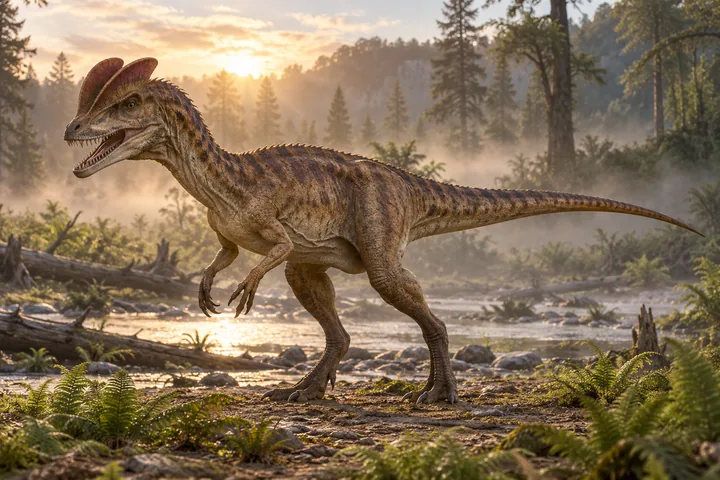
Dilophosaurus
This Early Jurassic carnivore lived in what is now Arizona. Modern study reveals stronger jaws and more complex crest anatomy than early reconstructions suggested.
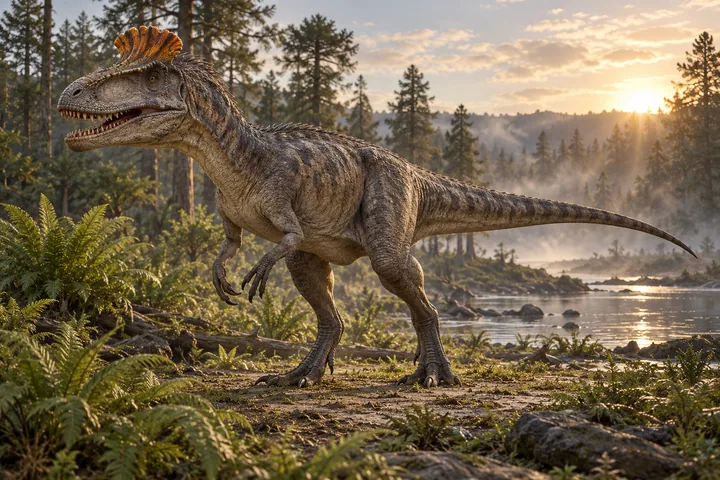
Cryolophosaurus ellioti
Cryolophosaurus ellioti was a large Early Jurassic predator from Antarctica. Its distinctive crest and preserved skeleton help illuminate early theropod evolution.
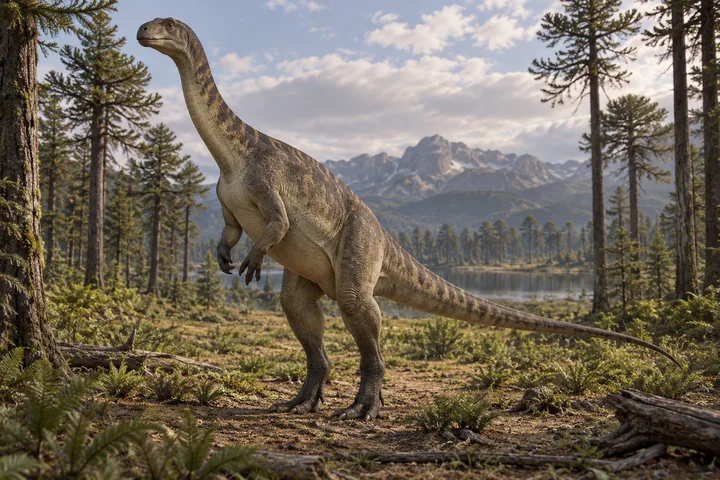
Mussaurus patagonicus
Mussaurus grew from tiny hatchlings into large sauropodomorphs. Eggs and clustered skeletons from Patagonia provide unusually rich evidence for nesting and age-related social organization.