
Body length
InferredAbout 8 m; museum reference
NHM gives 8 m; the LA exhibition uses a 25-foot reconstruction, approximately 7.6 m. These educational reconstructions are not a measured biological range. [D1] [D2]
EXHIBIT 22
Cryolophosaurus ellioti
Cryolophosaurus had a fluted crest running across the top of its skull.
TWO WAYS TO PICTURE THE PAST
Compare the evidence with the familiar movie image. The illustrations are not to a shared scale.

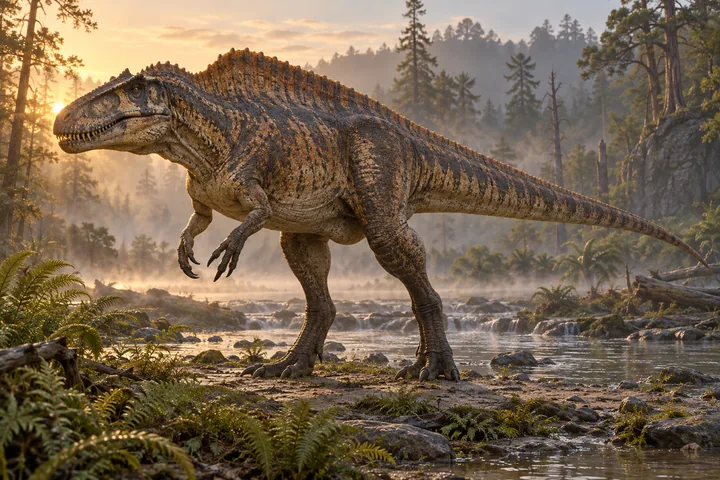
The artist identifies this reconstruction as Cryolophosaurus ellioti. Fossil-informed anatomy: Large bipedal theropod with a distinctive transverse, fluted crest above the eye region. Much of the body is inferred from relatives; soft tissues and coloration are interpretive. Phylogenetic placement is debated, so the source description of a close relationship to Dilophosaurus should not be treated as settled. [1] [2] [3] [4]
Cryolophosaurus ellioti 2022 Reconstruction.png — Leoomas. CC BY-SA 4.0. Remote source artwork displayed without additional cropping; Wikimedia supplies any display-size derivative.
Scientific picture served by Wikimedia · internet connection required.
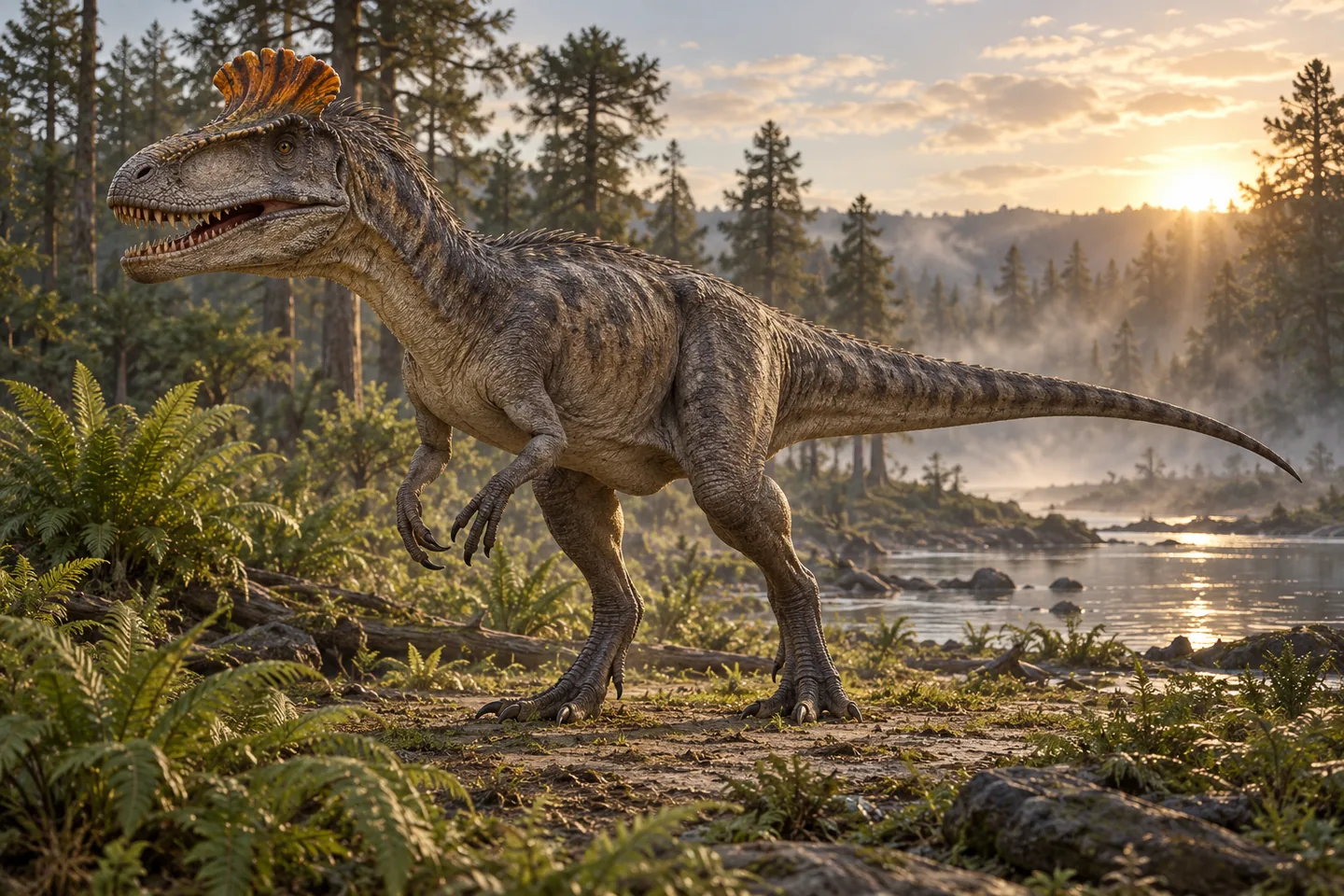
Cinematic Cryolophosaurus ellioti with a curved transverse head crest and balanced theropod body; reconstruct the incomplete snout and use artistic colors. Dramatic lighting, surface detail and scenery are artistic choices. This is an original cinema-inspired picture, rather than a frame from a film or a documented fossil locality.
Original artwork · artistic interpretation.
Scientific view: credited paleoart interpreting fossil evidence, served online by Wikimedia. Movie-style view: Original artistic interpretation. Colors, soft tissues and settings involve reconstruction.
MEET THE ANIMAL
Cryolophosaurus ellioti was a large predatory dinosaur from Early Jurassic Antarctica. Its fossils occur in the Hanson Formation of the Central Transantarctic Mountains. A bony crest on its skull gives it a recognizable profile. Anatomical research identifies bones near the eyes as major contributors to that crest, showing that it is a preserved skull structure rather than an invented decoration. [S1]
The animal's setting was very different from Antarctica's modern icy landscape. The museum exhibition reconstructs a vegetated environment with trees and other animals. This helps explain how a large land predator could live there. The reconstruction combines fossil and environmental evidence; it should not be read as a record of one exclusive habitat or a photograph of an individual dinosaur's daily life. [D2]
Researchers study the rest of the skull and skeleton to compare Cryolophosaurus with other early predatory dinosaurs. The anatomical work tests relationships using many features, including less conspicuous bones as well as the famous crest. A distinctive head shape can be useful for identification without revealing its exact purpose. The reviewed evidence does not establish a particular crest display, courtship routine, nest arrangement or parental care for this species. [S1]
PREHISTORIC ANIMAL DOSSIER
The animal, the evidence, and the questions still open.
Cryolophosaurus ellioti was a crested Antarctic theropod from the Jurassic. Its fossils record a predator in Antarctica's vegetated past, rather than the modern ice-covered landscape.
Profile scope: Species: Cryolophosaurus ellioti.
Source supported identifies a description documented by the cited source. Inferred marks a reconstruction or functional estimate. Debated marks competing interpretations. Not established means the sources reviewed for this dossier do not support a firm conclusion; it does not mean a behavior never occurred.
A size reference is an estimate, not a population range. Nesting evidence does not by itself establish courtship, mate choice, or lifelong pairing.
About 8 m; museum reference
NHM gives 8 m; the LA exhibition uses a 25-foot reconstruction, approximately 7.6 m. These educational reconstructions are not a measured biological range. [D1] [D2]
About 500 kg; museum estimate
NHM provides a rounded reference figure without identifying a specimen, life stage or calculation method. [D1]
Carnivore; other animals
NHM describes sharp pointed teeth and a diet of other animals. Specific prey species are not established by these sources. [D1]
Vegetated ancient Antarctica
The exhibition places Cryolophosaurus in a lush Antarctic environment with trees and other vertebrates. That ecosystem reconstruction does not identify a narrow habitat preference. [D2]
Walked on two legs
NHM identifies two-legged movement; speed and hunting technique remain unspecified here. [D1]
Curved cranial crest; pointed teeth
A bony crest on the skull is a documented feature. Its existence does not by itself demonstrate a mating display. [D1] [D2]
Not established here
The reviewed sources do not establish taxon-specific nest structure, clutch size or parental care.
Not established here
The reviewed sources do not establish a mating ritual, pair bond or breeding season for this taxon.
Not established here
The reviewed sources do not establish a taxon-specific group structure or social hierarchy.
Sources and inspection notes for the claims in this profile.
THE STORY IN THE FOSSILS
Cryolophosaurus comes from Antarctica’s Hanson Formation in the Central Transantarctic Mountains. Its unusual skull crest was formed primarily by the lacrimal bones. A 2007 anatomical analysis compared hundreds of skeletal characters, highlighting a mixture of features informative about relationships among early predatory dinosaurs. [1]
David Elliot encountered the fossils while studying Antarctic rocks, and subsequent work freed the skeleton over multiple field seasons. The recovered skull was incomplete, with part of the snout worn away. Suggested crest functions involve recognition or display, but the fossil does not establish these behaviors. [2] [3]
We have not established a comparable adult total-length estimate for this taxon in this draft. Specimen measurements in the text describe those individuals. A numerical age interval has not been reviewed here. Unknown does not mean zero.
Sources and evidence notes for this exhibit.
KEEP EXPLORING
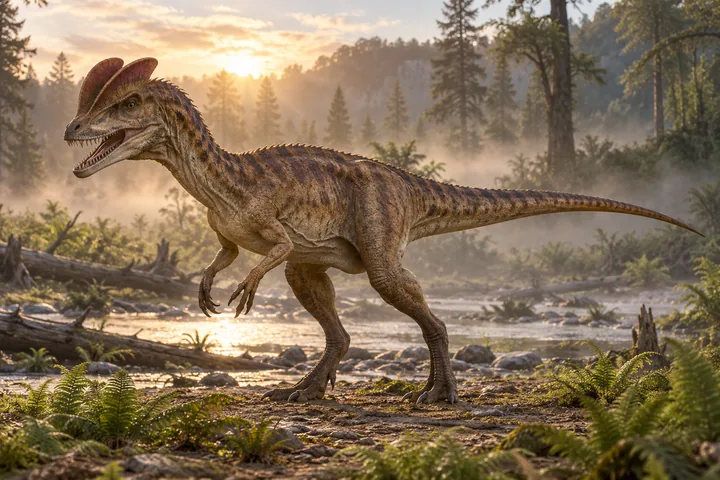
Dilophosaurus
Dilophosaurus had paired head crests penetrated by air spaces.
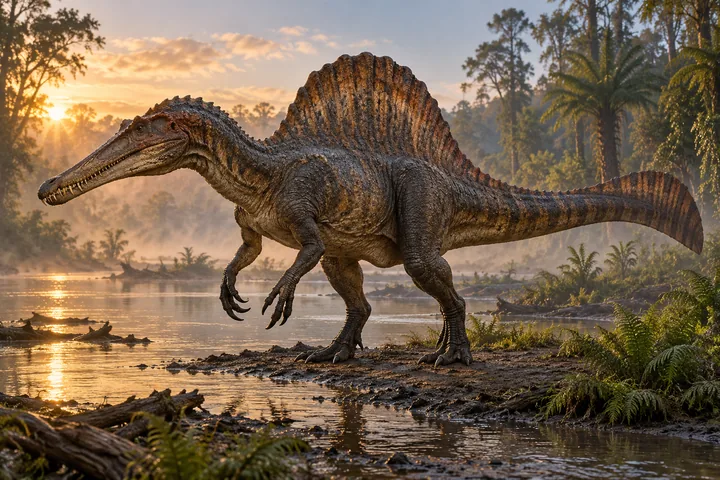
Spinosaurus
Spinosaurus had short hind limbs and a broad, paddle-shaped tail.
Acrocanthosaurus
Acrocanthosaurus carried unusually tall spines on its back, hip and tail vertebrae.