
Length
InferredAbout 3.5 m; institutional reference
Holtz gives an educational reconstruction without specimen, maturity or method. It is not the measured length of holotype MSM P2101. [D5]
EXHIBIT 136
Zuniceratops christopheri
Zuniceratops combined prominent brow horns with a hornless nose, before the later radiation of large ceratopsids. [2]
TWO WAYS TO PICTURE THE PAST
Compare the evidence with the familiar movie image. The illustrations are not to a shared scale.
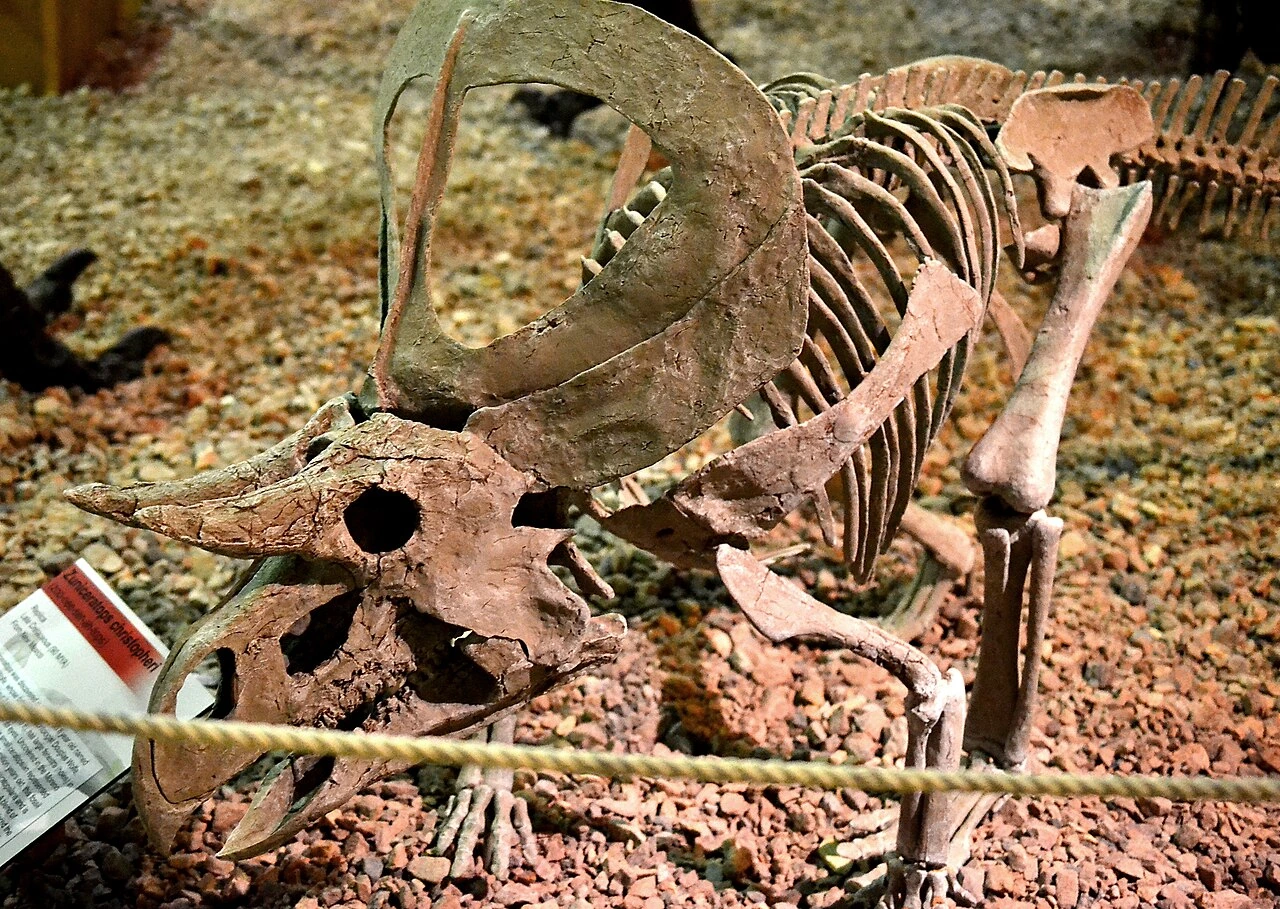
Mounted Zuniceratops reconstruction at the Wyoming Dinosaur Center. Complete body and skull contours include restored parts; the source does not identify one fossil individual or life stage. Fossil colors do not establish living colors or soft tissues. [2]
Zuniceratops.jpg · incidencematrix. CC BY 2.0. Proportionally resized Commons preview and converted to WebP; no anatomy edits.
Skeletal mounts and drawings may restore missing parts; the caption identifies the displayed material.
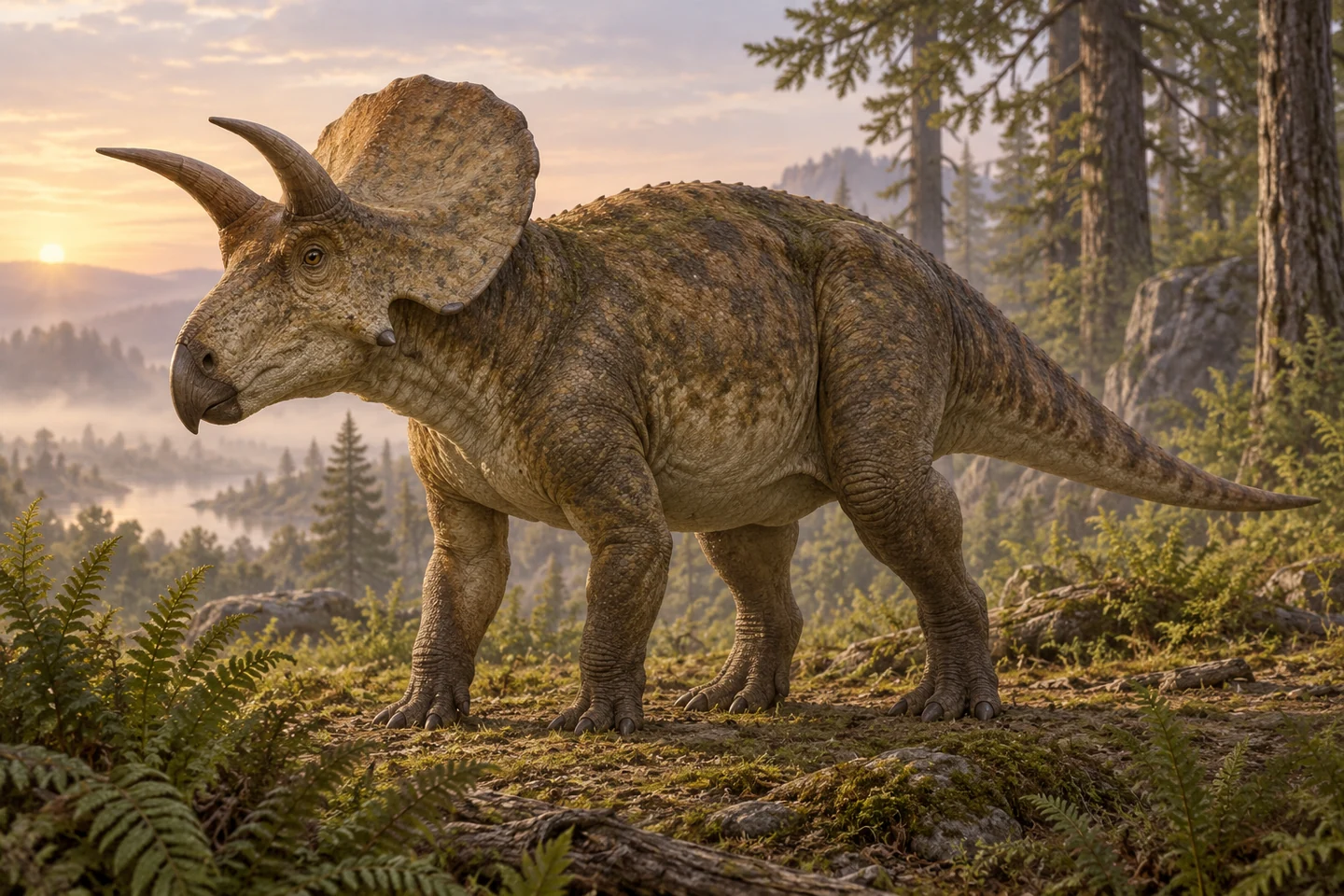
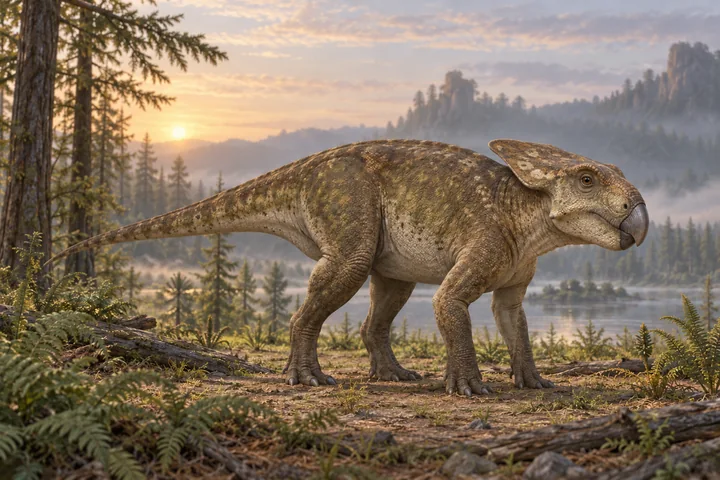
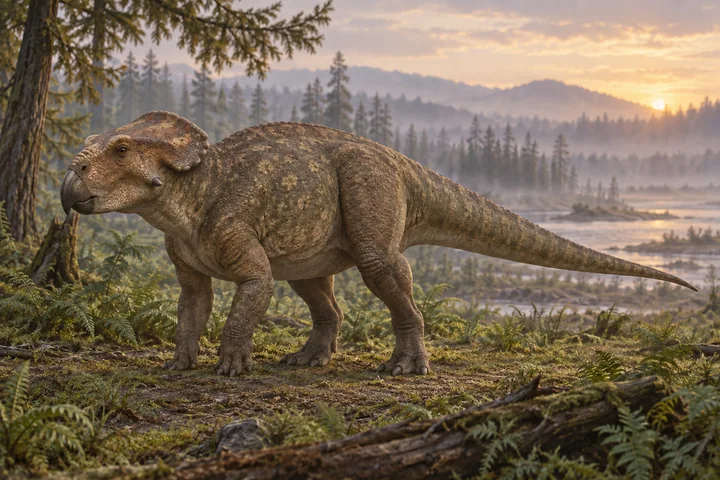
Original cinematic interpretation of Zuniceratops christopheri. Colors, soft tissues, scenery and missing anatomy are reconstructed artistic choices; this is not a directly observed individual or behavior. The two brow horns are distinct from frill ornament; missing anatomy, horn sheaths and living proportions are reconstructed. Lighting, coloration and scenery are artistic choices. This image does not document a fossil locality or behavior.
Original artwork · artistic interpretation.
Scientific view: source-informed reconstruction, credited paleoart or specimen-based imagery. Movie-style view: Original artistic interpretation. Reconstructions involve uncertainty.
MEET THE ANIMAL
Zuniceratops was a Late Cretaceous plant eater from what is now the United States. It had two prominent horns over its eyes and a relatively lightly built body. Its teeth could shear vertically through food, rather like scissors. This combination helps researchers investigate how the large horned dinosaurs evolved, without treating Zuniceratops itself as a demonstrated ancestor. [D1] [S1]
Its New Mexico fossils come from the Moreno Hill Formation. The surrounding rocks record rivers and a plain near a delta, where a river spreads sediment toward the sea. Researchers use tiny zircon crystals to constrain the age of these deposits. Those measurements help place the fossils in time, but do not give an exact birthday for each dinosaur. [D3]
Bones of Zuniceratops occur with another dinosaur, Nothronychus, and pieces of wood. Strong currents and trapped logs helped gather these remains after death. A collection of bones can therefore tell us about an ancient river without proving that the animals lived in a herd. Its everyday social life remains an open question in the reviewed evidence. [D4]
PREHISTORIC ANIMAL DOSSIER
The animal, the evidence, and the questions still open.
A mixed river bonebed expands its anatomy but also complicates claims about social behavior. Some early supposed skull material belonged to another dinosaur. [D4] [D2]
Profile scope: Z. christopheri: holotype MSM P2101 and referred Moreno Hill material; complete restorations combine incomplete individuals. [D2]
Source supported identifies a description documented by the cited source. Inferred marks a reconstruction or functional estimate. Debated marks competing interpretations. Not established means the sources reviewed for this dossier do not support a firm conclusion; it does not mean a behavior never occurred.
A size reference is an estimate, not a population range. Nesting evidence does not by itself establish courtship, mate choice, or lifelong pairing.
About 3.5 m; institutional reference
Holtz gives an educational reconstruction without specimen, maturity or method. It is not the measured length of holotype MSM P2101. [D5]
Not established here
The institutional appendix uses a qualitative animal comparison, without a calibrated kilogram value or reproducible model. No suitable numeric mass was established. [D5]
Plant eater
Museum classification and shearing cheek teeth support herbivory. No reviewed evidence identifies particular plants or feeding height. [D1] [D2]
River-influenced delta plain
Moreno Hill sediments record channels and floodplain deposits landward of the Gallup Delta. Initial lower deposition occurred after a90.9Ma maximum-age constraint; this is not a direct fossil date. [D3]
Probably quadrupedal
Partial limb and shoulder bones support a reconstructed ceratopsian body plan. Exact stance and movement speeds are not observed. [D2]
Brow horns without a nasal horn
Reviewed nasal bones lack a horn. Brow-horn size varies; the complete frill outline remains reconstructed from incomplete material. [D2]
Not established here
The type was interpreted as an older juvenile/young adult or a gracile individual. This ambiguity does not establish breeding maturity or nesting behavior. [D2]
Not established here
Horn variation has possible age and sex explanations. It does not demonstrate confirmed sexes, mate choice or a particular courtship display. [D2]
Not established here
Disarticulated Zuniceratops bones occur with Nothronychus and logs. Preferred orientations and current-driven trapping provide a depositional explanation; grouping remains unresolved. [D4]
Sources and inspection notes for the claims in this profile.
THE STORY IN THE FOSSILS
The Haystack Butte bonebed shows how many dinosaur bones can gather without recording a living herd. Strong currents and trapped logs helped concentrate disarticulated remains of more than one dinosaur genus. [4]
New age constraints revise the formation framework using zircon grains. They date the earliest possible sediment deposition, so a narrow lifespan for Zuniceratops cannot be read directly from those numbers. [3]
The dossier identifies the scope of each reference estimate. A mount, an individual fossil and a species-wide adult range are different measurements. Comparison metrics remain unavailable where adult scope has not been established. Unknown does not mean zero.
Sources support the stated claims and scopes. Refer to the evidence notes for uncertainty.
KEEP EXPLORING
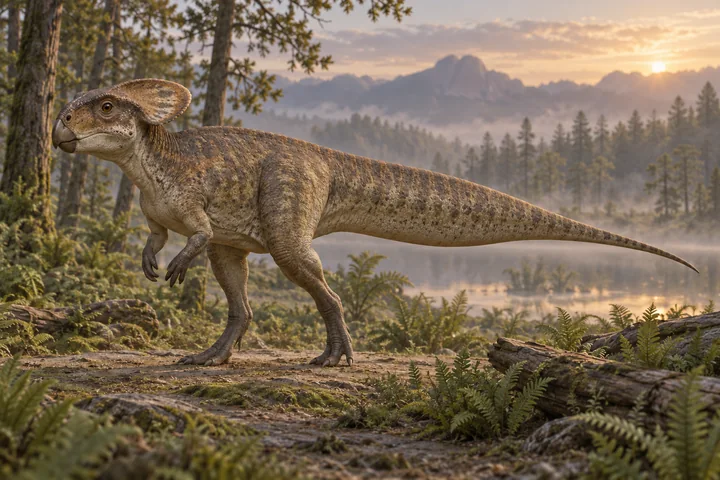
Yamaceratops dorngobiensis
Yamaceratops was a small beaked ceratopsian whose cheek and jaw anatomy records a distinctive early neoceratopsian combination.
Leptoceratops gracilis
Leptoceratops was a hornless, short-frilled plant eater whose teeth preserve evidence of complex chewing.
Montanoceratops cerorhynchus
Montanoceratops was a small beaked ceratopsian; incomplete skull material has repeatedly changed how its head is reconstructed.