
Body length
InferredApproximately 6 m reference length.
ROM reconstruction estimate; the fossil's missing limbs and reconstructed body do not establish a population range. [D3]
EXHIBIT 257
Zuul crurivastator
Dinosaur
A horned, armored ankylosaur from Montana with a tail club and unusually preserved skin. [3]
TWO WAYS TO PICTURE THE PAST
Compare the evidence with the familiar movie image. The illustrations are not to a shared scale.
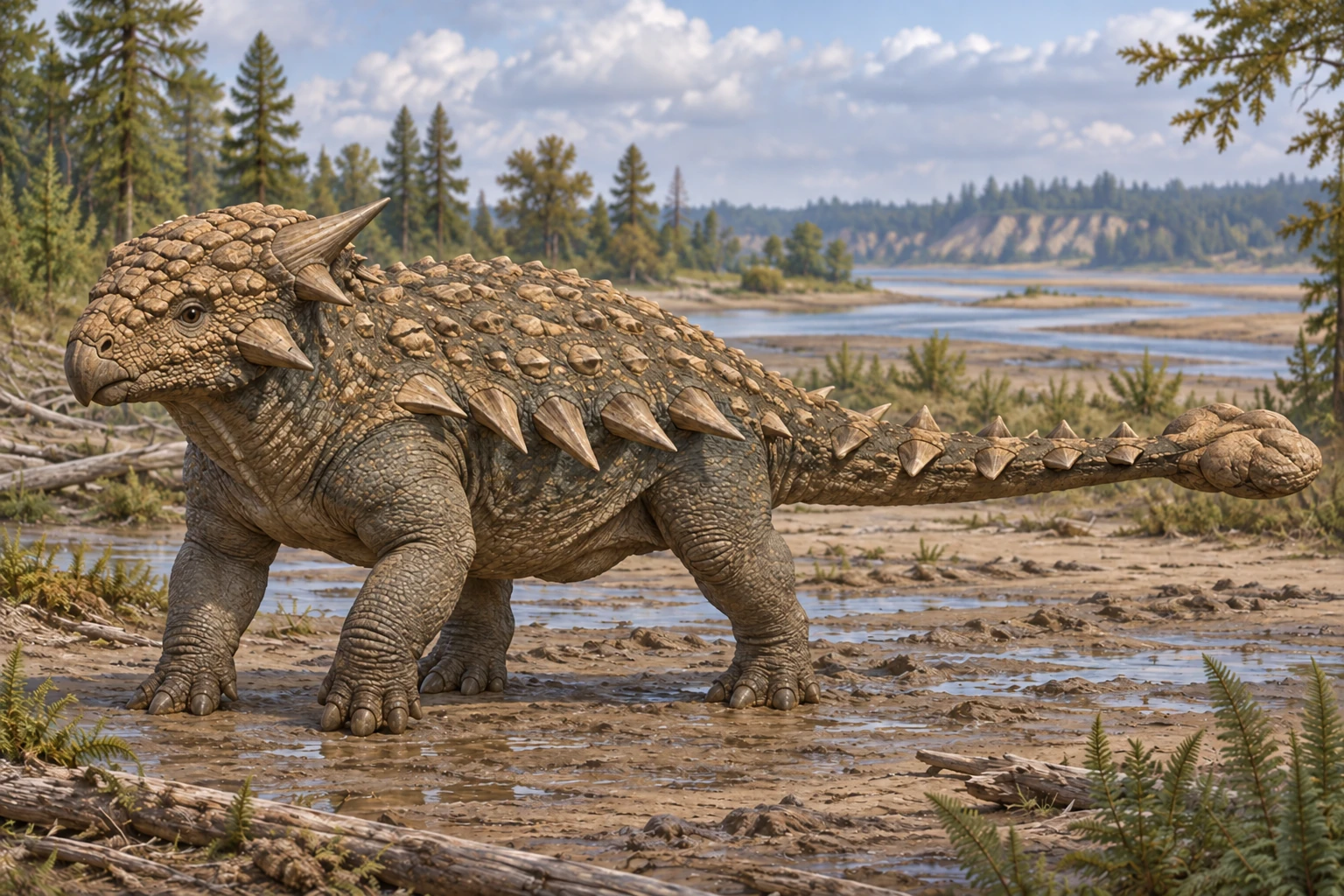
An illustrative reconstruction. Compare its anatomy with the evidence and limitations in the dossier. [1]
Source-informed reconstruction. Appearance evidence [1]. Original illustration; missing anatomy, coloration and scenery include interpretation.
Fossils constrain this life reconstruction. Missing anatomy, coloration and the environmental scene include interpretation; the dossier explains the evidence limits.
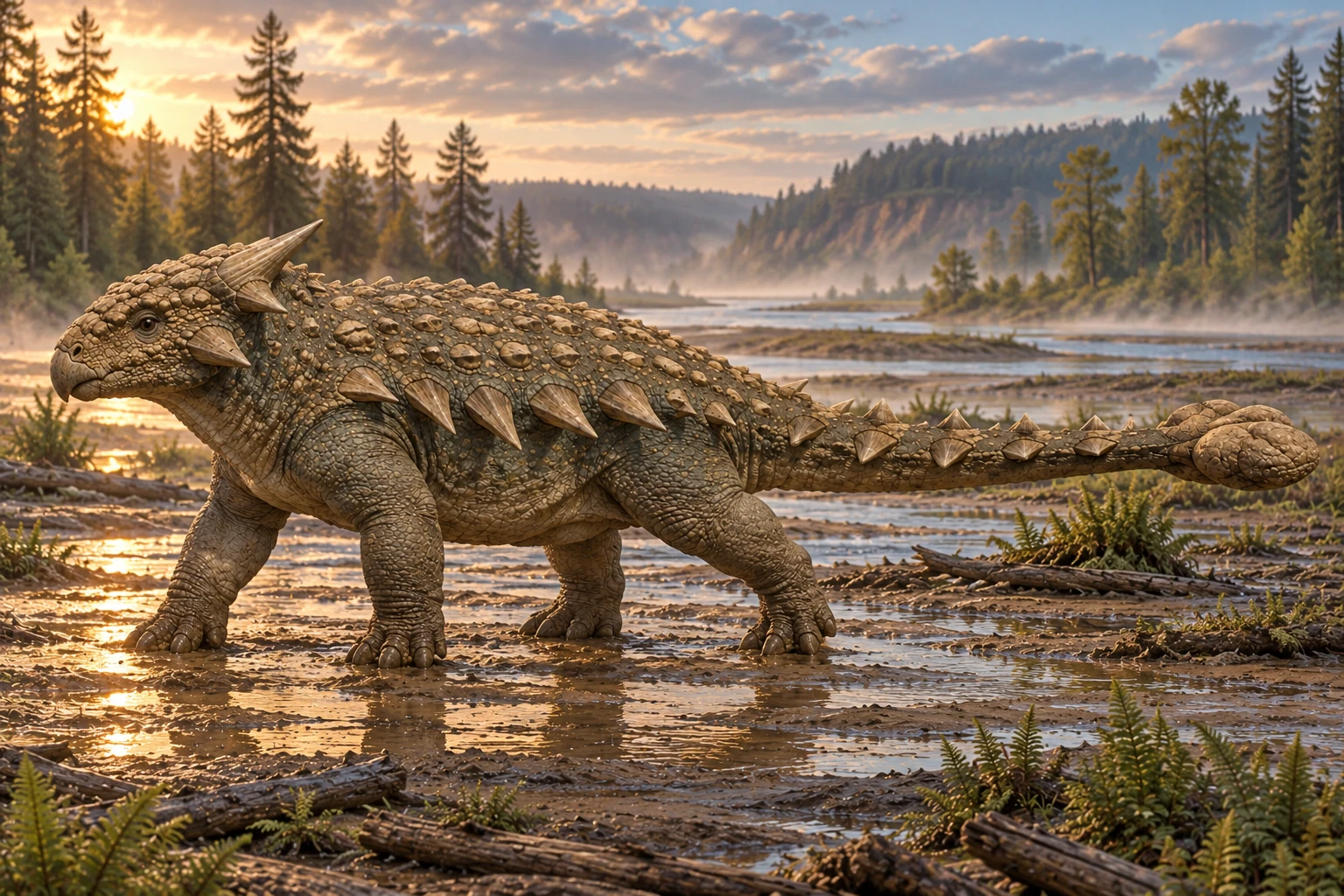
An illustrative reconstruction. Compare its anatomy with the evidence and limitations in the dossier. Lighting, coloration and scenery are artistic choices. This image does not document a fossil locality or behavior.
Original artwork · artistic interpretation.
Scientific view: source-informed reconstruction, credited paleoart or specimen-based imagery. Movie-style view: Original artistic interpretation. Reconstructions involve uncertainty.
MEET THE ANIMAL
Zuul was an armored plant-eating dinosaur from Montana. Its short rounded snout, horns behind the eyes and large tail club help distinguish it from other ankylosaurs. The museum's reconstruction is about six meters long. This gives a useful idea of scale, while remaining an estimate based on fossil evidence and restored missing parts. [D3]
The famous specimen preserves much more than an ordinary set of bones. Skin and armor remained associated with the body, letting researchers study how the protective covering was arranged. Its legs are missing, however, so even this exceptional fossil is incomplete. Preserved tissue also does not automatically reveal the animal's original color, its sex or every detail of its appearance. [D4]
Some armor spikes along its sides were damaged and healed while the animal was alive. Researchers think the location of these injuries fits strikes from another ankylosaur's tail club. This supports a possible combat explanation, but it does not preserve the fight itself. It also cannot tell us how often Zuul gathered in groups or exactly how an individual chose a mate. [D2]
PREHISTORIC ANIMAL DOSSIER
The animal, the evidence, and the questions still open.
Armor injuries provide unusually specific evidence for possible combat between ankylosaurs, while leaving the animal's sex and daily social life unresolved. [D2]
Profile scope: The exhibit concerns Zuul crurivastator, named from the exceptional holotype ROM 75860. [D1]
Source supported identifies a description documented by the cited source. Inferred marks a reconstruction or functional estimate. Debated marks competing interpretations. Not established means the sources reviewed for this dossier do not support a firm conclusion; it does not mean a behavior never occurred.
A size reference is an estimate, not a population range. Nesting evidence does not by itself establish courtship, mate choice, or lifelong pairing.
Approximately 6 m reference length.
ROM reconstruction estimate; the fossil's missing limbs and reconstructed body do not establish a population range. [D3]
Approximately 2,500 kg reference mass.
Museum estimate, rather than a measured fossil-individual mass or an adult species interval. [D3]
Plant eating inferred.
The museum identifies this ankylosaur as herbivorous; preferred plants and a specimen-specific meal remain unresolved. [D3]
Montana alluvial coastal plain.
Coal Ridge Member channel deposits lie within a terrestrial floodplain system; burial near a seaway does not imply marine life. [D1]
Four-legged ground movement.
The ankylosaur body plan supports quadrupedal restoration; original limb geometry remains partly comparative because legs are missing. [D4]
Short rounded snout, rear skull horns and clubbed tail.
Preserved skin and armor retain arrangement; fossil tissue does not establish the animal's living color. [D1]
Not established here
No Zuul egg or nest established. The exceptional body fossil does not assign reproductive remains or preserve parenting behavior. [D1]
Not established here
Sexual-selection explanations remain hypotheses. Healed flank injuries may indicate ritualized contests, but cannot establish sex, breeding season or mating displays. [D4]
Possible combat between individuals.
Flank injuries fit tail-club strikes; healing-rate differences or infection remain alternatives. The specimen does not establish herds. [D2]
Sources and inspection notes for the claims in this profile.
THE STORY IN THE FOSSILS
The unusually preserved tail combines a stiffened handle, terminal club and rows of pointed armor. Together with the skull, these features supported recognition of a distinct animal. [1]
Healed damage differs from burial damage. Its flank concentration led researchers to consider strikes from another ankylosaur. [2]
The dossier identifies the scope of each reference estimate. A mount, an individual fossil and a species-wide adult range are different measurements. Comparison metrics remain unavailable where adult scope has not been established. Unknown does not mean zero.
Sources support the stated claims and scopes. Refer to the evidence notes for uncertainty.
KEEP EXPLORING
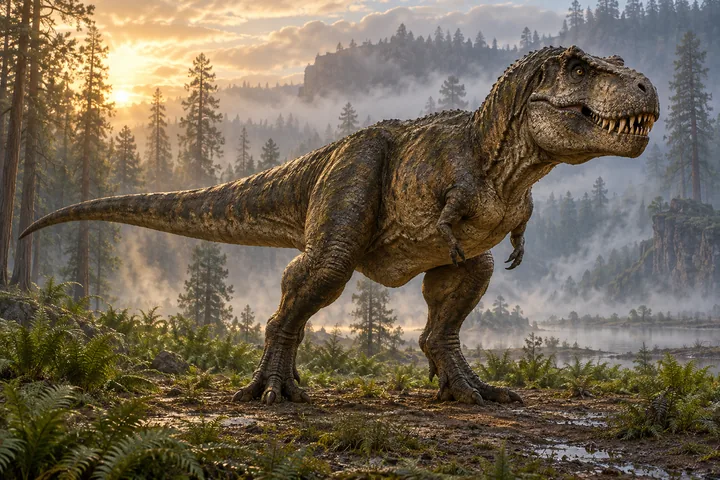
Tyrannosaurus rex
Tyrannosaurus rex was a large meat-eating dinosaur from the final part of the Cretaceous in western North America. Fossil teeth, bite marks and skeletons reveal a powerful animal whose behaviour still invites questions.
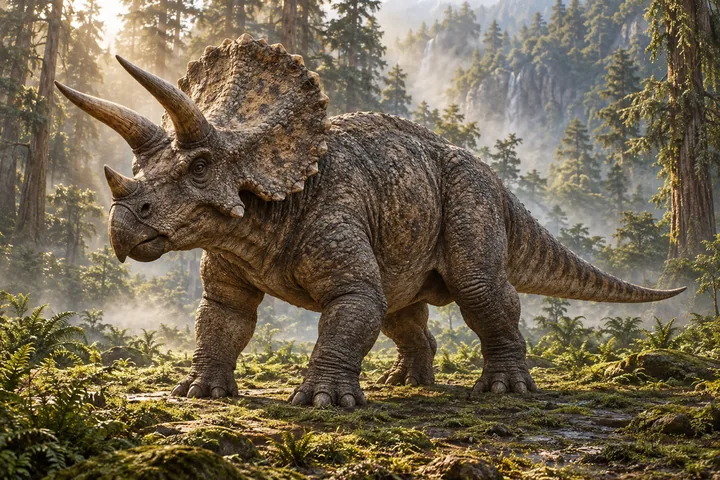
Triceratops horridus
Triceratops horridus was a horned dinosaur of the Late Cretaceous. Skin impressions attributed to this species reveal scales, while skulls and their positions in rock layers help researchers distinguish it from the later Triceratops prorsus.
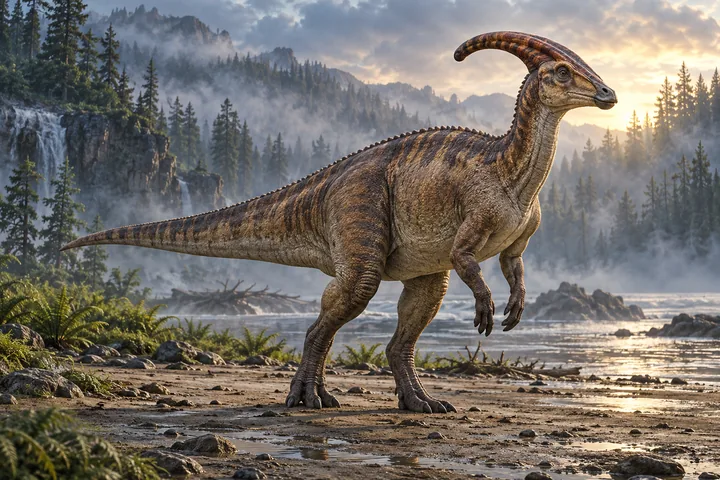
Parasaurolophus walkeri
Parasaurolophus walkeri was a crested duck-billed dinosaur from Late Cretaceous Alberta. Its famous Royal Ontario Museum skeleton preserves both an elongated tubular crest and healed injuries.