
Length
Not establishedNot established here
The reviewed type is a cranium; no inspected specimen-scoped whole-body length reconstruction establishes its body size. [D1]
EXHIBIT 193
Regaliceratops peterhewsi
Regaliceratops had a crown-like frill and an unusual combination of a prominent nasal horn and reduced brow horns. [2]
TWO WAYS TO PICTURE THE PAST
Compare the evidence with the familiar movie image. The illustrations are not to a shared scale.
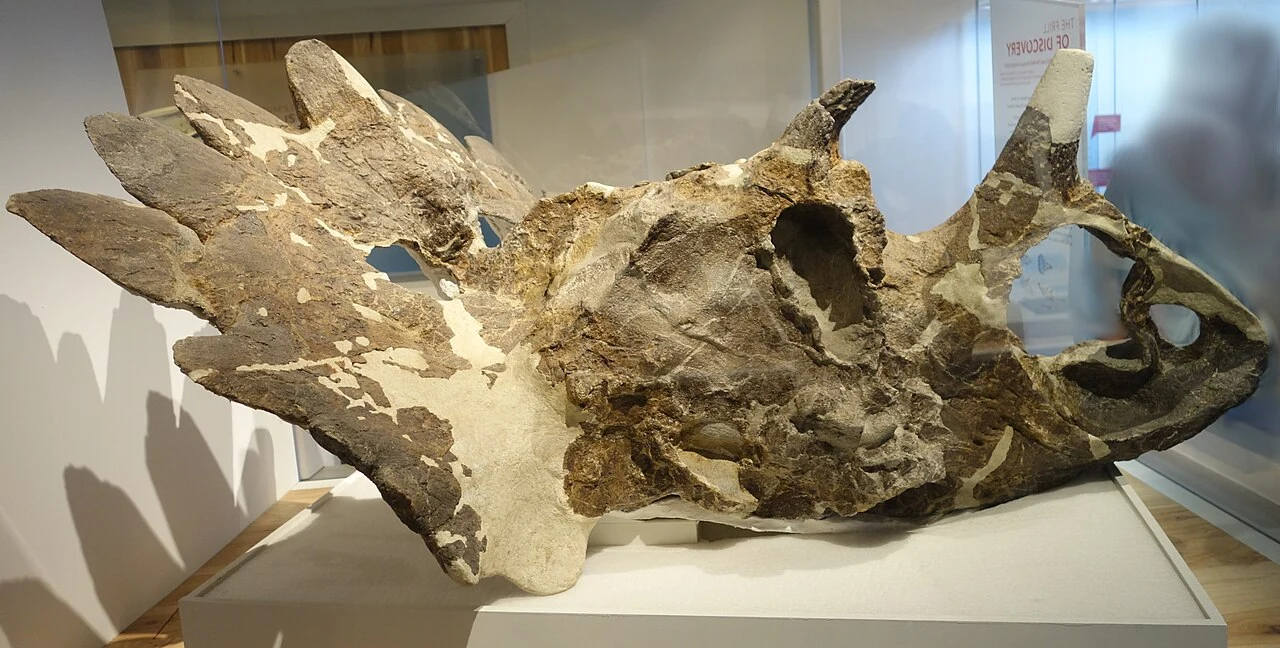
Displayed Regaliceratops skull, showing the crown-like frill and reduced brow cores. Preparation, restoration and fossil deformation affect its outline. Living colors and soft tissues are unknown; body anatomy is not documented by this skull photograph. [1]
Regaliceratops Royal Tyrrell 1.jpg · Etemenanki3. CC BY-SA 4.0. Proportional resizing and WebP conversion; no anatomy edits. Current Commons composition preserved.
The photograph or figure shows the credited fossil material; displayed mounts and labels can include interpretation.
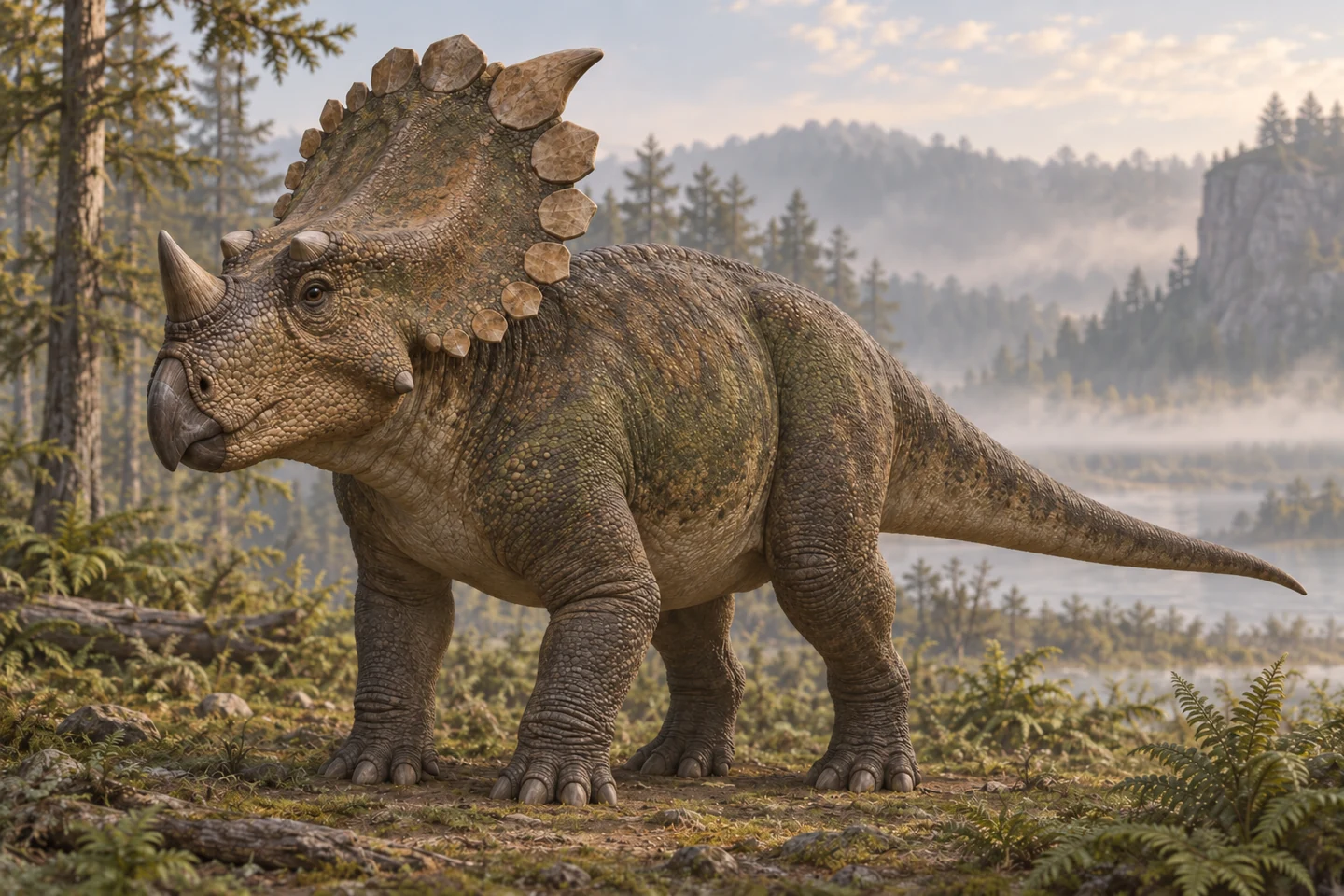
Original cinematic interpretation of Regaliceratops. The known cranium guides the crown-like border and unequal nasal and brow horns. The nasal tip, lower jaw and whole body are restored; post-depositional distortion limits the exact living frill outline. Lighting, colors and scenery are artistic choices; this image does not document directly observed behavior. Lighting, coloration and scenery are artistic choices. This image does not document a fossil locality or behavior.
Original artwork · artistic interpretation.
Scientific view: source-informed reconstruction, credited paleoart or specimen-based imagery. Movie-style view: Original artistic interpretation. Reconstructions involve uncertainty.
MEET THE ANIMAL
Regaliceratops was a horned dinosaur from Late Cretaceous Alberta. Its name means royal horned face, referring to the crown-like edge of its frill. A geologist spotted the fossil snout beside the Oldman River in 2005. After excavation and study, the skull was named in 2015 and became part of the Royal Tyrrell Museum's collection. The discovery added an unusual head shape to the region's rich record of horned dinosaurs. [S1]
Its head combined a large nose horn, small brow horns and an elaborately ornamented frill. That arrangement resembled a different branch of horned dinosaurs more than the usual pattern among its closer relatives. Researchers describe such similarities as evolutionary convergence: comparable features developing along separate branches of a family tree. An impressive resemblance can therefore be misleading when deciding which dinosaurs were most closely related. [S1]
Recovering this skull took years of difficult work, and hard surrounding rock made cleaning it challenging. The preserved head offers strong evidence for its distinctive ornaments. It is a more limited guide to the complete living animal. A decorated fossil skull does not record a courtship performance, tell us which individual was male or female, or show the organization of a living herd. [S1]
PREHISTORIC ANIMAL DOSSIER
The animal, the evidence, and the questions still open.
The skull combines traits normally associated with different ceratopsid branches. Its missing body and distorted frill limit reconstruction. [D2] [D1]
Profile scope: R. peterhewsi, holotype TMP 2005.055.0001: cranium only, lacking the lower jaw and rostral bone. [D1]
Source supported identifies a description documented by the cited source. Inferred marks a reconstruction or functional estimate. Debated marks competing interpretations. Not established means the sources reviewed for this dossier do not support a firm conclusion; it does not mean a behavior never occurred.
A size reference is an estimate, not a population range. Nesting evidence does not by itself establish courtship, mate choice, or lifelong pairing.
Not established here
The reviewed type is a cranium; no inspected specimen-scoped whole-body length reconstruction establishes its body size. [D1]
Not established here
A skull-only specimen does not provide a measured mass; no defensible specimen-scoped mass model was located. [D1]
Plant eater
Herbivory inferred from ceratopsid relationships; a specific menu or preserved meal is not established here. [D4]
Probably middle Maastrichtian; southern Alberta
Oldman River locality. Upper St. Mary River Formation is preferred; faulting complicates separation from lowermost Willow Creek strata. [D1]
Four-legged body plan
Ceratopsid posture inferred comparatively; genus-specific trackways, gait and speed are not established here. [D4]
Crown-like frill; reduced brow horns
Large flattened marginal processes and a central process decorate the frill. The nasal tip is missing and restored length is estimated. [D1]
Not established here
Brow-core resorption records skull modification; it does not establish sex, reproductive maturity, eggs, nests or parental care. [D1]
Not established here
Ceratopsian sexual-selection hypotheses are comparative. Ornament shape does not establish this genus’s mate choice, courtship sequence or sex-specific roles. [D3]
Not established here
The described evidence centers on one cranium; it cannot establish solitary living, herd structure or group size. [D1]
Sources and inspection notes for the claims in this profile.
THE STORY IN THE FOSSILS
Brown and Henderson interpreted the prominent nasal horn and reduced brows as convergence with the ornament pattern of centrosaurines, although Regaliceratops is a chasmosaurine. [2]
Ceratopsian ornament-divergence research supports testing display hypotheses, but an impressive frill cannot reveal an individual’s sex or a particular courtship routine. [3]
The dossier identifies the scope of each reference estimate. A mount, an individual fossil and a species-wide adult range are different measurements. Comparison metrics remain unavailable where adult scope has not been established. Unknown does not mean zero.
Sources support the stated claims and scopes. Refer to the evidence notes for uncertainty.
KEEP EXPLORING
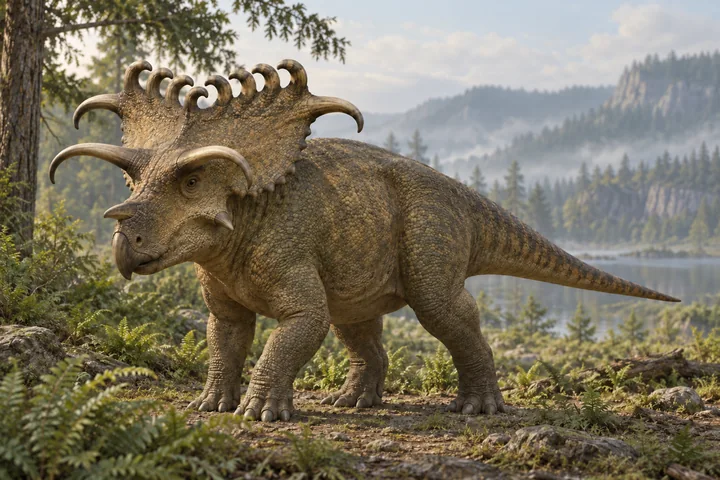
Kosmoceratops richardsoni
Kosmoceratops carried an unusually ornate head with fifteen horn-like features, including a curled frill margin.
Utahceratops gettyi
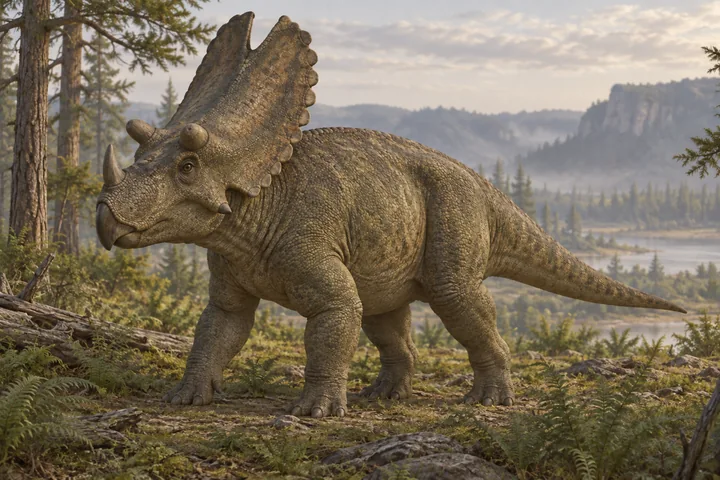
Utahceratops combined an elongated frill with short, blunt brow horns that projected strongly sideways.
Avaceratops lammersi
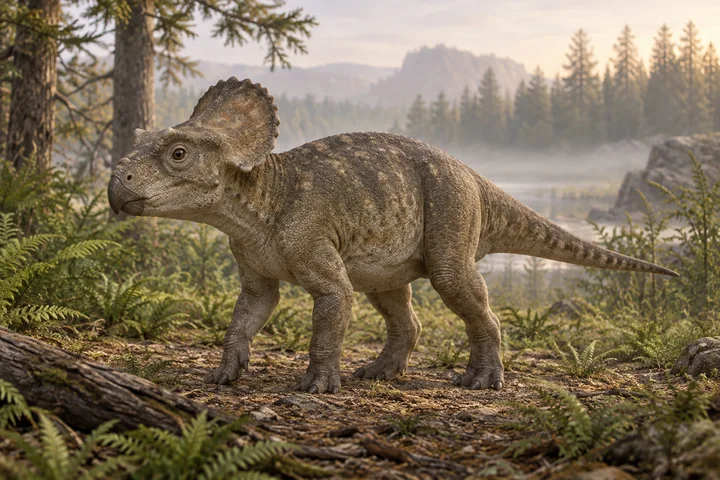
Avaceratops is known securely from an immature skeleton, making the adult appearance particularly difficult to establish.