
Length
InferredAbout 7 m; institutional reference
Holtz’s educational reconstruction has no specimen, maturity or method designation. It is not a measured individual or adult species range. [D3]
EXHIBIT 196
Sinoceratops zhuchengensis
Sinoceratops documents a ceratopsid in China with a nasal horn, no brow horns and a decorated frill. [1]
TWO WAYS TO PICTURE THE PAST
Compare the evidence with the familiar movie image. The illustrations are not to a shared scale.
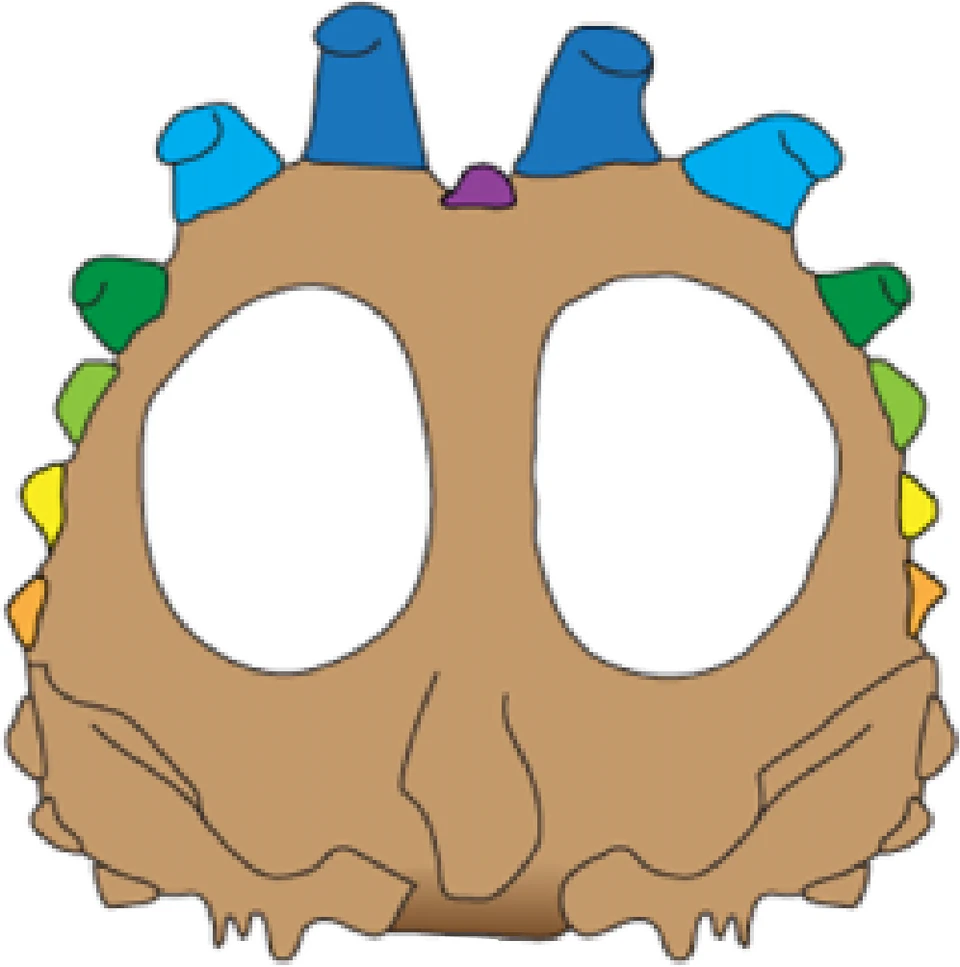
Interpretive bony-frill diagram cropped from a 2024 comparative study. Colors code marginal-ossification positions, not the animal’s skin. The bony windows would be skin-covered in life; missing anatomy and soft tissues remain interpreted. [1]
Sinoceratops zhuchengensis (frill).png · Mark A. Loewen, Joseph J. W. Sertich, Scott Sampson, Jingmai K. O’Connor, Savhannah Carpenter, Brock Sisson, Anna Øhlenschlæger, Andrew A. Farke, Peter J. Makovicky, Nicholas Longrich and David C. Evans. CC BY 4.0. Proportional resizing and WebP conversion; no anatomy edits. Current Commons composition preserved.
Skeletal mounts and drawings may restore missing parts; the caption identifies the displayed material.
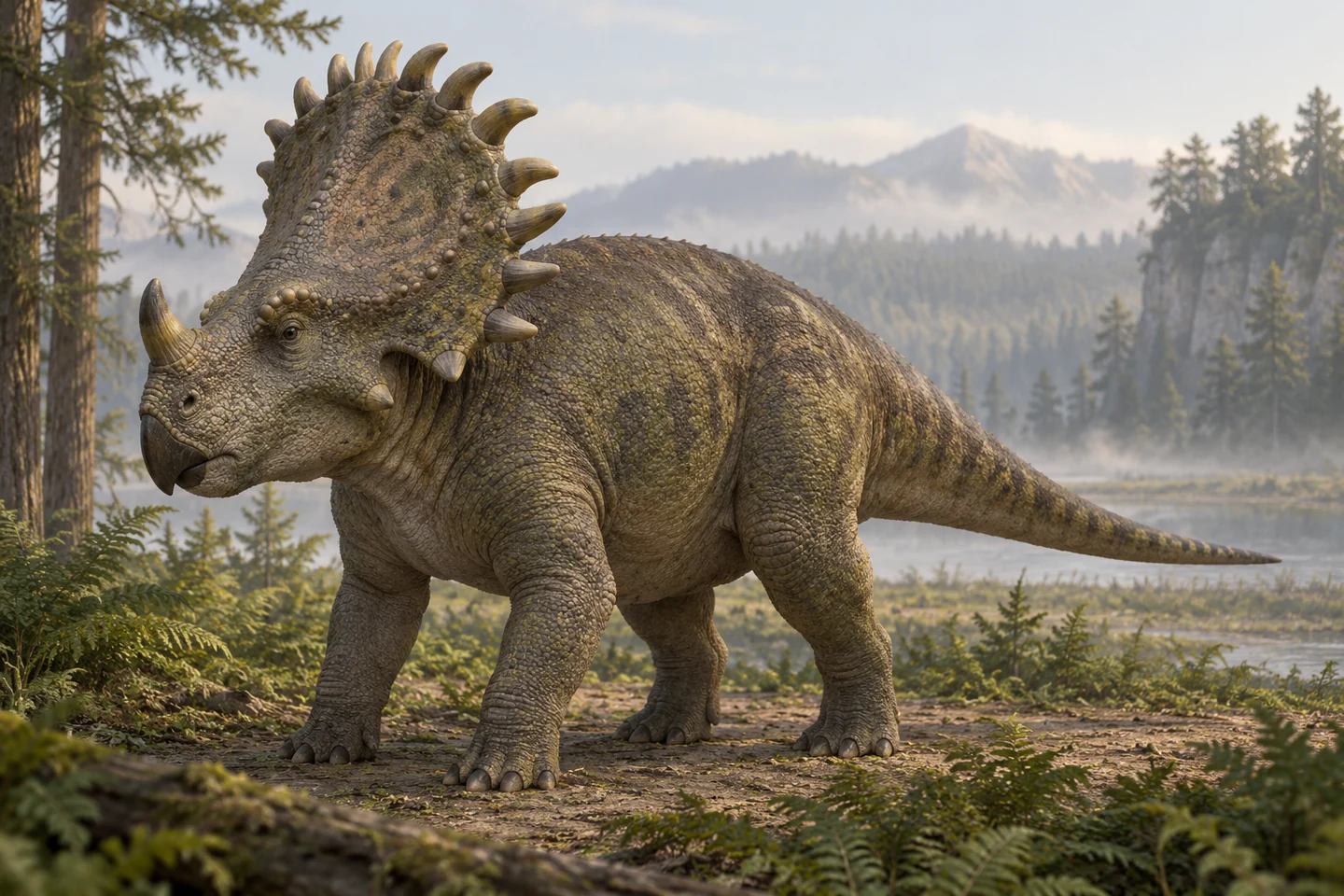
Original cinematic interpretation of Sinoceratops. Partial crania guide the nasal horn, weak brow bumps and curved frill processes. Whole-body proportions, horn coverings and skin over frill openings are comparative reconstructions. Lighting, colors and scenery are artistic choices; this image does not document directly observed behavior. Lighting, coloration and scenery are artistic choices. This image does not document a fossil locality or behavior.
Original artwork · artistic interpretation.
Scientific view: source-informed reconstruction, credited paleoart or specimen-based imagery. Movie-style view: Original artistic interpretation. Reconstructions involve uncertainty.
MEET THE ANIMAL
Sinoceratops was a large horned dinosaur from Late Cretaceous China. Its head carried a prominent nose horn and a frill edged with curved, spike-like ornaments. A frill is the bony shield extending behind the skull. Its Chinese discovery helped expand the known geography of the large horned dinosaurs, a group much more familiar from North American fossils. Sinoceratops remains are reported from Zangjiazhuang, near Zhucheng in Shandong Province. [S1] [S2]
The frill needs a careful reconstruction. Its bones contained openings, but the living animal's skin covered them. They were not open holes through the entire head shield. The Natural History Museum explains this difference when discussing its movie appearance. Looking at a bare fossil skull can reveal the framework of a head without showing exactly how its soft covering looked in life. [D4]
The fossil area also contains many duck-billed dinosaur bones and remains of tyrannosaur relatives. These finds help show the variety of dinosaurs recorded in this part of China. They do not document one group living together at a particular moment. A locality's collection of bones is evidence about an ancient region; it does not, by itself, reveal Sinoceratops's herd structure or prove that a particular predator attacked it. [S2]
PREHISTORIC ANIMAL DOSSIER
The animal, the evidence, and the questions still open.
The decorated frill had bony windows, but the living animal’s shield was skin-covered. Skull bones do not establish full-body proportions. [D4] [D1]
Profile scope: S. zhuchengensis: holotype ZCDM V0010 and two referred partial crania from Zangjiazhuang, Shandong; postcranial reconstruction is comparative. [D1]
Source supported identifies a description documented by the cited source. Inferred marks a reconstruction or functional estimate. Debated marks competing interpretations. Not established means the sources reviewed for this dossier do not support a firm conclusion; it does not mean a behavior never occurred.
A size reference is an estimate, not a population range. Nesting evidence does not by itself establish courtship, mate choice, or lifelong pairing.
About 7 m; institutional reference
Holtz’s educational reconstruction has no specimen, maturity or method designation. It is not a measured individual or adult species range. [D3]
Not established here
Reviewed material is partial crania; no defensible specimen-scoped kilogram model was located. A qualitative size category is not converted into a mass. [D1] [D3]
Plant eater
Herbivory inferred from ceratopsid relationships; a specific menu or preserved meal is not established here. [D6]
Late Cretaceous; Zhucheng, Shandong
Original material comes from Wangshi Group deposits. Regional Hongtuya conglomerate dating supplies context, not an exact lifespan for this genus. [D1] [D2]
Four-legged body plan
Ceratopsid posture inferred comparatively; genus-specific trackways, gait and speed are not established here. [D6]
Nasal horn; decorated short frill
Postorbital horn cores are absent. Curved parietal marginal processes project posterodorsally, with additional frill-surface bumps. [D1]
Not established here
The reviewed partial crania do not establish reproductive maturity, genus-specific eggs, nests, clutch size or parental care. [D1]
Not established here
Ceratopsian sexual-selection hypotheses are comparative. Ornament shape does not establish this genus’s mate choice, courtship sequence or sex-specific roles. [D5]
Not established here
Three partial crania from one locality are an association; they do not establish a living herd, group size or social hierarchy. [D1]
Sources and inspection notes for the claims in this profile.
THE STORY IN THE FOSSILS
The large openings seen in a bare bony frill do not imply exposed holes in the living shield. Museum paleontologists specifically rejected that feature of the film’s Sinoceratops. [4]
Regional zircon work gives a maximum depositional age rather than the animal’s birth or death date. Conglomerate provenance helps interpret the bonebed setting without establishing social behavior. [2]
The dossier identifies the scope of each reference estimate. A mount, an individual fossil and a species-wide adult range are different measurements. Comparison metrics remain unavailable where adult scope has not been established. Unknown does not mean zero.
Sources support the stated claims and scopes. Refer to the evidence notes for uncertainty.
KEEP EXPLORING
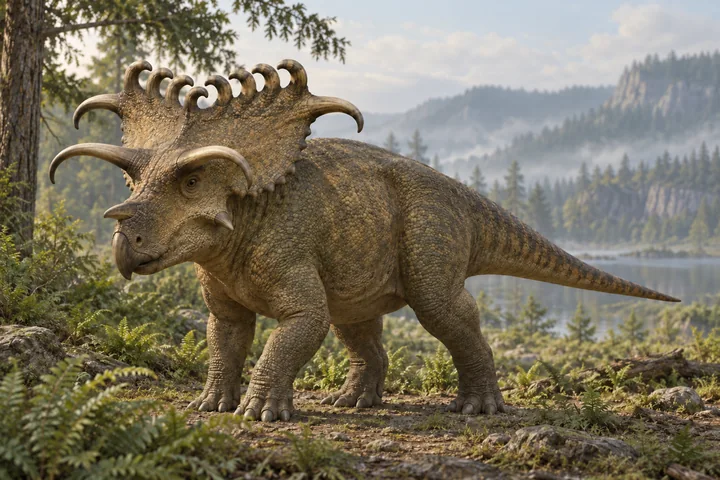
Kosmoceratops richardsoni
Kosmoceratops carried an unusually ornate head with fifteen horn-like features, including a curled frill margin.
Utahceratops gettyi
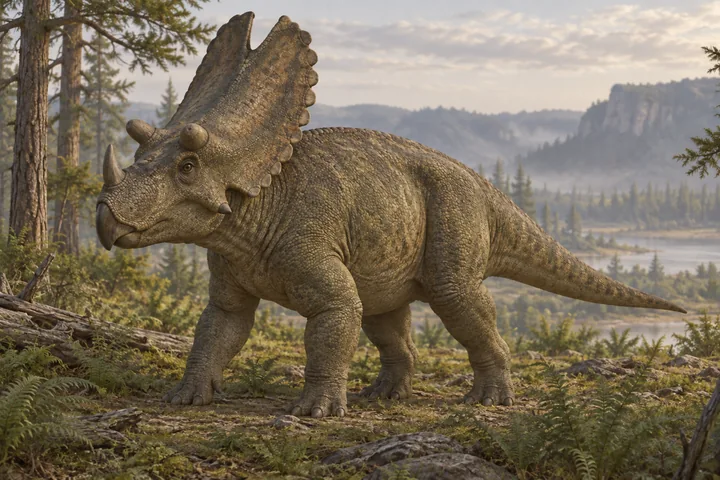
Utahceratops combined an elongated frill with short, blunt brow horns that projected strongly sideways.
Regaliceratops peterhewsi
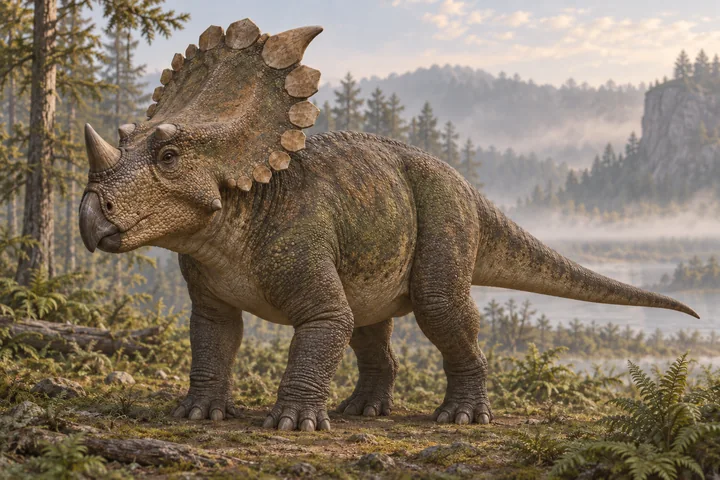
Regaliceratops had a crown-like frill and an unusual combination of a prominent nasal horn and reduced brow horns.