
Length
InferredAbout 4–5 m; museum reconstruction
Converted from the museum’s 13–16-foot reference. Method and full-grown status are unspecified; this is not a biological species range. [D2]
EXHIBIT 172
Akainacephalus johnsoni
Akainacephalus combined a heavily ornamented head with a broad tail club in the Late Cretaceous of southern Utah. [2]
TWO WAYS TO PICTURE THE PAST
Compare the evidence with the familiar movie image. The illustrations are not to a shared scale.
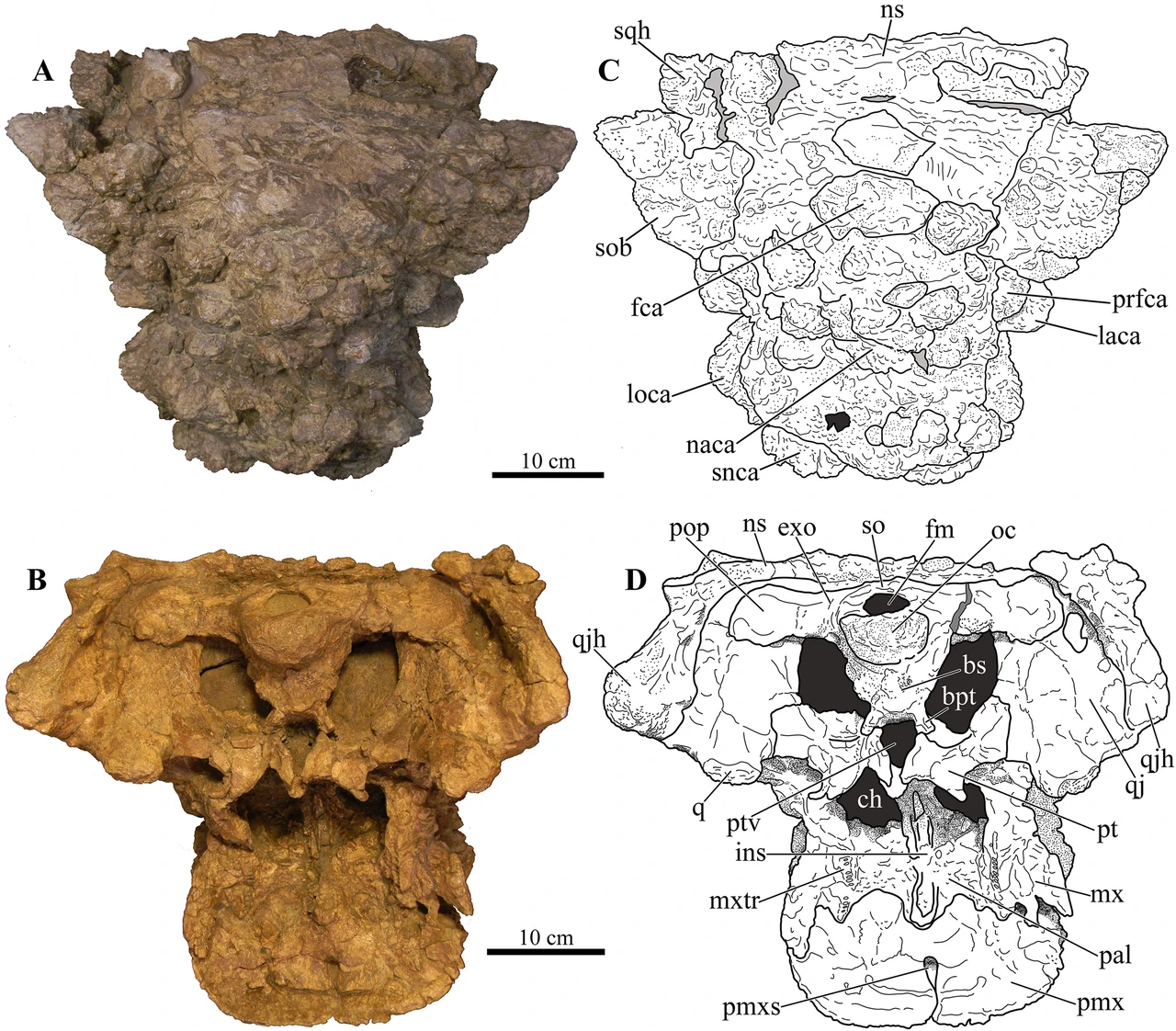
Original photographs and explanatory drawings of A. johnsoni holotype UMNH VP 20202, viewed from above and below. The bony cones and pyramids are preserved anatomy; living colors and soft-tissue coverings are unknown. [1]
Akainacephalus skull above and below.png · Jelle P. Wiersma and Randall B. Irmis. CC BY 4.0. Proportional resizing and WebP conversion; no anatomy edits.
The photograph or figure shows the credited fossil material; displayed mounts and labels can include interpretation.
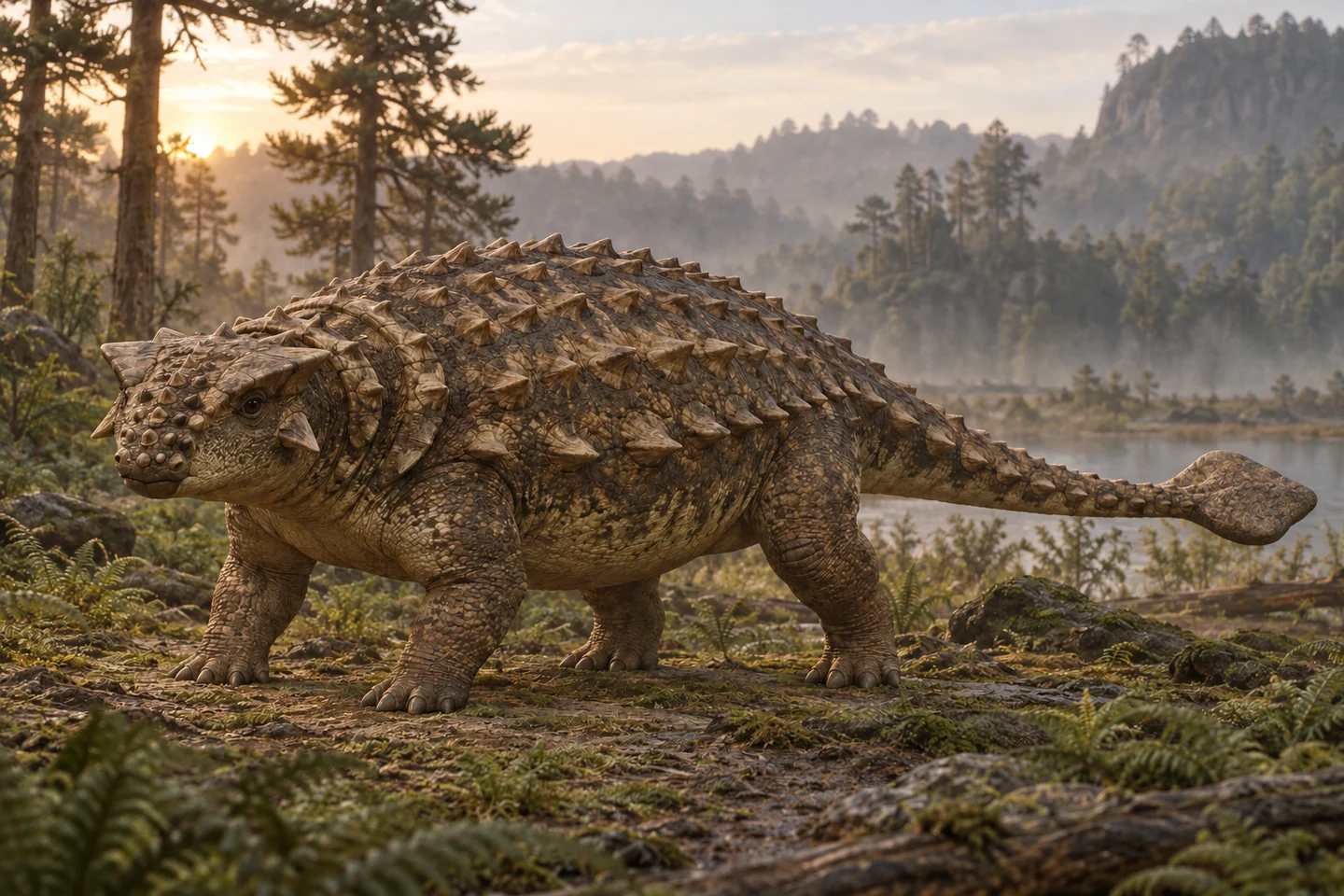
Original cinematic interpretation of Akainacephalus. The diagnosed skull ornaments, cervical half-rings and preserved club handle/knob guide this interpretation; soft tissues, complete armor placement and colors remain reconstructed. Colors, lighting and scenery are artistic choices; this is not directly observed behavior. Lighting, coloration and scenery are artistic choices. This image does not document a fossil locality or behavior.
Original artwork · artistic interpretation.
Scientific view: source-informed reconstruction, credited paleoart or specimen-based imagery. Movie-style view: Original artistic interpretation. Reconstructions involve uncertainty.
MEET THE ANIMAL
Akainacephalus was an armored dinosaur from Late Cretaceous southern Utah, around seventy-six million years ago. An associated partial skeleton preserves a nearly complete skull and a complete tail club. Cones and pyramidlike armor give the head a distinctive appearance. The club is broad, wider than it is long, at the end of a stiffened tail handle. [D1]
The quarry also contained a duck-billed dinosaur, a turtle and a crocodilian. These finds help reconstruct the diversity of the fossil locality, but a mixed assemblage does not identify an Akainacephalus herd. Different animals can become associated during burial without having formed a stable living group, family or coordinated gathering before they died. [D3]
Injuries in another armored dinosaur, Zuul, inspired a hypothesis that tail clubs could have been used in combat connected with sexual selection. That broader comparison raises a question worth testing. It does not establish Akainacephalus mating behavior, identify males and females or document a particular courtship contest in this genus. [D4]
The museum reconstructs it as a four-legged plant eater, about four to five metres long. That length interval expresses a reconstruction reference with unspecified maturity and method, rather than a measured species-wide size range. [D2]
PREHISTORIC ANIMAL DOSSIER
The animal, the evidence, and the questions still open.
Its skull carries distinctive cones and pyramids. Preserved limbs, vertebrae and armor document much of the body, although a living reconstruction still restores gaps. [D2]
Profile scope: A. johnsoni, holotype UMNH VP 20202: an associated partial skeleton with nearly complete skull and complete tail club. [D1]
Source supported identifies a description documented by the cited source. Inferred marks a reconstruction or functional estimate. Debated marks competing interpretations. Not established means the sources reviewed for this dossier do not support a firm conclusion; it does not mean a behavior never occurred.
A size reference is an estimate, not a population range. Nesting evidence does not by itself establish courtship, mate choice, or lifelong pairing.
About 4–5 m; museum reconstruction
Converted from the museum’s 13–16-foot reference. Method and full-grown status are unspecified; this is not a biological species range. [D2]
Not established here
The reviewed description and museum profile provide no specimen-scoped mass model; an illustrated body cannot supply a measured weight. [D2]
Plant eater
The museum identifies herbivory; exact food plants and preserved gut contents are not established here. [D2]
Southern Utah, about 76 million years ago
HMG Quarry lies in the middle Kaiparowits unit near a 76.26-million-year bentonite; crevasse-splay deposits record a floodplain environment. [D1]
Quadrupedal
The museum reconstructs four supporting limbs beneath the body. No genus-specific speed estimate or trackway is established here. [D2]
Conical skull armor; broad tail club
The skull has symmetrical caputegulae and backswept brow horns. A club wider than long terminates its stiffened tail handle. [D1]
Not established here
Synsacral fusion may vary ontogenetically; the type lacks a reviewed histological age or secure reproductive-maturity assessment. No identified nest is established. [D1]
Not established here
Zuul injuries underpin a comparative tail-club combat hypothesis. This does not demonstrate Akainacephalus courtship, sex differences or mate choice. [D4]
Not established here
Its quarry contains several kinds of animals. Such mixed association does not establish an Akainacephalus herd or social group. [D3]
Sources and inspection notes for the claims in this profile.
THE STORY IN THE FOSSILS
The discovery preserves an informative armored skeleton alongside a duck-billed dinosaur, a turtle and a crocodilian. These associated animals illuminate the quarry fauna rather than a single dinosaur’s social behavior. [3]
Volunteer Randy Johnson spent years preparing the skull and is honored by the species name. Its recovered armor shapes make the animal identifiable beyond a general armored silhouette. [2]
The dossier identifies the scope of each reference estimate. A mount, an individual fossil and a species-wide adult range are different measurements. Comparison metrics remain unavailable where adult scope has not been established. Unknown does not mean zero.
Sources support the stated claims and scopes. Refer to the evidence notes for uncertainty.
KEEP EXPLORING
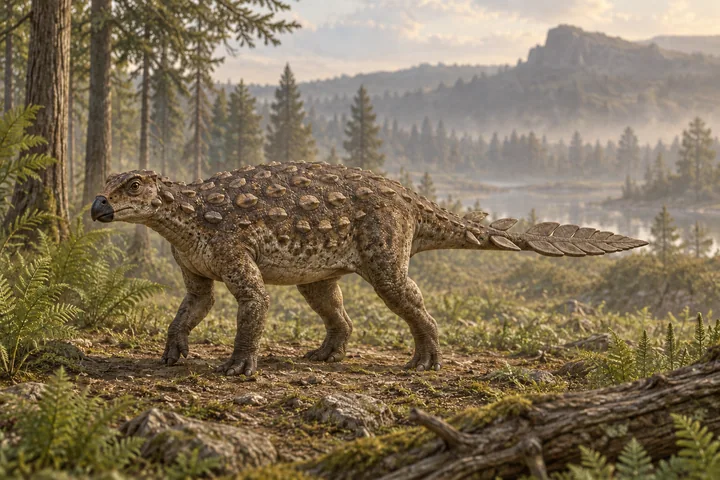
Stegouros elengassen
Stegouros was a small armored plant eater with a short tail ending in a flattened blade-like weapon.
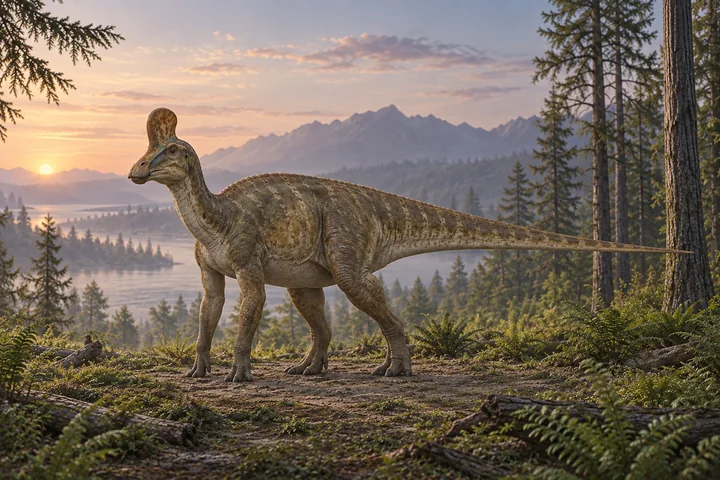
Tsintaosaurus spinorhinus
Tsintaosaurus was a plant-eating hadrosaur whose distinctive crest remains a subject of reconstruction and reassessment.
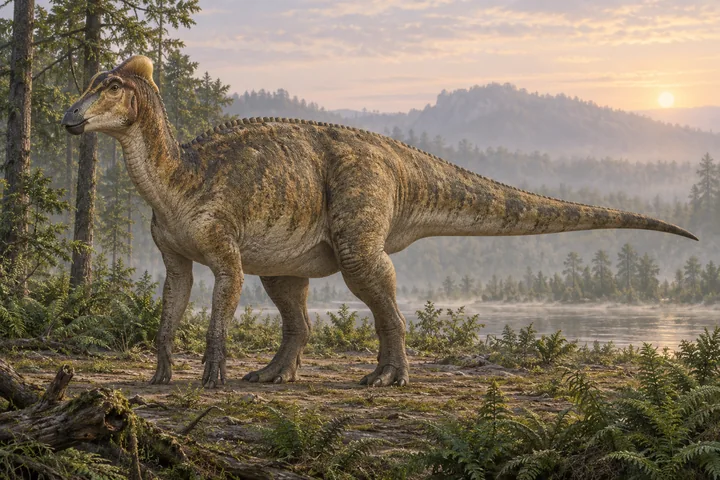
Amurosaurus riabinini
Amurosaurus was a hadrosaur with tooth batteries and skull architecture supporting a hollow crest whose complete shape remains unknown.