
Length
InferredAbout 1.5–1.65 m; revised digital reconstruction
The original 1.8–2 m estimate was revised in a public author comment after digital assembly. This is not a peer-reviewed species range. [D1]
EXHIBIT 173
Stegouros elengassen
Stegouros was a small armored plant eater with a short tail ending in a flattened blade-like weapon. [2]
TWO WAYS TO PICTURE THE PAST
Compare the evidence with the familiar movie image. The illustrations are not to a shared scale.
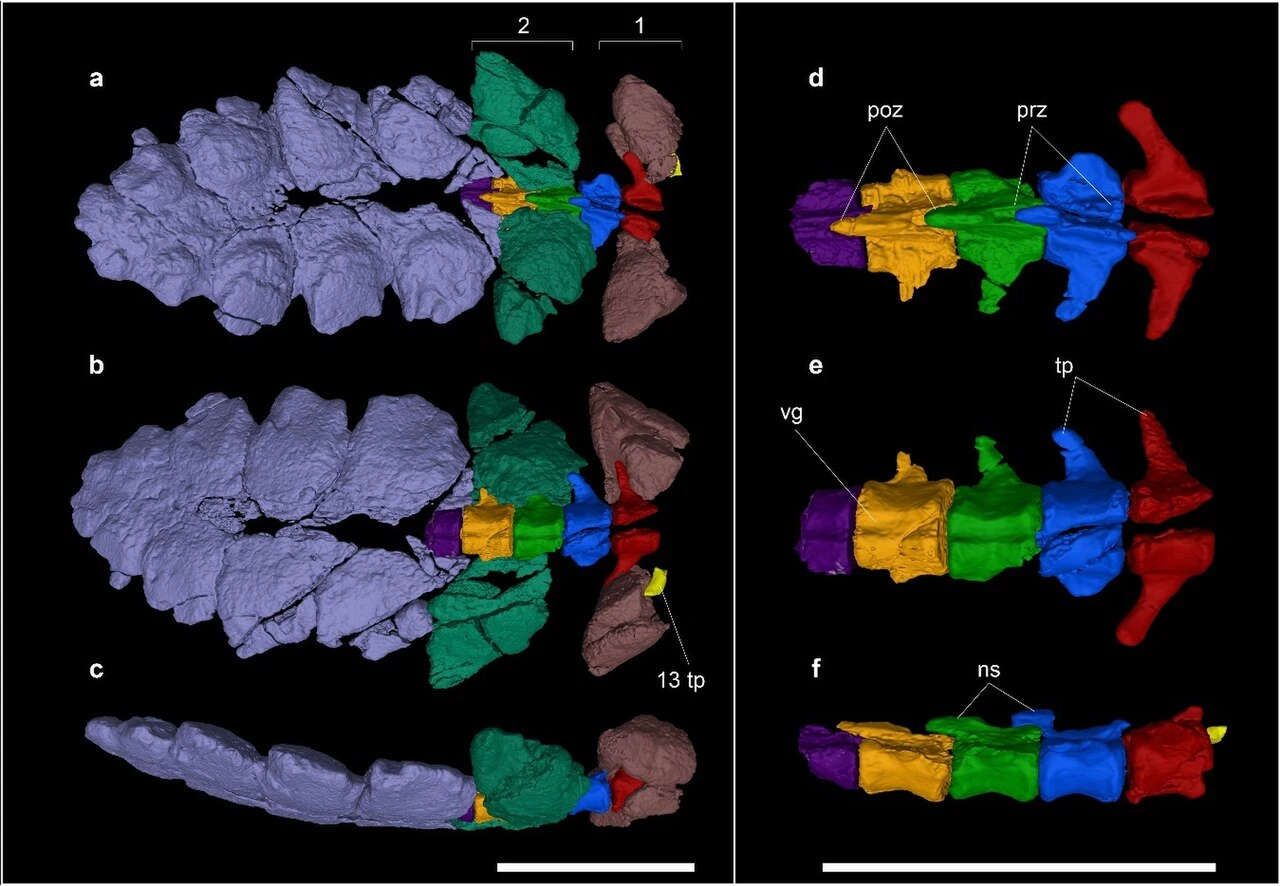
Author-preprint figure 2 reconstructs the tail weapon of S. elengassen CPAP-3165 from CT segmentation. Analytical colors distinguish bones, rather than living pigmentation; the distal fused blade differs from an ankylosaurid knob. Living colors and soft tissues are unknown. [1]
Stegouros tail.jpg · Sergio Soto-Acuña, Alexander Vargas, Jonatan Kaluza, Marcelo Leppe, Joao Botelho, José Palma-Liberona, Carolina Gutstein, Roy Fernández, Hector Ortiz, Verónica Milla, Bárbara Aravena, Leslie Manríquez, Jhonatan Alarcón-Muñoz, Juan Pino, Christine Trevisan, Héctor Mansilla, Luis Hinojosa, Vicente Muñoz-Walther and David Rubilar-Rogers. CC BY 4.0. Proportional resizing and WebP conversion; no anatomy edits.
Skeletal mounts and drawings may restore missing parts; the caption identifies the displayed material.
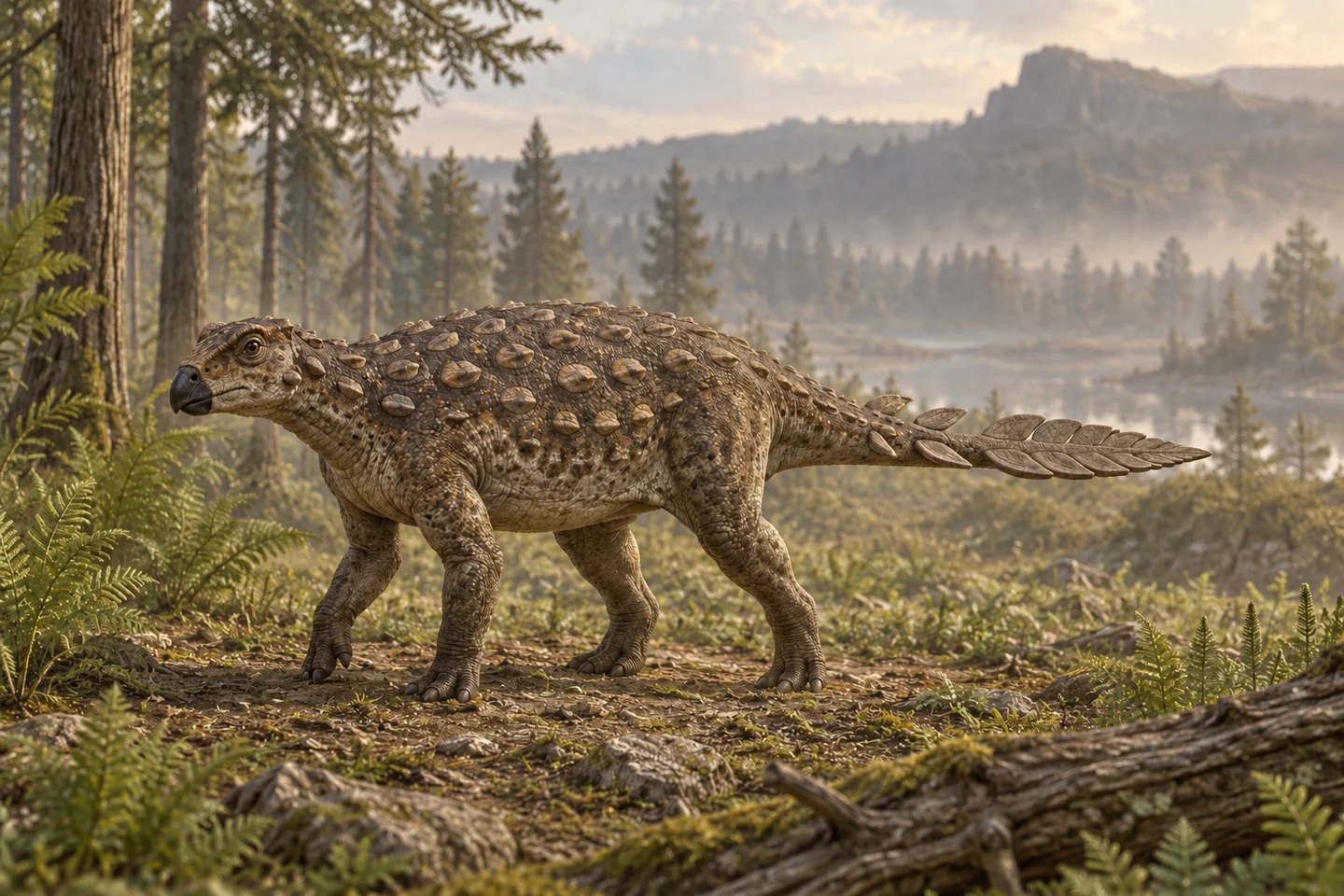
Original cinematic interpretation of Stegouros. The short tail and flattened lateral blade weapon are fossil-guided; complete skin, scute positions, colors and living pose remain interpretive. Colors, lighting and scenery are artistic choices; this is not directly observed behavior. Lighting, coloration and scenery are artistic choices. This image does not document a fossil locality or behavior.
Original artwork · artistic interpretation.
Scientific view: source-informed reconstruction, credited paleoart or specimen-based imagery. Movie-style view: Original artistic interpretation. Reconstructions involve uncertainty.
MEET THE ANIMAL
Stegouros was an armored dinosaur from Late Cretaceous Patagonia in Chile. Its genus name means 'roofed tail,' while the species name, elengassen, refers to an armored monster in Aonik'enk tradition. The name links a scientific discovery to the region's cultural history, rather than claiming that the dinosaur itself was the creature described in a legend. [S1]
The research team identified it as a plant eater in a southern landscape with rivers, forest vegetation and ferns. Its tail had an unusual flattened weapon, unlike the familiar rounded clubs of some northern ankylosaurs. The discovery adds a distinctive southern armored body plan without showing the exact plants eaten or a particular defensive encounter. [D2]
Seven pairs of lateral bony plates encased the tail's rear half. The final five pairs fused into a flat, lobed structure; the first two pairs remained separate. [D1]
Later fieldwork announced additional Stegouros remains. Those discoveries expand the material available for future study, but the report does not establish a herd, family group or nesting colony. More fossils can improve a profile without immediately resolving every behavioral question. [D3]
PREHISTORIC ANIMAL DOSSIER
The animal, the evidence, and the questions still open.
Seven paired lateral osteoderms form the tail weapon. The last five pairs fuse into a flattened frond, distinct from a rounded ankylosaurid club. [D1]
Profile scope: S. elengassen, chiefly CPAP-3165 from the Dorotea Formation: one informative published skeleton, with later field discoveries announced. [D1] [D3]
Source supported identifies a description documented by the cited source. Inferred marks a reconstruction or functional estimate. Debated marks competing interpretations. Not established means the sources reviewed for this dossier do not support a firm conclusion; it does not mean a behavior never occurred.
A size reference is an estimate, not a population range. Nesting evidence does not by itself establish courtship, mate choice, or lifelong pairing.
About 1.5–1.65 m; revised digital reconstruction
The original 1.8–2 m estimate was revised in a public author comment after digital assembly. This is not a peer-reviewed species range. [D1]
About 35 kg; illustrated reference
The 2026 publisher sample gives this educational estimate without an individual-specific method or maturity demonstration; excluded from adult comparison. [D4]
Plant eater
The research team identifies herbivory. Regional forest plants were possible foods, not preserved gut contents proving a specific menu. [D2]
Late Cretaceous austral river delta
Río Las Chinas fossils occur in the lower Dorotea succession. The institutional account describes winding rivers, forest vegetation and ferns. [D2]
Four-legged, with relatively slender limbs
The description contrasts its limbs with bulkier ankylosaurs. Hoof-like manual unguals support a walking reconstruction, not a measured running speed. [D1]
Short tail with a fused distal blade
The first two osteoderm pairs remain separate; the distal five join into a flat lobed structure, unlike an ankylosaurid knob. [D1]
Not established here
Bone fusion excludes an early juvenile interpretation, but does not establish breeding maturity, sex, egg number or nest type. [D1]
Not established here
Calling its tail a weapon does not demonstrate courtship display, sex differences or reproductive combat in this genus. [D2]
Not established here
Later fieldwork announced more Stegouros remains; the report does not establish a herd, family group or nesting colony. [D3]
Sources and inspection notes for the claims in this profile.
THE STORY IN THE FOSSILS
Excavators recovered a block whose rear skeleton remained articulated, including its distinctive tail. The incomplete front and well-preserved rear require different degrees of restoration in a whole-animal illustration. [2]
The discovery team proposed a southern ankylosaur lineage named Parankylosauria. This is an anatomical evolutionary hypothesis, not evidence that geographically separated armored dinosaurs shared behavior. [2]
The dossier identifies the scope of each reference estimate. A mount, an individual fossil and a species-wide adult range are different measurements. Comparison metrics remain unavailable where adult scope has not been established. Unknown does not mean zero.
Sources support the stated claims and scopes. Refer to the evidence notes for uncertainty.
KEEP EXPLORING
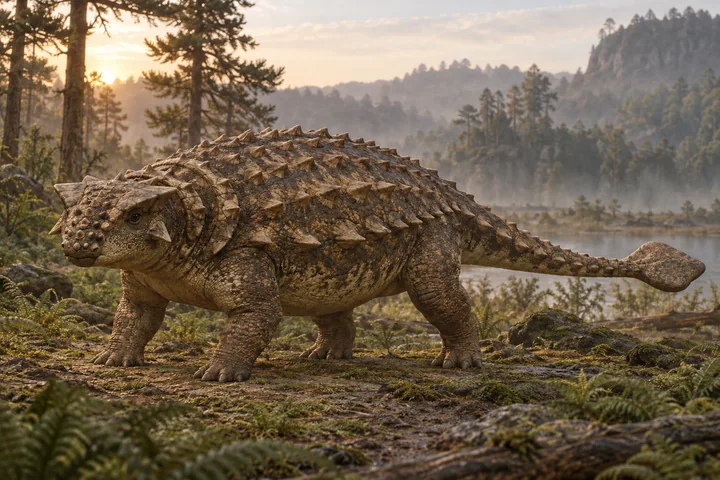
Akainacephalus johnsoni
Akainacephalus combined a heavily ornamented head with a broad tail club in the Late Cretaceous of southern Utah.
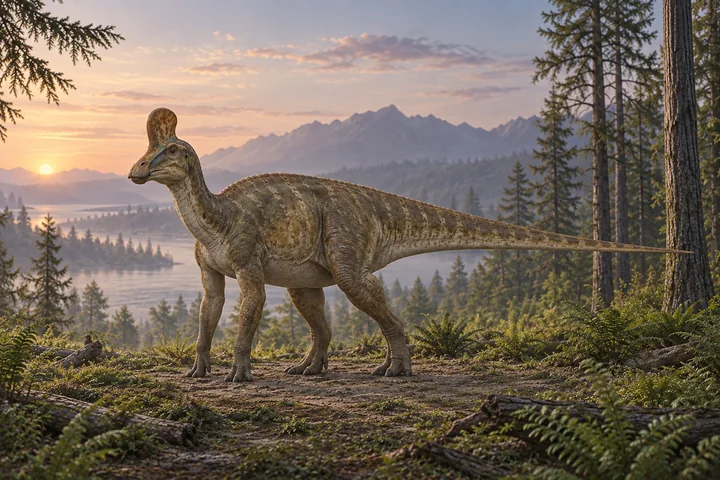
Tsintaosaurus spinorhinus
Tsintaosaurus was a plant-eating hadrosaur whose distinctive crest remains a subject of reconstruction and reassessment.
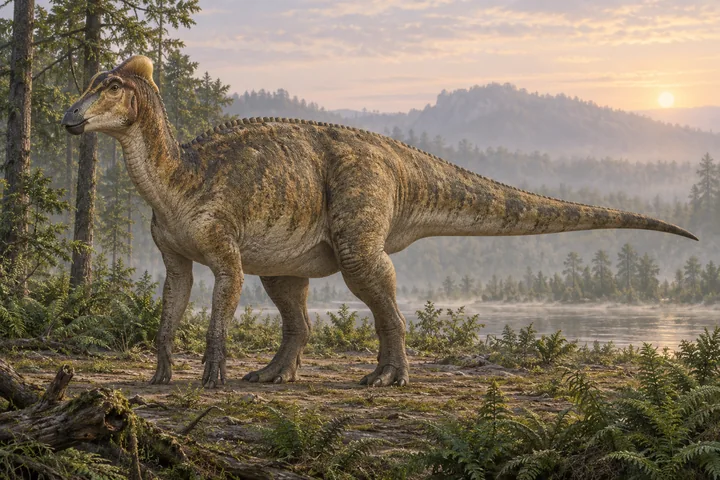
Amurosaurus riabinini
Amurosaurus was a hadrosaur with tooth batteries and skull architecture supporting a hollow crest whose complete shape remains unknown.