
Body length
InferredAbout 2 m; museum reference
The museum supplies a whole-body reference without specimen, stage or method. Larger referred individuals are known, so this reference is not an adult maximum or a genus-wide range. [D6] [D1]
EXHIBIT 146
Anchisaurus polyzelus
Anchisaurus was a small North American sauropodomorph whose juvenile and mature skulls reveal changes during growth. [3]
TWO WAYS TO PICTURE THE PAST
Compare the evidence with the familiar movie image. The illustrations are not to a shared scale.
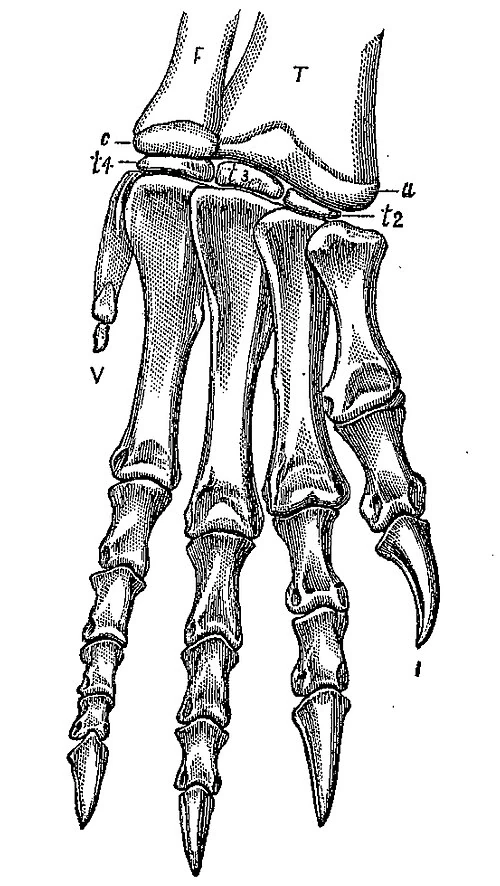
Marsh’s 1889 drawing of a right hindfoot, originally Anchisaurus major and later Ammosaurus major. The 2010 revision includes this historical species under Anchisaurus polyzelus. This is a foot, not a hand, and is not the YPM 1883 mass-reference individual. [3]
Historical hindfoot of Anchisaurus major · O. C. Marsh (1889). Public domain. Resized proportionally and converted to WebP; no anatomical edits. Same source license applies.
Skeletal mounts and drawings may restore missing parts; the caption identifies the displayed material.
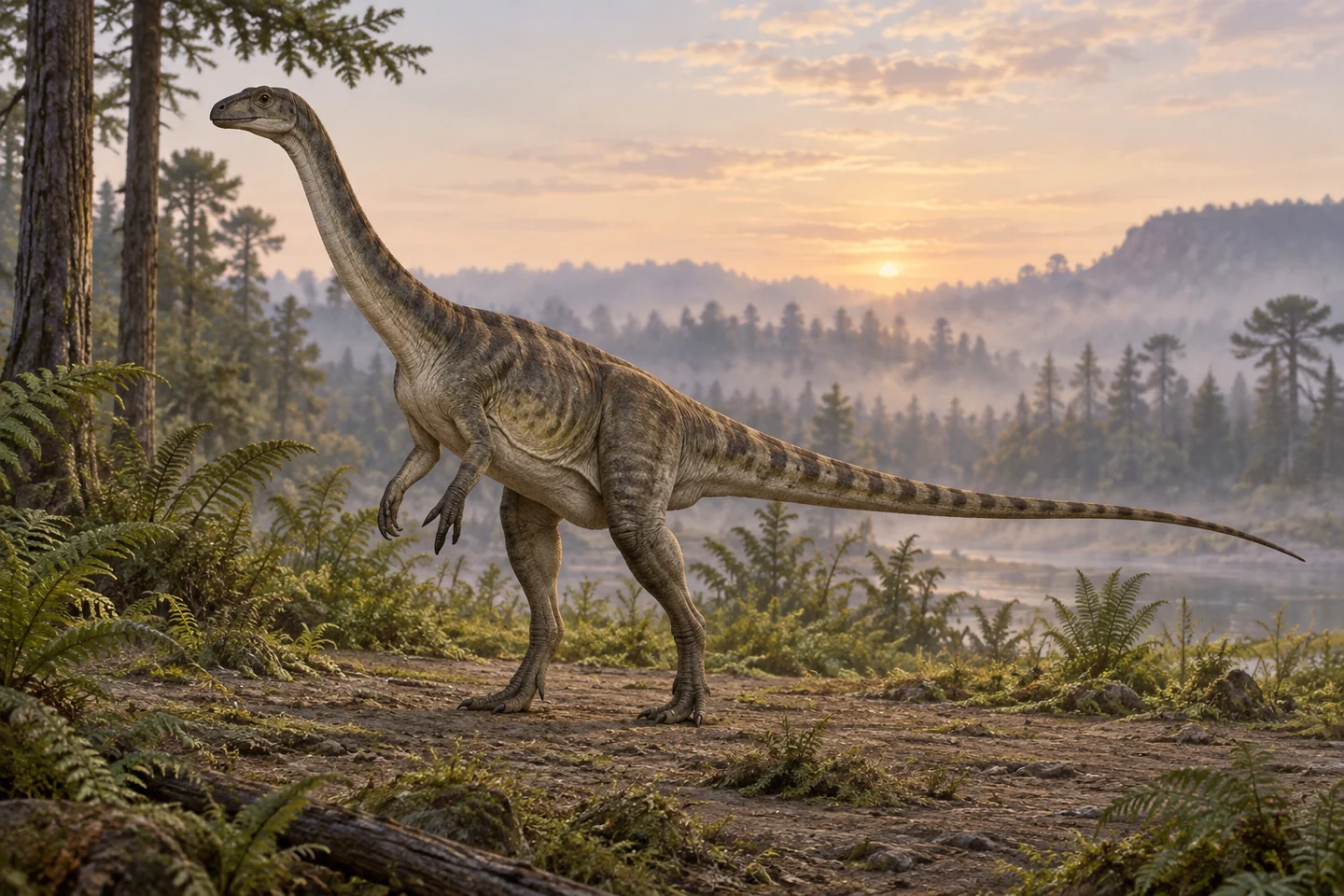
Original cinematic interpretation with the forelimbs raised for the displayed pose and an enlarged medial thumb claw. Habitual stance is uncertain: functional analyses differ, including a quadrupedal interpretation. Colors, soft tissues and setting are artistic. Lighting, coloration and scenery are artistic choices. This image does not document a fossil locality or behavior.
Original artwork · artistic interpretation.
Scientific view: source-informed reconstruction, credited paleoart or specimen-based imagery. Movie-style view: Original artistic interpretation. Reconstructions involve uncertainty.
MEET THE ANIMAL
Anchisaurus was a small plant-eating dinosaur from Early Jurassic North America. It belonged to the wider dinosaur group that includes the giant sauropods, although the museum's general length reference is only about two metres. That reference is not linked to a particular growth stage. It describes a reconstructed scale, rather than the largest possible mature Anchisaurus. [D6]
Two skulls from Connecticut helped researchers investigate how its head changed as it grew. They used micro-CT scans, a form of X-ray imaging, to build three-dimensional models. The young animal and the adult did not have identical skull shapes. Comparing individuals at different ages helps separate developmental changes from differences that might otherwise be mistaken for separate species. [S1]
This growth comparison also contributes to a larger evolutionary question. Later sauropods developed some distinctive head features earlier in their lives than Anchisaurus did. Changes in the timing of development can therefore help explain how dinosaur bodies evolved. The study concerns the formation of skulls, not a direct record of nesting, family life or the age when an individual first reproduced. [S1]
PREHISTORIC ANIMAL DOSSIER
The animal, the evidence, and the questions still open.
CT and histology reveal head growth. Its usual walking stance has competing interpretations. [D3] [D5]
Profile scope: Genus profile centered on Anchisaurus polyzelus. YPM 1883 is the designated neotype; larger YPM 208 and young YPM 209 are separate referred individuals. [D2] [D1]
Source supported identifies a description documented by the cited source. Inferred marks a reconstruction or functional estimate. Debated marks competing interpretations. Not established means the sources reviewed for this dossier do not support a firm conclusion; it does not mean a behavior never occurred.
A size reference is an estimate, not a population range. Nesting evidence does not by itself establish courtship, mate choice, or lifelong pairing.
About 2 m; museum reference
The museum supplies a whole-body reference without specimen, stage or method. Larger referred individuals are known, so this reference is not an adult maximum or a genus-wide range. [D6] [D1]
About 20 kg; newly mature neotype model
Paul’s volume-scaled reconstruction estimates YPM 1883. Independent histology identifies that individual as having just reached somatic maturity; body restoration and density retain uncertainty. [D4] [D3]
Plants
The museum identifies herbivory. CT evidence shows anterior teeth projecting forward more strongly in the mature individual, but does not identify its precise food plants or daily intake. [D6] [D3]
Early Jurassic northeastern United States
Reviewed material includes Springfield, Massachusetts, and Manchester, Connecticut. The articulated Manchester skeletons come from the Portland Formation, assigned a Pliensbachian age in the revision. [D1]
Walking stance remains debated
A limb-proportion classifier favors quadrupedality but gives weaker support than for other sampled transitional taxa. Earlier anatomical reconstructions favored bipedality; neither demonstrates an observed living stance. [D5]
Head shape changes during growth
The mature skull has a longer snout, more retracted nostrils and more projecting front teeth than YPM 209. CT-restored skulls include reconstructed missing margins; they are not intact undistorted originals. [D3]
Not established here
Histology distinguishes a young individual from a newly somatically mature one. Somatic maturity does not establish reproductive maturity, eggs, nest layout or parental care. [D3]
Not established here
Developmental skull differences do not identify sexes or mating displays. Focused searches did not establish calls, mate choice or courtship. [D3]
Not established here
Several separate skeletons came from the Manchester quarry. The reviewed taxonomic study does not establish a persistent herd or family group from that association. [D1]
Sources and inspection notes for the claims in this profile.
THE STORY IN THE FOSSILS
The young and mature skulls provide a developmental comparison. Their differences indicate growth rather than identifying sexes. [3]
The nomenclatural ruling made YPM 1883 the neotype, replacing fragmentary earlier material. Its former name, Anchisaurus colurus, therefore does not receive a separate exhibit. [2]
The dossier identifies the scope of each reference estimate. A mount, an individual fossil and a species-wide adult range are different measurements. Comparison metrics remain unavailable where adult scope has not been established. Unknown does not mean zero.
Sources support the stated claims and scopes. Refer to the evidence notes for uncertainty.
KEEP EXPLORING
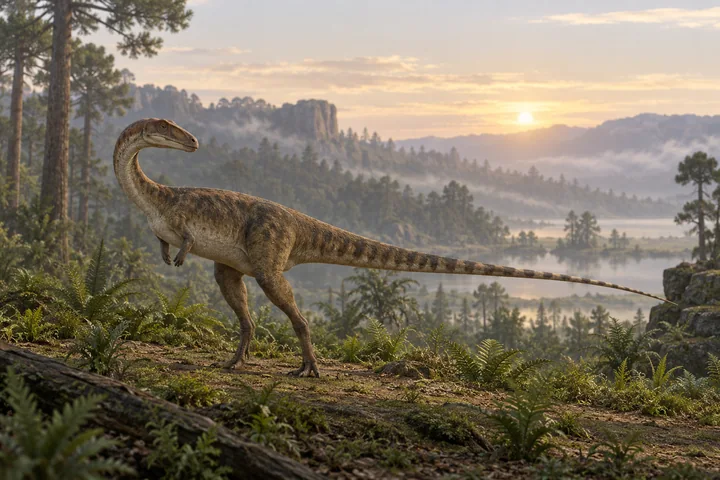
Saturnalia tupiniquim
Saturnalia was a small Brazilian sauropodomorph, combining a lightly built skeleton with evidence consistent with mixed feeding.
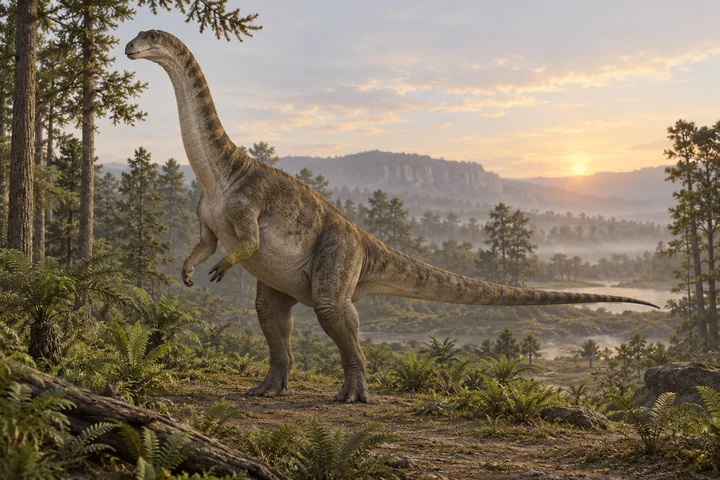
Antetonitrus ingenipes
Antetonitrus was a large early sauropodomorph combining substantial hindlimbs with forelimbs that retained grasping capabilities.
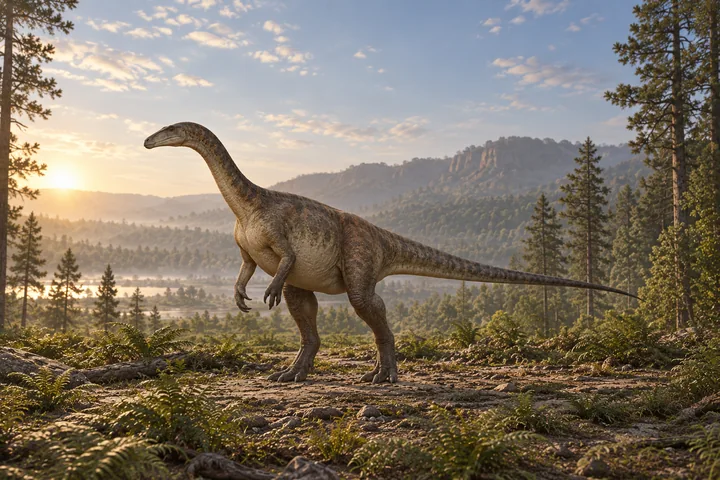
Aardonyx celestae
Aardonyx was a South African sauropodomorph whose jaws suggest bulk plant feeding while its forelimbs retain a mainly bipedal, grasping arrangement.