
Body length
Not establishedNot established here
A verified whole-body length tied to a specified individual was not obtained from the reviewed primary texts. Preserved limb lengths cannot simply be substituted for total body length. [D1]
EXHIBIT 148
Antetonitrus ingenipes
Antetonitrus was a large early sauropodomorph combining substantial hindlimbs with forelimbs that retained grasping capabilities. [1]
TWO WAYS TO PICTURE THE PAST
Compare the evidence with the familiar movie image. The illustrations are not to a shared scale.
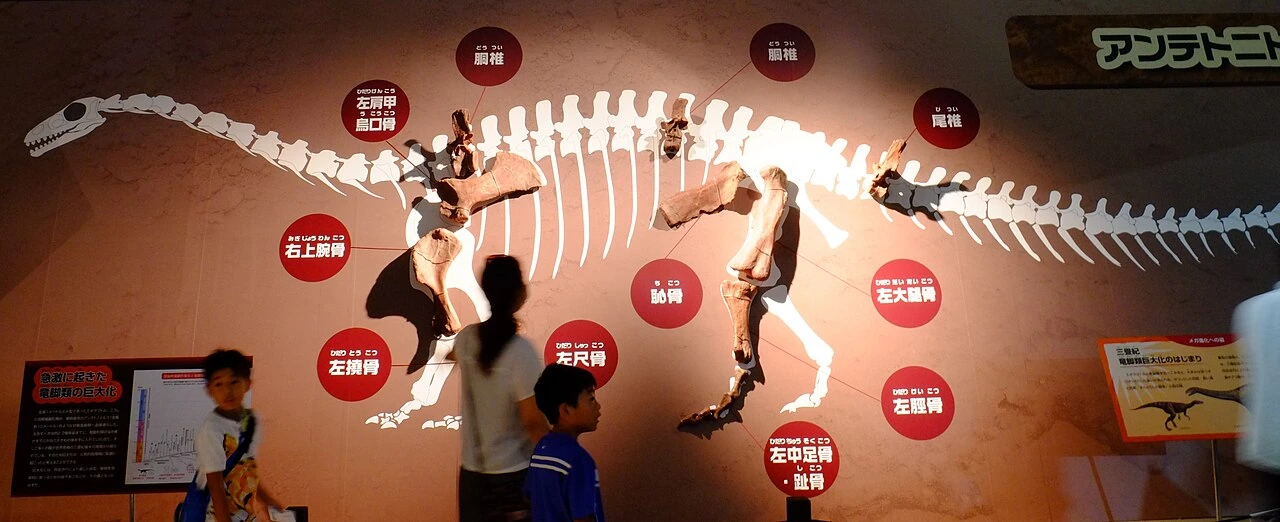
Antetonitrus display photographed at the 2015 Dino Expo in Tokyo: partial bones are positioned over a reconstructed outline. The head and much of the body are restored. Historical whole-body size and age labels are not adopted as current specimen measurements. [1]
Antetonitrus bone display over reconstructed outline · ★Kumiko★. CC BY-SA 2.0. Resized proportionally and converted to WebP; no anatomical edits. Same source license applies.
Skeletal mounts and drawings may restore missing parts; the caption identifies the displayed material.
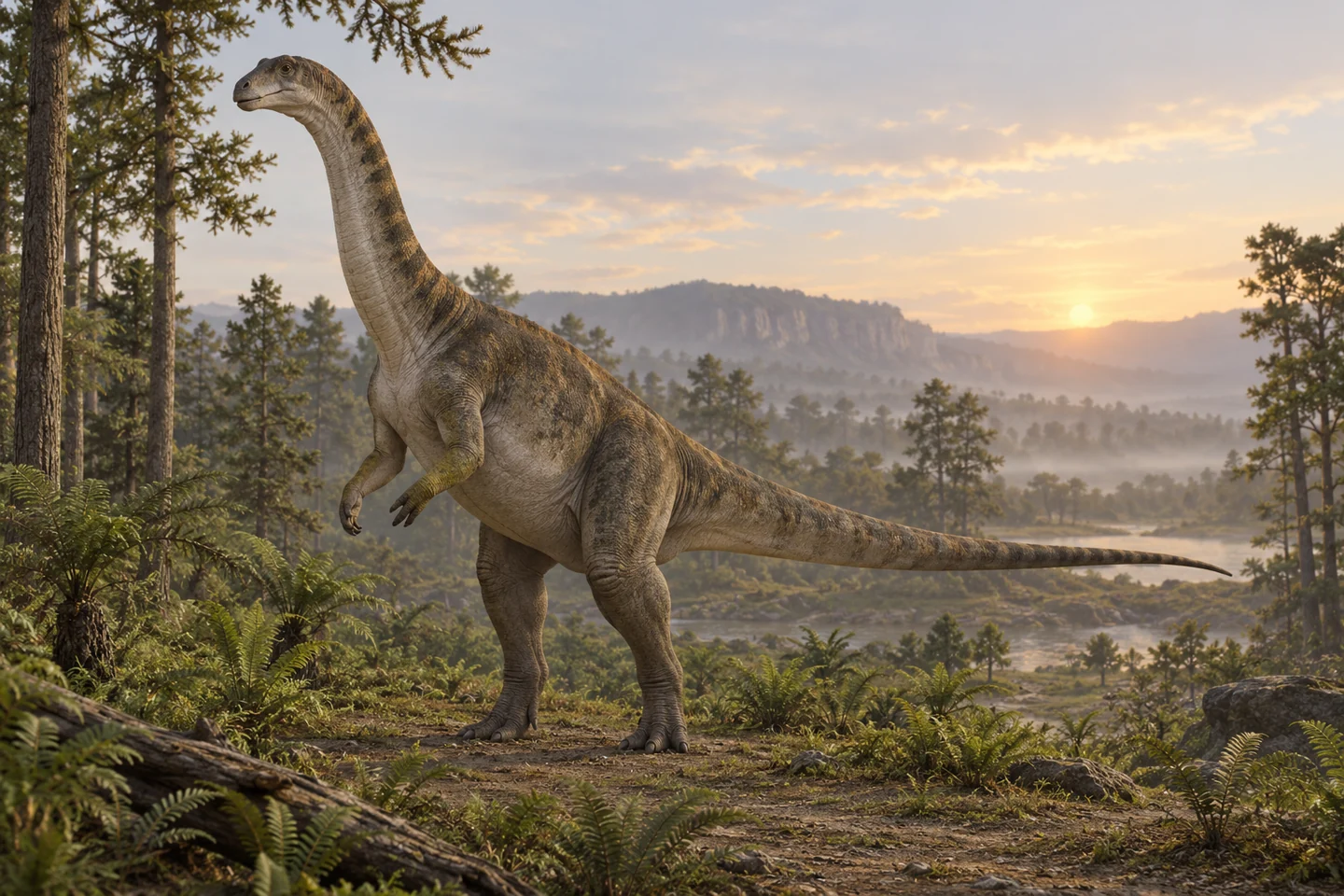
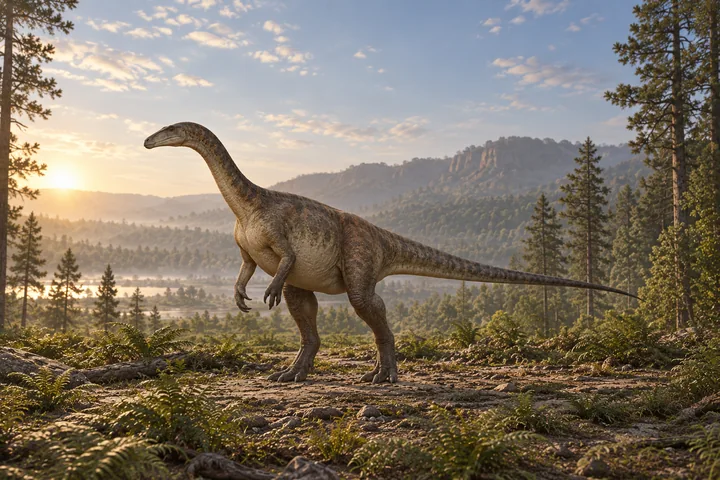
Original cinematic interpretation showing raised mobile grasping forelimbs. The 2014 anatomical facultative-biped interpretation and 2018 quadrupedal model differ; this displayed pose does not certify habitual locomotion. Complete hands, head, colors and soft tissues are reconstructed. Lighting, coloration and scenery are artistic choices. This image does not document a fossil locality or behavior.
Original artwork · artistic interpretation.
Scientific view: source-informed reconstruction, credited paleoart or specimen-based imagery. Movie-style view: Original artistic interpretation. Reconstructions involve uncertainty.
MEET THE ANIMAL
Antetonitrus was a large early sauropodomorph from South Africa, now placed in an Early Jurassic setting. Its limb proportions help researchers investigate the transition toward the weight-bearing bodies of sauropods. [D4]
Its skeleton combines features suited to carrying a substantial body with hands that could still grasp. The forelimbs were long, while the hand bones were relatively short and broad. Its thighbone and foot also show changes in the way weight was supported. This mixture is useful evidence that the familiar sauropod body plan developed through several changes, rather than appearing fully formed in one step. [S1]
Mobile, grasping forelimbs leave room for functions besides walking. However, sparse hand bones do not establish every finger or claw, and a fully restored hand remains an interpretation. [D1]
Microscopic tissues record growth and periods of slowing. Some referred bones have uncertain collection histories. Their association does not establish a herd, and developmental stages do not directly reveal breeding age or nesting. A fossil’s identity and context affect what it can show. [D3]
PREHISTORIC ANIMAL DOSSIER
The animal, the evidence, and the questions still open.
Its type locality was reassigned to the upper Elliot Formation. Anatomy and limb-proportion models offer differing interpretations of whether it regularly traveled on four legs. [D2] [D4]
Profile scope: Genus profile centered on Antetonitrus ingenipes type BP/1/4952. Unassociated NMQR 1705 limb bones referred from Lesotho require separate individual and stratigraphic qualifications. [D3]
Source supported identifies a description documented by the cited source. Inferred marks a reconstruction or functional estimate. Debated marks competing interpretations. Not established means the sources reviewed for this dossier do not support a firm conclusion; it does not mean a behavior never occurred.
A size reference is an estimate, not a population range. Nesting evidence does not by itself establish courtship, mate choice, or lifelong pairing.
Not established here
A verified whole-body length tied to a specified individual was not obtained from the reviewed primary texts. Preserved limb lengths cannot simply be substituted for total body length. [D1]
About 5.6 tonnes; immature type model
The limb-circumference estimate uses BP/1/4952. The study explicitly identifies osteological immaturity; it is neither an adult maximum nor a population range. [D4]
Plants; comparative inference
Its sauropodomorph affinities support a plant-feeding reconstruction. A secure type skull and teeth are not described, so precise foods and feeding height cannot be established directly. [D1]
Early Jurassic type; referred chronology uncertain
The South African type locality is now assigned to upper Elliot deposits. The Lesotho histology collection retained a Late Triassic assignment with incomplete provenance; this should not silently fix a precise genus-wide timespan. [D2] [D3]
Quadrupedal model; anatomical alternative
The 2018 classifier strongly favors four-legged travel. The anatomical study instead proposes facultative bipedality; mobile, grasping forelimbs are compatible with functions beyond walking. [D4] [D1]
Grasping forelimb retained beside robust hindlimbs
Only limited hand elements are known, including first and second metacarpals and one thumb phalanx. These do not establish a complete hand or all claw counts; the skull requires comparative restoration. [D1]
Growth documented; nesting unestablished
Histology records rapid bone deposition interrupted by growth marks and late-stage slowing in some referred bones. Developmental stages do not establish reproductive maturity, clutch size, nests or parental care. [D3]
Not established here
Focused searches did not establish displays, calls, sex-specific coloration, sexual dimorphism or mate choice. Large size and grasping anatomy do not identify a reproductive signal.
Not established here
The NMQR 1705 bones represent multiple unassociated animals and lack adequate field notes. Their collection does not establish an organized herd, family group or coordinated behavior. [D3]
Sources and inspection notes for the claims in this profile.
THE STORY IN THE FOSSILS
The type locality’s revised stratigraphy moves the animal into an Early Jurassic setting. Historical Late Triassic labels on displays should therefore be interpreted with their source date and referral scope attached. [2]
The histology sample combines the type with unassociated referred bones. A developmental sequence can be informative without demonstrating that all individuals died together or belonged to one social group. [3]
The dossier identifies the scope of each reference estimate. A mount, an individual fossil and a species-wide adult range are different measurements. Comparison metrics remain unavailable where adult scope has not been established. Unknown does not mean zero.
Sources support the stated claims and scopes. Refer to the evidence notes for uncertainty.
KEEP EXPLORING
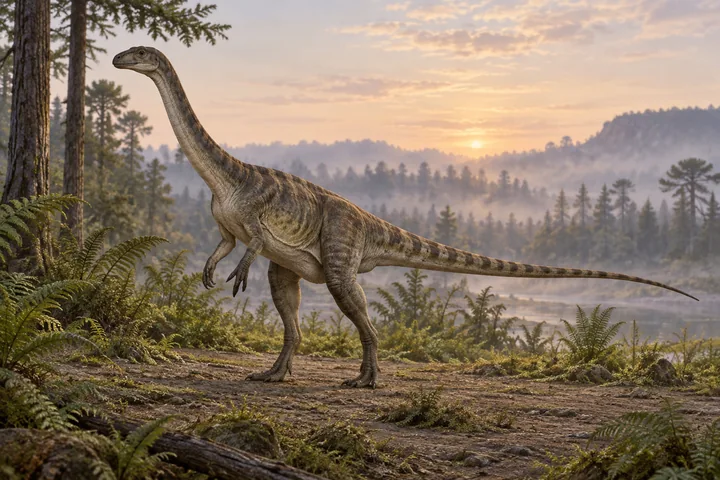
Anchisaurus polyzelus
Anchisaurus was a small North American sauropodomorph whose juvenile and mature skulls reveal changes during growth.
Aardonyx celestae
Aardonyx was a South African sauropodomorph whose jaws suggest bulk plant feeding while its forelimbs retain a mainly bipedal, grasping arrangement.
Herrerasaurus
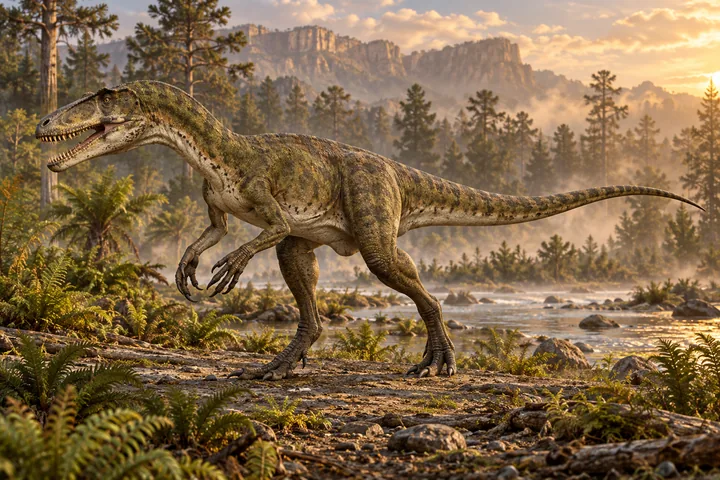
Herrerasaurus was a two-legged meat eater from Late Triassic Argentina. A 1988 skull revealed recurved teeth alongside powerful arms and grasping hands.