
Length
InferredAbout 4 m (Chicago profile)
The laboratory profile gives 3.96 m, while NHM lists 3 m. Neither establishes a complete adult species range or specifies the represented individual's maturity. [D2] [D1]
EXHIBIT 56
Herrerasaurus
Strong grasping arms and long recurved teeth near dinosaur origins.
TWO WAYS TO PICTURE THE PAST
Compare the evidence with the familiar movie image. The illustrations are not to a shared scale.

The artist identifies this reconstruction as Herrerasaurus. Fossil-informed anatomy: Early bipedal meat eater with long recurved teeth, strong arms and grasping hands; long balancing tail and forward-held body. File identifies the genus only. Colour, integument and soft-tissue contours are artistic reconstruction. [1] [2]
Herrerasaurus TD.png — TotalDino. CC BY-SA 4.0. Remote source artwork displayed without additional cropping; Wikimedia supplies any display-size derivative.
Scientific picture served by Wikimedia · internet connection required.
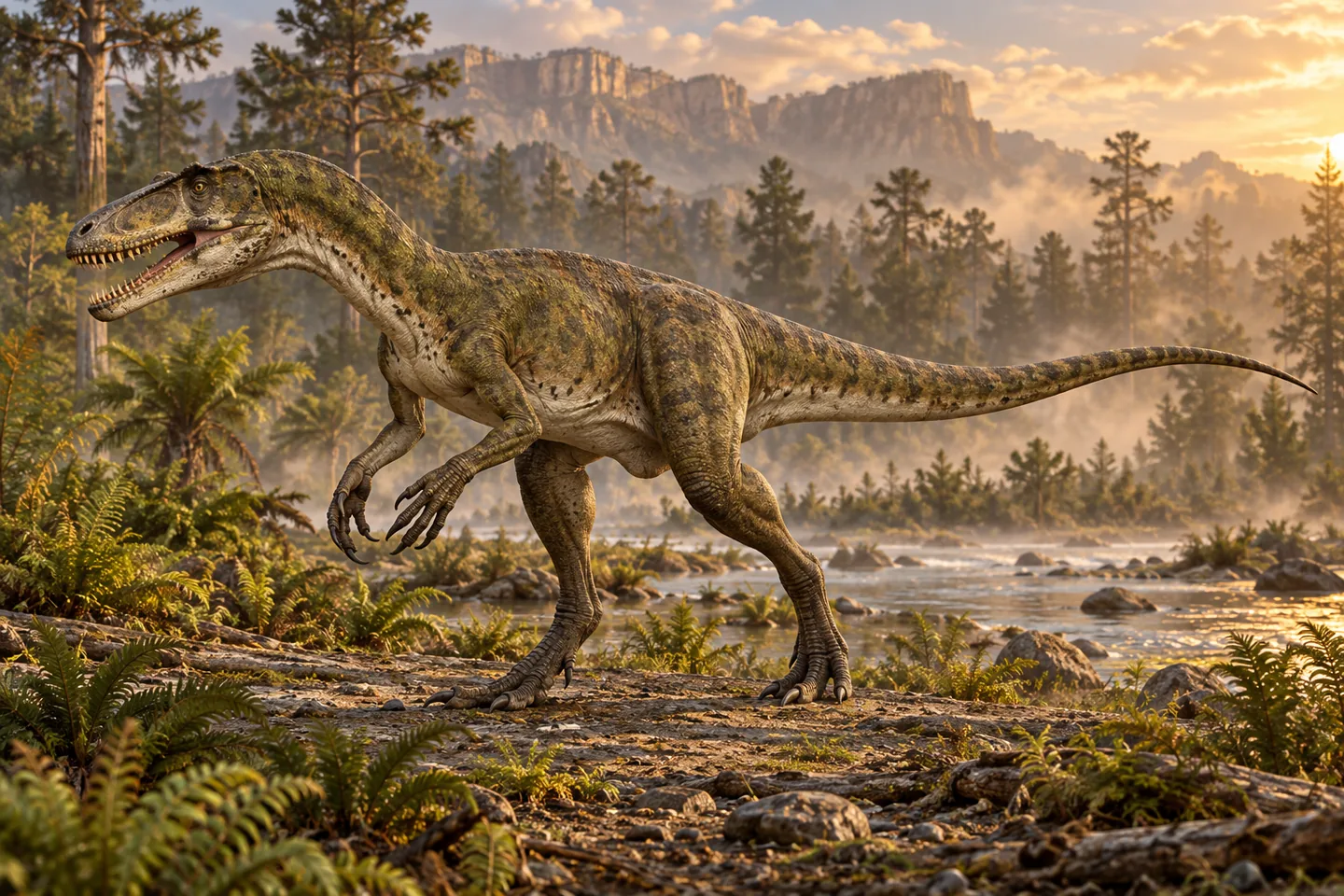
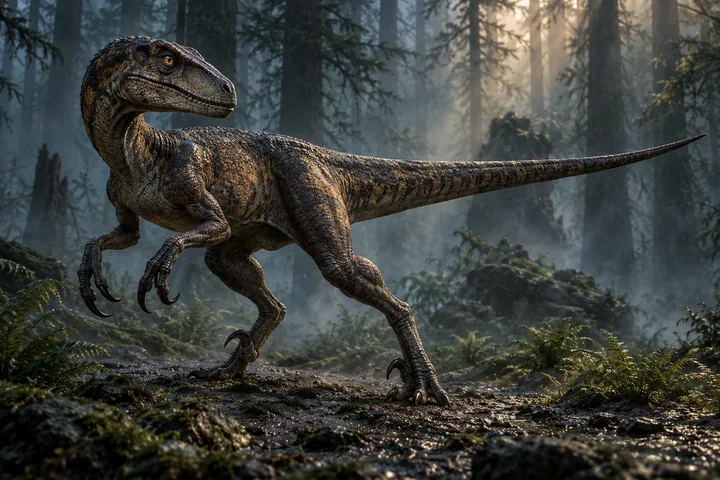
Cinematic early Herrerasaurus predator with strong grasping arms, recurved teeth and a long balancing tail; forward-held bipedal body, restrained speculative skin texture. Dramatic lighting, surface detail and scenery are artistic choices. This is an original cinema-inspired picture, rather than a frame from a film or a documented fossil locality.
Original artwork · artistic interpretation.
Scientific view: credited paleoart interpreting fossil evidence, served online by Wikimedia. Movie-style view: Original artistic interpretation. Colors, soft tissues and settings involve reconstruction.
MEET THE ANIMAL
Herrerasaurus was an early dinosaur from Late Triassic Argentina, around 230 million years ago. Its sharp teeth and claws identify the equipment of a predator, rather than a plant grinder. The reconstructed body walked on two legs. Herrerasaurus is useful for imagining the first chapters of dinosaur evolution, when these animals were already developing different body plans and ways of feeding. [S1] [S2]
A skull of Herrerasaurus ischigualastensis found in 1988 provides detailed evidence beyond a general body outline. Researchers scanned this specimen to examine its structure digitally, and the fossil is held in San Juan, Argentina. A scan lets scientists investigate internal anatomy and compare bones without taking the skull apart. Such evidence sharpens reconstructions while leaving many questions about the living animal unanswered. [S1]
Museum length references describe an animal several metres long, but differ without establishing a measured adult range. A reconstructed skeleton represents a particular interpretation, rather than the exact size of every Herrerasaurus. Its carnivorous identity is clearer than details such as the particular prey it preferred or the speed at which it could run. [D1] [S1]
PREHISTORIC ANIMAL DOSSIER
The animal, the evidence, and the questions still open.
Herrerasaurus was an early two-legged meat eater with strong grasping arms and long backward-curving teeth. A skull found by a joint American–Argentinian team in 1988 sharpened its anatomical profile.
Profile scope: Genus: Herrerasaurus; Chicago skeletal profile specifically concerns H. ischigualastensis.
Source supported identifies a description documented by the cited source. Inferred marks a reconstruction or functional estimate. Debated marks competing interpretations. Not established means the sources reviewed for this dossier do not support a firm conclusion; it does not mean a behavior never occurred.
A size reference is an estimate, not a population range. Nesting evidence does not by itself establish courtship, mate choice, or lifelong pairing.
About 4 m (Chicago profile)
The laboratory profile gives 3.96 m, while NHM lists 3 m. Neither establishes a complete adult species range or specifies the represented individual's maturity. [D2] [D1]
Not established here
The reviewed sources do not establish a verified body-mass estimate for Herrerasaurus.
Meat eater with recurved teeth
The teeth and grasping arms support predatory feeding. Exact prey selection is not established in the reviewed profiles. [D2]
Late Triassic Ischigualasto fossil setting
Chicago places the remains in the Ischigualasto region of Argentina. This is a fossil occurrence rather than a demonstrated habitat preference. [D2]
Two-legged walking
The laboratory reconstructs bipedal locomotion. A specific running speed is not established here. [D2]
Strong arms, grasping hands and recurved teeth
The 1988 skull preserves backward-curving teeth. Using the hands to seize or rake prey is a functional inference. [D2]
Not established here
The reviewed sources do not establish nest structure, incubation or parental care for Herrerasaurus.
Not established here
The reviewed sources do not establish a courtship sequence or mating system for Herrerasaurus.
Not established here
The reviewed sources do not establish usual group size or lasting social organization for Herrerasaurus.
Sources and inspection notes for the claims in this profile.
THE STORY IN THE FOSSILS
Herrerasaurus lived in the Ischigualasto region of Argentina near the beginning of dinosaur history. Its two-legged skeleton carried strong arms and hands suited to grasping. The University of Chicago account links those hands to seizing or raking prey, a functional interpretation of the bones. [2]
A joint American–Argentinian expedition led by Paul Sereno discovered an informative skull in 1988. It preserved long, backward-curving teeth consistent with meat eating. The directory gives about 228 million years as a reference age, while the laboratory account summarizes a broader 230–225 million-year interval. [2] [1]
We have not established a comparable adult total-length estimate for this taxon in this draft. Specimen measurements in the text describe those individuals. The cited dates are approximately 228 million years ago. Approximate reference age, represented by equal endpoints; not a demonstrated full temporal range. Unknown does not mean zero.
Sources and evidence notes for this exhibit.
KEEP EXPLORING
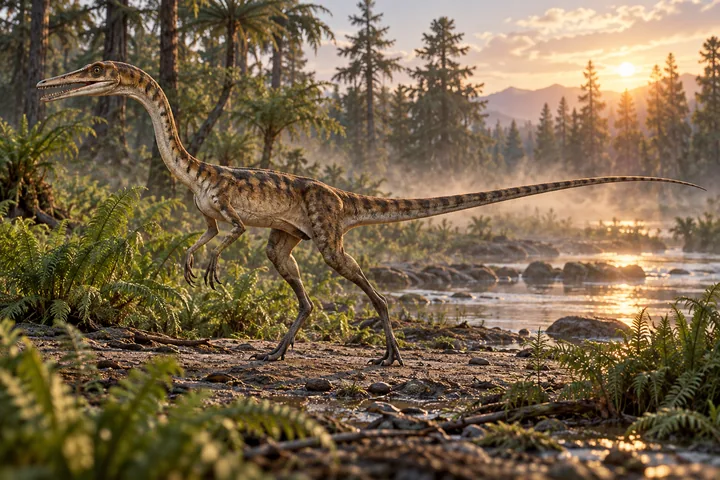
Coelophysis bauri
The famous claim that Coelophysis ate its young failed detailed fossil re-examination.
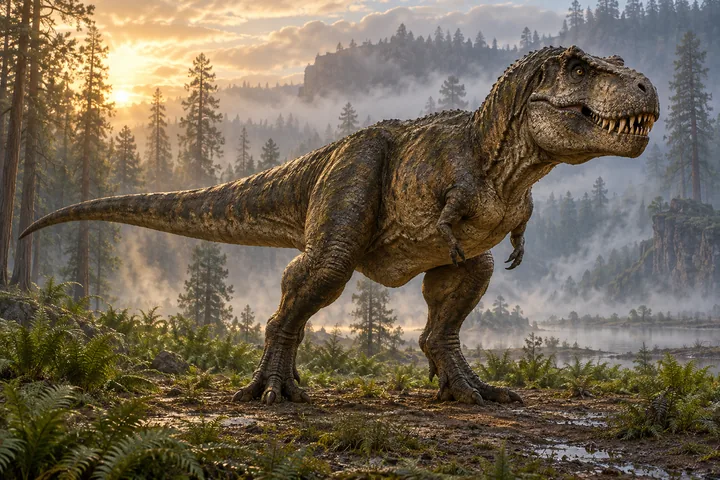
Tyrannosaurus rex
Bone-crushing jaws left traces of meals in the fossil record.
Velociraptor mongoliensis
A small predator whose famous fossil preserves an encounter with Protoceratops.