EXPLORE PREHISTORY 220 prehistoric animal profiles · Scientific & movie-style image galleries

EXHIBIT 21

Coelophysis

Coelophysis bauri

The famous claim that Coelophysis ate its young failed detailed fossil re-examination.

Evidence profile
PERIODLate Triassic[1]
DIETCarnivoreEvidence-informed classification [1]
TOTAL LENGTHNot established hereComparable estimate unavailable
FOSSILS FOUNDUSA[1]
CompareRead the dossierView the sources

MEET THE ANIMAL

Meet Coelophysis

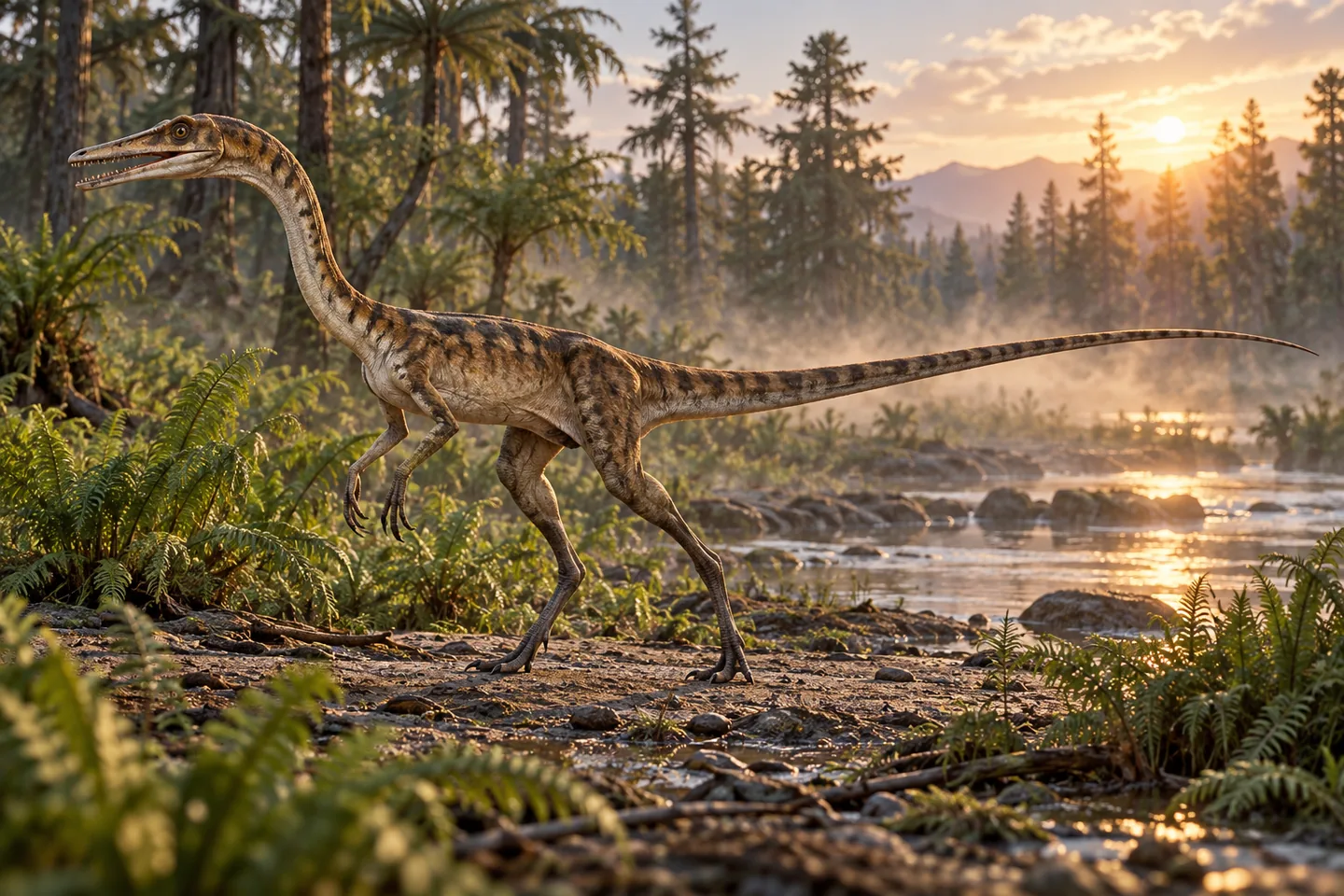
Coelophysis was a small meat-eating dinosaur of the Late Triassic. The rich fossil deposit at Ghost Ranch in New Mexico preserves many individuals of Coelophysis bauri. Sharp serrated teeth, curved claws and a two-legged body plan distinguish this animal from the much larger predators that appeared later. Its skeleton offers a useful view of an early predatory-dinosaur form. [S1] [S2]

Many Ghost Ranch skeletons were preserved remarkably well, sometimes with the bones still connected. Having numerous individuals allows researchers to compare growth and development instead of treating one animal as typical of an entire species. However, the number of skeletons preserved is not the same as the number prepared well enough for detailed study. Even a famous fossil deposit can continue to reveal new information as material is carefully examined. [S1]

One feeding interpretation changed after researchers revisited the fossils. Bones near the belly of a specimen had been taken as evidence of cannibalism, but closer study identified remains of an animal related to crocodiles instead. That correction concerns the studied evidence; it does not describe every meal Coelophysis ever ate. Likewise, many carcasses buried together do not automatically prove a hunting pack, and specific courtship and parenting remain unresolved here. [S3] [S2]

Overview sources
  1. Ghost Ranch: Fossil Site That Keeps GivingAmerican Museum of Natural History · Accessed 2026-10-04Inspected: page
  2. CoelophysisAmerican Museum of Natural History · Accessed 2026-10-04Inspected: page
  3. The Coelophysis in the SubwayAmerican Museum of Natural History · Accessed 2026-10-04Inspected: page

PREHISTORIC ANIMAL DOSSIER

A life in profile.

The animal, the evidence, and the questions still open.

Coelophysis bauri was a lightly built, two-legged carnivore represented by many skeletons at Ghost Ranch, New Mexico. A famous cannibalism claim based on supposed juvenile gut remains was later rejected.

Profile scope: Species: Coelophysis bauri; genus-reference figures explicitly identified.

Time
Late Triassic
Fossil locations in this exhibit
USA
How to read the evidence

Source supported identifies a description documented by the cited source. Inferred marks a reconstruction or functional estimate. Debated marks competing interpretations. Not established means the sources reviewed for this dossier do not support a firm conclusion; it does not mean a behavior never occurred.

A size reference is an estimate, not a population range. Nesting evidence does not by itself establish courtship, mate choice, or lifelong pairing.

Body length

Inferred

Common reference: 1.8–2.4 m; some about 3 m

The geological survey describes C. bauri as generally 6–8 feet long, with some individuals reaching 10 feet. Metric values are rounded conversions, not a population confidence interval. [D2]

Body mass

Inferred

About 27 kg; genus reference

NHM supplies this rounded figure on its Coelophysis genus page, whose type species is bauri. No specimen, life stage or estimation method is supplied. [D1]

Diet

Source supported

Small vertebrates and other animals

Sharp teeth and grasping claws support carnivory. NHM explains that the remains once taken for a swallowed baby Coelophysis instead belong to a small crocodile. [D1]

Habitat & fossil setting

Inferred

Ghost Ranch flood-related burial setting

The geological survey discusses flood transport and rapid burial at Whitaker Quarry. A death assemblage does not establish an exclusive riverbank habitat. [D2]

Movement

Source supported

Walked on two legs

Both reviewed institutional accounts identify bipedal locomotion; they do not establish an exact running speed. [D2] [D1]

Distinctive anatomy

Source supported

Hollow limb bones; sharp teeth; grasping claws

NHM describes a light skeleton with hollow limb bones and feeding structures suited to taking small animals. [D1]

Reproduction & life together

Reproduction & nesting

Not established

Not established here

The reviewed sources do not establish taxon-specific nest structure, clutch size or parental care.

Courtship & mating

Not established

Not established here

The reviewed sources do not establish a mating ritual, pair bond or breeding season for this taxon.

Social behavior

Not established

Not established here

Numerous C. bauri skeletons occur together, but flood transport and other burial processes must be considered. The assemblage alone does not establish pack hunting. [D2]

Dossier research & sources

Sources and inspection notes for the claims in this profile.

  1. Coelophysis — Dino DirectoryNatural History Museum, London · Accessed 2026-10-02Museum genus reference; life stage and specimen not specified. · Inspected: page
  2. Geologic Tour — Ghost RanchNew Mexico Bureau of Geology & Mineral Resources · Accessed 2026-10-02Species C. bauri at Whitaker Quarry; size and sedimentary setting. The page's older cannibalism assertion is superseded by the reviewed museum account. · Inspected: page

THE STORY IN THE FOSSILS

Meet Coelophysis.

Coelophysis had hollow limb bones, sharp serrated teeth and curved grasping claws. The Ghost Ranch bone bed in New Mexico contains hundreds of Coelophysis bauri skeletons. Museum researchers interpret this death assemblage as bodies gathered by flooding and subsequently buried in muddy sediment. [1] [2] [3]

Researchers re-examined two celebrated specimens thought to show cannibalism. One contained bones of a primitive crocodile relative, while supposed stomach contents in the other lay outside the rib cage. These observations removed the evidential basis of the familiar claim that Coelophysis swallowed its young. [3]

A note on scale and time

We have not established a comparable adult total-length estimate for this taxon in this draft. Specimen measurements in the text describe those individuals. The cited dates are approximately 210 million years ago. Approximately 210 Ma for the Ghost Ranch fossil occurrence; not a complete species range. Unknown does not mean zero.

Sources & editorial notes

Sources and evidence notes for this exhibit.

  1. Coelophysis — Dino DirectoryNatural History Museum, London · Accessed 2026-10-02Dino facts, hollow bones and taxonomy, lines 67–114. Do not adopt legacy genus distribution or 225–190 Ma range for species C. bauri.
  2. Coelophysis: Agile PredatorAmerican Museum of Natural History · Accessed 2026-10-02Permanent exhibit description, lines 211–212. Death assemblage flood interpretation, claw and tooth anatomy. Educational dimensions not adult-scoped.
  3. Paleontologists overturn claim that dinosaur ate its ownAmerican Museum of Natural History · Accessed 2026-10-02Museum research report, lines 197–214. Species C. bauri in Upper Triassic Ghost Ranch, abdominal specimen reassessment and limitations of cannibalism claim.

FOLLOW YOUR CURIOSITY

Who will you meet next?

KEEP EXPLORING

More from the collection