EXPLORE PREHISTORY 220 prehistoric animal profiles · Scientific & movie-style image galleries

EXHIBIT 199

Aquilops

Aquilops americanus

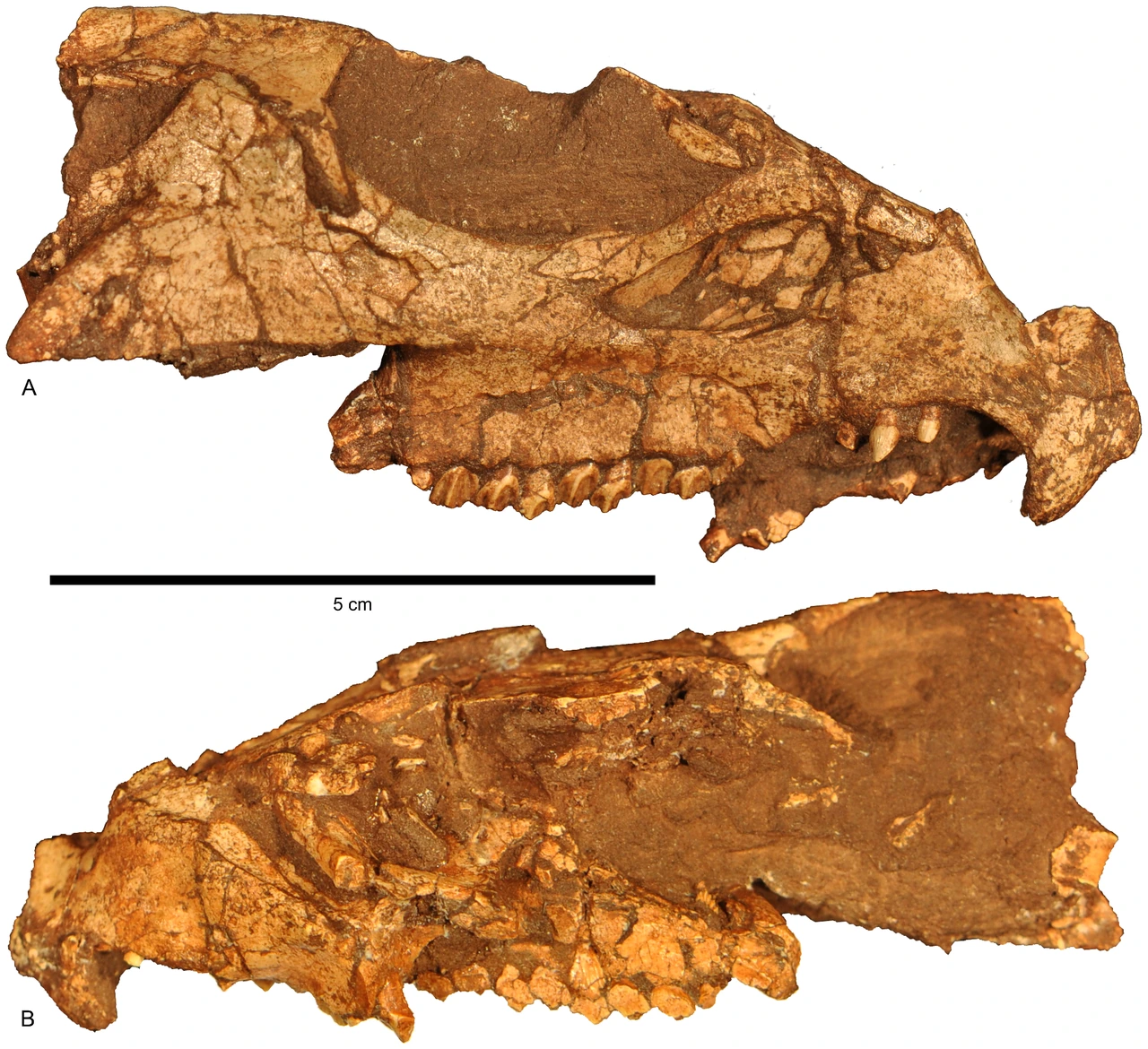
Aquilops was a small early ceratopsian from Montana, distinguished by a hooked beak with a low bump. Its known fossil is a partial skull and jaws. [1]

Evidence profile
PERIODEarly Cretaceous[1]
DIETHerbivore (inferred)Evidence and uncertainty in the dossier
TOTAL LENGTHSee the dossierEstimate scope matters
FOSSILS FOUNDUnited States[1]
CompareRead the dossierView the sources

MEET THE ANIMAL

Meet Aquilops

Aquilops is a small relative of the horned dinosaurs, known from a single skull rather than a complete skeleton. That skull can reveal features of the head, but it leaves the animal's limb proportions and tail length unknown. The University of Oklahoma's account explains how researchers use related animals to fill those gaps when making a body reconstruction. [D5]

The Natural History Museum describes a plant eater and gives a body-length reference of about sixty centimetres. That length is not measured along a preserved head-to-tail individual. Its growth stage is also uncertain, so a small fossil should not automatically become the maximum adult size for its species. Size estimates are useful as long as their anatomical and growth limits remain visible. [D4]

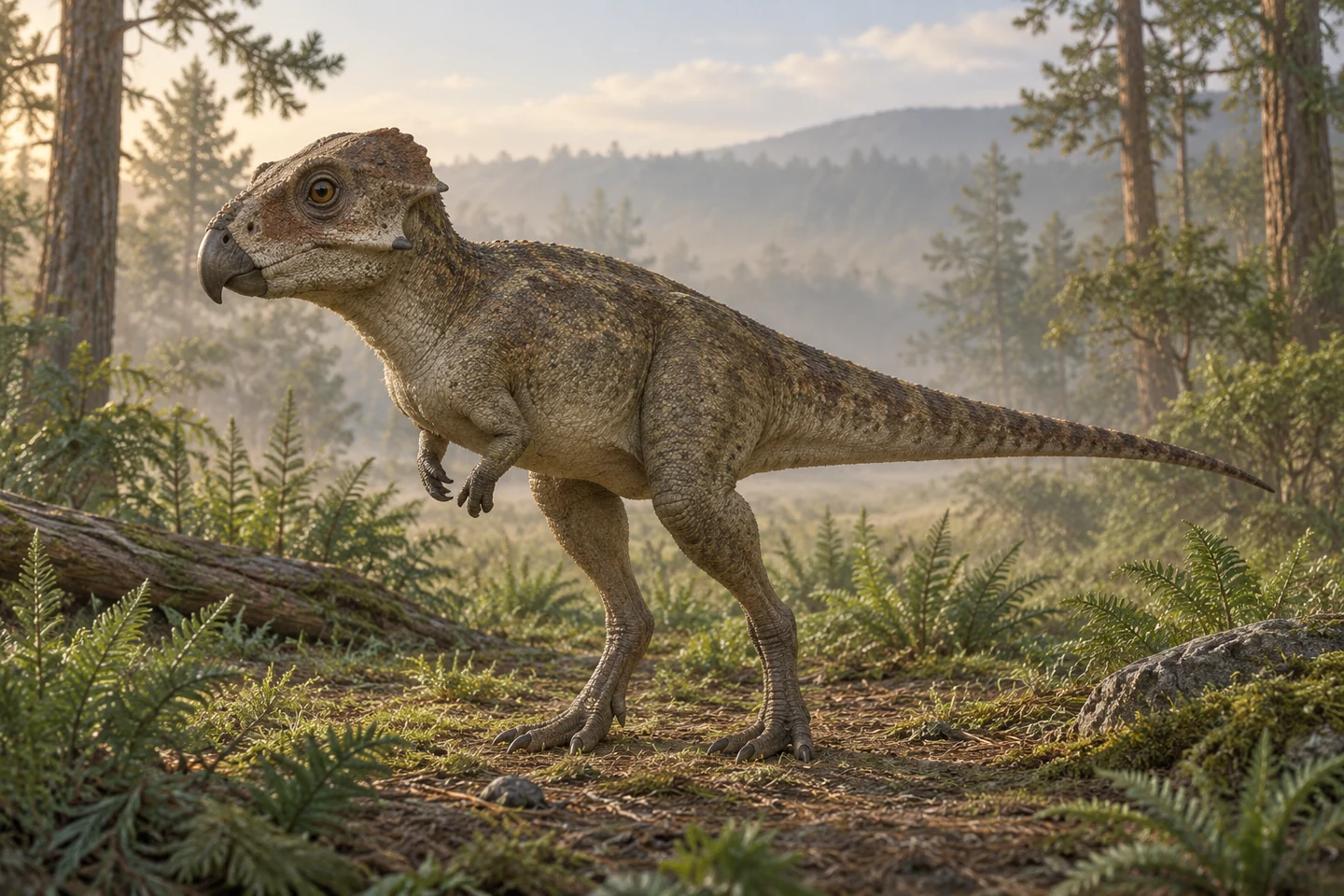
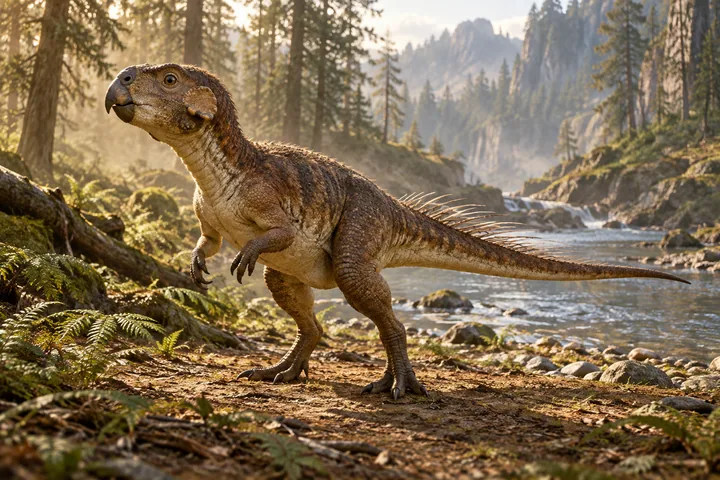
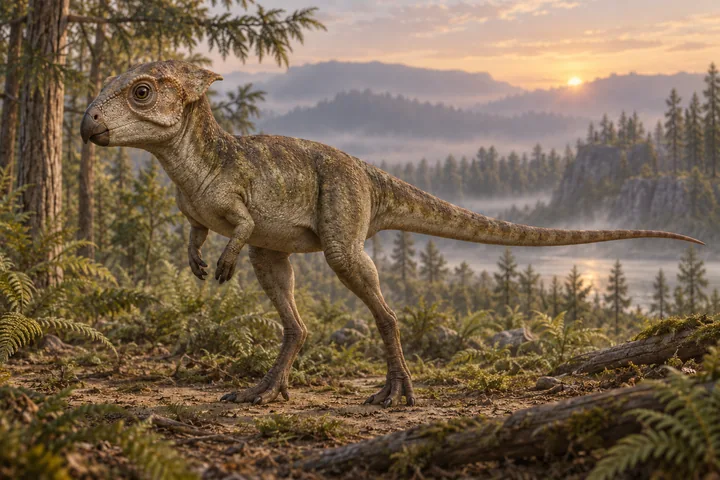
Its beak had a distinctive bump, but the bump's job remains unresolved. The original describer's explanation also presents a mostly two-legged reconstruction while acknowledging that limb bones are missing. Aquilops is a good example of a dinosaur whose head is much more securely known than its complete silhouette. The fossil supports a recognizable animal without settling every detail of its appearance or behavior. [D2]

PREHISTORIC ANIMAL DOSSIER

A life in profile.

The animal, the evidence, and the questions still open.

Aquilops is known from a skull rather than a complete skeleton. Its body can be reconstructed from relatives, but limb proportions and tail length are not directly preserved. [D5]

Profile scope: Genus Aquilops; A. americanus, type OMNH 34557. One cranial individual underpins the profile; whole-body models and proposed subadult stage remain qualified. [D1]

Time
Early Cretaceous
Fossil locations in this exhibit
United States
How to read the evidence

Source supported identifies a description documented by the cited source. Inferred marks a reconstruction or functional estimate. Debated marks competing interpretations. Not established means the sources reviewed for this dossier do not support a firm conclusion; it does not mean a behavior never occurred.

A size reference is an estimate, not a population range. Nesting evidence does not by itself establish courtship, mate choice, or lifelong pairing.

Body length

Inferred

About 0.6 m; skull-based reconstruction

Sam Noble gives two feet. The describer explains scaling the body from close relatives; no postcranial skeleton or independently established adult maximum underpins this reference. [D3] [D2]
Body mass

Inferred

1 kg or 3 lb; differing museum references

NHM gives 1 kg; Sam Noble gives three pounds (about 1.36 kg). These educational alternatives lack separate individual calculations and are not a population range or secure mature body mass. [D4] [D3]

Diet

Inferred

Herbivory inferred

The museum classifies Aquilops as plant-eating. Its record does not identify a particular plant, preserved meal or proportion of different foods. [D4]

Habitat & fossil setting

Source supported

Probably middle–late Albian Cloverly deposits

The type comes from deep red sandy claystone in basal Unit VII, Carbon County, Montana. The original age assignment is provisional; depositional setting does not establish a preferred microhabitat. [D1]

Movement

Inferred

Mostly bipedal reconstruction

The describer restores a large head, long hindlimbs, shorter forelimbs and long tail using close relatives. No Aquilops limb bones establish gait, speed or precise proportions. [D2]

Distinctive anatomy

Source supported

Downturned beak with low midline boss

The type cranium measures 84.2 mm as preserved. It has three premaxillary teeth, nine upper cheek teeth and at least twelve lower cheek teeth; absent skull regions are restored. [D1]

Reproduction & life together

Reproduction & nesting

Not established

Not established here

Mixed juvenile and adult cranial traits suggest a subadult. This comparative growth hypothesis supplies no breeding age, assigned eggs, nest or parental behavior. [D1]

Courtship & mating

Not established

Not established here

The describer leaves the bump’s function unresolved. Its shape does not establish a mating ornament, sex differences or observed courtship. [D2]

Social behavior

Not established

Not established here

The current institutional account identifies only one fossil specimen. This provides no living group or parent–young association; focused searches found no genus-specific social evidence. [D5]

Dossier research & sources

Sources and inspection notes for the claims in this profile.

  1. A Ceratopsian Dinosaur from the Lower Cretaceous of Western North America, and the Biogeography of NeoceratopsiaPLOS ONE; Farke, Maxwell, Cifelli & Wedel (2014) · Accessed 2026-10-02Original full eighteen-page PDF and publisher page inspected: systematic diagnosis, OMNH 34557 material, provisional Albian horizon, detailed cranium/dentition, proposed subadult stage and biogeographic modeling. · Inspected: page
  2. Aquilops, the little dinosaur that couldThe Official PLOS Blog; Andrew Farke (2014) · Accessed 2026-10-02Original describer’s complete explanatory post inspected: body reconstruction scaled from relatives, mostly bipedal interpretation, missing limb bones and limits of maturity testing; beak-bump function unresolved. This is an author explanation, not another fossil description. · Inspected: page
  3. Discovering Aquilops AmericanusSam Noble Oklahoma Museum of Natural History · Accessed 2026-10-02Current institutional page inspected through the web page text: two-foot and three-pound educational reconstructions, discovery/collection and modeled Asian dispersal. Local direct download returned 403; the displayed web content was read. · Inspected: page
  4. AquilopsNatural History Museum, London · Accessed 2026-10-02Current full dinosaur-directory page inspected: 0.6 m and 1 kg educational figures, herbivory, only one skull, possible incomplete growth and comparative two-or-four-leg interpretation. No individual calculation is supplied. · Inspected: page
  5. Starring in Jurassic World: Rebirth, Meet the Oklahoma Museum of Natural History’s Newest Celebrity: Aquilops AmericanusUniversity of Oklahoma; Alexander Mann (2025) · Accessed 2026-10-02Institutional page inspected in full article text: only known fossil specimen; describers’ direct explanations of missing limb proportions/tail length and comparisons with relatives. Its loose ceratopsid wording is not adopted: the original diagnosis places Aquilops outside Ceratopsidae. · Inspected: page

THE STORY IN THE FOSSILS

One skull, a much larger story.

Relationships with Asian early ceratopsians support a dispersal hypothesis. The Montana skull records an occurrence; it does not record an individual animal crossing a continent. [3]

A complete restored animal is a useful hypothesis. The describers emphasize that unknown limb proportions and tail length must be filled from relatives rather than treated as surviving bones. [5]

A note on scale and time

The dossier identifies the scope of each reference estimate. A mount, an individual fossil and a species-wide adult range are different measurements. Comparison metrics remain unavailable where adult scope has not been established. Unknown does not mean zero.

Sources & editorial notes

Sources support the stated claims and scopes. Refer to the evidence notes for uncertainty.

  1. A Ceratopsian Dinosaur from the Lower Cretaceous of Western North America, and the Biogeography of NeoceratopsiaPLOS ONE; Farke, Maxwell, Cifelli & Wedel (2014) · Accessed 2026-10-02Original full eighteen-page PDF and publisher page inspected: systematic diagnosis, OMNH 34557 material, provisional Albian horizon, detailed cranium/dentition, proposed subadult stage and biogeographic modeling. · Inspected: page
  2. Aquilops, the little dinosaur that couldThe Official PLOS Blog; Andrew Farke (2014) · Accessed 2026-10-02Original describer’s complete explanatory post inspected: body reconstruction scaled from relatives, mostly bipedal interpretation, missing limb bones and limits of maturity testing; beak-bump function unresolved. This is an author explanation, not another fossil description. · Inspected: page
  3. Discovering Aquilops AmericanusSam Noble Oklahoma Museum of Natural History · Accessed 2026-10-02Current institutional page inspected through the web page text: two-foot and three-pound educational reconstructions, discovery/collection and modeled Asian dispersal. Local direct download returned 403; the displayed web content was read. · Inspected: page
  4. AquilopsNatural History Museum, London · Accessed 2026-10-02Current full dinosaur-directory page inspected: 0.6 m and 1 kg educational figures, herbivory, only one skull, possible incomplete growth and comparative two-or-four-leg interpretation. No individual calculation is supplied. · Inspected: page
  5. Starring in Jurassic World: Rebirth, Meet the Oklahoma Museum of Natural History’s Newest Celebrity: Aquilops AmericanusUniversity of Oklahoma; Alexander Mann (2025) · Accessed 2026-10-02Institutional page inspected in full article text: only known fossil specimen; describers’ direct explanations of missing limb proportions/tail length and comparisons with relatives. Its loose ceratopsid wording is not adopted: the original diagnosis places Aquilops outside Ceratopsidae. · Inspected: page

FOLLOW YOUR CURIOSITY

Who will you meet next?

KEEP EXPLORING

More from the collection

Three-horned Triceratops on four legs in a forest, with a large textured frill and rugged skin.
Movie-style interpretation
Late Cretaceous

Triceratops

Triceratops horridus

Triceratops horridus was a horned dinosaur of the Late Cretaceous. Skin impressions attributed to this species reveal scales, while skulls and their positions in rock layers help researchers distinguish it from the later Triceratops prorsus.